
The peptide field guide
Tesamorelin
Tesamorelin is a modified 44-amino-acid GHRH analogue associated with the Egrifta product names.
The labelled HIV-associated lipodystrophy setting is distinct from general weight-loss management.
Explore this compoundConceptual editorial illustration; not a measured molecular structure, product photograph or treatment result.
02 / At a glance
At a glance
Key facts
- Also known as
- Egrifta, Egrifta SV, Egrifta WR
- Type
- Growth Hormone
- Evidence level
- FDA-approved for HIV belly fat: prescription only.
- US regulatory status
- FDA-approved as Egrifta® for HIV-associated lipodystrophy
- Updated
Identity
Tesamorelin is a modified 44-amino-acid GHRH analogue associated with the Egrifta product names.
Research context
Label and original-product trial context for excess abdominal fat in adults with HIV and lipodystrophy.
Evidence limits
The labelled HIV-associated lipodystrophy setting is distinct from general weight-loss management.
Read the technical profile and study-use reference
Quick answer
Evidence: HighGHRH analog sold as Egrifta SV and Egrifta WR for excess abdominal fat in adults with HIV and lipodystrophy. Its trials cut visceral fat 14 to 18% at 26 weeks; it is not a weekly CJC-1295.
- FDA label dose
- FDA label (Egrifta WR, Egrifta SV): dose and schedule set by the prescriber and the label
Research summary, not medical advice.
At a glance
Kymata peptide profile · Oct 29, 2026- Common vials
- 2 mg / 11.6 mg
- Molecular weight
- 5135.9 Da (label)
- CAS
- 901758-09-6
- FDA label dose
- FDA label (Egrifta WR, Egrifta SV): dose and schedule set by the prescriber and the label
- Half-life
- 8 min (Egrifta SV) and 11 min (Egrifta WR) after one dose; 26 to 38 min after 14 days (original formulation)
03 / Identity and origin
Identity and origin
Also called Egrifta, Egrifta SV, Egrifta WR. GHRH analog (Egrifta SV, Egrifta WR).
Read the sequence and compound record
Compound card
- Sequence
- Trans-3-hexenoyl-GHRH(1-44)
- Class
- GHRH analog (Egrifta SV, Egrifta WR)
- Formula
- C221H366N72O67S1
- Molecular weight
- 5135.9 Da (label)
- CAS
- 901758-09-6
- Described by
- Theratechnologies Inc., 2010 (first US label)
- Bioavailability
- Under 4% after an injection under the skin (label)
04 / How it may work
How it may work
GHRH analog (Egrifta SV, Egrifta WR)
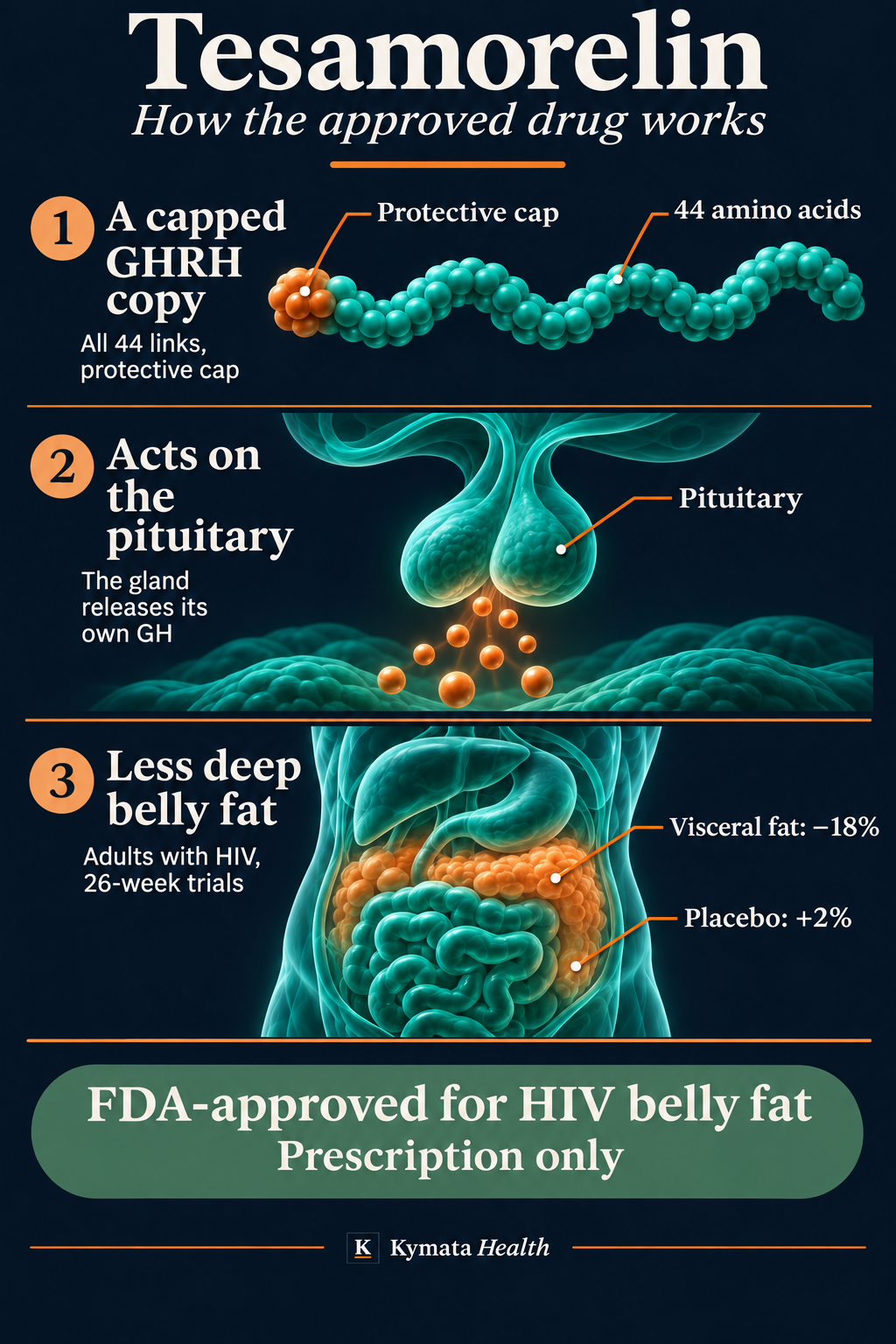
The guide shows tesamorelin as the full 44-amino-acid GHRH sequence with a protective cap, which makes the pituitary release more of its own growth hormone (Stanley 2011, PMID 20943777). In two 26-week placebo-controlled trials in adults with HIV, visceral fat fell 18% against a 2% rise on placebo, and 14% against 2% (Egrifta label). It is FDA-approved as Egrifta for excess abdominal fat in adults with HIV and lipodystrophy. The drawing is a schematic, not a measured molecular structure, a product photograph or a treatment result. Illustration review: 22 November 2026, against this page’s own mechanism, evidence and regulatory records.
The record describes trans-3-hexenoyl-GHRH(1–44), including a chemical modification, without a complete verified residue list. A plain unmodified chain is not substituted for that product form.
Illustration notes and source record
Read the source record on this page. Laboratory, topical and injected studies are separate evidence; this illustration does not establish an indication or a treatment outcome.

How it works
SourcedTesamorelin is the full 44-amino-acid human GHRH sequence with a trans-3-hexenoyl group on its first amino acid, which slows its breakdown. It binds the GHRH receptor on the pituitary and makes it release more of its own growth hormone, which raises IGF-1. GH still comes in pulses: in healthy men tesamorelin made the pulses larger without making them more frequent, and the pattern returned to baseline two weeks after stopping (Stanley 2011, PMID 20943777).
Because the pituitary still answers to somatostatin and to IGF-1 feedback, tesamorelin works through the body's own control loop rather than around it, as injected GH does. That is also why its effect depends on a working pituitary: the labels exclude people whose hypothalamic-pituitary axis has been disrupted by surgery, tumour, radiation or injury.
Source: FDA Label (Egrifta)
Background & History
Theratechnologies developed tesamorelin (TH9507) as a longer-lasting GHRH: the 44-amino-acid human sequence with a trans-3-hexenoyl group that slows its breakdown. Its phase 3 program (two trials, 816 adults with HIV and abdominal fat gain) led to the first US label in 2010; Egrifta SV (2 mg vial) and Egrifta WR (11.6 mg multi-dose vial, 2025) replaced the original 1 mg vials.
05 / Evidence and limits
Evidence and limits
Phase 3 RCTs in HIV; smaller trials outside HIV
Human evidence
Phase 3 RCTs in HIV; smaller trials outside HIV- People counted
- 816
- Studies listed here
- 2
- Two placebo-controlled phase 3 trials, 412 and 404 adults with HIV: visceral fat −18% vs +2% and −14% vs −2% at 26 weeks (label, Table 2).
- IGF-1 rose by about 107 ng/mL; 36% were above 3 SDS at 26 weeks (label).
- Liver fat in HIV fell 37% relative to placebo over 12 months (Stanley 2019, PMID 31611038).
- In 60 obese adults without HIV, visceral fat fell 35 cm² against placebo with glucose unchanged (Makimura 2012, PMID 23015655).
- Cognition: favourable in one 152-person trial (Baker 2012, PMID 22869065); no benefit in two later trials.
Use-case scores
0–100–10 against the evidence we have, not a gym ranking. Hidden domains do not apply here.
- Metabolic / weight8/10Two phase 3 trials (816 adults with HIV) cut visceral fat 14 to 18% at 26 weeks against placebo; liver-fat trial in HIV. Haircut: the trials are in HIV-associated fat gain, fat returns after stopping, and a research vial is not Egrifta.
Limits of current evidence
5 limits- The phase 3 trials enrolled adults with HIV and abdominal fat gain. Results outside that group come from one 60-person obesity trial (Makimura 2012) and registry-only liver data (NCT03375788).
- Visceral fat returned within 26 weeks of switching to placebo (label, Table 4).
- Cognition: one positive 20-week trial (Baker 2012) and two later null trials (Ellis 2025, Stewart 2026).
- No human study of tesamorelin with ipamorelin, another GHRP or MK-677, and none comparing morning, bedtime or pre-exercise dosing.
- The labels give no data for people over 65.
Published Trial Data
6 trials| Study | Phase | Summary | Source |
|---|---|---|---|
| Falutz 2007, NEJM (n=412) | Phase 3 | Visceral fat −15.2% vs +5.0% at 26 weeks; triglycerides −50 vs +9 mg/dL. | Source |
| Falutz 2010, JAIDS (n=404) | Phase 3 | Visceral fat −10.9% vs −0.6% at 26 weeks; about 18% lower at 12 months with continued use. | Source |
| Falutz 2010, JCEM (n=806) | Pooled phase 3 | Visceral fat −24 vs +2 cm²; IGF-1 +108 vs −7 ng/mL; loss reached 17.5% at 52 weeks. | Source |
| Stanley 2019, Lancet HIV (n=61) | Phase 2 | Liver fat −4.1 points vs placebo (37% relative); fibrosis progression 10.5% vs 37.5%. | Source |
| Makimura 2012, JCEM (n=60, no HIV) | RCT | Visceral fat −35 cm² vs placebo over 12 months; glucose unchanged. | Source |
| Baker 2012, Arch Neurol (n=152) | RCT | 1 mg 30 min before bedtime for 20 weeks; cognition composite favoured tesamorelin (P=.03). | Source |
Trial FinderRecruiting now: 3 open registrations for tesamorelin
What it is studied for
- Egrifta identity vs CJC-1295 vs sermorelin
- Why HIV-lipodystrophy VAT math does not become a research-chem cut protocol
- Not a NAFLD or MCI treatment page
Verdict
Tesamorelin is the GHRH analog behind Egrifta: it makes the pituitary release more of its own GH in pulses. Its evidence is deep but narrow: visceral and liver fat in adults with HIV, a smaller non-HIV obesity trial, and a mixed cognition record. No human study has combined it with ipamorelin or any other secretagogue, or compared dosing times.
Where it is prescribed
Sermorelin is prescribed through US telehealth clinics.
What the trials measured
Visceral fat by CT scan in the two label trials, then every other outcome studied in people.
Visceral fat over 52 weeks
Weeks 0 to 26
Weeks 26 to 52
Other outcomes
9 findings| Outcome | Who and how long | Result | Source |
|---|---|---|---|
| Visceral fat, 52 weeks | 806 adults with HIV, pooled phase 3 | Loss reached 17.5% by week 52 among those kept on treatment; it came back after switching to placebo. | Falutz 2010, JCEMEgrifta WR label |
| Triglycerides | 412 adults with HIV, 26 weeks | −50 mg/dL on tesamorelin vs +9 mg/dL on placebo. | Falutz 2007, NEJM |
| Liver fat (HIV) | 61 adults with HIV and fatty liver, 12 months | Liver fat fell 4.1 points more than placebo (37% relative); 35% vs 4% reached under 5%. Fibrosis progressed in 10.5% vs 37.5%; existing fibrosis did not improve. | Stanley 2019, Lancet HIV |
| Liver fat (no HIV) | Adults without HIV, 12 months, 1.4 mg | Registry results only: median −5.3% vs +3.6%. No journal paper found. | NCT03375788 (registry results) |
| Abdominal obesity without HIV | 60 adults with low GH secretion, 12 months | Visceral fat down 35 cm² against placebo; glucose unchanged. | Makimura 2012, JCEM |
| Type 2 diabetes | 53 adults, 12 weeks, 1 or 2 mg | No change in glycaemic control or insulin response. | Clemmons 2017, PLoS One |
| Cognition | 152 older adults (normal or MCI), 20 weeks, 1 mg | Cognition composite favoured tesamorelin (P=.03), mainly executive function; adverse events 68% vs 36%; brain GABA rose in a substudy. | Baker 2012, Arch NeurolFriedman 2013, JAMA Neurol |
| Cognition (later trials) | 73 adults with HIV; 22 older adults | No benefit over standard care or on direct measures. | Ellis 2025, J Infect DisStewart 2026, eNeurologicalSci |
| Own GH pattern | 13 healthy men, 14 days, 2 mg | Pulses got larger, not more frequent; insulin sensitivity unchanged; back to baseline 2 weeks after stopping. | Stanley 2011, JCEM |
06 / Product forms and access
Product forms and access
Regulatory & legal status
- FDA status (US)
- ApprovedFDA-approved as Egrifta® for HIV-associated lipodystrophy
- WADA status (2026)
- Prohibited (S2)Competitive athletes subject to anti-doping controls should not use Tesamorelin.
- Classification
- Prescription Drug
- US compounding
- Not eligible / not available
Three labelled formulations
Each has its own vial, storage and label, for the people it is approved for; dose and schedule are set by the prescriber and the label.
Not interchangeable Egrifta WR and Egrifta SV are not substitutable (Egrifta WR label, section 2.1). The 1.28 mg, 1.4 mg and 2 mg doses give similar exposure because the formulations differ, not because the dose is flexible.
By formulation
| Product | Dose on the label | Vial and mixing | In use and storage | Half-life |
|---|---|---|---|---|
| Egrifta WR | 1.28 mg (0.16 mL) under the skin of the abdomen, once daily | 11.6 mg powder; 1.3 mL bacteriostatic water, giving 8 mg/mL | One vial gives 7 daily doses; discard 7 days after mixing. Room temperature (20 to 25 °C), before and after mixing; do not freeze. | 11 min after a single dose in healthy adults (Egrifta WR label) |
| Egrifta SV | 1.4 mg (0.35 mL) under the skin of the abdomen, once daily | 2 mg powder; 0.5 mL of the supplied diluent | Inject right after mixing; discard what is left. Room temperature (20 to 25 °C), protected from light. | 8 min after a single dose in healthy adults (Egrifta SV label) |
| Egrifta (2010, 1 mg vials) (no longer listed on DailyMed) | 2 mg once daily, from two 1 mg vials | 1 mg powder; Sterile water for injection, used at once | Single use. Refrigerated (2 to 8 °C). | 26 min (healthy) and 38 min (HIV) after 14 days of dosing (Egrifta label, 2010) |
07 / Tools and practical checks
Tools and practical checks
Dose it
2 mg + 0.5 mL BAC water → 4 mg/mL · 1 unit (U-100) = 40 mcg.
Reconstitution math
U-100 syringe| Vial | Water | Concentration |
|---|---|---|
| Egrifta WR 11.6 mg | 1.3 mL bacteriostatic water (label) | 8 mg/mL (label) |
| Egrifta SV 2 mg | 0.5 mL supplied diluent (label) | 2 mg per 0.5 mL |
08 / Published study use
Published study use
What the label states, for the patients it is approved for, and the source. Not a dose for you.
What the FDA label says
FDA label- Egrifta WR: 1.28 mg injected under the skin of the abdomen once a day. Egrifta WR label, DailyMed (opens in new tab)
- Egrifta SV: 1.4 mg injected under the skin of the abdomen once a day. The two products are not interchangeable. Egrifta SV label, DailyMed (opens in new tab)
The label’s dosing, for the patients it is approved for; the prescriber sets the dose.
Administration
- Route / form
- Injection under the skin of the abdomen, rotating sites (label)
Timeline
4 stages- Days
GH pulses larger within 14 days in healthy men (Stanley 2011).
- 13 weeks
IGF-1 above 2 SDS in some patients as early as week 13 (label).
- 26 weeks
Visceral fat −14 to −18% vs placebo in the label trials; responders were defined by an 8% drop.
- 52 weeks
Loss held with continued use; it returned after switching to placebo (label, Table 4).
Who it is for
4 uses| Category | Fit | What exists |
|---|---|---|
| Abdominal fat in HIV | High | Two phase 3 trials and the label indication. |
| Liver fat | Moderate | One randomised trial in HIV; non-HIV results only on the trial registry. |
| Abdominal obesity without HIV | Low | One 60-person trial in adults with low GH secretion. |
| Cognition | Low | One positive trial, two later null trials. |
Timing: bedtime, morning or before exercise
What each study did. No study ranks one time over another; timing is the prescriber's decision.
The evidence No human study has compared a GH secretagogue taken before exercise with one taken before bed, on GH, IGF-1, body composition or anything else. Trials of tesamorelin used the morning in one study and bedtime in another, and the labels name no time.
When the studies dosed
6 studies| Study | Agent | When | Finding |
|---|---|---|---|
| Egrifta WR label | Tesamorelin | No time of day stated | Once daily into the abdomen. |
| Stanley 2011, JCEM | Tesamorelin 2 mg, 14 days | Morning | Overnight GH pulse size and baseline GH rose; number of pulses unchanged; back to baseline 2 weeks after stopping. |
| Baker 2012, Arch Neurol | Tesamorelin 1 mg, 20 weeks | 30 min before bedtime | IGF-1 rose; cognition scores favoured tesamorelin in this trial. |
| Corpas 1992, JCEM | GHRH(1-29) 1 mg, 14 days | Twice daily | 24-hour GH and IGF-1 in older men rose to the levels of young men at the higher dose. |
| Vittone 1997, Metabolism | GHRH(1-29) 2 mg, 6 weeks | Once nightly | Nocturnal GH rose; IGF-1 did not. The authors judged single nightly doses less effective than several a day. |
| Maas 2000, Med Sci Sports Exerc | GHRH and GHRP-2, IV | During hard cycling | Exercise GH output rose with either; together they added up, not more. |
09 / Safety and interactions
Safety and interactions
What the record says
Tesamorelin is FDA-approved only as Egrifta SV and Egrifta WR, for excess abdominal fat in adults with HIV and lipodystrophy. Label adverse reactions against placebo: injection-site reactions 25% vs 14%, peripheral edema 6% vs 2%, myalgia 6% vs 2%, and HbA1c of 6.5% or more in 5% vs 1%. Contraindicated with a disrupted hypothalamic-pituitary axis, active cancer, known hypersensitivity, and in pregnancy. The label asks for glucose checks before and during treatment, IGF-1 monitoring, and eye checks in people with diabetes; glucocorticoid replacement doses may need to rise.
Interactions & Contraindications
Label: glucose and IGF-1 monitoring; glucocorticoid replacement may need a higher dose; in healthy volunteers tesamorelin changed simvastatin and ritonavir levels only slightly (AUC −8% for simvastatin, −15% for its active acid, −9% for ritonavir), and the label calls the simvastatin effect not significant; GH can still change the clearance of other CYP450-metabolised drugs. Contraindicated with active cancer.
Monitoring named on the label
What the Egrifta labels and trials ask a prescriber to check. A clinician decides the schedule.
Checks and why
| Check | When | Why |
|---|---|---|
| IGF-1 | Periodically during treatment | At 26 weeks 47% had IGF-1 above 2 SDS and 36% above 3 SDS. The label says to consider stopping with persistent levels above 3 SDS, mainly when the fat response is weak. (Egrifta WR label) |
| Glucose, HbA1c | Before starting, then periodically | HbA1c reached 6.5% or more in 5% on tesamorelin vs 1% on placebo (hazard ratio 3.3). (Egrifta WR label) |
| Eyes (people with diabetes) | At regular intervals | The label asks for monitoring for new or worse retinopathy. (Egrifta WR label) |
| Swelling, joint pain, numbness | Ongoing | Fluid retention (edema, arthralgia, carpal tunnel) is linked to GH; peripheral edema 6% vs 2%, myalgia 6% vs 2%. (Egrifta WR label) |
| Injection sites | Ongoing | Injection-site reactions 25% vs 14% in the first 26 weeks. (Egrifta WR label) |
| Visceral fat response | After about 26 weeks | Trials defined response as an 8% or larger drop in visceral fat; fat came back after stopping. (Stanley 2012, CID) |
10 / Comparisons and goal guides
Comparisons and goal guides
Combinations: what has been tested
1 pairing- + Ipamorelin →A GHRH analog and a ghrelin-receptor agonist act on different receptors; with other agents of the two classes, healthy adults released more GH than with either alone (Bowers 1990, Popovic 1995). Tesamorelin with ipamorelin itself has no human study.
Tesamorelin vs. Sermorelin
6 attributesCanonical comparison: Tesamorelin vs Sermorelin · Sermorelin evidence profile
| Attribute | Tesamorelin | Sermorelin |
|---|---|---|
| What it is | Full GHRH(1-44) with a stabilising hexenoyl group | GHRH(1-29), the shortest fully active fragment |
| Receptor | GHRH receptor (pituitary) | GHRH receptor (pituitary), the same one |
| Half-life | 8 to 38 min (labels, by formulation) | 6 to 7 min IV (EU product information); 11 to 12 min (US prescribing information) |
| Labelled product | Egrifta SV, Egrifta WR | Geref; US approvals withdrawn in 2009 at the maker's request, not for safety or effectiveness reasons (78 FR 14095) |
| Human evidence | Two phase 3 trials, 816 adults with HIV; liver-fat and cognition trials | Small trials in GH-deficient children and older adults, mostly from the 1990s |
| Taken together | Not studied. Same receptor; the GHRH response tops out near 1 µg/kg, so a second analog is expected to add little | Same |
Appears in goal guides
3 guidesGoal guides give the evidence and status for each compound, with no doses. A mention here is not a treatment plan.
- GoalFat Loss and Metabolic HealthSemaglutide and tirzepatide (FDA-approved), tesamorelin (approved for one use) and the pipeline drugs: what the labels and trials show, and why the prescriber sets the dose.Evidence and status
- GoalWeight Loss PlateausTesamorelin, AOD-9604 and MOTS-c as they come up for a stalled diet: the one approved use, the failed obesity trials, the mouse data, and why no dose is given.Evidence and status
- GoalFat Metabolism CompoundsThe “Furnace” combination: thyroid and pancreas capsules, tesamorelin, AOD-9604, retatrutide and 5-amino-1MQ. What each has been studied for, its status, and why no dose is given.Evidence and status
What has been tested in combination
What human studies measured when a GHRH analog was given with a ghrelin-receptor agonist, and which pairs have never been tested.
Two receptors, not one
Tesamorelin, sermorelin and CJC-1295 are GHRH analogs: they act on the GHRH receptor of the pituitary, which signals through cAMP (Mayo 1992, Mol Endocrinol). Ipamorelin, GHRP-2, GHRP-6, hexarelin and MK-677 act on a different receptor, the ghrelin receptor (GHS-R1a), found in both the hypothalamus and the pituitary (Howard 1996, Science; Raun 1998, Eur J Endocrinol).
In people, the ghrelin-receptor route works largely through the hypothalamus: with the pituitary stalk cut, GHRP-6 released almost no GH and the combination lost its extra effect (Popovic 1995, JCEM). It also escapes somatostatin, the brake on GH release: under a somatostatin analog, the GH response to GHRH fell by 38% while the response to GHRP-2 was unaffected (Dimaraki 2003, Am J Physiol).
Two GHRH analogs share one receptor. The GH response to GHRH tops out near 1 µg/kg; doses ten times higher made the response last longer but not peak higher (Gelato 1984, JCEM; Vance 1984, JCEM). No study has given two GHRH analogs together; from those dose-response curves a second one would be expected to add little, an inference rather than a trial result.
GHRH, a GHRP, and both, in healthy adults
What has been tested in people
| Combination | Human evidence |
|---|---|
| Tesamorelin with ipamorelin | No human study. None of the registered tesamorelin trials has a GHRP arm (PubMed and ClinicalTrials.gov, searched 2026-10-22). |
| GHRH with a GHRP (other agents) | More GH than either alone in healthy adults, often more than the sum at test doses. (Bowers 1990, JCEM; Popovic 1995, JCEM; Pombo 1995, JCEM; Ramos-Dias 1996, JCEM) |
| At full doses of both | One study found the combination no greater than the sum: the extra effect is clearest at lower doses. (Tiulpakov 1995, Clin Endocrinol) |
| Two GHRH analogs together | No human study. GHRH response tops out near 1 µg/kg, so a second agonist on the same receptor is expected to add little. (Gelato 1984, JCEM; Vance 1984, JCEM) |
The growth hormone family
GH itself, the drugs that make the pituitary release more of it, and IGF-1 downstream. Half-lives are human values.
Three ways to raise GH
| Class | Acts on |
|---|---|
| GHRH analog (this page) | GHRH receptor on the pituitary (cAMP) |
| Ghrelin-receptor agonist | Ghrelin receptor (GHS-R1a) in hypothalamus and pituitary |
| Growth hormone (daily) | GH receptor directly; bypasses the pituitary |
| Growth hormone (weekly) | GH receptor directly, released over a week |
| IGF-1 | IGF-1 receptor, downstream of GH |
Compared
16 agents| Agent | Class | Labelled product | Half-life (human) | Taken |
|---|---|---|---|---|
| Somatropin (rhGH) | Growth hormone (daily) | Genotropin, Humatrope, Norditropin, Omnitrope, Zomacton, Serostim | 2 to 3.8 h (SC, across labels) (Humatrope label) | Daily injection (label) |
| Somapacitan | Growth hormone (weekly) | Sogroya | about 2 to 3 days (adults) (Sogroya label) | Weekly injection (label) |
| Somatrogon | Growth hormone (weekly) | Ngenla | 37.7 h (effective, children) (Ngenla label) | Weekly injection (label) |
| Lonapegsomatropin | Growth hormone (weekly) | Skytrofa | about 31 h (prodrug, children) (Skytrofa label) | Weekly injection (label) |
| Tesamorelin | GHRH analog | Egrifta SV, Egrifta WR | 8 to 38 min (by formulation and study) (Egrifta WR label) | Daily injection (label) |
| Sermorelin | GHRH analog | None | 6 to 7 min IV (EU product information) (Geref 50 SPC (HPRA)) | Daily injection in studies |
| CJC-1295 with DAC | GHRH analog | None | 5.8 to 8.1 days (Teichman 2006, JCEM) | Weekly or every other week in studies |
| CJC-1295 without DAC (mod GRF 1-29) | GHRH analog | None | No human value published | No human study published |
| Ipamorelin | Ghrelin-receptor agonist | None | 2 h (IV infusion) (Gobburu 1999, Pharm Res) | Single IV infusions in the human study |
| GHRP-2 | Ghrelin-receptor agonist | GHRP Kaken 100 (Japan) | 0.42 to 0.69 h (IV, Japanese label) (GHRP Kaken 100 label (PMDA, 2025)) | One IV dose, as a diagnostic test (Japanese label) |
| GHRP-6 | Ghrelin-receptor agonist | None | 2.5 h (IV) (Cabrales 2013, Eur J Pharm Sci) | IV test doses in studies |
| Hexarelin | Ghrelin-receptor agonist | None | No human value published | Twice daily under the skin for up to 16 weeks in studies; the GH response fades |
| MK-677 (ibutamoren) | Ghrelin-receptor agonist | None | No human value published | Daily by mouth in studies; GH raised over 24 h |
| Macimorelin | Ghrelin-receptor agonist | Macrilen | 4.1 h (Macrilen label) | One oral dose, as a diagnostic test (label) |
| Mecasermin (rhIGF-1) | IGF-1 | Increlex | 5.8 h (children) (Increlex label) | Twice daily with a meal (label) |
| IGF-1 LR3 | IGF-1 | None | No human value published | No human dosing study identified |
GH axis guides6
- Growth hormone: the GH axisHow GH is controlled, every agent compared
- Why tesamorelin pairs with ipamorelin and not with sermorelinTwo receptors, one ceiling, and the combinations no one has tested in people.
- Growth hormone vs GH secretagoguesGiving the hormone itself, or asking the pituitary to make more of its own.
- IGF-1 monitoring on GH-axis treatmentWhy IGF-1 is the test, when to draw it on weekly GH, and what the labels say to do with it.
- Tesamorelin and liver fat: what the trials showTwo randomised trials in HIV, registry-only data without HIV, and what neither shows.
- Tesamorelin vs sermorelinSame receptor, different molecule, very different evidence.
11 / Common questions
Common questions
Common questions
17 answersWhat is tesamorelin?
A lab-made version of GHRH, the hypothalamic hormone that tells the pituitary to release growth hormone. It is the active ingredient of Egrifta SV and Egrifta WR.
What dose do the labels give?
Egrifta WR: 1.28 mg (0.16 mL) once daily. Egrifta SV: 1.4 mg (0.35 mL) once daily. The original 2010 product used 2 mg daily. The labels say WR and SV are not substitutable; the doses differ because the formulations do, and they give similar exposure.
What is its half-life?
Very short: 8 minutes after one dose of Egrifta SV and 11 minutes after Egrifta WR, and 26 to 38 minutes after 14 days of the original formulation, by the labels. The GH it releases, and the IGF-1 that follows, last much longer than the drug.
How much visceral fat did it remove in the trials?
In the two label trials, visceral fat changed by −18% vs +2% on placebo and −14% vs −2% at 26 weeks, measured by CT scan in adults with HIV. People switched to placebo regained it over the next 26 weeks.
Does it work without HIV?
The evidence is thinner. In 60 obese adults with low GH secretion, visceral fat fell 35 cm² against placebo over 12 months (Makimura 2012). A 12-month liver-fat trial without HIV has posted results on ClinicalTrials.gov (NCT03375788) but no journal paper.
What did the liver-fat trials show?
In 61 adults with HIV and fatty liver, liver fat fell 4.1 points more than placebo (a 37% relative drop), and fewer people progressed in fibrosis (10.5% vs 37.5%). Existing fibrosis did not improve (Stanley 2019).
Does tesamorelin improve memory or thinking?
One 20-week trial in 152 older adults found a favourable effect on a cognition composite, mostly executive function (Baker 2012). Two later trials, one in people with HIV and one small pilot, found no benefit.
Can tesamorelin be combined with ipamorelin?
No human study has tested that pair. The rationale comes from other agents: in healthy adults a GHRH plus a ghrelin-receptor agonist such as GHRP-6 released more GH than either alone, often more than the sum, because they act on different receptors. At full doses of both, one study found no more than the sum.
Why not combine tesamorelin with sermorelin?
Both are GHRH analogs acting on the same receptor, and the GH response to GHRH reaches its ceiling near 1 µg/kg (Gelato 1984). A second GHRH analog is therefore expected to add little. No study has tested two together.
Is bedtime or pre-workout better?
No human study has compared them. The labels give no time of day; one tesamorelin trial dosed in the morning, another 30 minutes before bedtime. Timing is a decision for the prescriber.
Does it shut down the body's own GH?
Not in the way injected GH can. In healthy men, 14 days of tesamorelin made GH pulses larger without changing their number, and GH secretion returned to baseline two weeks after stopping (Stanley 2011).
What does it do to blood sugar?
In the label trials HbA1c reached 6.5% or more in 5% on tesamorelin vs 1% on placebo. In separate trials glucose was unchanged in obese adults without HIV and glycaemic control was unchanged over 12 weeks in type 2 diabetes. The label asks for glucose checks before and during treatment.
Which labs are monitored?
The label names IGF-1 (stopping is considered if it stays above 3 SDS, mainly when fat response is weak), glucose or HbA1c, and eye checks in people with diabetes. A clinician sets the schedule.
Who should not take it?
The labels exclude people with a disrupted hypothalamic-pituitary axis (pituitary surgery, tumour, head radiation or trauma), active cancer, known hypersensitivity, and pregnancy.
Is tesamorelin banned in sport?
Yes. The WADA Prohibited List names tesamorelin under S2 (growth hormone releasing factors), prohibited in and out of competition.
How is tesamorelin different from CJC-1295?
Both are GHRH analogs. Tesamorelin lasts minutes in the blood and has phase 3 trials and FDA labels. CJC-1295 with DAC binds albumin and lasts 5.8 to 8.1 days, and its human data are two small studies from 2006.
Is Tesamorelin FDA-approved?
Yes. FDA-approved as Egrifta® for HIV-associated lipodystrophy.
12 / Sources and references
Sources and references
22 papers cited on this page.
Sources
22 papers- 1“EGRIFTA WR (tesamorelin) prescribing information.”Theratechnologies DailyMed (2025).
- 2“EGRIFTA SV (tesamorelin) prescribing information.”Theratechnologies DailyMed (2024).
- 3“Metabolic effects of a growth hormone-releasing factor in patients with HIV.”Falutz J, et al. N Engl J Med (2007). PMID: 18057338
- 4“Long-term safety and effects of tesamorelin in HIV patients with abdominal fat accumulation.”Falutz J, et al. AIDS (2008). PMID: 18690162
- 5“Effects of tesamorelin in HIV-infected patients with abdominal fat accumulation: a randomized placebo-controlled trial with a safety extension.”Falutz J, et al. J Acquir Immune Defic Syndr (2010). PMID: 20101189
- 6“Effects of tesamorelin (TH9507) in HIV-infected patients with excess abdominal fat: a pooled analysis of two phase 3 trials.”Falutz J, et al. J Clin Endocrinol Metab (2010). PMID: 20554713
- 7“Effects of a growth hormone-releasing hormone analog on endogenous GH pulsatility and insulin sensitivity in healthy men.”Stanley TL, et al. J Clin Endocrinol Metab (2011). PMID: 20943777
- 8“Reduction in visceral adiposity is associated with an improved metabolic profile in HIV-infected patients receiving tesamorelin.”Stanley TL, et al. Clin Infect Dis (2012). PMID: 22495074
- 9“Effect of tesamorelin on visceral fat and liver fat in HIV-infected patients with abdominal fat accumulation.”Stanley TL, et al. JAMA (2014). PMID: 25038357
- 10“Effects of tesamorelin on non-alcoholic fatty liver disease in HIV.”Stanley TL, et al. Lancet HIV (2019). PMID: 31611038
- 11“Metabolic effects of a growth hormone-releasing factor in obese subjects with reduced growth hormone secretion.”Makimura H, et al. J Clin Endocrinol Metab (2012). PMID: 23015655
- 12“Safety and metabolic effects of tesamorelin in patients with type 2 diabetes.”Clemmons DR, et al. PLoS One (2017). PMID: 28617838
- 13“Effects of growth hormone-releasing hormone on cognitive function in adults with mild cognitive impairment and healthy older adults.”Baker LD, et al. Arch Neurol (2012). PMID: 22869065
- 14“Growth hormone-releasing hormone effects on brain GABA levels in mild cognitive impairment and healthy aging.”Friedman SD, et al. JAMA Neurol (2013). PMID: 23689947
- 15“Effects of tesamorelin on neurocognitive impairment in persons with HIV and abdominal obesity.”Ellis RJ, et al. J Infect Dis (2025). PMID: 39813152
- 16“The effect of growth hormone-releasing hormone on cognition and brain connectivity in adults with cognition ranging from normal to mild cognitive impairment.”Stewart CE, et al. eNeurologicalSci (2026). PMID: 42382101
- 17“Dose-response relationships for the effects of growth hormone-releasing factor-(1-44)-NH2 in young adult men and women.”Gelato MC, et al. J Clin Endocrinol Metab (1984). PMID: 6330151
- 18“Growth hormone-releasing peptide stimulates GH release in normal men and acts synergistically with GH-releasing hormone.”Bowers CY, et al. J Clin Endocrinol Metab (1990). PMID: 2108187
- 19“Blocked GHRP-6-induced GH secretion and absence of the synergic action of GHRP-6 plus GHRH in patients with hypothalamopituitary disconnection.”Popovic V, et al. J Clin Endocrinol Metab (1995). PMID: 7883854
- 20“GH responses to intravenous bolus infusions of GHRH and GHRP-2 separately and in combination in adult volunteers.”Tiulpakov AN, et al. Clin Endocrinol (Oxf) (1995). PMID: 7586605
- 21“Interrelations between sleep and the somatotropic axis.”Van Cauter E, et al. Sleep (1998). PMID: 9779515
- 22“Exercise-dependent growth hormone release is linked to markers of heightened central adrenergic outflow.”Weltman A, et al. J Appl Physiol (2000). PMID: 10926647
14 / Prescription options
Prescription options
Prescription options: compare licensed telehealth providers
Some peptide therapies are available only by prescription after a consult with a licensed clinician.
Compare telehealth →15 / Peptide library
Peptide library
Keep reading: Peptide research library
Peptide research library: every pagePeptide libraryBrowse all topics
- DSIPPrevious in this topic · Nine-residue peptide from 1970s delta-sleep literature.
- AOD-9604Next in this topic · AOD-9604 is a modified growth hormone fragment that WADA prohibits in and out of competition.
- Khavinson catalog setsThe organ boxes Khavinson catalogs sell together: label serving, evidence and US status for each bottle; every name links to a peptide page.
- GHK-CuGHK-Cu is glycine–histidine–lysine bound to copper.
- LL-37LL-37 is the mature 37-residue human cathelicidin peptide cleaved from hCAP18.
Regulatory and sport classification
- WADA (S2): prohibited in sport at all times
- FDA-approved