
The peptide field guide
GHK-Cu
GHK-Cu is a complex of the three-amino-acid peptide Gly–His–Lys and copper(II).
Laboratory and small topical studies do not establish injection or hair-regrowth benefits.
Explore this compoundLast checked October 2026
02 / At a glance
At a glance
Identity
GHK-Cu is a complex of the three-amino-acid peptide Gly–His–Lys and copper(II).
Research context
Collagen-related laboratory research and a topical study in 13 people after laser resurfacing.
Evidence limits
Laboratory and small topical studies do not establish injection or hair-regrowth benefits.
Read the technical profile and study-use reference
Quick answer
Evidence: ModerateGly-His-Lys copper complex. Pickart dermal/matrikine literature and topical cosmetics are the honest file. “4000 genes / younger biological age” is marketing. Injectable research vials are a different copper exposure than a cream.
- In published studies
- No human study of injections published
Research summary, not medical advice.
At a glance
Kymata peptide profile · October 2026- Common vials
- 5 mg / 50 mg
- CAS
- 89030-95-5
- In published studies
- No human study of injections published
- Half-life
- ~<30 minutes (systemic)
- Molecular weight
- 340.83 g/mol (copper complex)
03 / Identity and origin
Identity and origin
Also called Copper peptide, Glycyl-L-histidyl-L-lysine:copper(II). Copper-binding matricryptic tripeptide (cosmetic + research injectable).
Read the sequence and compound record
Compound card
- Sequence
- GHK·Cu2+
- Class
- Copper-binding matricryptic tripeptide (cosmetic + research injectable)
- Formula
- C14H24CuN6O4
- Molecular weight
- 340.83 g/mol (copper complex)
- CAS
- 89030-95-5
- Described by
- Loren Pickart (originally isolated), 1973
- Bioavailability
- Topical and subcutaneous
04 / How it may work
How it may work
Copper-binding matricryptic tripeptide (cosmetic + research injectable)
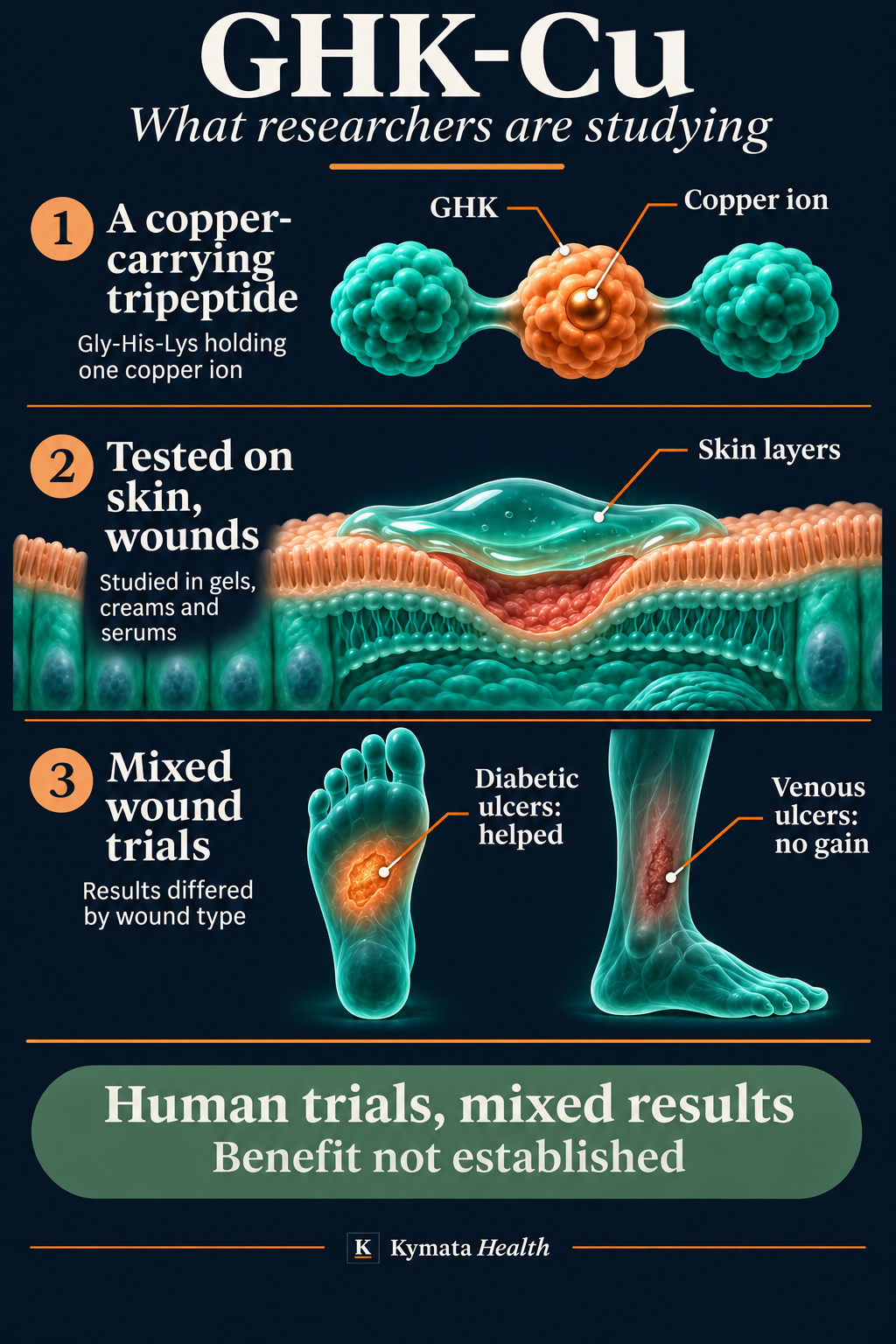
This guide separates collagen-related cell research from a topical study in 13 people after laser resurfacing. That study found no measured difference in redness, wrinkles or skin quality, while participants rated their skin higher. The reviewed record does not establish controlled human hair-regrowth results or a published human injection study. The copper label identifies the complex; the sequence explorer depicts only the amino-acid part.
Choose Rotate or Pan, then focus the diagram and use the arrow keys. Up and down tilt in Rotate mode. Pinch or use + and − to zoom.
Each bead is one amino acid. Once it is part of the chain, it is called a residue. Drag to rotate or tap a bead. The shape is a schematic illustration.
- Glycine / proline
- Basic
Its side branch is a single hydrogen atom, leaving the chain more room to bend here. This letter identifies a residue in the catalogue sequence. The model is illustrative; it does not establish molecular folding or clinical effect.
Read the full sequence
A peptide bond is a covalent link joining two amino acids in a chain. A hydrogen bond is a weaker attraction, for example between a hydrogen on an oxygen and a nearby oxygen atom. A side chain may form hydrogen bonds without joining another amino acid to the chain. This diagram shows the sequence; it does not measure these interactions.
GHK
- Glycine. Its side branch is a single hydrogen atom, leaving the chain more room to bend here.
- Histidine. Its side branch contains a five-atom loop called imidazole. It can gain or lose a positive charge as acidity changes.
- Lysine. Its side branch usually carries a positive charge near neutral pH, the middle of the acidity scale.
Illustration notes and source record
Read the source record on this page. Laboratory, topical and injected studies are separate evidence; this illustration does not establish an indication or a treatment outcome.

How it works
SourcedGHK-Cu (Glycyl-L-histidyl-L-lysine:copper(II)) is a naturally occurring copper tripeptide found in human plasma, saliva, and urine. Plasma levels decline significantly with age, from ~200 ng/mL at age 20 to ~80 ng/mL by age 60. GHK-Cu has broad biological activities: it stimulates collagen synthesis (Types I and III), glycosaminoglycan production (chondroitin sulfate, dermatan sulfate), and decorin synthesis.
GHK-Cu has been studied both topically and systemically. In laboratory and animal work it promotes wound healing and skin remodeling and enlarges hair follicles; no controlled human trial has measured hair regrowth with GHK-Cu or compared it with minoxidil.
Source: PMID: 18644225
Background & History
GHK-Cu (Glycyl-L-Histidyl-L-Lysine:copper) was discovered by Loren Pickart in 1973 while investigating why liver cells of aged humans behaved differently from young plasma. He isolated GHK as the causative factor in youthful plasma that reprogrammed aged cells. The copper complex GHK-Cu is found naturally in human plasma, saliva, and urine, declining with age. It is one of the most pleiotropic peptides known (activating over 4,000 genes) and has been called a "master skin repair signal." Topical cosmetic use is widespread; injectable use is growing.
05 / Evidence and limits
Evidence and limits
Limits of current evidence
3 limits- Most gene-expression work is in vitro / explant. Do not treat that as a human aging trial.
- Copper load is a real constraint on high-mg daily SubQ folklore.
- GHK Basic (copper-free) is a different SKU.
Trial FinderRecruiting now: 1 open registration for GHK-Cu
What it is studied for
- Identity: copper tripeptide vs GHK Basic vs topical vs SubQ
- Why “4000 genes” is not a wrinkle RCT
- Not Botox and not a telomere drug
Verdict
GHK-Cu is Gly-His-Lys with copper. Topical cosmetic use is the honest mass-market story. Injectable research vials are a different exposure. It is not a telomere drug and not a Botox.
06 / Product forms and access
Product forms and access
Regulatory & legal status
- FDA status (US)
- Research Only
- WADA status (2026)
- Not ListedNot currently on the WADA 2026 Prohibited List. Policies may change. Verify before competition.
- US compounding
- Not eligible / not available
07 / Tools and practical checks
Tools and practical checks
Dose it
50 mg + 5 mL BAC water → 10 mg/mL · 1 unit (U-100) = 100 mcg.
Reconstitution math
U-100 syringe| Vial | Water | Concentration |
|---|---|---|
| 50 mg lyophilized | 5 mL BAC | 10 mg/mL |
08 / Published study use
Published study use
What published studies gave, in whom, and the source. Not a dose for you.
What studies used
No human study of injections- We found no published human dosing study of injected GHK-Cu.
- Its main research group summarized the laboratory and gene-expression work in a 2018 review. Pickart 2018, PMID 29986520 (opens in new tab)
- The doses quoted online come from animal work and vendor or forum sources.
A record of what researchers gave, in whom; not a dose for you.
Administration
- Route / form
- Not established: no published human study of injected GHK-Cu.
GHK-Cu: Topical serum / cream vs Injectable research vial
2 routesTopical serum / cream
- Bioavailability
- Cosmetic and explant literature is the honest topical file (Pickart dermal/matrikine work, PMID 18644225). That is not a published systemic F% for a face serum, and it is not Botox.
- Advantages
- This is how most people actually buy GHK-Cu.
- No syringe. Blue color is the complex, not a potency assay by eye.
- Considerations
- “4000 genes / reverse biological age” is marketing.
- Topical cosmetic trials are not an injectable wound-drug NDA.
Injectable research vial
- Bioavailability
- Human injectable PK is thin. PIP and copper load are the practical limits, not a Pickart gene-chip headline.
- Advantages
- Concentration math is checkable when the bottle is lyophilized GHK-Cu.
- Separates systemic use from cosmetic SKUs.
- Considerations
- Injectable lots are mostly preclinical plus PIP. Not a reconstruction NDA.
- Copper exposure is real. This is not copper-free GHK Basic (separate page).
Who it is for
2 uses| Category | Fit | What exists |
|---|---|---|
| Skin Anti-Aging / Collagen | High | One of the most studied cosmetic peptides. Direct collagen I/III synthesis and wound healing. |
| Hair Growth | Low | Follicle effects in laboratory and animal work only. No controlled human trial, and no comparison with minoxidil. |
09 / Safety and interactions
Safety and interactions
What the record says
Copper tripeptide. Injectable lots are mostly preclinical plus PIP. Topical cosmetic trials exist. Do not combine topically with vitamin C or AHAs. Not a reconstruction NDA.
Interactions & Contraindications
Topical use: the studies that exist found little GHK-Cu absorbed into the body from the skin; that is not a full safety record. Injection: no human study has been published, and copper accumulation is possible. Do not use concurrently with copper chelators (e.g., penicillamine).
10 / Comparisons and goal guides
Comparisons and goal guides
Combinations: what has been tested
1 pairing- + TB-500 →Actin-fragment marketing plus copper-tripeptide marketing. Complementary labels are not connective-tissue restoration and not a combo trial.
GHK-Cu vs. BPC-157
5 attributesCanonical comparison: GHK-Cu vs BPC-157 · BPC-157 evidence profile
| Attribute | GHK-Cu | BPC-157 |
|---|---|---|
| Mechanism | Copper-peptide signaling + collagen synthesis | VEGF/FGF angiogenesis + NO pathway |
| Admin Route | Topical (primary), injectable | Injectable (primary), oral (gut) |
| Best For | Skin aging, wound healing, hair, topical collagen | Tendon, ligament, gut, systemic injury healing |
| Evidence Quality | Limited human data (mostly in-vitro) | Animal models (strong preclinical data) |
| Availability | OTC creams + injectable research grade | Injectable or oral research grade |
Appears in goal guides
5 guidesGoal guides give the evidence and status for each compound, with no doses. A mention here is not a treatment plan.
- GoalAging and LongevityThe compounds that come up in longevity talk: GH secretagogues, epitalon, GHK-Cu and NAD+ precursors. What each has been studied for, its status, and why no dose is given.Evidence and status
- GoalSkinGHK-Cu on the skin and as an injection: the small human skin-care study, the lab data, FDA’s safety listing for the injectable, and why no dose is given.Evidence and status
- GoalHealing After SurgeryBPC-157, TB-500 and GHK-Cu as they come up after surgery: the animal evidence, the missing surgical data, HHS status, and why your surgeon’s plan comes first.Evidence and status
- GoalAthletic PerformanceMuscle and blood-vessel bioregulator capsules, BPC-157, TB-500, GH secretagogues, MOTS-c and GHK-Cu as they come up in athletic circles: the evidence, the status and the sport rules.Evidence and status
- GoalLongevity Bioregulators and PeptidesThe Khavinson pineal, thymus and bone-marrow capsules, plus epitalon, GHK-Cu, FOXO4-DRI and MOTS-c: what each has been studied for, its status, and why no course or dose is given.Evidence and status
11 / Common questions
Common questions
Common questions
3 answersTopical or injectable?
Both SKUs exist. Creams are the cosmetic job. Injectable research vials are a different copper exposure, and no human study of GHK-Cu injections has been published. Do not inject a serum. Gene-count marketing is not a label. Copper-free GHK is a separate page.
Can GHK-Cu be used topically or only by injection?
Topical GHK-Cu is the form studied in people, in small skin-care studies such as one after laser resurfacing (PMID 16847171). No published human study has tested GHK-Cu injections, and FDA lists injectable GHK-Cu among substances that may present significant safety risks in compounding. We give no injection dose.
Does GHK-Cu help with hair growth?
Not shown in people. The hair findings are laboratory and animal work; no controlled human trial has measured hair regrowth with GHK-Cu or compared it with minoxidil.
12 / Sources and references
Sources and references
1 paper cited on this page.
Sources
1 paper- 1“GHK peptide as a natural modulator of multiple cellular pathways in skin biology.”Pickart L, Margolina A. Biomed Res Int (2015). PMID: 26236730
14 / Prescription options
Prescription options
Prescription options: compare licensed telehealth providers
Some peptide therapies are available only by prescription after a consult with a licensed clinician.
Compare telehealth →15 / Peptide library
Peptide library
Keep reading: Peptide research library
Peptide research library: every pagePeptide libraryBrowse all topics
- AOD-9604Previous in this topic · Modified hGH 176–191 fragment (N-terminal tyrosine).
- LL-37Next in this topic · LL-37 is the mature 37-residue human cathelicidin peptide cleaved from hCAP18.
- SermorelinSermorelin is GHRH(1-29), a peptide that prompts the pituitary to release its own growth hormone; it is not growth hormone itself.
- IGF-1 LR3Long-R3 IGF-1 analog that evades IGFBPs, stretching activity vs native IGF-1.
- HGH Fragment 176-191Unmodified hGH C-terminal 176–191 fragment.
Regulatory and sport classification
- Not FDA-approved, research chemical