
The peptide field guide
GHRP-6
GHRP-6 is a six-amino-acid growth-hormone secretagogue.
The cited hormone studies do not establish appetite, recovery or muscle benefits.
Explore this compoundResearch-sampling metaphor only; not a participant sample, actual trial photograph, concentration result or treatment effect.
02 / At a glance
At a glance
Key facts
- Also known as
- Growth Hormone Releasing Peptide 6
- Sequence
- His-D-Trp-Ala-Trp-D-Phe-Lys-NH2
- Evidence level
- Early human trials: benefit not yet confirmed.
- US regulatory status
- Not FDA-approved, research chemical
- Updated
Identity
GHRP-6 is a six-amino-acid growth-hormone secretagogue.
Research context
Short intravenous hormone observations, separate from a twenty-four-hour experiment in eight healthy young men.
Evidence limits
The cited hormone studies do not establish appetite, recovery or muscle benefits.
Read the technical profile and study-use reference
Quick answer
Evidence: ModerateFirst-generation GHS-R1a hexapeptide. Hunger, cortisol, and prolactin are class effects. Not a cachexia drug and not ipamorelin.
- In published studies
- Trial amounts are recorded under What studies used (PMID 2543692)
Research summary, not medical advice.
At a glance
Kymata peptide profile · Oct 30, 2026- Half-life
- 2.5 hours (IV)
- Common vials
- 5 mg
- Molecular weight
- 873.01 g/mol
- CAS
- 87616-84-0
- In published studies
- Trial amounts are recorded under What studies used (PMID 2543692)
03 / Identity and origin
Identity and origin
Also called Growth Hormone Releasing Peptide 6. First-generation GHS-R1a hexapeptide (ghrelin mimetic).
Read the sequence and compound record
Compound card
- Sequence
- His-D-Trp-Ala-Trp-D-Phe-Lys-NH2
- Class
- First-generation GHS-R1a hexapeptide (ghrelin mimetic)
- Formula
- C46H56N12O6
- Molecular weight
- 873.01 g/mol
- CAS
- 87616-84-0
- PubChem CID
- 5486806
- Described by
- Cyril Y. Bowers, Tulane University, 1984
- Bioavailability
- Not measured in people under the skin
04 / How it may work
How it may work
First-generation GHS-R1a hexapeptide (ghrelin mimetic)
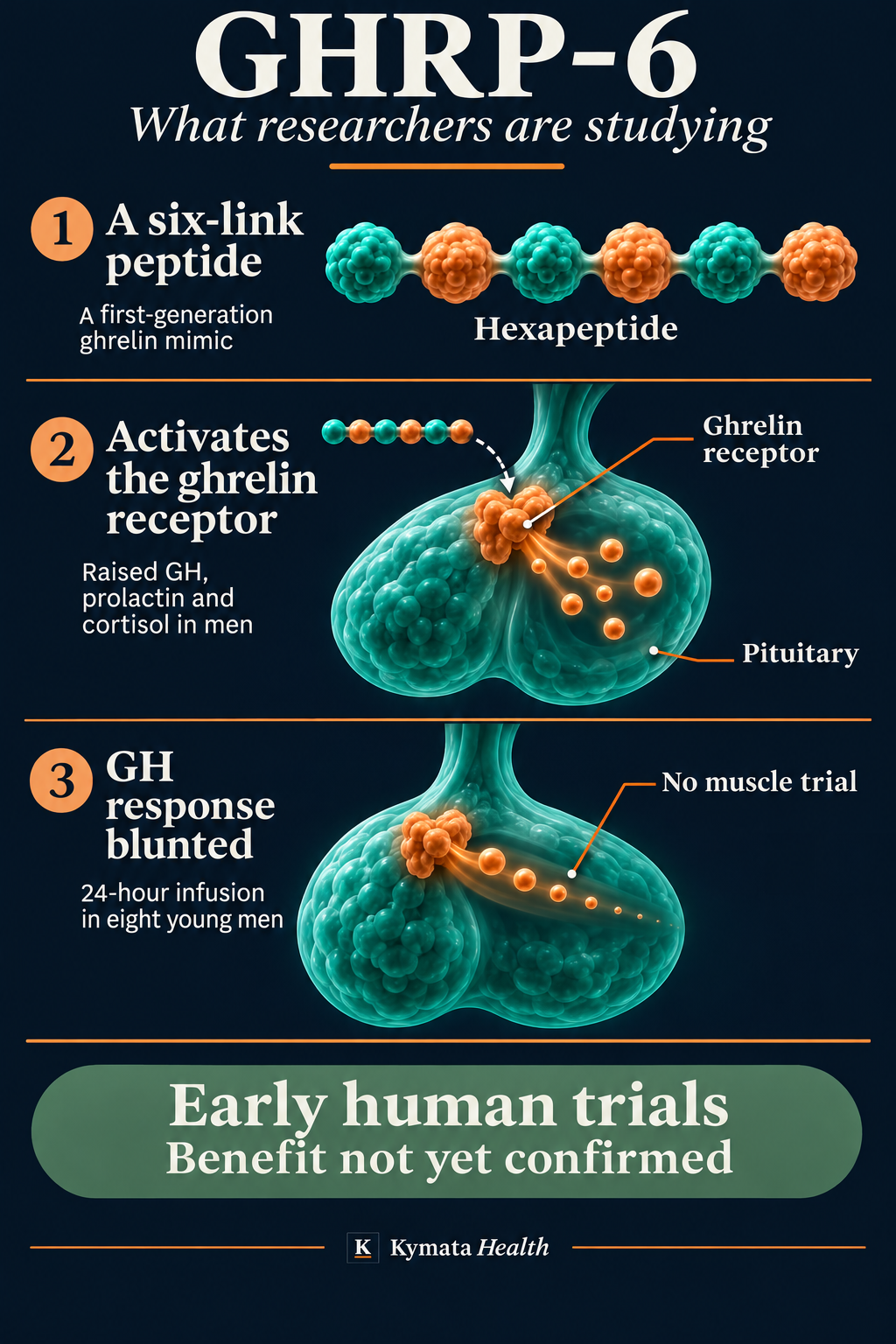
The guide shows GHRP-6 as a first-generation six-amino-acid peptide that activates the ghrelin receptor. In healthy men a single IV dose raised growth hormone, and prolactin and cortisol rose too (PMID 2543692, 2108187). During a 24-hour infusion in eight young men, the growth hormone response to a later dose was blunted (PMID 8496311). No trial has measured recovery, appetite or muscle. The drawing is a schematic, not a measured molecular structure, a product photograph or a treatment result. Illustration review: 22 November 2026, against this page’s own mechanism, evidence and regulatory records.
The retained technical record includes a modified or incompletely specified chain. No simplified residue model is inferred; read the sequence and compound record for its exact scope.
Illustration notes and source record
Read the source record on this page. Laboratory, topical and injected studies are separate evidence; this illustration does not establish an indication or a treatment outcome.

How it works
GHRP-6 is a first-generation hexapeptide growth hormone releasing peptide that activates the ghrelin receptor (GHS-R1a). In healthy men one IV dose raised GH with dose (peak 63 µg/L at 1 µg/kg) without changing LH, FSH, TSH or ACTH (Ilson 1989, PMID 2543692); prolactin and cortisol about doubled at 1 µg/kg (Bowers 1990, PMID 2108187).
A 24-hour infusion raised GH secretion 8-fold and IGF-1 12 to 22%, but blunted the response to a later dose (Huhn 1993, PMID 8496311). No human study has measured its effect on appetite.
Background & History
GHRP-6 is Bowers’ first-generation GHS-R1a hexapeptide. Cortisol and prolactin rise in people; its effect on appetite has not been measured in people. A research powder is not a cachexia drug.
05 / Evidence and limits
Evidence and limits
Limits of current evidence
2 limits- Cortisol and prolactin rose in human studies; appetite was measured for GHRP-2, not GHRP-6.
- This is not a cachexia drug page and not a pediatric GHD protocol.
What it is studied for
- First-generation GHRP identity vs ipamorelin
- Appetite: the human data are for GHRP-2, not GHRP-6
- Not cancer/HIV cachexia treatment
Verdict
GHRP-6 is Bowers’ first-generation ghrelin-receptor agonist. In people it raised GH, prolactin and cortisol in short IV studies; no human study has measured its effect on appetite, and its one phase III trial (with EGF, in stroke) missed its primary endpoint. It is not ipamorelin and not somatropin.
Where it is prescribed
Sermorelin is prescribed through US telehealth clinics.
What the human studies measured
Every human study of GHRP-6 we found, what it measured and what it showed, including the negative and the unpublished.
Outcomes
6 findings| Outcome | Who and how long | Result | Source |
|---|---|---|---|
| GH after one IV dose | 17 healthy men, 30-minute infusion | Peak GH 18, 38 and 63 µg/L at 0.25, 0.5 and 1 µg/kg; LH, FSH, TSH and ACTH unchanged. | Ilson 1989, JCEM |
| 24-hour infusion | 8 healthy young men | GH secretion 8-fold higher; IGF-1 rose 12 to 22% vs a fall on saline; the response to a later dose was blunted. | Huhn 1993, JCEM |
| 6-hour infusion | 6 healthy adults | Partial loss of the GH response to a dose given afterwards. | DeBell 1991, JCEM |
| Sleep, by route | Young men, evening doses | By mouth, no hormone change; into the nose, GH rose all night. | Frieboes 1999, J Neuroendocrinol |
| Stroke, phase III (with EGF) | 188 patients, IV twice daily for 7 days, open label | Missed its primary endpoint: no difference in disability, daily function or survival. A combination product, so GHRP-6’s own effect cannot be separated. | Hernández-Bernal 2026, J Clin Neurosci |
| Appetite in people | Searched PubMed, 25 October 2026 | No human food-intake study of GHRP-6. The human appetite data are for GHRP-2. | None published |
06 / Product forms and access
Product forms and access
Regulatory & legal status
- FDA status (US)
- Research Only
- WADA status (2026)
- Prohibited (S2)Competitive athletes subject to anti-doping controls should not use GHRP-6.
- US compounding
- Not eligible / not available
07 / Tools and practical checks
Tools and practical checks
Dose it
5 mg + 2.5 mL BAC water → 2 mg/mL · 1 unit (U-100) = 20 mcg.
Reconstitution math
U-100 syringe| Vial | Water | Concentration |
|---|---|---|
| 5 mg lyophilized | 2.5 mL BAC | 2 mg/mL |
08 / Published study use
Published study use
What published studies gave, in whom, and the source. Not a dose for you.
What studies used
Short hormone studies- 17 healthy men: 0.05 to 2.5 µg/kg as a 30-minute IV infusion; GH rose at 0.25 µg/kg and above. Ilson 1989, PMID 2543692 (opens in new tab)
- 6 healthy men: 1 µg/kg IV, and 5, 15 or 30 µg/kg into the nose. Hayashi 1991, PMID 1915110 (opens in new tab)
- These measured hormone responses over hours, not treatment outcomes.
A record of what researchers gave, in whom; not a dose for you.
Administration
- Route / form
- Route used in studies: IV infusion and nasal (small hormone studies).
Who it is for
2 uses| Category | Fit | What exists |
|---|---|---|
| Raising GH | Moderate | Short IV studies in healthy men; a 24-hour infusion raised IGF-1 12 to 22% (Huhn 1993). |
| Weight or muscle gain | Low | No human study of appetite, weight or muscle. |
Timing: bedtime, morning or before exercise
What each study did. No study ranks one time over another; timing is the prescriber's decision.
The evidence No human study has compared a GH secretagogue taken before exercise with one taken before bed, on GH, IGF-1, body composition or anything else. Trials of tesamorelin used the morning in one study and bedtime in another, and the labels name no time.
When the studies dosed
2 studies| Study | When | Finding |
|---|---|---|
| Frieboes 1999, J Neuroendocrinol | Evening only | Night-time GH rose with the nasal route; no other time was tested. |
| Huhn 1993, JCEM | Continuous over 24 hours | GH stayed raised but the response to a later dose was blunted. |
09 / Safety and interactions
Safety and interactions
What the record says
Research peptide. Prolactin and cortisol about doubled after an IV dose (PMID 2108187). FDA cites a possible effect on cortisol and higher blood glucose. No human study has measured its effect on appetite.
Interactions & Contraindications
No interaction study exists. FDA cites a possible effect on cortisol and higher blood glucose from lower insulin sensitivity.
Side effects in the record
What labels, trials and FDA have reported, with how often where a number exists.
By source
| Effect or signal | What the record says | Source |
|---|---|---|
| Prolactin and cortisol | Both about doubled after 1 µg/kg IV. | Bowers 1990, JCEM |
| Insulin and glucose | With GH action blocked, one dose raised insulin from 10 to 81 mU/L and glucose from 4.2 to 6.0 mmol/L in fed men (an experimental condition). | Muller 2001, JCEM |
| FDA’s safety signal | FDA cites a possible effect on cortisol and higher blood glucose from lower insulin sensitivity. | FDA bulk-substance safety-risk list |
| Short studies | Described as safe and well tolerated at single IV doses. | Ilson 1989, JCEM |
What the label and trials checked
No label exists, so this is what the trials checked. A clinician decides what to measure.
Checks and why
| Check | When | Why |
|---|---|---|
| GH and IGF-1 | Every 10 minutes for 28.5 hours | How the 24-hour infusion study measured the effect. (Huhn 1993, JCEM) |
| Serious adverse events and disability scores | Over 6 months | How the stroke trial assessed safety and outcome. (Hernández-Bernal 2026, J Clin Neurosci) |
10 / Comparisons and goal guides
Comparisons and goal guides
Combinations: what has been tested
1 pairing- + CJC-1295 no DAC →No human study of GHRP-6 with CJC-1295. GHRP-6 with GHRH gave more GH than either alone in short IV tests (PMID 7883854).
GHRP-6 vs. Ipamorelin
5 attributesCanonical comparison: GHRP-6 vs Ipamorelin · Ipamorelin evidence profile
| Attribute | GHRP-6 | Ipamorelin |
|---|---|---|
| Receptor | Ghrelin receptor (GHS-R1a) | Ghrelin receptor (GHS-R1a), the same one |
| GH release (pigs) | Similar potency and peak (PMID 9849822) | Similar potency and peak to GHRP-6 |
| ACTH and cortisol (pigs) | Raised (PMID 9849822) | No rise beyond GHRH |
| Prolactin (pigs) | Unchanged (PMID 9849822) | Unchanged |
| Human studies | Short hormone studies at IV test doses | One IV GH study; one negative surgery trial (PMID 25331030) |
What has been tested in combination
What human studies measured when a GHRH analog was given with a ghrelin-receptor agonist, and which pairs have never been tested.
Two receptors, not one
Tesamorelin, sermorelin and CJC-1295 are GHRH analogs: they act on the GHRH receptor of the pituitary, which signals through cAMP (Mayo 1992, Mol Endocrinol). Ipamorelin, GHRP-2, GHRP-6, hexarelin and MK-677 act on a different receptor, the ghrelin receptor (GHS-R1a), found in both the hypothalamus and the pituitary (Howard 1996, Science; Raun 1998, Eur J Endocrinol).
In people, the ghrelin-receptor route works largely through the hypothalamus: with the pituitary stalk cut, GHRP-6 released almost no GH and the combination lost its extra effect (Popovic 1995, JCEM). It also escapes somatostatin, the brake on GH release: under a somatostatin analog, the GH response to GHRH fell by 38% while the response to GHRP-2 was unaffected (Dimaraki 2003, Am J Physiol).
Two GHRH analogs share one receptor. The GH response to GHRH tops out near 1 µg/kg; doses ten times higher made the response last longer but not peak higher (Gelato 1984, JCEM; Vance 1984, JCEM). No study has given two GHRH analogs together; from those dose-response curves a second one would be expected to add little, an inference rather than a trial result.
GHRH, a GHRP, and both, in healthy adults
What has been tested in people
| Combination | Human evidence |
|---|---|
| GHRP-6 with GHRH | More GH than either alone in healthy adults; lost when the pituitary stalk was cut. (Popovic 1995, JCEM; Pombo 1995, JCEM; Ramos-Dias 1996, JCEM) |
| GHRP-6 with sermorelin and GHRP-2 | One chart review of 14 men; IGF-1 rose, with no control group. (Sigalos 2017, Am J Mens Health) |
| GHRP-6 with CJC-1295 | No human study. |
The growth hormone family
GH itself, the drugs that make the pituitary release more of it, and IGF-1 downstream. Half-lives are human values.
Three ways to raise GH
| Class | Acts on |
|---|---|
| GHRH analog | GHRH receptor on the pituitary (cAMP) |
| Ghrelin-receptor agonist (this page) | Ghrelin receptor (GHS-R1a) in hypothalamus and pituitary |
| Growth hormone (daily) | GH receptor directly; bypasses the pituitary |
| Growth hormone (weekly) | GH receptor directly, released over a week |
| IGF-1 | IGF-1 receptor, downstream of GH |
Compared
16 agents| Agent | Class | Labelled product | Half-life (human) | Taken |
|---|---|---|---|---|
| Somatropin (rhGH) | Growth hormone (daily) | Genotropin, Humatrope, Norditropin, Omnitrope, Zomacton, Serostim | 2 to 3.8 h (SC, across labels) (Humatrope label) | Daily injection (label) |
| Somapacitan | Growth hormone (weekly) | Sogroya | about 2 to 3 days (adults) (Sogroya label) | Weekly injection (label) |
| Somatrogon | Growth hormone (weekly) | Ngenla | 37.7 h (effective, children) (Ngenla label) | Weekly injection (label) |
| Lonapegsomatropin | Growth hormone (weekly) | Skytrofa | about 31 h (prodrug, children) (Skytrofa label) | Weekly injection (label) |
| Tesamorelin | GHRH analog | Egrifta SV, Egrifta WR | 8 to 38 min (by formulation and study) (Egrifta WR label) | Daily injection (label) |
| Sermorelin | GHRH analog | None | 6 to 7 min IV (EU product information) (Geref 50 SPC (HPRA)) | Daily injection in studies |
| CJC-1295 with DAC | GHRH analog | None | 5.8 to 8.1 days (Teichman 2006, JCEM) | Weekly or every other week in studies |
| CJC-1295 without DAC (mod GRF 1-29) | GHRH analog | None | No human value published | No human study published |
| Ipamorelin | Ghrelin-receptor agonist | None | 2 h (IV infusion) (Gobburu 1999, Pharm Res) | Single IV infusions in the human study |
| GHRP-2 | Ghrelin-receptor agonist | GHRP Kaken 100 (Japan) | 0.42 to 0.69 h (IV, Japanese label) (GHRP Kaken 100 label (PMDA, 2025)) | One IV dose, as a diagnostic test (Japanese label) |
| GHRP-6 | Ghrelin-receptor agonist | None | 2.5 h (IV) (Cabrales 2013, Eur J Pharm Sci) | IV test doses in studies |
| Hexarelin | Ghrelin-receptor agonist | None | No human value published | Twice daily under the skin for up to 16 weeks in studies; the GH response fades |
| MK-677 (ibutamoren) | Ghrelin-receptor agonist | None | No human value published | Daily by mouth in studies; GH raised over 24 h |
| Macimorelin | Ghrelin-receptor agonist | Macrilen | 4.1 h (Macrilen label) | One oral dose, as a diagnostic test (label) |
| Mecasermin (rhIGF-1) | IGF-1 | Increlex | 5.8 h (children) (Increlex label) | Twice daily with a meal (label) |
| IGF-1 LR3 | IGF-1 | None | No human value published | No human dosing study identified |
11 / Common questions
Common questions
Common questions
4 answersDoes GHRP-6 increase appetite?
No human study has measured it. The human appetite data are for GHRP-2, which raised food intake by about a third in two infusion studies (PMID 15699539, 16861611).
What dose did studies use for GHRP-6?
In healthy men one IV dose raised GH with dose, peaking at 63 µg/L at 1 µg/kg (PMID 2543692); a second study tested IV and nasal use (PMID 1915110). These were one-time hormone tests, not treatment courses.
How does GHRP-6 compare to GHRP-2?
Both act on the ghrelin receptor and both raise cortisol and prolactin in people. No human study has compared their potency or appetite effects head to head; in pigs GHRP-2 was more potent but released less GH at its peak (PMID 9849822).
Is GHRP-6 FDA-approved?
No. Not FDA-approved, research chemical.
12 / Sources and references
Sources and references
No separate record is provided here. Read the linked evidence and limitations for this compound.
14 / Prescription options
Prescription options
Prescription options: compare licensed telehealth providers
Some peptide therapies are available only by prescription after a consult with a licensed clinician.
Compare telehealth →15 / Peptide library
Peptide library
Keep reading: Peptide research library
Peptide research library: every pagePeptide libraryBrowse all topics
- IpamorelinPrevious in this topic · Ghrelin-receptor pentapeptide.
- GHRP-2Next in this topic · GHS-R1a hexapeptide (pralmorelin), approved in Japan only as a one-dose GH-deficiency test.
- HexarelinGHS-R1a hexapeptide (examorelin) that raises GH, with documented desensitization.
- MK-677Oral non-peptide GHS-R1a agonist (ibutamoren).
- PT-141PT-141 is bremelanotide, the active drug in Vyleesi, an FDA-approved autoinjector for acquired, generalized HSDD in premenopausal women; the label says it is not indicated for…
Regulatory and sport classification
- Not FDA-approved, research chemical
- WADA (S2): prohibited in sport at all times