
The peptide field guide
DSIP
DSIP is a peptide of nine amino acids, also called delta sleep-inducing peptide.
A small intravenous trial found weak effects; better sleep is not established.
Explore this compoundConceptual editorial illustration; not a measured molecular structure, product photograph or treatment result.
02 / At a glance
At a glance
Key facts
- Also known as
- Delta Sleep-Inducing Peptide
- Sequence
- WAGGDASGE
- Evidence level
- Research peptide: little published research.
- US regulatory status
- Not FDA-approved, research chemical
- Updated
Identity
DSIP is a peptide of nine amino acids, also called delta sleep-inducing peptide.
Research context
A small intravenous study in 16 adults with chronic insomnia.
Evidence limits
A small intravenous trial found weak effects; better sleep is not established.
Read the technical profile and study-use reference
Quick answer
Evidence: LowNine-residue peptide from 1970s delta-sleep literature. Minutes-class plasma t½. Not a hypnotic NDA, not a withdrawal protocol, not a cortisol-reset drug.
- In published studies
- Trial amounts are recorded under What studies used (PMID 1299794)
Research summary, not medical advice.
At a glance
Kymata peptide profile · Oct 30, 2026- Half-life
- ~2-3 minutes (plasma)
- Common vials
- 5 mg
- Molecular weight
- 848.82 g/mol
- CAS
- 62568-57-4
- In published studies
- Trial amounts are recorded under What studies used (PMID 1299794)
03 / Identity and origin
Identity and origin
Also called Delta Sleep-Inducing Peptide. Delta-sleep-inducing nonapeptide.
Read the sequence and compound record
Compound card
1 cell = 1 amino acid- Sequence
- WAGGDASGE
- Class
- Delta-sleep-inducing nonapeptide
- Formula
- C35H48N10O15
- Molecular weight
- 848.82 g/mol
- CAS
- 62568-57-4
- Described by
- Schoenenberger GA, Monnier M (University of Geneva), 1974
- Bioavailability
- Subcutaneous injection
04 / How it may work
How it may work
Delta-sleep-inducing nonapeptide
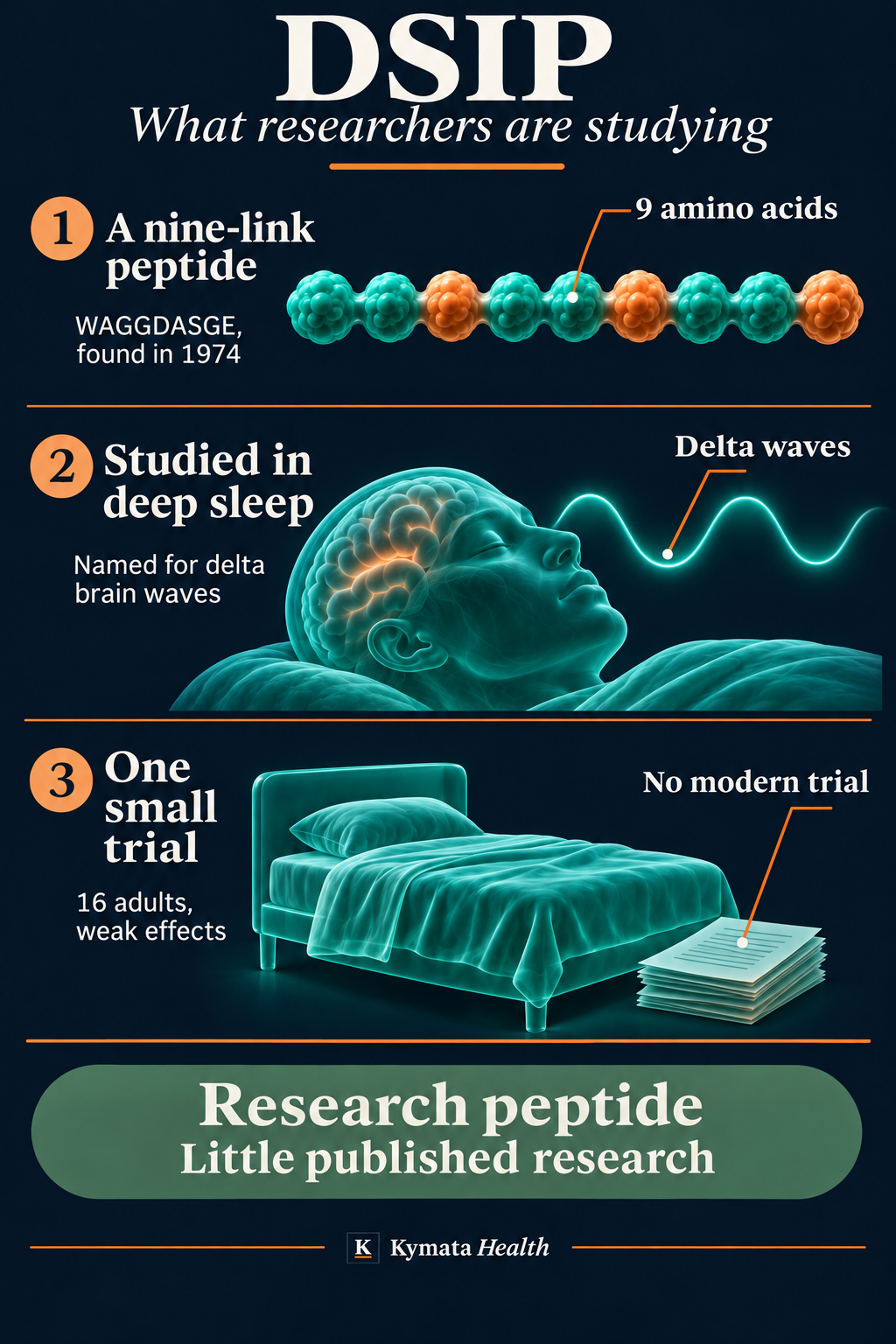
The guide shows delta sleep-inducing peptide (DSIP) as the nine-amino-acid sequence WAGGDASGE, first isolated from rabbit brain in 1974 and named for the delta brain waves of deep sleep. The published clinical record is one small trial in adults with chronic insomnia, given intravenously, which found weak effects (PMID 1299794). No modern trial has measured deep-sleep duration. The drawing is a schematic, not a measured molecular structure, a product photograph or a treatment result. Illustration review: 22 November 2026, against this page’s own mechanism, evidence and regulatory records.
Illustration notes and source record
Read the source record on this page. Laboratory, topical and injected studies are separate evidence; this illustration does not establish an indication or a treatment outcome.

DSIP amino acid sequence
Choose Rotate or Pan, then focus the diagram and use the arrow keys. Up and down tilt in Rotate mode. Pinch or use + and − to zoom.
Each bead is one amino acid. Once it is part of the chain, it is called a residue. Drag to rotate or tap a bead. The shape is a schematic illustration.
- Aromatic
- Nonpolar
- Glycine / proline
- Acidic
- Polar
Its two joined rings form a structure called indole. One part of that structure can form a hydrogen bond. This letter identifies a residue in the catalogue sequence. The model is illustrative; it does not establish molecular folding or clinical effect.
Read the full sequence
A peptide bond is a covalent link joining two amino acids in a chain. A hydrogen bond is a weaker attraction, for example between a hydrogen on an oxygen and a nearby oxygen atom. A side chain may form hydrogen bonds without joining another amino acid to the chain. This diagram shows the sequence; it does not measure these interactions.
WAGGDASGE
- Tryptophan. Its two joined rings form a structure called indole. One part of that structure can form a hydrogen bond.
- Alanine. Its short side branch mixes poorly with water. Chemists call this a nonpolar methyl group.
- Glycine. Its side branch is a single hydrogen atom, leaving the chain more room to bend here.
- Glycine. Its side branch is a single hydrogen atom, leaving the chain more room to bend here.
- Aspartate. Its side branch usually carries a negative charge near neutral pH, the middle of the acidity scale.
- Alanine. Its short side branch mixes poorly with water. Chemists call this a nonpolar methyl group.
- Serine. An oxygen and hydrogen at its tip help it form weak attractions called hydrogen bonds.
- Glycine. Its side branch is a single hydrogen atom, leaving the chain more room to bend here.
- Glutamate. Its side branch usually carries a negative charge near neutral pH, the middle of the acidity scale.
How it works
DSIP (Delta Sleep-Inducing Peptide) is a naturally occurring nonapeptide that promotes delta-wave (Stage 3/4 deep) sleep, the most restorative phase of the sleep cycle. It was first isolated from rabbit brain venous blood in 1974 at the University of Geneva.
DSIP modulates several neurochemical systems: it enhances serotonin release, reduces stress-related ACTH and cortisol levels, and normalizes circadian rhythms. Unlike sedative-hypnotics (benzodiazepines, z-drugs), DSIP promotes delta-wave architecture rather than artificially sedating, maintaining natural sleep stage progression.
Background & History
DSIP (Delta Sleep-Inducing Peptide) is a nonapeptide first isolated from rabbit cerebral venous blood by Marcel Monnier at the University of Basel in 1977. It was the first peptide identified specifically for sleep regulation and produced normal physiological slow-wave sleep in animal and human experiments without the hangover effects of pharmacological sleep aids. Its mechanisms include modulation of serotonin, norepinephrine, and GABA systems, as well as normalization of cortisol circadian rhythms, making it useful beyond sleep into stress resilience.
05 / Evidence and limits
Evidence and limits
Limits of current evidence
2 limits- PMID 6325741 is historical, not a 2026 insomnia Phase 3.
- This site will not treat insomnia, PTSD, or withdrawal from a DSIP page.
What it is studied for
- Identity: 1970s nonapeptide vs a hypnotic NDA (there is not one)
- Minutes-class t½ vs bedtime folklore
- Not a withdrawal or insomnia protocol on this site
Verdict
DSIP is a nine-residue peptide from the 1970s sleep literature. Plasma t½ is minutes. It is not Ambien, not a withdrawal protocol, and not a cortisol-reset drug.
06 / Product forms and access
Product forms and access
Regulatory & legal status
- FDA status (US)
- Research Only
- WADA status (2026)
- Not ListedNot currently on the WADA 2026 Prohibited List. Policies may change. Verify before competition.
- US compounding
- Not eligible / not available
07 / Tools and practical checks
Tools and practical checks
Dose it
5 mg + 2.5 mL BAC water → 2 mg/mL · 1 unit (U-100) = 20 mcg.
Reconstitution math
U-100 syringe| Vial | Water | Concentration |
|---|---|---|
| 5 mg lyophilized | 2.5 mL BAC | 2 mg/mL |
08 / Published study use
Published study use
What published studies gave, in whom, and the source. Not a dose for you.
What studies used
One small insomnia trial- 25 nmol/kg by IV infusion on three afternoons, in 16 people with chronic insomnia (half on placebo). The effects were weak, and the authors judged it unlikely to be of major benefit. Bes 1992, PMID 1299794 (opens in new tab)
A record of what researchers gave, in whom; not a dose for you.
Administration
- Route / form
- Route used in studies: IV infusion.
Who it is for
2 uses| Category | Fit | What exists |
|---|---|---|
| Deep Sleep / Insomnia | Low | Promotes delta-wave sleep without sedation. Limited modern clinical trials but significant preclinical and historical research. |
| Cortisol / Stress Normalization | Low | Reduces ACTH and cortisol, so it may improve sleep quality in high-stress individuals. |
09 / Safety and interactions
Safety and interactions
What the record says
Research peptide. Limited modern human safety data. Generally well-tolerated in older studies. May cause morning grogginess at higher doses. Not for use with CNS depressants.
Interactions & Contraindications
No interaction study has been published for DSIP. A sedative effect adding to benzodiazepines, z-drugs or antihistamines follows from the mechanism but has not been measured, and the one published clinical record (PMID 1299794) tested no combination. Alcohol deepens CNS depression on its own. A cortisol-rhythm effect appears in the older literature; no study has measured it against any medicine.
10 / Comparisons and goal guides
Comparisons and goal guides
Combinations: what has been tested
1 pairing- + Selank →Daytime tuftsin analog vs nighttime DSIP folklore. Two SKUs is not a stress-sleep protocol and not a US insomnia NDA.
Appears in goal guides
1 guideGoal guides give the evidence and status for each compound, with no doses. A mention here is not a treatment plan.
11 / Common questions
Common questions
Common questions
3 answersHow does DSIP differ from sleep drugs like Ambien?
Unlike sedative-hypnotics that knock you unconscious and distort sleep architecture, DSIP specifically promotes delta-wave (deep) sleep while maintaining natural sleep stage progression. It works with your sleep biology rather than overriding it.
Is there a studied time to take DSIP?
No. Its one small insomnia trial gave it by IV in the afternoon and found weak effects (PMID 1299794). No study has set a time, route or course, and we give none.
Is DSIP FDA-approved?
No. Not FDA-approved, research chemical.
12 / Sources and references
Sources and references
1 paper cited on this page.
Sources
1 paper- 1“Delta sleep-inducing peptide (DSIP): an update.”Graf MV et al. Peptides (1986). PMID: 3550726
14 / Prescription options
Prescription options
Prescription options: compare licensed telehealth providers
Some peptide therapies are available only by prescription after a consult with a licensed clinician.
Compare telehealth →15 / Peptide library
Peptide library
Keep reading: Peptide research library
Peptide research library: every pagePeptide libraryBrowse all topics
- SemaxPrevious in this topic · Semax is a synthetic seven-amino-acid analogue of an ACTH fragment.
- TesamorelinNext in this topic · GHRH analog sold as Egrifta SV and Egrifta WR for excess abdominal fat in adults with HIV and lipodystrophy.
- AOD-9604AOD-9604 is a modified growth hormone fragment that WADA prohibits in and out of competition.
- Khavinson catalog setsThe organ boxes Khavinson catalogs sell together: label serving, evidence and US status for each bottle; every name links to a peptide page.
- GHK-CuGHK-Cu is glycine–histidine–lysine bound to copper.
Regulatory and sport classification
- Not FDA-approved, research chemical