
The peptide field guide
AOD-9604
AOD-9604 is a modified C-terminal fragment of human growth hormone.
Rodent research and a failed late-stage obesity trial do not establish human weight-loss benefit.
Explore this compoundConceptual editorial illustration; not a measured molecular structure, product photograph or treatment result.
02 / At a glance
At a glance
Key facts
- Also known as
- Anti-Obesity Drug 9604
- Type
- Fat Loss
- Evidence level
- Human trials, mixed results: benefit not established.
- US regulatory status
- Not FDA-approved, research chemical
- Updated
Identity
AOD-9604 is a modified C-terminal fragment of human growth hormone.
Research context
Rodent fat-cell studies; a separate late-stage obesity trial missed its weight-loss target.
Evidence limits
Rodent research and a failed late-stage obesity trial do not establish human weight-loss benefit.
Read the technical profile and study-use reference
Quick answer
Evidence: LowAOD-9604 is a modified growth hormone fragment that WADA prohibits in and out of competition. The modified sequence begins with tyrosine. Monash obesity program did not become a labeled fat-loss drug. Not somatropin, not a GLP-1, not “lipolysis without IGF-1” as a clinical guarantee.
- In published studies
- Human trial doses not stated in published abstracts
Research summary, not medical advice.
At a glance
Kymata peptide profile · Oct 30, 2026- Common vials
- 5 mg
- Molecular weight
- 1816.12 g/mol
- CAS
- 221231-10-3
- In published studies
- Human trial doses not stated in published abstracts
- Half-life
- Not established in humans
03 / Identity and origin
Identity and origin
Also called Anti-Obesity Drug 9604. Tyr-hGH 177–191: hGH residues 177–191 with an added N-terminal tyrosine (not somatropin).
Read the sequence and compound record
Compound card
- Class
- Tyr-hGH 177–191: hGH residues 177–191 with an added N-terminal tyrosine (not somatropin)
- Formula
- C78H123N23O23S2
- Molecular weight
- 1816.12 g/mol
- CAS
- 221231-10-3
- Described by
- Metabolic Pharmaceuticals (Melbourne, Australia), 1990s
- Bioavailability
- Subcutaneous injection or oral
04 / How it may work
How it may work
Tyr-hGH 177–191: hGH residues 177–191 with an added N-terminal tyrosine (not somatropin)
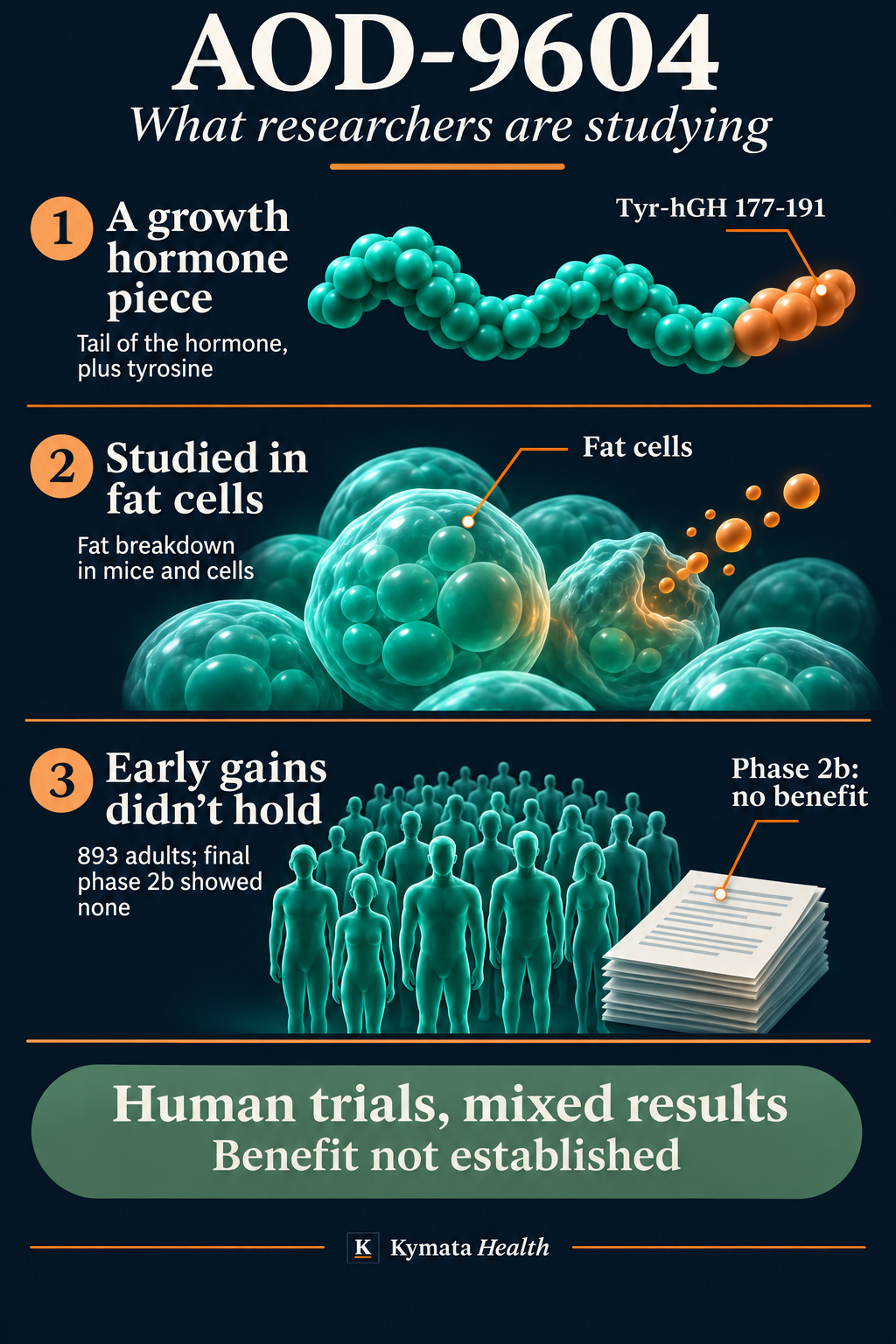
The guide shows AOD-9604 as Tyr-hGH 177–191: the last residues of human growth hormone, with a tyrosine added at the N-terminus in place of the native phenylalanine at position 176. Fat breakdown was measured in mice and in cultured fat cells. Six placebo-controlled trials ran in 893 adults between 2001 and 2006; the weight loss seen in early studies was not seen in the final phase 2b study, no phase 3 trial was run, and IGF-1 and glucose tolerance were unchanged (Stier 2013, J Endocrinol Metab). The drawing is a schematic, not a measured molecular structure, a product photograph or a treatment result. Illustration review: 22 November 2026, against this page’s own mechanism, evidence and regulatory records.
A sequence model is not provided for this record. Read the identity and evidence notes; an illustration does not verify a molecular structure.
Illustration notes and source record
Read the source record on this page. Laboratory, topical and injected studies are separate evidence; this illustration does not establish an indication or a treatment outcome.

How it works
AOD-9604 is a modified fragment of human growth hormone (hGH amino acids 177-191, with an added tyrosine) specifically engineered to retain hGH's fat-metabolizing properties while eliminating its anabolic and proliferative effects.
AOD-9604 stimulates lipolysis (fat breakdown) and inhibits lipogenesis (fat storage) via β-3 adrenergic receptors and direct lipase activation, without binding the GH receptor or elevating IGF-1. These effects come from animal and cell studies. It was developed by Metabolic Pharmaceuticals (Melbourne) and reached phase 2b trials for obesity, never phase 3. The efficacy results were not published as a full peer-reviewed paper; a 2013 paper pooled safety data from six placebo-controlled trials in 893 adults and reported no rise in IGF-1 and no impaired glucose tolerance (Stier 2013, J Endocrinol Metab).
Background & History
AOD-9604 is a modified fragment of human growth hormone: residues 177–191, with a tyrosine added at the N-terminus in place of the native phenylalanine at position 176, so it is 16 residues long but not the native 176–191 fragment. Developed by Monash University researchers led by John Ng in Australia, it was designed to capture the lipolytic properties of GH without its diabetogenic effects. Six placebo-controlled trials ran between 2001 and 2006, ending with Phase 2b obesity studies that did not meet their primary endpoints; no Phase 3 trial was run (Stier 2013, J Endocrinol Metab).
05 / Evidence and limits
Evidence and limits
Limits of current evidence
4 limits- “Catastrophic fat-loss without IGF-1” is not a clinical fact.
- Related to fragment 176–191; they are not interchangeable SKUs.
- GRAS talk is food-additive folklore, not an obesity NDA.
- This site will not treat obesity from an AOD page.
What it is studied for
- Identity: modified 176–191 vs somatropin vs AOD vs fragment SKU
- Failed late-stage obesity work is part of the file
- Not a GLP-1 and not Egrifta VAT math
Verdict
AOD-9604 is a modified C-terminal GH fragment sold for fat loss. It is not hGH, not a GLP-1, and not an approved obesity medicine. Failed late-stage obesity work is part of the story.
06 / Product forms and access
Product forms and access
Regulatory & legal status
- FDA status (US)
- Research OnlyReached Phase 2b trials for obesity, never Phase 3; not FDA-approved as a drug
- WADA status (2026)
- Prohibited (S2)Competitive athletes subject to anti-doping controls should not use AOD-9604. The 2026 WADA Prohibited List names AOD-9604 as an example of a prohibited growth hormone fragment in class S2: prohibited at all times, in and out of competition (checked November 22, 2026)
- US compounding
- Not eligible / not available
07 / Tools and practical checks
Tools and practical checks
Dose it
5 mg + 2 mL BAC water → 2.5 mg/mL · 1 unit (U-100) = 25 mcg.
Reconstitution math
U-100 syringe| Vial | Water | Concentration |
|---|---|---|
| 5 mg lyophilized | 2 mL BAC | 2.5 mg/mL |
08 / Published study use
Published study use
What published studies gave, in whom, and the source. Not a dose for you.
What studies used
Human trial doses not published in abstracts- Obese mice: 14 days by implanted pump. Heffernan 2001, PMID 11673763 (opens in new tab)
- In people it reached phase IIa obesity trials by 2002, and a 2013 paper reports its safety and tolerability in humans. Neither record we could read states a dose, so we quote none. Wilding 2004, PMID 15134286 (opens in new tab)Stier 2013, DOI 10.4021/jem157w (opens in new tab)
A record of what researchers gave, in whom; not a dose for you.
Administration
- Route / form
- Not established: the human trial records we could read state no route.
Who it is for
1 use| Category | Fit | What exists |
|---|---|---|
| Fat Loss / Lipolysis | Low | Lipolysis shown in obese mice (Heffernan 2001). No IGF-1 change versus placebo in six human trials (Stier 2013). Phase 2b obesity results were not published in a peer-reviewed journal. |
09 / Safety and interactions
Safety and interactions
What the record says
A pooled report of six placebo-controlled trials in 893 adults found no IGF-1 change versus placebo, no worsening of glucose tolerance, no anti-AOD9604 antibodies and no withdrawals or serious adverse events attributed to the drug (Stier 2013, J Endocrinol Metab, doi:10.4021/jem157w). The report comes from the developer's investigators, and no phase 3 trial was run. In cell assays AOD9604 did not bind the hGH receptor or induce cell proliferation (Heffernan 2001, PMID 11673763). Long-term human safety is unknown. FDA lists AOD-9604 among compounding substances that may present significant safety risks.
Interactions & Contraindications
Does not affect IGF-1 or blood glucose, so it is safer metabolically than full GH. No significant drug interactions identified. Not for use with active cancer.
10 / Comparisons and goal guides
Comparisons and goal guides
Appears in goal guides
2 guidesGoal guides give the evidence and status for each compound, with no doses. A mention here is not a treatment plan.
- GoalWeight Loss PlateausTesamorelin, AOD-9604 and MOTS-c as they come up for a stalled diet: the one approved use, the failed obesity trials, the mouse data, and why no dose is given.Evidence and status
- GoalFat Metabolism CompoundsThe “Furnace” combination: thyroid and pancreas capsules, tesamorelin, AOD-9604, retatrutide and 5-amino-1MQ. What each has been studied for, its status, and why no dose is given.Evidence and status
11 / Common questions
Common questions
Common questions
3 answersDoes AOD-9604 raise IGF-1?
Not in the trials reported so far. A pooled report of six placebo-controlled trials in 893 adults found no IGF-1 difference from placebo at 12 or 24 weeks (Stier 2013, doi:10.4021/jem157w). In cell assays it did not compete for the hGH receptor or induce cell proliferation, unlike hGH (Heffernan 2001, PMID 11673763).
Does AOD-9604 have a studied timing or fasting rule?
No. The human trial records we could read state no dose and no timing (PMID 15134286); the mouse study gave it by implanted pump (PMID 11673763). We give none.
Is AOD-9604 FDA-approved?
No. Reached Phase 2b trials for obesity, never Phase 3; not FDA-approved as a drug.
12 / Sources and references
Sources and references
5 papers cited on this page.
Sources
5 papers- 1“Safety and tolerability of the hexadecapeptide AOD9604 in humans.”Stier H, Vos E, Kenley D J Endocrinol Metab (2013).
- 2“Increase of fat oxidation and weight loss in obese mice caused by chronic treatment with human growth hormone or a modified C-terminal fragment.”Heffernan MA, Thorburn AW, Fam B, et al. Int J Obes Relat Metab Disord (2001).
- 3“AOD-9604 Metabolic.”Wilding J Curr Opin Investig Drugs (2004).
- 4“World Anti-Doping Code: 2026 Prohibited List (class S2 names growth hormone fragments, e.g. AOD-9604 and hGH 176-191).”World Anti-Doping Agency WADA (2026).
- 5“Metabolic studies of a synthetic lipolytic domain (AOD9604) of human growth hormone.”Ng FM, et al. Horm Res (2000). PMID: 11146367
14 / Prescription options
Prescription options
Prescription options: compare licensed telehealth providers
Some peptide therapies are available only by prescription after a consult with a licensed clinician.
Compare telehealth →15 / Peptide library
Peptide library
Keep reading: Peptide research library
Peptide research library: every pagePeptide libraryBrowse all topics
- TesamorelinPrevious in this topic · GHRH analog sold as Egrifta SV and Egrifta WR for excess abdominal fat in adults with HIV and lipodystrophy.
- Khavinson catalog setsNext in this topic · The organ boxes Khavinson catalogs sell together: label serving, evidence and US status for each bottle; every name links to a peptide page.
- GHK-CuGHK-Cu is glycine–histidine–lysine bound to copper.
- LL-37LL-37 is the mature 37-residue human cathelicidin peptide cleaved from hCAP18.
- SermorelinSermorelin is GHRH(1-29), a peptide that prompts the pituitary to release its own growth hormone; it is not growth hormone itself.
Regulatory and sport classification
- Not FDA-approved, research chemical
- WADA (S2): prohibited in sport at all times