
The peptide field guide
LL-37
LL-37 is the mature 37-amino-acid human cathelicidin released from hCAP18.
Laboratory membrane activity and topical ulcer research do not establish injection benefit.
Explore this compoundConceptual editorial illustration; not a measured molecular structure, product photograph or treatment result.
02 / At a glance
At a glance
Key facts
- Also known as
- Cathelicidin, hCAP18
- Sequence
- LLGDFFRKSKEKIGKEFKRIVQRIKDFLRNLVPRTES
- Evidence level
- Cell and animal research: human benefit remains unproven.
- US regulatory status
- Not FDA-approved, research chemical
- Updated
Identity
LL-37 is the mature 37-amino-acid human cathelicidin released from hCAP18.
Research context
Laboratory membrane research and a separate topical leg-ulcer trial in 34 people.
Evidence limits
Laboratory membrane activity and topical ulcer research do not establish injection benefit.
Read the technical profile and study-use reference
Quick answer
Evidence: LowLL-37 is the mature 37-residue human cathelicidin peptide cleaved from hCAP18. Pore-forming antimicrobial and innate-immune signaling biology is real in vitro and in animal models. Injectable research-chem vials are not an antibiotic, not a Lyme drug, and not a MRSA protocol. Vitamin D induces endogenous CAMP expression; that is not the same as injecting a 5 mg vial.
- In published studies
- Trial amounts are recorded under What studies used (PMID 25041740)
Research summary, not medical advice.
At a glance
Kymata peptide profile · Oct 28, 2026- Common vials
- 5 mg
- Molecular weight
- 4493.3 g/mol
- CAS
- 154947-66-7
- In published studies
- Trial amounts are recorded under What studies used (PMID 25041740)
- Half-life
- Hours-class in some models; SKU PK unpublished. The ~4 h catalog figure is not a human injection study we will treat as fact.
03 / Identity and origin
Identity and origin
Also called Cathelicidin, hCAP18. Human cathelicidin (mature 37-mer from hCAP18).
Read the sequence and compound record
Compound card
1 cell = 1 amino acid- Sequence
- LLGDFFRKSKEKIGKEFKRIVQRIKDFLRNLVPRTES
- Class
- Human cathelicidin (mature 37-mer from hCAP18)
- Formula
- C205H340N60O53
- Molecular weight
- 4493.3 g/mol
- CAS
- 154947-66-7
- Described by
- Agerberth / Gudmundsson cathelicidin lineage (1995–1996), 1995 (FALL-39); 1996 (LL-37 mature form)
- Bioavailability
- Endogenous peptide; research-chem route is usually SC. Topical/wound programs are a different presentation.
04 / How it may work
How it may work
Human cathelicidin (mature 37-mer from hCAP18)
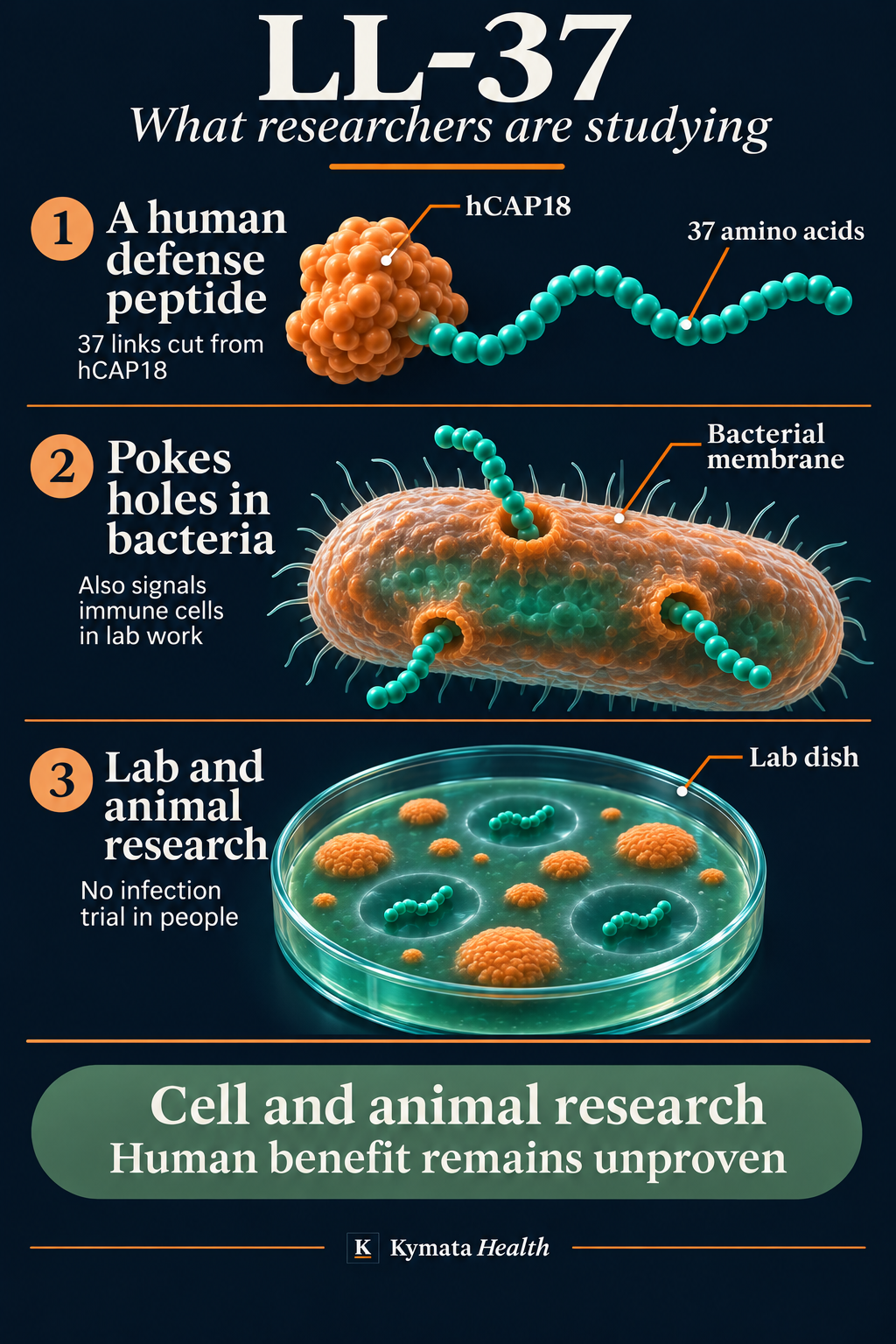
The guide shows LL-37 as the 37-amino-acid human defense peptide cut from the precursor hCAP18 (Agerberth 1995; Gudmundsson 1996). In laboratory work it pokes holes in bacterial membranes and signals immune cells. These findings come from cell and animal models; no infection trial in people supports research-vial use. The drawing is a schematic, not a measured molecular structure, a product photograph or a treatment result. Illustration review: 22 November 2026, against this page’s own mechanism, evidence and regulatory records.
Illustration notes and source record
Read the source record on this page. Laboratory, topical and injected studies are separate evidence; this illustration does not establish an indication or a treatment outcome.

LL-37 amino acid sequence
Choose Rotate or Pan, then focus the diagram and use the arrow keys. Up and down tilt in Rotate mode. Pinch or use + and − to zoom.
Each bead is one amino acid. Once it is part of the chain, it is called a residue. Drag to rotate or tap a bead. The shape is a schematic illustration.
- Nonpolar
- Glycine / proline
- Acidic
- Aromatic
- Basic
- Polar
Its branching side chain mixes poorly with water, a property called hydrophobicity. This letter identifies a residue in the catalogue sequence. The model is illustrative; it does not establish molecular folding or clinical effect.
Read the full sequence
A peptide bond is a covalent link joining two amino acids in a chain. A hydrogen bond is a weaker attraction, for example between a hydrogen on an oxygen and a nearby oxygen atom. A side chain may form hydrogen bonds without joining another amino acid to the chain. This diagram shows the sequence; it does not measure these interactions.
LLGDFFRKSKEKIGKEFKRIVQRIKDFLRNLVPRTES
- Leucine. Its branching side chain mixes poorly with water, a property called hydrophobicity.
- Leucine. Its branching side chain mixes poorly with water, a property called hydrophobicity.
- Glycine. Its side branch is a single hydrogen atom, leaving the chain more room to bend here.
- Aspartate. Its side branch usually carries a negative charge near neutral pH, the middle of the acidity scale.
- Phenylalanine. Six carbon atoms form a closed loop in its side branch. Chemists call this an aromatic ring. It mixes poorly with water.
- Phenylalanine. Six carbon atoms form a closed loop in its side branch. Chemists call this an aromatic ring. It mixes poorly with water.
- Arginine. Its tip, called a guanidinium group, usually carries a positive charge near neutral pH.
- Lysine. Its side branch usually carries a positive charge near neutral pH, the middle of the acidity scale.
- Serine. An oxygen and hydrogen at its tip help it form weak attractions called hydrogen bonds.
- Lysine. Its side branch usually carries a positive charge near neutral pH, the middle of the acidity scale.
- Glutamate. Its side branch usually carries a negative charge near neutral pH, the middle of the acidity scale.
- Lysine. Its side branch usually carries a positive charge near neutral pH, the middle of the acidity scale.
- Isoleucine. Its branching side chain mixes poorly with water, a property called hydrophobicity.
- Glycine. Its side branch is a single hydrogen atom, leaving the chain more room to bend here.
- Lysine. Its side branch usually carries a positive charge near neutral pH, the middle of the acidity scale.
- Glutamate. Its side branch usually carries a negative charge near neutral pH, the middle of the acidity scale.
- Phenylalanine. Six carbon atoms form a closed loop in its side branch. Chemists call this an aromatic ring. It mixes poorly with water.
- Lysine. Its side branch usually carries a positive charge near neutral pH, the middle of the acidity scale.
- Arginine. Its tip, called a guanidinium group, usually carries a positive charge near neutral pH.
- Isoleucine. Its branching side chain mixes poorly with water, a property called hydrophobicity.
- Valine. Its short, branching side chain mixes poorly with water, a property called hydrophobicity.
- Glutamine. Its uncharged tip can form weak attractions called hydrogen bonds with nearby molecules.
- Arginine. Its tip, called a guanidinium group, usually carries a positive charge near neutral pH.
- Isoleucine. Its branching side chain mixes poorly with water, a property called hydrophobicity.
- Lysine. Its side branch usually carries a positive charge near neutral pH, the middle of the acidity scale.
- Aspartate. Its side branch usually carries a negative charge near neutral pH, the middle of the acidity scale.
- Phenylalanine. Six carbon atoms form a closed loop in its side branch. Chemists call this an aromatic ring. It mixes poorly with water.
- Leucine. Its branching side chain mixes poorly with water, a property called hydrophobicity.
- Arginine. Its tip, called a guanidinium group, usually carries a positive charge near neutral pH.
- Asparagine. Its uncharged tip can form weak attractions called hydrogen bonds with nearby molecules.
- Leucine. Its branching side chain mixes poorly with water, a property called hydrophobicity.
- Valine. Its short, branching side chain mixes poorly with water, a property called hydrophobicity.
- Proline. Its side branch loops back onto the main chain, limiting how freely the chain can turn here.
- Arginine. Its tip, called a guanidinium group, usually carries a positive charge near neutral pH.
- Threonine. Its branched side chain has a hydroxyl group (an oxygen bonded to hydrogen) that can form hydrogen bonds with nearby molecules.
- Glutamate. Its side branch usually carries a negative charge near neutral pH, the middle of the acidity scale.
- Serine. An oxygen and hydrogen at its tip help it form weak attractions called hydrogen bonds.
How it works
LL-37 is the only human cathelicidin antimicrobial peptide, the 37-residue C-terminal fragment of hCAP18. Agerberth et al. 1995 (PNAS, PMID 7529412) cloned it as FALL-39; Gudmundsson et al. 1996 (PMID 8681941) established the mature LL-37 processing. It is amphipathic: it can pore bacterial membranes and it talks to innate immune receptors (FPRL1/FPR2, TLR modulation). Vitamin D induces the CAMP gene. That is endogenous biology, not a reason to inject a 5 mg vial.
Human therapeutic development has been mostly topical/wound and device-adjacent. Injectable research-chem calendars and Lyme/MRSA protocols are not an antibiotic label; the one controlled trial put it on leg ulcers (PMID 25041740). Hemolysis and pro-inflammatory signaling at high concentration are why “more AMP” is not automatically better.
Do not delay indicated antimicrobials or wound care because a cathelicidin page exists. Research-chem LL-37 is unlabeled.
05 / Evidence and limits
Evidence and limits
Limits of current evidence
4 limits- No approved injectable LL-37 antibiotic. Topical/wound research is not a SubQ infection protocol.
- PMID 7529412 is FALL-39 cloning, not a human RCT. Do not cite it as clinical proof.
- Herxheimer-like “die-off” stories are community interpretation, not a monitored antimicrobial endpoint.
- High concentrations can be cytotoxic/hemolytic in vitro. Start-low folklore exists because of that, not because of a Phase 2 dose-finding trial.
What it is studied for
- Identity: the only human cathelicidin AMP
- Wound/keratinocyte models (preclinical)
- Not a substitute for indicated antimicrobials
Goal context
2 goals- Innate immunity vs a named infection
- CAMP biology is why people search this page. Lyme, Candida, and MRSA are diagnoses. Pore-forming peptides in a dish do not become a home antibiotic.
- Vitamin D is not the vial
- Vitamin D upregulates endogenous LL-37. Correcting deficiency is ordinary medicine. It is not equivalent to injecting synthetic LL-37.
Verdict
LL-37 is a real human AMP with a real cloning paper. It is not a Lyme drug, not MRSA-in-a-syringe, and not “stronger than antibiotics.” Use this page for identity and vial math. Take infections to a clinician.
06 / Product forms and access
Product forms and access
Regulatory & legal status
- FDA status (US)
- Research Only
- WADA status (2026)
- Not ListedNot currently on the WADA 2026 Prohibited List. Policies may change. Verify before competition.
- US compounding
- Not eligible / not available
07 / Tools and practical checks
Tools and practical checks
Dose it
5 mg + 2.5 mL BAC water → 2 mg/mL · 1 unit (U-100) = 20 mcg.
Reconstitution math
U-100 syringe| Vial | Water | Concentration |
|---|---|---|
| 5 mg | 2.5 mL BAC | 2 mg/mL |
08 / Published study use
Published study use
What published studies gave, in whom, and the source. Not a dose for you.
What studies used
One topical trial- Applied to the wound at 0.5, 1.6 or 3.2 mg/mL twice a week for 4 weeks, in 34 people with hard-to-heal venous leg ulcers; the two lower strengths did better than placebo. Grönberg 2014, PMID 25041740 (opens in new tab)
- That was a topical wound treatment, not an injection.
A record of what researchers gave, in whom; not a dose for you.
Administration
- Route / form
- Route used in studies: applied to the skin (a topical leg-ulcer trial). No injection study.
Who it is for
2 uses| Category | Fit | What exists |
|---|---|---|
| AMP identity / innate-immune research | Moderate | This is the human 37-mer. Biology is real. Drug is not. |
| Named infection treatment | Low | Wrong tool. See a clinician. |
09 / Safety and interactions
Safety and interactions
What the record says
Antimicrobial peptide (AMP). Can irritate at the site. Theoretical hemolysis and pro-inflammatory signaling at high concentration. Not for use as a standalone antimicrobial. Active systemic infection belongs in clinic, not in a peptide calculator.
Interactions & Contraindications
High concentrations can be cytotoxic/hemolytic in vitro. Local sting is common. Immunostimulatory AMP biology is a caution in autoimmunity. Not an antibiotic substitute.
10 / Comparisons and goal guides
Comparisons and goal guides
Combinations: what has been tested
1 pairing- + BPC-157 →People pair them in wound folklore. Complementary marketing is not a synergy RCT. Infections still need indicated care.
Appears in goal guides
2 guidesGoal guides give the evidence and status for each compound, with no doses. A mention here is not a treatment plan.
- GoalImmune HealthThymosin alpha-1, Thymalin, LL-37, KPV and thymopentin: what each has been studied for, in whom, their US status, and why no dose is given.Evidence and status
- GoalThymus Bioregulators and Immune PeptidesThe Khavinson thymus, pineal and bone-marrow capsules, plus thymosin alpha-1, selank, LL-37 and KPV: what each has been studied for, its status, and why no course or dose is given.Evidence and status
11 / Common questions
Common questions
Common questions
8 answersDoes LL-37 treat Lyme or MRSA?
No indication we will print. Membrane-active AMP biology is real in vitro. That is not a borrelia or MRSA protocol.
What dose did studies use?
The one controlled trial applied it to hard-to-heal venous leg ulcers in 34 people (PMID 25041740). That was a wound treatment, not an injection. We do not give an injection dose.
How do I reconstitute a 5 mg vial?
This page’s default is 5 mg + 2.5 mL BAC = 2 mg/mL (each unit on a U-100 syringe is 20 mcg). That is arithmetic, not a dose; we give no injection dose.
Is the half-life 4 hours?
That is a catalog estimate. We will not treat it as a human injection PK study.
Why do people mention Vitamin D?
The CAMP gene is vitamin-D responsive. That is endogenous expression, not vial math.
Has it been tested with BPC-157?
No study has tested the pair, and we give no stacking advice. Infections still need indicated care.
Is it FDA-approved?
Not as an injectable antibiotic. Do not confuse endogenous CAMP with a drug approval.
What about autoimmune disease?
AMPs can be immunostimulatory. Unlabeled use in autoimmunity is a clinician problem, not a DIY plus.
12 / Sources and references
Sources and references
3 papers cited on this page.
Sources
3 papers- 1“FALL-39, a putative human peptide antibiotic, is cysteine-free and expressed in bone marrow and testis.”Agerberth B, Gunne H, Odeberg J, et al. Proc Natl Acad Sci U S A (1995). PMID: 7529412
- 2“The human gene FALL39 and processing of the cathelin precursor to the antibacterial peptide LL-37 in granulocytes.”Gudmundsson GH, Agerberth B, Odeberg J, et al. Eur J Biochem (1996). PMID: 8681941
- 3“The human cathelicidin LL-37 - a multifunctional peptide involved in infection and inflammation in the lung.”Tjabringa GS et al. Pulm Pharmacol Ther (2005). PMID: 15939310
14 / Prescription options
Prescription options
Prescription options: compare licensed telehealth providers
Some peptide therapies are available only by prescription after a consult with a licensed clinician.
Compare telehealth →15 / Peptide library
Peptide library
Keep reading: Peptide research library
Peptide research library: every pagePeptide libraryBrowse all topics
- GHK-CuPrevious in this topic · GHK-Cu is glycine–histidine–lysine bound to copper.
- SermorelinNext in this topic · Sermorelin is GHRH(1-29), a peptide that prompts the pituitary to release its own growth hormone; it is not growth hormone itself.
- IGF-1 LR3IGF-1 LR3 changed the proportions of two kinds of amyloid plaque in the brains of male 5XFAD mice but did not preserve memory.
- HGH Fragment 176-191HGH Fragment 176-191 is the last 16 amino acids of mature human growth hormone.
- Thymosin Alpha-1Thymosin alpha-1, also called thymalfasin, is a 28-amino-acid peptide studied as an immune modulator.
Regulatory and sport classification
- Not FDA-approved, research chemical