
The peptide field guide
IGF-1 LR3
IGF-1 LR3 is a modified IGF-1 research analogue.
The reviewed animal and endogenous-IGF-1 records do not establish human muscle benefit.
Explore this compoundIllustrative culture setting, not a recreation of the cited mouse experiment or a demonstrated tissue effect.
02 / At a glance
At a glance
Key facts
- Also known as
- Long R3 IGF-1, Insulin-like Growth Factor 1 Long R3, Long R3 IGF-I, LR3-IGF-I
- Type
- Growth Factor
- Evidence level
- Cell and animal research: human benefit remains unproven.
- US regulatory status
- Not FDA-approved
- Updated
Identity
IGF-1 LR3 is a modified IGF-1 research analogue.
Research context
A seven-month intranasal LR3 study in an Alzheimer-model mouse population, separate from human IGF-1 treatment.
Evidence limits
The reviewed animal and endogenous-IGF-1 records do not establish human muscle benefit.
Read the technical profile and study-use reference
Quick answer
Evidence: LowIGF-1 LR3 changed the proportions of two kinds of amyloid plaque in the brains of male 5XFAD mice but did not preserve memory. This engineered form of IGF-1 has no established human dose or clinical benefit in the studies reviewed.
- In published studies
- No established human dose in the reviewed studies
Research summary, not medical advice.
At a glance
Kymata peptide profile · Nov 22, 2026- CAS
- 143045-27-6
- In published studies
- No established human dose in the reviewed studies
- Half-life
- No human half-life established
- Common vials
- Research vial; no sourced vial preset in this calculator
03 / Identity and origin
Identity and origin
Also called Long R3 IGF-1, Insulin-like Growth Factor 1 Long R3, Long R3 IGF-I, LR3-IGF-I. Engineered 83-residue IGF-1 analogue.
Read the sequence and compound record
Compound card
- Class
- Engineered 83-residue IGF-1 analogue
- CAS
- 143045-27-6
- Bioavailability
- Unknown in humans. The long-term mouse study used intranasal delivery.
04 / How it may work
How it may work
Engineered 83-residue IGF-1 analogue
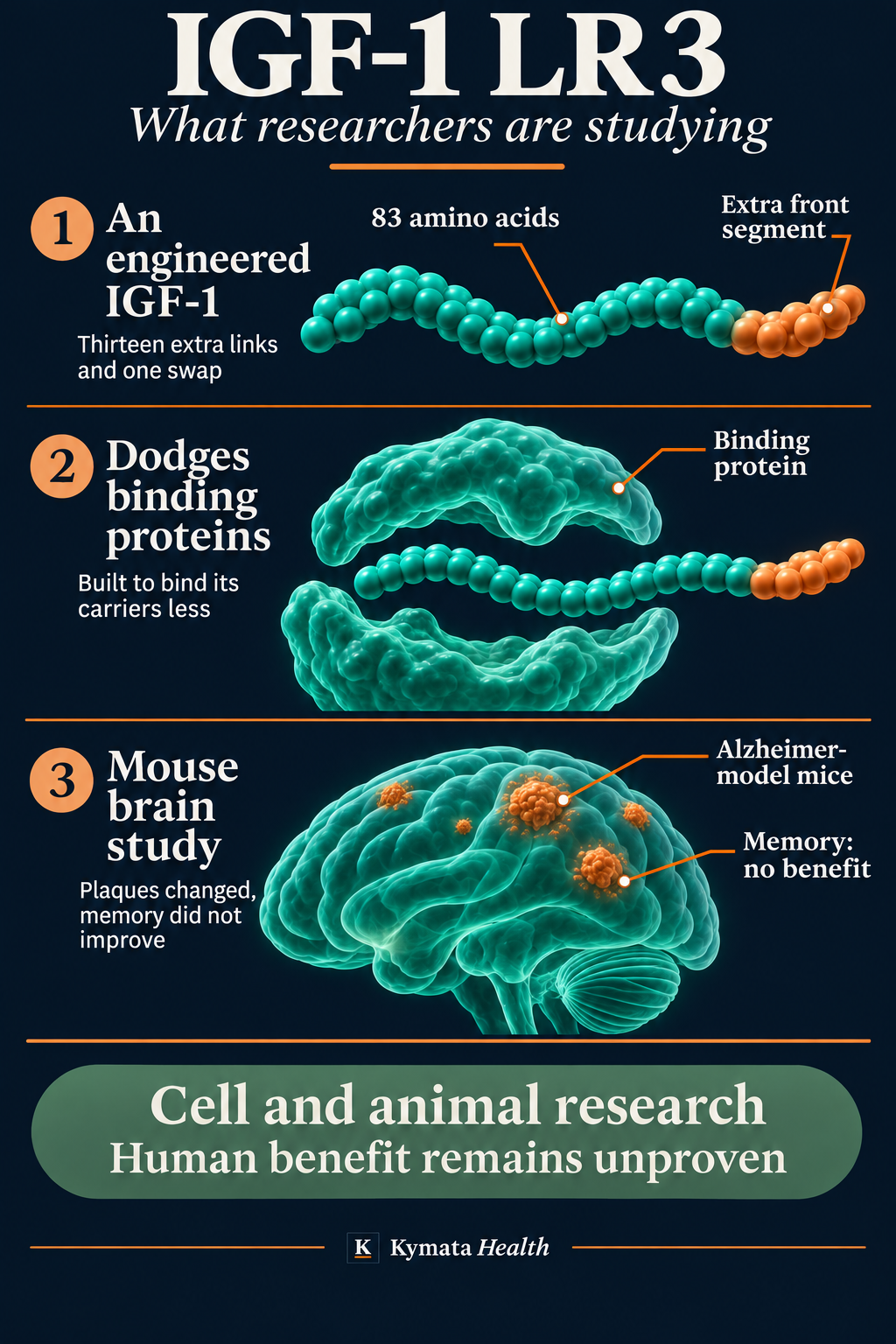
The guide shows IGF-1 LR3 as an engineered 83-amino-acid form of IGF-1, with 13 extra amino acids at the front and one swap, built to bind IGF-binding proteins less. In male Alzheimer-model 5XFAD mice given it for seven months, cortical plaque types changed, but memory tests showed no benefit (Engel 2025). The drawing is a schematic, not a measured molecular structure, a product photograph or a treatment result. Illustration review: 22 November 2026, against this page’s own mechanism, evidence and regulatory records.
The retained technical record includes a modified or incompletely specified chain. No simplified residue model is inferred; read the sequence and compound record for its exact scope.
Illustration notes and source record
Read the source record on this page. Laboratory, topical and injected studies are separate evidence; this illustration does not establish an indication or a treatment outcome.

How it works
SourcedLong R3 IGF-1 is an 83-amino-acid analogue of mature IGF-1. It has 13 extra residues at the amino terminus. At position 3 of the original IGF-1 sequence, arginine replaces glutamate (Glu3→Arg). Laajoki 2000 (PMID 10744677), an NMR solution-structure study of 15N-labeled Long-[Arg3]IGF-I, describes that mutation and extension and interprets the altered N terminus in terms of lower binding affinity for IGF-binding proteins. Binding affinity alone cannot tell us how long a substance circulates in people.
Source: PMID: 39610283, PMID: 10744677
Background & History
The 13-residue extension gives Long R3 its name. In the original IGF-1 sequence, arginine replaces glutamate at position 3. Researchers use the analogue to examine how binding proteins affect IGF signaling.
05 / Evidence and limits
Evidence and limits
Engel and colleagues compared male 5XFAD mice, a model of Alzheimer’s disease, with wild-type male mice. The study did not enroll people.
Human evidence
Engel and colleagues compared male 5XFAD mice, a model of Alzheimer’s disease, with wild-type male mice. The study did not enroll people.- Researchers gave LR3 or saline intranasally for seven months, from age three to ten months, in four groups of 19–27 male mice each. The numbers contributing to individual tests varied, and the paper also reports improved body composition.
- Engel 2025 (PMID 39610283) found fewer filamentous and more inert amyloid plaques in the cerebral cortex of treated 5XFAD mice; the paper describes the same plaque effects as less pronounced in the hippocampus.
- LR3 did not improve performance on Y-maze or box-maze memory testing. The cortical finding provides no evidence that LR3 preserves memory in people.
Limits of current evidence
2 limits- The main mouse experiment included only males. Effects on cortical plaques cannot establish a clinical benefit in people.
- Binding-protein experiments and animal clearance measurements do not establish a human elimination half-life.
What it is studied for
- Distinguishing plaque morphology from memory outcomes in the mouse experiment
- Understanding how LR3 differs from DES and full-length mecasermin
Verdict
Male 5XFAD mice given LR3 had a lower proportion of filamentous plaques in the cerebral cortex. Memory tests showed no benefit. The study gives no basis for a human dose.
06 / Product forms and access
Product forms and access
Regulatory & legal status
- FDA status (US)
- Research OnlyNo FDA-approved LR3 product was identified. Increlex contains the distinct 70-residue molecule mecasermin.
- WADA status (2026)
- Prohibited (S2)Competitive athletes subject to anti-doping controls should not use IGF-1 LR3.
- Classification
- Research Chemical
- US compounding
- Not eligible / not available
07 / Tools and practical checks
Tools and practical checks
No separate record is provided here. Read the linked evidence and limitations for this compound.
08 / Published study use
Published study use
What published studies gave, in whom, and the source. Not a dose for you.
What studies used
Animal evidence; human dosing unestablished- In male 5XFAD mice, seven months of intranasal LR3 shifted the proportions of cortical amyloid plaque types. Behavioral tests showed no memory benefit. Engel et al., mouse experiment, PMID 39610283 (opens in new tab)
- Radiolabeled LR3 cleared faster from plasma than intact IGF-1 in pregnant and nonpregnant rats. A human plasma half-life and clinical dose remain unestablished. Bastian et al., rat clearance study, PMID 7693845 (opens in new tab)
A record of what researchers gave, in whom; not a dose for you.
Administration
- Route / form
- Animal studies used several routes. We found no study establishing a clinical route for LR3.
09 / Safety and interactions
Safety and interactions
What the record says
Tomas 1997 (PMID 9415072), an acute bolus study in pigs and marmoset monkeys, found IGF-I variants including LR3IGF-I and des(1-3)IGF-I lowered plasma glucose 2- to 3-fold more potently and for longer than native IGF-I. We found no human administration study that established the frequency or severity of low blood sugar with LR3. The warning about hypoglycemia on the Increlex label applies to mecasermin, a different molecule.
Interactions & Contraindications
An experiment found that LR3 lowered blood glucose in pigs. The sources reviewed do not establish human interaction rates or a safe combination with insulin.
10 / Comparisons and goal guides
Comparisons and goal guides
IGF-1 LR3 vs. MK-677
4 attributesCanonical comparison: IGF-1 LR3 vs MK-677 · MK-677 evidence profile
| Attribute | IGF-1 LR3 | MK-677 |
|---|---|---|
| Molecule | Engineered IGF-1 analogue | Ibutamoren, an oral ghrelin mimetic |
| Model | Male 5XFAD mice and wild-type controls | Randomized trial in 65 older adults |
| Measured outcome | Cortical plaque types shifted without a memory benefit | Fat-free mass increased. Strength and function did not improve. |
| WADA status | Prohibited (S2) | Prohibited (S2) |
The growth hormone family
GH itself, the drugs that make the pituitary release more of it, and IGF-1 downstream. Half-lives are human values.
Three ways to raise GH
| Class | Acts on |
|---|---|
| GHRH analog | GHRH receptor on the pituitary (cAMP) |
| Ghrelin-receptor agonist | Ghrelin receptor (GHS-R1a) in hypothalamus and pituitary |
| Growth hormone (daily) | GH receptor directly; bypasses the pituitary |
| Growth hormone (weekly) | GH receptor directly, released over a week |
| IGF-1 (this page) | IGF-1 receptor, downstream of GH |
Compared
16 agents| Agent | Class | Labelled product | Half-life (human) | Taken |
|---|---|---|---|---|
| Somatropin (rhGH) | Growth hormone (daily) | Genotropin, Humatrope, Norditropin, Omnitrope, Zomacton, Serostim | 2 to 3.8 h (SC, across labels) (Humatrope label) | Daily injection (label) |
| Somapacitan | Growth hormone (weekly) | Sogroya | about 2 to 3 days (adults) (Sogroya label) | Weekly injection (label) |
| Somatrogon | Growth hormone (weekly) | Ngenla | 37.7 h (effective, children) (Ngenla label) | Weekly injection (label) |
| Lonapegsomatropin | Growth hormone (weekly) | Skytrofa | about 31 h (prodrug, children) (Skytrofa label) | Weekly injection (label) |
| Tesamorelin | GHRH analog | Egrifta SV, Egrifta WR | 8 to 38 min (by formulation and study) (Egrifta WR label) | Daily injection (label) |
| Sermorelin | GHRH analog | None | 6 to 7 min IV (EU product information) (Geref 50 SPC (HPRA)) | Daily injection in studies |
| CJC-1295 with DAC | GHRH analog | None | 5.8 to 8.1 days (Teichman 2006, JCEM) | Weekly or every other week in studies |
| CJC-1295 without DAC (mod GRF 1-29) | GHRH analog | None | No human value published | No human study published |
| Ipamorelin | Ghrelin-receptor agonist | None | 2 h (IV infusion) (Gobburu 1999, Pharm Res) | Single IV infusions in the human study |
| GHRP-2 | Ghrelin-receptor agonist | GHRP Kaken 100 (Japan) | 0.42 to 0.69 h (IV, Japanese label) (GHRP Kaken 100 label (PMDA, 2025)) | One IV dose, as a diagnostic test (Japanese label) |
| GHRP-6 | Ghrelin-receptor agonist | None | 2.5 h (IV) (Cabrales 2013, Eur J Pharm Sci) | IV test doses in studies |
| Hexarelin | Ghrelin-receptor agonist | None | No human value published | Twice daily under the skin for up to 16 weeks in studies; the GH response fades |
| MK-677 (ibutamoren) | Ghrelin-receptor agonist | None | No human value published | Daily by mouth in studies; GH raised over 24 h |
| Macimorelin | Ghrelin-receptor agonist | Macrilen | 4.1 h (Macrilen label) | One oral dose, as a diagnostic test (label) |
| Mecasermin (rhIGF-1) | IGF-1 | Increlex | 5.8 h (children) (Increlex label) | Twice daily with a meal (label) |
| IGF-1 LR3 | IGF-1 | None | No human value published | No human dosing study identified |
11 / Common questions
Common questions
Common questions
4 answersDid intranasal IGF-1 LR3 improve memory in mice?
No. After seven months in male 5XFAD mice, the proportions of cortical plaque types shifted. LR3 did not improve memory on the behavioral tests. The researchers did not study people with Alzheimer’s disease.
What does Long R3 mean?
Long refers to 13 extra amino acids at the start of the molecule. R3 means arginine replaces glutamate at position 3 of the mature IGF-1 sequence. DES removes the first three amino acids. Mecasermin retains the mature human IGF-1 sequence.
What is the half-life or dose of IGF-1 LR3 in people?
We found no human administration study that established a plasma half-life, dose or schedule for LR3. Animal clearance experiments and the prescribing information for mecasermin cannot supply those values.
Is IGF-1 LR3 FDA-approved?
No. No FDA-approved LR3 product was identified. Increlex contains the distinct 70-residue molecule mecasermin.
12 / Sources and references
Sources and references
8 sources cited on this page.
Sources
8 sources- 1“Intranasal long R3 insulin-like growth factor-1 treatment promotes amyloid plaque remodeling in cerebral cortex but fails to preserve cognitive function in male 5XFAD mice.”Engel MG et al. Journal of Alzheimer’s Disease (2025). PMID: 39610283 DOI: 10.1177/13872877241299056
- 2“Solution structure and backbone dynamics of long-[Arg(3)]insulin-like growth factor-I.”Laajoki LG et al. Journal of Biological Chemistry (2000). PMID: 10744677 DOI: 10.1074/jbc.275.14.10009
- 3“Plasma clearance and tissue distribution of labelled insulin-like growth factor-I (IGF-I) and an analogue LR3IGF-I in pregnant rats.”Bastian SE et al. Journal of Endocrinology (1993). PMID: 7693845 DOI: 10.1677/joe.0.1380327
- 4“IGF-I variants which bind poorly to IGF-binding proteins show more potent and prolonged hypoglycaemic action than native IGF-I in pigs and marmoset monkeys.”Tomas FM et al. Journal of Endocrinology (1997). PMID: 9415072 DOI: 10.1677/joe.0.1550377
- 5“Effects of an oral ghrelin mimetic on body composition and clinical outcomes in healthy older adults: a randomized trial (MK-677 trial, cited in the LR3 vs MK-677 comparison).”Nass R et al. Annals of Internal Medicine (2008). PMID: 18981485 DOI: 10.7326/0003-4819-149-9-200811040-00003
- 6“FDA substance identity for Long-(Arg3) insulin-like growth factor-I, UNII M9L22Y19H9 (CAS 143045-27-6).”US Food and Drug Administration FDA Global Substance Registration System (current).
- 7“INCRELEX (mecasermin) injection: prescribing information (a different molecule; the hypoglycemia warning is for mecasermin).”Ipsen DailyMed (current). Prescribing information
- 8“World Anti-Doping Code: 2026 Prohibited List (S2.3 names IGF-1 and its analogues).”World Anti-Doping Agency WADA (2026).
14 / Prescription options
Prescription options
Prescription options: compare licensed telehealth providers
Some peptide therapies are available only by prescription after a consult with a licensed clinician.
Compare telehealth →15 / Peptide library
Peptide library
Keep reading: Peptide research library
Peptide research library: every pagePeptide libraryBrowse all topics
- SermorelinPrevious in this topic · Sermorelin is GHRH(1-29), a peptide that prompts the pituitary to release its own growth hormone; it is not growth hormone itself.
- HGH Fragment 176-191Next in this topic · HGH Fragment 176-191 is the last 16 amino acids of mature human growth hormone.
- Thymosin Alpha-1Thymosin alpha-1, also called thymalfasin, is a 28-amino-acid peptide studied as an immune modulator.
- GonadorelinGonadorelin is synthetic native GnRH (pGlu-His-Trp-Ser-Tyr-Gly-Leu-Arg-Pro-Gly-NH2).
- KPVKPV is the three-amino-acid sequence Lys-Pro-Val, taken from the end of alpha-melanocyte-stimulating hormone.
Regulatory and sport classification
- Not FDA-approved
- WADA (S2): prohibited in sport at all times