
The peptide field guide
GHRP-2
GHRP-2, also called pralmorelin, is a synthetic six-residue peptide.
Food-intake and hormone findings came from different short studies, not a long-term benefit trial.
Explore this compoundThe food is illustrative, not a study meal, recommended portion or observed treatment effect.
02 / At a glance
At a glance
Key facts
- Also known as
- Growth Hormone Releasing Peptide 2
- Type
- Growth Hormone
- Evidence level
- Early human trials: benefit not yet confirmed.
- US regulatory status
- Not FDA-approved, research chemical
- Updated
Identity
GHRP-2, also called pralmorelin, is a synthetic six-residue peptide.
Research context
A 2005 experiment in seven lean healthy men and a separate five-day 1998 study in nine healthy young men.
Evidence limits
Food-intake and hormone findings came from different short studies, not a long-term benefit trial.
Read the technical profile and study-use reference
Quick answer
Evidence: ModerateGHS-R1a hexapeptide (pralmorelin), approved in Japan only as a one-dose GH-deficiency test. Raises cortisol, prolactin and appetite too. Not a 5 mg research powder.
- In published studies
- Diagnostic test use; abstracts give no dose (PMID 23079545)
Research summary, not medical advice.
At a glance
Kymata peptide profile · Oct 30, 2026- Common vials
- 5 mg
- Molecular weight
- 817.99 g/mol
- CAS
- 158861-67-7
- In published studies
- Diagnostic test use; abstracts give no dose (PMID 23079545)
- Half-life
- 0.42-0.69 hours (IV per the Japanese label)
03 / Identity and origin
Identity and origin
Also called Growth Hormone Releasing Peptide 2. GHS-R1a hexapeptide (pralmorelin; diagnostic use exists outside this SKU).
Read the sequence and compound record
Compound card
- Sequence
- D-Ala-D-2Nal-Ala-Trp-D-Phe-Lys-NH2 (pralmorelin)
- Class
- GHS-R1a hexapeptide (pralmorelin; diagnostic use exists outside this SKU)
- Formula
- C45H55N9O6
- Molecular weight
- 817.99 g/mol
- CAS
- 158861-67-7
- Described by
- Cyril Y. Bowers, Tulane University, 1993
- Bioavailability
- Not measured in people under the skin
04 / How it may work
How it may work
GHS-R1a hexapeptide (pralmorelin; diagnostic use exists outside this SKU)
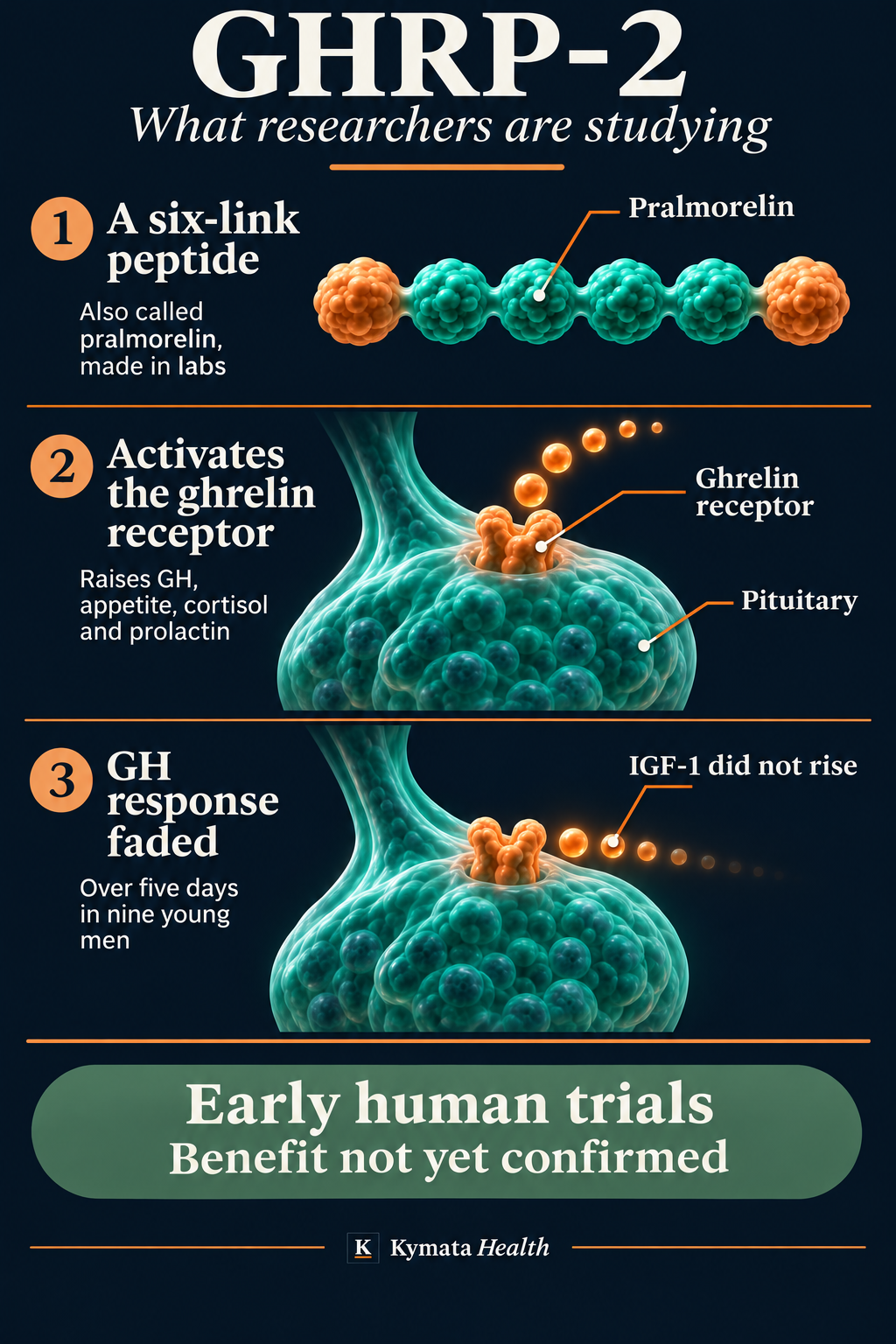
The guide shows GHRP-2 (pralmorelin) as a six-amino-acid peptide that activates the ghrelin receptor, raising growth hormone along with appetite, cortisol and prolactin. In nine young men given it daily for five days, the growth hormone response shrank and IGF-1 did not rise (PMID 9820615). In Japan it is approved only as a one-time test for growth hormone deficiency. The drawing is a schematic, not a measured molecular structure, a product photograph or a treatment result. Illustration review: 22 November 2026, against this page’s own mechanism, evidence and regulatory records.
The retained technical record includes a modified or incompletely specified chain. No simplified residue model is inferred; read the sequence and compound record for its exact scope.
Illustration notes and source record
Read the source record on this page. Laboratory, topical and injected studies are separate evidence; this illustration does not establish an indication or a treatment outcome.

How it works
GHRP-2 (pralmorelin) is a synthetic hexapeptide that activates the ghrelin receptor (GHS-R1a). Japan approved it in 2004 as GHRP Kaken 100 for one-dose testing of GH deficiency; after an IV dose its half-life is about 0.4 to 0.7 hours (label).
In people it also raised ACTH, cortisol and prolactin, and increased food intake by about a third in two infusion studies. With daily injections the GH response shrank within 5 days and IGF-1 did not rise (Nijland 1998, PMID 9820615).
Background & History
GHRP-2 (pralmorelin) is a GHS-R1a hexapeptide, approved in Japan only as a one-dose GH-deficiency test. Diagnostic pralmorelin is not a 5 mg research powder. Cortisol, prolactin and appetite rise with it.
05 / Evidence and limits
Evidence and limits
Limits of current evidence
2 limits- Pediatric diagnostic protocols do not apply to a wellness vial.
- No human study ranks the GHRPs head to head, and a potency ranking is not a reason to skip glucose watching.
What it is studied for
- Pralmorelin identity vs GHRP-6 vs ipamorelin
- Diagnostic GH-stimulation history vs daily biohack use
- Not a hypertrophy NDA
Verdict
GHRP-2 (pralmorelin) is approved in Japan only as a one-dose test for GH deficiency (GHRP Kaken 100). In people it raised GH, appetite, ACTH, cortisol and prolactin; with daily injections the GH response shrank within 5 days and IGF-1 did not rise (PMID 9820615). A 5 mg research powder is not that product.
Where it is prescribed
Sermorelin is prescribed through US telehealth clinics.
What the human studies measured
Every human study of GHRP-2 we found, what it measured and what it showed, including the negative and the unpublished.
Outcomes
6 findings| Outcome | Who and how long | Result | Source |
|---|---|---|---|
| Diagnosing GH deficiency (Japan) | Adults and children, one IV dose of 100 µg (adults) or 2 µg/kg, fasting | Approved in Japan in 2004 as GHRP Kaken 100 for this test only. Peak GH 84.6 µg/L in healthy adults vs 1.36 in GH deficiency; a 15 µg/L cut-off matched the insulin tolerance test. | GHRP Kaken 100 label (PMDA, 2025)Chihara 2007, Eur J Endocrinol |
| Appetite | 7 lean men; then 10 lean and 9 obese adults, IV infusion | Food intake rose 36% vs saline in lean men, and 10% and 34% at two doses in the second study, with or without obesity. | Laferrère 2005, JCEMLaferrère 2006, Obesity |
| Daily injections for 5 days | 9 healthy young men, 100 µg under the skin | The GH response shrank from 83 to 51 µg/L by day 5, and IGF-1 did not rise. | Nijland 1998, Eur J Endocrinol |
| 30-day infusion, older adults | 17 healthy older men and women, continuous infusion under the skin | GH more than 3-fold on day 1 and more than 1.8-fold at days 14 and 30; IGF-1 rose to a plateau; safety tests stayed normal. | Bowers 2004, JCEM |
| GH-deficient children, 8 months | 6 prepubertal children, rising doses under the skin | Growth was faster on treatment, but IGF-1 and IGFBP-3 did not rise. | Mericq 1998, JCEM |
| Prolonged critical illness, 5 days | 33 men in intensive care, IV infusion | IGF-1 normalised, but GHRP-2 alone did not reduce protein breakdown; lactate and white cells rose on day 5. | Van den Berghe 2002, Clin Endocrinol |
06 / Product forms and access
Product forms and access
Regulatory & legal status
- FDA status (US)
- Research Only
- WADA status (2026)
- Prohibited (S2)Competitive athletes subject to anti-doping controls should not use GHRP-2.
- US compounding
- Not eligible / not available
07 / Tools and practical checks
Tools and practical checks
Dose it
5 mg + 2.5 mL BAC water → 2 mg/mL · 1 unit (U-100) = 20 mcg.
Reconstitution math
U-100 syringe| Vial | Water | Concentration |
|---|---|---|
| 5 mg lyophilized | 2.5 mL BAC | 2 mg/mL |
08 / Published study use
Published study use
What published studies gave, in whom, and the source. Not a dose for you.
What studies used
Diagnostic test use (Japan)- Used in Japan as a one-time growth hormone stimulation test; 71 adults with pituitary tumors had it alongside the insulin tolerance test. The indexed abstract does not give the dose. Kinoshita 2013, PMID 23079545 (opens in new tab)
- Early studies gave it to healthy younger men and women by IV, under the skin and by mouth. The indexed abstract does not give the doses. Bowers 1993, PMID 8374685 (opens in new tab)
A record of what researchers gave, in whom; not a dose for you.
Administration
- Route / form
- Route used in studies: IV, under the skin and by mouth (early studies).
Who it is for
2 uses| Category | Fit | What exists |
|---|---|---|
| Diagnosing GH deficiency | High | Its labelled use in Japan: one IV dose, then GH measured over an hour. |
| Raising IGF-1 with daily use | Low | Five days of daily injections did not raise IGF-1 in young men (Nijland 1998), nor did 8 months in GH-deficient children (Mericq 1998). |
Timing: bedtime, morning or before exercise
What each study did. No study ranks one time over another; timing is the prescriber's decision.
The evidence No human study has compared a GH secretagogue taken before exercise with one taken before bed, on GH, IGF-1, body composition or anything else. Trials of tesamorelin used the morning in one study and bedtime in another, and the labels name no time.
When the studies dosed
2 studies| Study | When | Finding |
|---|---|---|
| GHRP Kaken 100 label (PMDA, 2025) | Fasting, after rest, for the diagnostic test | Eating changes GH, so the label requires fasting. |
| Mericq 1998, JCEM | Evening injections | Little effect on GH later in the night. |
09 / Safety and interactions
Safety and interactions
What the record says
Research peptide. With the Japanese diagnostic dose, 37.9% had side effects, mostly a feeling of heat and stomach rumbling, and ACTH, cortisol and prolactin rose. It raised food intake by about a third in two infusion studies (PMID 15699539, 16861611). FDA cites reports of higher insulin needs, deaths of critically ill study subjects, infection and pancreatitis, without establishing cause.
Interactions & Contraindications
Cortisol/prolactin vs ipamorelin. Not for a “clean” long-term secretagogue story.
Side effects in the record
What labels, trials and FDA have reported, with how often where a number exists.
By source
| Effect or signal | What the record says | Source |
|---|---|---|
| Side effects with the test dose | 37.9% of 227 people in the Japanese trials: a feeling of heat (11%, 16% on the label), stomach rumbling (11.5%), sweating (5.3%), a rise in white cells (4.9%). | GHRP Kaken 100 interview form (PMDA)GHRP Kaken 100 label (PMDA, 2025) |
| ACTH, cortisol and prolactin | All three rose significantly after IV doses in healthy adults; only ACTH rose with dose. | GHRP Kaken 100 interview form (PMDA) |
| Pregnancy | Ruled out on the Japanese label. | GHRP Kaken 100 label (PMDA, 2025) |
| FDA’s safety signal | FDA cites reports of a higher insulin need to control glucose, deaths of critically ill study subjects, infection and pancreatitis, without naming the study or establishing cause. | FDA bulk-substance safety-risk list |
What the label and trials checked
From the Japanese label (a one-dose diagnostic test) and the trials. A clinician decides what to measure.
Checks and why
| Check | When | Why |
|---|---|---|
| GH | Before and 15, 30, 45 and 60 minutes after the test dose | The label’s diagnostic test; severe GH deficiency if the peak is 15 ng/mL or less. (GHRP Kaken 100 label (PMDA, 2025)) |
| IGF-1, IGFBP-3, overnight GH, safety tests | During the 8-month pediatric study | IGF-1 and IGFBP-3 did not rise. (Mericq 1998, JCEM) |
10 / Comparisons and goal guides
Comparisons and goal guides
Combinations: what has been tested
1 pairing- + CJC-1295 no DAC →No human study of GHRP-2 with CJC-1295. With GHRH at full IV doses, GHRP-2 gave no more than the sum (PMID 7586605).
What has been tested in combination
What human studies measured when a GHRH analog was given with a ghrelin-receptor agonist, and which pairs have never been tested.
Two receptors, not one
Tesamorelin, sermorelin and CJC-1295 are GHRH analogs: they act on the GHRH receptor of the pituitary, which signals through cAMP (Mayo 1992, Mol Endocrinol). Ipamorelin, GHRP-2, GHRP-6, hexarelin and MK-677 act on a different receptor, the ghrelin receptor (GHS-R1a), found in both the hypothalamus and the pituitary (Howard 1996, Science; Raun 1998, Eur J Endocrinol).
In people, the ghrelin-receptor route works largely through the hypothalamus: with the pituitary stalk cut, GHRP-6 released almost no GH and the combination lost its extra effect (Popovic 1995, JCEM). It also escapes somatostatin, the brake on GH release: under a somatostatin analog, the GH response to GHRH fell by 38% while the response to GHRP-2 was unaffected (Dimaraki 2003, Am J Physiol).
Two GHRH analogs share one receptor. The GH response to GHRH tops out near 1 µg/kg; doses ten times higher made the response last longer but not peak higher (Gelato 1984, JCEM; Vance 1984, JCEM). No study has given two GHRH analogs together; from those dose-response curves a second one would be expected to add little, an inference rather than a trial result.
GHRH, a GHRP, and both, in healthy adults
What has been tested in people
| Combination | Human evidence |
|---|---|
| GHRP-2 with GHRH | At full IV doses, the combination was not greater than the sum in 8 healthy men. (Tiulpakov 1995, Clin Endocrinol) |
| GHRP-2 with sermorelin and GHRP-6 | One chart review of 14 men on testosterone; IGF-1 rose, with no control group. (Sigalos 2017, Am J Mens Health) |
| A GHRH analog with a ghrelin-receptor agonist (other agents) | More GH than either alone in healthy adults, often more than the sum at test doses. (Bowers 1990, JCEM; Popovic 1995, JCEM; Pombo 1995, JCEM; Ramos-Dias 1996, JCEM) |
The growth hormone family
GH itself, the drugs that make the pituitary release more of it, and IGF-1 downstream. Half-lives are human values.
Three ways to raise GH
| Class | Acts on |
|---|---|
| GHRH analog | GHRH receptor on the pituitary (cAMP) |
| Ghrelin-receptor agonist (this page) | Ghrelin receptor (GHS-R1a) in hypothalamus and pituitary |
| Growth hormone (daily) | GH receptor directly; bypasses the pituitary |
| Growth hormone (weekly) | GH receptor directly, released over a week |
| IGF-1 | IGF-1 receptor, downstream of GH |
Compared
16 agents| Agent | Class | Labelled product | Half-life (human) | Taken |
|---|---|---|---|---|
| Somatropin (rhGH) | Growth hormone (daily) | Genotropin, Humatrope, Norditropin, Omnitrope, Zomacton, Serostim | 2 to 3.8 h (SC, across labels) (Humatrope label) | Daily injection (label) |
| Somapacitan | Growth hormone (weekly) | Sogroya | about 2 to 3 days (adults) (Sogroya label) | Weekly injection (label) |
| Somatrogon | Growth hormone (weekly) | Ngenla | 37.7 h (effective, children) (Ngenla label) | Weekly injection (label) |
| Lonapegsomatropin | Growth hormone (weekly) | Skytrofa | about 31 h (prodrug, children) (Skytrofa label) | Weekly injection (label) |
| Tesamorelin | GHRH analog | Egrifta SV, Egrifta WR | 8 to 38 min (by formulation and study) (Egrifta WR label) | Daily injection (label) |
| Sermorelin | GHRH analog | None | 6 to 7 min IV (EU product information) (Geref 50 SPC (HPRA)) | Daily injection in studies |
| CJC-1295 with DAC | GHRH analog | None | 5.8 to 8.1 days (Teichman 2006, JCEM) | Weekly or every other week in studies |
| CJC-1295 without DAC (mod GRF 1-29) | GHRH analog | None | No human value published | No human study published |
| Ipamorelin | Ghrelin-receptor agonist | None | 2 h (IV infusion) (Gobburu 1999, Pharm Res) | Single IV infusions in the human study |
| GHRP-2 | Ghrelin-receptor agonist | GHRP Kaken 100 (Japan) | 0.42 to 0.69 h (IV, Japanese label) (GHRP Kaken 100 label (PMDA, 2025)) | One IV dose, as a diagnostic test (Japanese label) |
| GHRP-6 | Ghrelin-receptor agonist | None | 2.5 h (IV) (Cabrales 2013, Eur J Pharm Sci) | IV test doses in studies |
| Hexarelin | Ghrelin-receptor agonist | None | No human value published | Twice daily under the skin for up to 16 weeks in studies; the GH response fades |
| MK-677 (ibutamoren) | Ghrelin-receptor agonist | None | No human value published | Daily by mouth in studies; GH raised over 24 h |
| Macimorelin | Ghrelin-receptor agonist | Macrilen | 4.1 h (Macrilen label) | One oral dose, as a diagnostic test (label) |
| Mecasermin (rhIGF-1) | IGF-1 | Increlex | 5.8 h (children) (Increlex label) | Twice daily with a meal (label) |
| IGF-1 LR3 | IGF-1 | None | No human value published | No human dosing study identified |
11 / Common questions
Common questions
Common questions
4 answersIs GHRP-2 stronger than GHRP-6?
No human study has compared them head to head at matched doses. In pigs GHRP-2 was more potent but released less GH at its peak than GHRP-6 (PMID 9849822).
What dose did studies use for GHRP-2?
Its Japanese label gives one IV dose for the GH-deficiency test: 100 µg in adults and 2 µg/kg (up to 100 µg) in children aged 4 to 17, fasting. Healthy adults peaked at 84.6 µg/L of GH, against 1.36 in GH deficiency (PMID 17609397).
Does GHRP-2 increase appetite?
Yes, in two infusion studies: lean men ate 36% more than on saline (PMID 15699539), and lean and obese adults ate 10% and 34% more at two doses (PMID 16861611).
Is GHRP-2 FDA-approved?
No. Not FDA-approved, research chemical.
12 / Sources and references
Sources and references
No separate record is provided here. Read the linked evidence and limitations for this compound.
14 / Prescription options
Prescription options
Prescription options: compare licensed telehealth providers
Some peptide therapies are available only by prescription after a consult with a licensed clinician.
Compare telehealth →15 / Peptide library
Peptide library
Keep reading: Peptide research library
Peptide research library: every pagePeptide libraryBrowse all topics
- GHRP-6Previous in this topic · First-generation GHS-R1a hexapeptide.
- HexarelinNext in this topic · GHS-R1a hexapeptide (examorelin) that raises GH, with documented desensitization.
- MK-677Oral non-peptide GHS-R1a agonist (ibutamoren).
- PT-141PT-141 is bremelanotide, the active drug in Vyleesi, an FDA-approved autoinjector for acquired, generalized HSDD in premenopausal women; the label says it is not indicated for…
- Melanotan IICyclic α-MSH analog.
Regulatory and sport classification
- Not FDA-approved, research chemical
- WADA (S2): prohibited in sport at all times