
The peptide field guide
Macimorelin
Macimorelin is the oral peptidomimetic in the retained Macrilen adult growth-hormone-deficiency diagnostic label.
A diagnostic GH response is not evidence of treatment benefit; this is not a daily GH-replacement or enhancement product.
Explore this compoundConceptual oral-test metaphor, not actual Macrilen packaging, a dosage vessel, study apparatus or a diagnostic result.
02 / At a glance
At a glance
Key facts
- Also known as
- AEZS-130, Macrilen, oral GH test
- Type
- Growth Hormone
- Evidence level
- FDA-approved for a growth hormone test: now listed as discontinued.
- US regulatory status
- FDA-approved as Macrilen® for diagnosis of adult growth hormone deficiency; Drugs@FDA lists the product as discontinued (label last revised July 2026)
- Updated
Identity
Macimorelin is the oral peptidomimetic in the retained Macrilen adult growth-hormone-deficiency diagnostic label.
Research context
The local label/status record, read 19 October 2026, describes an oral diagnostic challenge with laboratory GH measurements and lists Macrilen as discontinued; current availability was not rechecked.
Evidence limits
A diagnostic GH response is not evidence of treatment benefit; this is not a daily GH-replacement or enhancement product.
Read the technical profile and study-use reference
Quick answer
Evidence: ModerateFDA-approved oral AGHD diagnostic (Macrilen). Single fasted dose with timed GH draws. Not MK-677, not a daily secretagogue, and this database has no SubQ vial.
- FDA label dose
- FDA label (Macrilen): one oral test dose, set by the label and the prescriber
Research summary, not medical advice.
At a glance
Kymata peptide profile · Nov 21, 2026- Common vials
- N/A (oral)
- CAS
- 381231-18-1
- FDA label dose
- FDA label (Macrilen): one oral test dose, set by the label and the prescriber
- Half-life
- Mean terminal half-life 4.1 hours (Macrilen label)
- Molecular weight
- 474.6 g/mol (534.6 g/mol as the acetate)
03 / Identity and origin
Identity and origin
Also called AEZS-130, Macrilen, oral GH test. Adult GHD diagnostic (Macrilen), not replacement therapy.
Read the sequence and compound record
Compound card
- Sequence
- Oral ghrelin-mimetic peptidomimetic (AEZS-130)
- Class
- Adult GHD diagnostic (Macrilen), not replacement therapy
- Formula
- C26H30N6O3 (macimorelin; Macrilen contains the acetate, C28H34N6O5)
- Molecular weight
- 474.6 g/mol (534.6 g/mol as the acetate)
- CAS
- 381231-18-1
- Described by
- Aeterna Zentaris (Macrilen), 2017 (FDA approval)
- Bioavailability
- Absolute oral bioavailability not stated in the label; a liquid meal lowered Cmax by 55% and AUC by 49%
04 / How it may work
How it may work
Adult GHD diagnostic (Macrilen), not replacement therapy
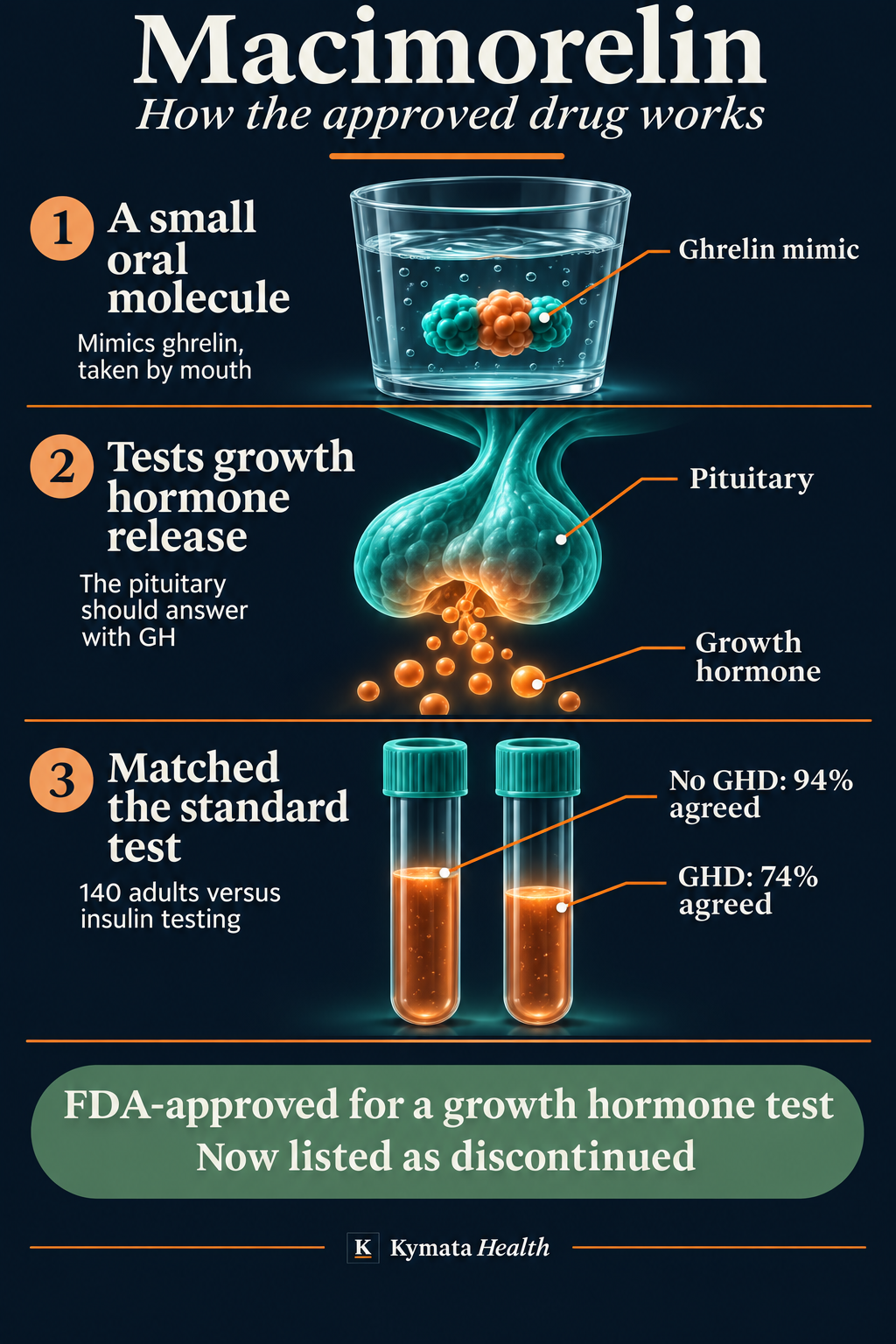
The guide shows macimorelin as a small molecule taken by mouth that mimics ghrelin and prompts the pituitary to release growth hormone, which makes it a test for adult growth hormone deficiency. In the label’s crossover study of 140 adults it agreed with the insulin tolerance test in 94% of people without the deficiency and 74% of people with it. It was FDA-approved as Macrilen; Drugs@FDA now lists the product as discontinued. The drawing is a schematic, not a measured molecular structure, a product photograph or a treatment result. Illustration review: 22 November 2026, against this page’s own mechanism, evidence and regulatory records.
The retained identity is a peptidomimetic, not a verified ordinary amino-acid chain; no residue explorer is inferred.
Illustration notes and source record
Read the source record on this page. Laboratory, topical and injected studies are separate evidence; this illustration does not establish an indication or a treatment outcome.

How it works
SourcedMacimorelin (AEZS-130) is an orally active peptidomimetic agonist of the growth hormone secretagogue receptor (GHS-R1a), the receptor ghrelin acts on. Ghrelin itself is a 28-amino-acid peptide; macimorelin is a small synthetic molecule taken by mouth.
Macrilen is labeled only for the diagnosis of adult growth hormone deficiency. In the label trial it was compared with the insulin tolerance test (ITT), with GH measured at set times after the dose. It is not labeled as a treatment.
Source: FDA Label (Macrilen)
Background & History
Macimorelin (Macrilen) is an oral diagnostic for adult growth hormone deficiency, not GH replacement or a recovery treatment. The July 2026 FDA label describes QT and test-interpretation warnings, and Drugs@FDA lists the product as discontinued.
05 / Evidence and limits
Evidence and limits
Use-case scores
0–100–10 against the evidence we have, not a gym ranking. Hidden domains do not apply here.
- Sexual / hormonal7/10Approved diagnostic for adult GHD. Ceiling 9 for approval; haircut because this page is a test, not replacement therapy.
Limits of current evidence
4 limits- Label section 1: safety and diagnostic performance are not established for BMI above 40 kg/m², and diagnostic accuracy was not shown in children.
- Label sections 5 and 7: QT prolongation, medicines that interfere with the test (strong CYP3A4 inducers can give false positives) and false negatives in recent-onset hypothalamic disease.
- The labeled result uses the highest GH level across four blood samples; a single GH value or a cutoff read online is not a self-diagnosis.
- Off-label “oral GH optimization” is not Macrilen, and Drugs@FDA lists Macrilen as discontinued, so a published label does not mean current supply.
What it is studied for
- Diagnostic identity and limits (not MK-677, not a daily secretagogue)
- How the test compared with the insulin tolerance test
- Why a single GH value is not a self-diagnosis
Verdict
Macimorelin (Macrilen) is an oral test for adult growth hormone deficiency, not GH replacement or a recovery treatment. In the label’s crossover trial of 140 adults it agreed with the insulin tolerance test in 94% of people without GHD and 74% of people with it. The July 2026 FDA label warns about QT prolongation and results that can mislead, so the ordering clinician interprets it. It is not MK-677 and has no research-vial form.
06 / Product forms and access
Product forms and access
Regulatory & legal status
- FDA status (US)
- ApprovedFDA-approved as Macrilen® for diagnosis of adult growth hormone deficiency; Drugs@FDA lists the product as discontinued (label last revised July 2026)
- WADA status (2026)
- Prohibited (S2)Competitive athletes subject to anti-doping controls should not use Macimorelin.
- Classification
- Prescription Drug
- US compounding
- Not eligible / not available
07 / Tools and practical checks
Tools and practical checks
No separate record is provided here. Read the linked evidence and limitations for this compound.
08 / Published study use
Published study use
What the label states, for the patients it is approved for, and the source. Not a dose for you.
What the FDA label says
FDA label (diagnostic)- Macrilen is labeled for the diagnosis of adult growth hormone deficiency, not GH replacement. The label describes QT prolongation and limits on test interpretation; preparation and medicine decisions belong with the clinical team. Macrilen label, DailyMed (opens in new tab)
FDA status: Macimorelin is FDA-approved as Macrilen for adult GHD diagnosis; Drugs@FDA lists the product as discontinued, so a published label does not establish current supply or coverage. The label’s dosing, for the patients it is approved for; the prescriber sets the dose.
Administration
- Route / form
- Oral solution (reconstituted powder)
Timeline
2 stages- Label trial
In the randomized, open-label crossover study in the label (section 14), 140 adults had both Macrilen and the insulin tolerance test; Macrilen agreed with the ITT in 94% of ITT-negative and 74% of ITT-positive people, and 1 of 154 Macrilen tests failed for a technical reason versus 27 of 157 ITTs.
- Within the test
Macrilen label: peak GH levels occur 30 to 90 minutes after the dose, and the label trial measured GH at 30, 45, 60 and 90 minutes. The ordering clinician interprets the result.
Who it is for
1 use| Category | Fit | What exists |
|---|---|---|
| Adult GHD diagnosis | High | Labeled diagnostic use (Macrilen), compared against the insulin tolerance test in the label trial, subject to the label’s safety and interpretation limits. Not GH replacement therapy; accuracy was not shown in children. |
09 / Safety and interactions
Safety and interactions
What the record says
FDA-approved (Macrilen) as a single-dose diagnostic; Drugs@FDA lists the product as discontinued. Common adverse reactions in the label include dysgeusia, dizziness, headache, fatigue, nausea, hunger and diarrhea. The label warns of QT prolongation (about 11 msec) and advises avoiding drugs that prolong the QT interval; strong CYP3A4 inducers can cause false-positive results, and recent-onset hypothalamic disease can cause false negatives (sections 5 and 7). Section 4 lists no contraindications; that does not mean the test has no risks. It is not labeled as a treatment.
Interactions & Contraindications
The July 2026 FDA label describes QT-prolonging medicines, strong CYP3A4 inducers and other medicines that affect GH release as safety or interpretation concerns, and a liquid meal lowered exposure. This page gives no medicine-adjustment instructions.
10 / Comparisons and goal guides
Comparisons and goal guides
The growth hormone family
GH itself, the drugs that make the pituitary release more of it, and IGF-1 downstream. Half-lives are human values.
Three ways to raise GH
| Class | Acts on |
|---|---|
| GHRH analog | GHRH receptor on the pituitary (cAMP) |
| Ghrelin-receptor agonist (this page) | Ghrelin receptor (GHS-R1a) in hypothalamus and pituitary |
| Growth hormone (daily) | GH receptor directly; bypasses the pituitary |
| Growth hormone (weekly) | GH receptor directly, released over a week |
| IGF-1 | IGF-1 receptor, downstream of GH |
Compared
16 agents| Agent | Class | Labelled product | Half-life (human) | Taken |
|---|---|---|---|---|
| Somatropin (rhGH) | Growth hormone (daily) | Genotropin, Humatrope, Norditropin, Omnitrope, Zomacton, Serostim | 2 to 3.8 h (SC, across labels) (Humatrope label) | Daily injection (label) |
| Somapacitan | Growth hormone (weekly) | Sogroya | about 2 to 3 days (adults) (Sogroya label) | Weekly injection (label) |
| Somatrogon | Growth hormone (weekly) | Ngenla | 37.7 h (effective, children) (Ngenla label) | Weekly injection (label) |
| Lonapegsomatropin | Growth hormone (weekly) | Skytrofa | about 31 h (prodrug, children) (Skytrofa label) | Weekly injection (label) |
| Tesamorelin | GHRH analog | Egrifta SV, Egrifta WR | 8 to 38 min (by formulation and study) (Egrifta WR label) | Daily injection (label) |
| Sermorelin | GHRH analog | None | 6 to 7 min IV (EU product information) (Geref 50 SPC (HPRA)) | Daily injection in studies |
| CJC-1295 with DAC | GHRH analog | None | 5.8 to 8.1 days (Teichman 2006, JCEM) | Weekly or every other week in studies |
| CJC-1295 without DAC (mod GRF 1-29) | GHRH analog | None | No human value published | No human study published |
| Ipamorelin | Ghrelin-receptor agonist | None | 2 h (IV infusion) (Gobburu 1999, Pharm Res) | Single IV infusions in the human study |
| GHRP-2 | Ghrelin-receptor agonist | GHRP Kaken 100 (Japan) | 0.42 to 0.69 h (IV, Japanese label) (GHRP Kaken 100 label (PMDA, 2025)) | One IV dose, as a diagnostic test (Japanese label) |
| GHRP-6 | Ghrelin-receptor agonist | None | 2.5 h (IV) (Cabrales 2013, Eur J Pharm Sci) | IV test doses in studies |
| Hexarelin | Ghrelin-receptor agonist | None | No human value published | Twice daily under the skin for up to 16 weeks in studies; the GH response fades |
| MK-677 (ibutamoren) | Ghrelin-receptor agonist | None | No human value published | Daily by mouth in studies; GH raised over 24 h |
| Macimorelin | Ghrelin-receptor agonist | Macrilen | 4.1 h (Macrilen label) | One oral dose, as a diagnostic test (label) |
| Mecasermin (rhIGF-1) | IGF-1 | Increlex | 5.8 h (children) (Increlex label) | Twice daily with a meal (label) |
| IGF-1 LR3 | IGF-1 | None | No human value published | No human dosing study identified |
11 / Common questions
Common questions
Common questions
6 answersWhat is macimorelin used for?
Macimorelin (Macrilen) is labeled for diagnosing adult growth hormone deficiency (AGHD). A single oral dose stimulates GH release, and the ordering clinician interprets the measured GH response against the label criteria. It is not labeled for children or as a treatment.
Can macimorelin be used to boost GH therapeutically?
No. Its label covers one use: a single oral dose given to help diagnose adult growth hormone deficiency.
Does a GH result below 2.8 ng/mL diagnose adult GHD by itself?
No. Label sections 2 and 14 use the highest GH level across samples at 30, 45, 60 and 90 minutes, with a cut point of 2.8 ng/mL, inside a clinical assessment; one value is not the same test. Medicines that interfere and recent-onset hypothalamic disease can mislead the result, so interpretation belongs with the ordering clinician.
How accurate is the Macrilen test?
In the label’s randomized, open-label crossover study, 140 adults had both tests: Macrilen agreed with the insulin tolerance test in 94% of people the ITT classed as not deficient and 74% of those it classed as deficient (lower 95% confidence bounds 85% and 63%). It is labeled for adults only, and not for BMI above 40 kg/m².
Is Macrilen still available?
Drugs@FDA lists Macrilen (NDA 205598) as discontinued, although its label was revised in July 2026. Ask the ordering clinician or laboratory about current availability; this page has no verified supply, price or coverage information.
Is Macimorelin FDA-approved?
Yes. FDA-approved as Macrilen® for diagnosis of adult growth hormone deficiency; Drugs@FDA lists the product as discontinued (label last revised July 2026).
12 / Sources and references
Sources and references
2 papers cited on this page.
Sources
2 papers- 1“Macrilen (macimorelin) for oral solution: prescribing information (revised 07/2026).”US Food and Drug Administration Drugs@FDA (2026).
- 2“Drugs@FDA: NDA 205598 (Macrilen), marketing status.”US Food and Drug Administration Drugs@FDA (2026).
14 / Diagnostic testing
Macrilen diagnostic test
What the test measures
A healthcare professional gives Macrilen and measures the growth hormone response to help diagnose adult growth hormone deficiency.
Read the evidence for this test15 / Peptide library
Peptide library
Keep reading: Peptide research library
Peptide research library: every pagePeptide libraryBrowse all topics
- CagriSemaPrevious in this topic · Novo's combination of cagrilintide 2.4 mg and semaglutide 2.4 mg, studied in the REDEFINE trials.
- VilonNext in this topic · Vilon (Lys-Glu) is a short synthetic peptide (cytogen) from the Khavinson group; its published studies, mostly Russian cell and animal work, examined the thymus and immune cells.
- CortagenCortagen (Ala-Glu-Asp-Pro) is a short synthetic peptide (cytogen) from the Khavinson group; its published studies, mostly Russian cell and animal work, examined brain tissue and…
- CrystagenCrystagen (Glu-Asp-Pro) is a short synthetic peptide (cytogen) from the Khavinson group, listed as an immune-cell bioregulator.
- LivagenLivagen (Lys-Glu-Asp-Ala) is a short synthetic peptide (cytogen) from the Khavinson group; its published studies, mostly Russian cell and animal work, examined liver tissue and…
Regulatory and sport classification
- WADA (S2): prohibited in sport at all times
- FDA-approved