
The peptide field guide
Sermorelin
Sermorelin is the amidated 29-residue fragment GHRH(1–29)-NH₂.
Historical Geref evidence does not validate current compounded products or establish adult wellness benefits.
Explore this compoundConceptual editorial illustration; not a measured molecular structure, product photograph or treatment result.
02 / At a glance
At a glance
Key facts
- Also known as
- GRF 1-29, Geref
- Sequence
- GHRH(1-29)-NH2
- Evidence level
- FDA-approved as Geref: now listed as discontinued.
- US regulatory status
- Not FDA-approved, research chemical
- Updated
Identity
Sermorelin is the amidated 29-residue fragment GHRH(1–29)-NH₂.
Research context
Historical Geref treatment and diagnostic presentations, alongside a separate small adult study.
Evidence limits
Historical Geref evidence does not validate current compounded products or establish adult wellness benefits.
Read the technical profile and study-use reference
Quick answer
Evidence: ModerateSermorelin is GHRH(1-29), a peptide that prompts the pituitary to release its own growth hormone; it is not growth hormone itself. FDA approved it as Geref for children with GH deficiency until the maker discontinued it, and no FDA-approved sermorelin is sold now. In those children growth rose on it, but less than on daily GH; small studies in older men measured GH and IGF-1, not health outcomes.
- In published studies
- Trial amounts are recorded under What studies used (PMID 8772599)
Research summary, not medical advice.
At a glance
Kymata peptide profile · Oct 30, 2026- Common vials
- 2 mg / 5 mg / 9 mg
- Molecular weight
- 3357.93 g/mol
- CAS
- 86168-78-7
- In published studies
- Trial amounts are recorded under What studies used (PMID 8772599)
- Half-life
- 11-12 minutes (US label, IV or SC); 6-7 minutes IV (EU product information)
03 / Identity and origin
Identity and origin
Also called GRF 1-29, Geref. GHRH fragment (historical Geref; withdrawn US brand, not current rhGH).
Read the sequence and compound record
Compound card
- Sequence
- GHRH(1-29)-NH2
- Class
- GHRH fragment (historical Geref; withdrawn US brand, not current rhGH)
- Formula
- C149H246N44O42S1
- Molecular weight
- 3357.93 g/mol
- CAS
- 86168-78-7
- Described by
- Wyeth-Ayerst Laboratories, 1990
- Bioavailability
- Subcutaneous injection
04 / How it may work
How it may work
GHRH fragment (historical Geref; withdrawn US brand, not current rhGH)
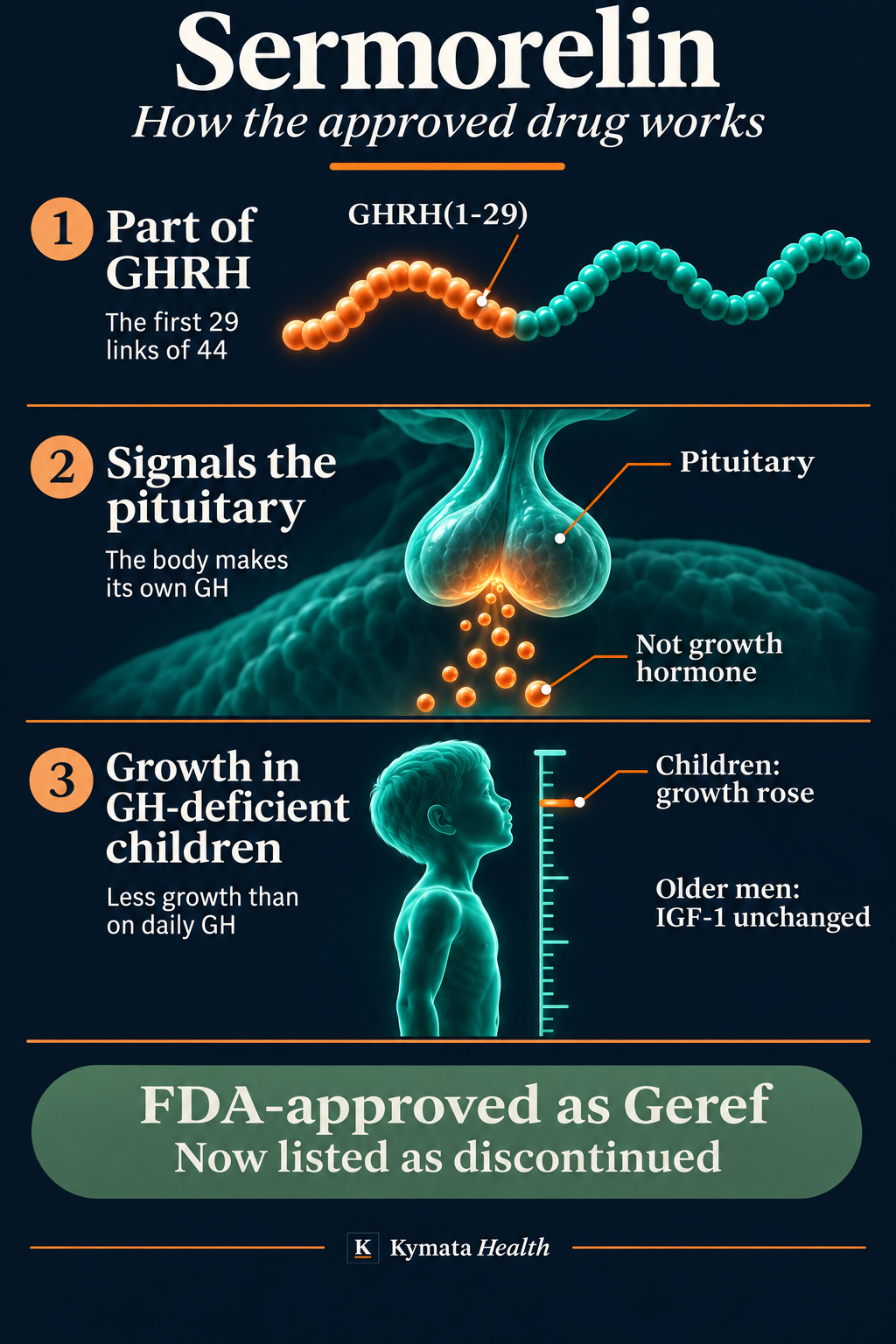
The guide shows sermorelin as GHRH(1-29), the first 29 of growth-hormone-releasing hormone’s 44 amino acids, which prompts the pituitary to release the body’s own growth hormone. As Geref it was FDA-approved for children with growth hormone deficiency, who grew on it but less than on daily growth hormone; in a six-week study in older men, growth hormone rose while IGF-1 did not change. Geref is discontinued and no FDA-approved sermorelin is sold now. The drawing is a schematic, not a measured molecular structure, a product photograph or a treatment result. Illustration review: 22 November 2026, against this page’s own mechanism, evidence and regulatory records.
The record identifies GHRH(1–29)-NH₂ without listing every residue. A residue model is not supplied from an inferred chain; read the existing form and source record.
Illustration notes and source record
Read the source record on this page. Laboratory, topical and injected studies are separate evidence; this illustration does not establish an indication or a treatment outcome.

How it works
Sermorelin (GRF 1-29) is a bioidentical analog of natural Growth Hormone Releasing Hormone (GHRH), consisting of the first 29 amino acids of the 44-amino-acid GHRH peptide. These 29 amino acids contain the full biological activity of the complete molecule.
Sermorelin stimulates pituitary somatotroph cells to produce and release growth hormone. Unlike exogenous HGH, it still has to go through the pituitary, so output is capped by somatotroph reserve and somatostatin. That is not a guarantee of “no supraphysiological GH.” Geref was FDA-approved for pediatric use and is not a current US brand.
Background & History
Sermorelin is GHRH(1-29). Geref was a US pediatric GHD product and is not a current anti-aging NDA. Walker 2006 (PMID 18046908) is an editorial. Prakash/Goa 1999 (PMID 18031173) is the BioDrugs review.
05 / Evidence and limits
Evidence and limits
Limits of current evidence
3 limits- Walker’s PMID is 18046908, not 18046879. It is an editorial.
- The pediatric Geref trial studied children with GH deficiency (PMID 8772599); adult wellness use has no trial.
- No published study has tested sermorelin with ipamorelin.
What it is studied for
- GHRH(1-29) identity vs tesamorelin vs Mod GRF vs somatropin
- Historical Geref, not a current anti-aging NDA
- What has not been tested with a GHRP
Verdict
Sermorelin is GHRH(1-29). Geref was a US product for pediatric GHD diagnosis/treatment and is not a current anti-aging NDA. Walker 2006 is an editorial (PMID 18046908), not a Phase 3. Prakash/Goa 1999 (PMID 18031173) is the BioDrugs review. It is not “safer HGH forever.”
Where it is prescribed
What the human studies measured
Every human study of Sermorelin we found, what it measured and what it showed, including the negative and the unpublished.
Outcomes
8 findings| Outcome | Who and how long | Result | Source |
|---|---|---|---|
| Growth in GH-deficient children | 110 prepubertal children, 30 µg/kg under the skin at bedtime, up to 1 year (open label) | Growth rate rose from 4.1 to 8.0 cm a year at 6 months and 7.2 at 12 months; 74% responded well at 6 months. Fasting glucose did not change and IGF-1 did not overshoot. | Thorner 1996, JCEM |
| Against daily GH (randomised) | 60 children with GH deficiency, 6 months, two GHRH doses by continuous infusion | Growth 9.2 and 9.3 cm a year on GHRH vs 14.6 on GH. Almost every child on GHRH made antibodies to it; they had nearly gone 9 months after stopping. | Chen 1993, Acta Paediatr Suppl |
| Against daily GH, three doses a day | 43 children with GH deficiency, 6 months | Growth was slowest on the low dose and similar on the high dose and GH; only GH improved height for bone age. | Neyzi 1993, Acta Paediatr Suppl |
| Short stature without GH deficiency | 18 children, 20 µg/kg twice daily, 12 months | Growth rate 4.8 → 7.2 cm a year. Fasting glucose, insulin and IGF-1 rose; growth slowed again in the 3 months after stopping. | Kirk 1994, Clin Endocrinol |
| Older men, twice daily | 10 men about 68, 0.5 or 1 mg twice daily for 14 days | 24-hour GH and IGF-1 rose only at 1 mg. Fasting glucose, blood pressure and blood counts did not change. | Corpas 1992, JCEM |
| Older men, one nightly dose | 11 men aged 64 to 76, 2 mg nightly for 6 weeks | Night-time GH rose. IGF-1, weight, DEXA muscle and fat, glucose and lipids did not change; the authors judged one nightly dose less effective than several a day. | Vittone 1997, Metabolism |
| Older adults, a modified analog | 19 men and women aged 55 to 71, [Nle27]-GHRH(1-29) 10 µg/kg nightly, 16 weeks | Not sermorelin itself. IGF-1 rose within 2 weeks; lean mass rose in men only; sleep quality did not change; blood lipids rose for a while. | Khorram 1997, JCEM |
| With GHRP-2 and GHRP-6, in men on testosterone | 14 men, chart review | IGF-1 rose from 159.5 to 239.0 ng/mL. With three drugs at once, sermorelin’s share cannot be separated. | Sigalos 2017, Am J Mens Health |
06 / Product forms and access
Product forms and access
Regulatory & legal status
- FDA status (US)
- Research OnlyBrand Geref discontinued; FDA found it was not withdrawn from sale for safety or effectiveness reasons (Federal Register 2013-04827, checked Oct 19, 2026). No FDA-approved sermorelin is sold in the US; available via licensed compounding pharmacies
- WADA status (2026)
- Prohibited (S2)Competitive athletes subject to anti-doping controls should not use Sermorelin.
- Classification
- Compounded Drug (Rx)
- US compounding
- Available via licensed pharmacy Rx
07 / Tools and practical checks
Tools and practical checks
Dose it
5 mg + 2.5 mL BAC water → 2 mg/mL · 1 unit (U-100) = 20 mcg.
Reconstitution math
U-100 syringe| Vial | Water | Concentration |
|---|---|---|
| 5 mg lyophilized | 2.5 mL BAC | 2 mg/mL |
08 / Published study use
Published study use
What published studies gave, in whom, and the source. Not a dose for you.
What studies used
Human trials (children, older men)- 110 children with growth hormone deficiency (Geref International Study Group): 30 µg/kg under the skin once a day at bedtime for up to a year. Thorner 1996, PMID 8772599 (opens in new tab)
- 11 healthy men aged 64 to 76 with low IGF-I: 2 mg under the skin nightly for 6 weeks. Night-time GH rose; IGF-I did not change. Vittone 1997, PMID 9005976 (opens in new tab)
A record of what researchers gave, in whom; not a dose for you.
Administration
- Route / form
- Route used in studies: injection under the skin.
Who it is for
2 uses| Category | Fit | What exists |
|---|---|---|
| Need GHRH(1-29) identity | Moderate | This is the fragment. Geref history is pediatric, not a 2026 anti-aging NDA. |
| Need rhGH itself | Low | That is somatropin. Different page, different suppression profile. |
Timing: bedtime, morning or before exercise
What each study did. No study ranks one time over another; timing is the prescriber's decision.
The evidence No human study has compared a GH secretagogue taken before exercise with one taken before bed, on GH, IGF-1, body composition or anything else. Trials of tesamorelin used the morning in one study and bedtime in another, and the labels name no time.
When the studies dosed
5 studies| Study | When | Finding |
|---|---|---|
| Thorner 1996, JCEM | Once daily at bedtime | Growth rose in GH-deficient children; bedtime was the only time tested. |
| Vittone 1997, Metabolism | Once nightly | Night-time GH rose but IGF-1 did not; the authors judged one nightly dose less effective than several a day. |
| Corpas 1992, JCEM | Twice daily | GH and IGF-1 rose at 1 mg twice daily. |
| Kirk 1991, Clin Endocrinol | 9-hour infusion by day (5 children) or by night (5 others) | Mean GH 17.7 by day and 26.9 mU/L by night, in different children; the two times were not compared statistically. |
| Geref 50 SPC (HPRA) | Morning, after an overnight fast | The one-off diagnostic test. Obesity, high glucose and high blood fatty acids blunt the GH response. |
09 / Safety and interactions
Safety and interactions
What the record says
Compounded sermorelin is not the Geref product the trials used. On the 2001 US label, about 1 child in 6 had an injection-site reaction, other effects such as headache, flushing and dizziness each occurred in under 1%, and 6.5% developed hypothyroidism. The EU product information rules it out in pregnancy and breastfeeding. Active malignancy is a GH-class conversation.
Interactions & Contraindications
Same GH-class cautions as other GHRH analogs: glucose, active cancer, glucocorticoids blunt the GH response.
Side effects in the record
What labels, trials and FDA have reported, with how often where a number exists.
By source
| Effect or signal | What the record says | Source |
|---|---|---|
| Injection-site reaction | About 1 patient in 6 on daily injections (pain, swelling or redness); 3 of 350 stopped because of it. | Geref US label (2001, RxList copy) |
| Other effects on daily injections | Each under 1%: headache, flushing, trouble swallowing, dizziness, hyperactivity, sleepiness, hives. | Geref US label (2001, RxList copy) |
| The one-off IV test dose | Facial warmth or flushing and pain at the injection site, usually gone within minutes. | Geref 50 SPC (HPRA) |
| Antibodies | Most children made antibodies to the drug. They did not appear to affect growth, and no generalised allergic reactions were reported. | Geref US label (2001, RxList copy)Chen 1993, Acta Paediatr Suppl |
| Thyroid | Hypothyroidism appeared in 6.5% of children during treatment in the trials. | Geref US label (2001, RxList copy) |
| Pregnancy and breastfeeding | Ruled out in the EU product information. | Geref 50 SPC (HPRA) |
| Why Geref ended | EMD Serono discontinued it in 2008; in 2013 FDA determined it was not withdrawn for reasons of safety or effectiveness. No primary source gives the company’s reason. | FDA 2013, Federal Register |
What the label and trials checked
From the 2001 US label (as reproduced by RxList; no DailyMed copy exists) and the trials. A clinician decides the schedule.
Checks and why
| Check | When | Why |
|---|---|---|
| Thyroid function | Before starting and throughout | The label asks for it; hypothyroidism appeared in 6.5% during the trials. (Geref US label (2001, RxList copy)) |
| Growth rate and bone age | During treatment, in children | The outcome the pediatric trials measured. (Thorner 1996, JCEM; Neyzi 1993, Acta Paediatr Suppl) |
| IGF-1 and fasting glucose | Measured in the trials | No overshoot or glucose change in the pediatric trial; IGF-1, glucose and insulin rose in the short-stature trial. (Thorner 1996, JCEM; Kirk 1994, Clin Endocrinol) |
| Other blood tests | During treatment | Phosphorus, alkaline phosphatase, GH and IGF-1 may rise on treatment. (Geref US label (2001, RxList copy)) |
| Glucocorticoids | If taken at the same time | They may blunt the response. (Geref US label (2001, RxList copy); Geref 50 SPC (HPRA)) |
10 / Comparisons and goal guides
Comparisons and goal guides
Combinations: what has been tested
1 pairing- + Ipamorelin →No published study has tested sermorelin with ipamorelin. Other GHRH and GHRP pairs gave more GH than either alone at IV test doses (PMID 2108187).
Sermorelin vs. Tesamorelin
6 attributesCanonical comparison: Sermorelin vs Tesamorelin · Tesamorelin evidence profile
| Attribute | Sermorelin | Tesamorelin |
|---|---|---|
| What it is | GHRH(1-29), the shortest fully active fragment | Full GHRH(1-44) with a stabilising hexenoyl group |
| Receptor | GHRH receptor (pituitary) | GHRH receptor (pituitary), the same one |
| Half-life | 6 to 7 min IV (EU product information); 11 to 12 min (US prescribing information) | 8 to 38 min (labels, by formulation) |
| Labelled product | Geref; US approvals withdrawn in 2009 at the maker's request, not for safety or effectiveness reasons (78 FR 14095) | Egrifta SV, Egrifta WR |
| Human evidence | Small trials in GH-deficient children and older adults, mostly from the 1990s | Two phase 3 trials, 816 adults with HIV; liver-fat and cognition trials |
| WADA | Prohibited (S2) | Prohibited (S2) |
What has been tested in combination
What human studies measured when a GHRH analog was given with a ghrelin-receptor agonist, and which pairs have never been tested.
Two receptors, not one
Tesamorelin, sermorelin and CJC-1295 are GHRH analogs: they act on the GHRH receptor of the pituitary, which signals through cAMP (Mayo 1992, Mol Endocrinol). Ipamorelin, GHRP-2, GHRP-6, hexarelin and MK-677 act on a different receptor, the ghrelin receptor (GHS-R1a), found in both the hypothalamus and the pituitary (Howard 1996, Science; Raun 1998, Eur J Endocrinol).
In people, the ghrelin-receptor route works largely through the hypothalamus: with the pituitary stalk cut, GHRP-6 released almost no GH and the combination lost its extra effect (Popovic 1995, JCEM). It also escapes somatostatin, the brake on GH release: under a somatostatin analog, the GH response to GHRH fell by 38% while the response to GHRP-2 was unaffected (Dimaraki 2003, Am J Physiol).
Two GHRH analogs share one receptor. The GH response to GHRH tops out near 1 µg/kg; doses ten times higher made the response last longer but not peak higher (Gelato 1984, JCEM; Vance 1984, JCEM). No study has given two GHRH analogs together; from those dose-response curves a second one would be expected to add little, an inference rather than a trial result.
GHRH, a GHRP, and both, in healthy adults
What has been tested in people
| Combination | Human evidence |
|---|---|
| Sermorelin with ipamorelin | No human study of this pair. |
| Sermorelin with GHRP-2 and GHRP-6 | One chart review of 14 men; IGF-1 rose, with no control group. (Sigalos 2017, Am J Mens Health) |
| A GHRH analog with a ghrelin-receptor agonist (other agents) | More GH than either alone in healthy adults, often more than the sum at test doses. (Bowers 1990, JCEM; Popovic 1995, JCEM; Pombo 1995, JCEM; Ramos-Dias 1996, JCEM) |
| The same pairing at full doses | One study found the combination no greater than the sum: the extra effect is clearest at lower doses. (Tiulpakov 1995, Clin Endocrinol) |
| Two GHRH analogs together | No human study. The GH response to GHRH tops out near 1 µg/kg, so a second agonist on the same receptor is expected to add little. (Gelato 1984, JCEM; Vance 1984, JCEM) |
The growth hormone family
GH itself, the drugs that make the pituitary release more of it, and IGF-1 downstream. Half-lives are human values.
Three ways to raise GH
| Class | Acts on |
|---|---|
| GHRH analog (this page) | GHRH receptor on the pituitary (cAMP) |
| Ghrelin-receptor agonist | Ghrelin receptor (GHS-R1a) in hypothalamus and pituitary |
| Growth hormone (daily) | GH receptor directly; bypasses the pituitary |
| Growth hormone (weekly) | GH receptor directly, released over a week |
| IGF-1 | IGF-1 receptor, downstream of GH |
Compared
16 agents| Agent | Class | Labelled product | Half-life (human) | Taken |
|---|---|---|---|---|
| Somatropin (rhGH) | Growth hormone (daily) | Genotropin, Humatrope, Norditropin, Omnitrope, Zomacton, Serostim | 2 to 3.8 h (SC, across labels) (Humatrope label) | Daily injection (label) |
| Somapacitan | Growth hormone (weekly) | Sogroya | about 2 to 3 days (adults) (Sogroya label) | Weekly injection (label) |
| Somatrogon | Growth hormone (weekly) | Ngenla | 37.7 h (effective, children) (Ngenla label) | Weekly injection (label) |
| Lonapegsomatropin | Growth hormone (weekly) | Skytrofa | about 31 h (prodrug, children) (Skytrofa label) | Weekly injection (label) |
| Tesamorelin | GHRH analog | Egrifta SV, Egrifta WR | 8 to 38 min (by formulation and study) (Egrifta WR label) | Daily injection (label) |
| Sermorelin | GHRH analog | None | 6 to 7 min IV (EU product information) (Geref 50 SPC (HPRA)) | Daily injection in studies |
| CJC-1295 with DAC | GHRH analog | None | 5.8 to 8.1 days (Teichman 2006, JCEM) | Weekly or every other week in studies |
| CJC-1295 without DAC (mod GRF 1-29) | GHRH analog | None | No human value published | No human study published |
| Ipamorelin | Ghrelin-receptor agonist | None | 2 h (IV infusion) (Gobburu 1999, Pharm Res) | Single IV infusions in the human study |
| GHRP-2 | Ghrelin-receptor agonist | GHRP Kaken 100 (Japan) | 0.42 to 0.69 h (IV, Japanese label) (GHRP Kaken 100 label (PMDA, 2025)) | One IV dose, as a diagnostic test (Japanese label) |
| GHRP-6 | Ghrelin-receptor agonist | None | 2.5 h (IV) (Cabrales 2013, Eur J Pharm Sci) | IV test doses in studies |
| Hexarelin | Ghrelin-receptor agonist | None | No human value published | Twice daily under the skin for up to 16 weeks in studies; the GH response fades |
| MK-677 (ibutamoren) | Ghrelin-receptor agonist | None | No human value published | Daily by mouth in studies; GH raised over 24 h |
| Macimorelin | Ghrelin-receptor agonist | Macrilen | 4.1 h (Macrilen label) | One oral dose, as a diagnostic test (label) |
| Mecasermin (rhIGF-1) | IGF-1 | Increlex | 5.8 h (children) (Increlex label) | Twice daily with a meal (label) |
| IGF-1 LR3 | IGF-1 | None | No human value published | No human dosing study identified |
GH axis guides5
- Growth hormone: the GH axisHow GH is controlled, every agent compared
- Why tesamorelin pairs with ipamorelin and not with sermorelinTwo receptors, one ceiling, and the combinations no one has tested in people.
- Tesamorelin vs sermorelinSame receptor, different molecule, very different evidence.
- Sermorelin vs CJC-1295Same receptor, minutes against a week, and only one with a legal route to a prescription.
- Sermorelin vs HGH (somatropin)One asks the pituitary for more growth hormone; the other is the hormone.
11 / Common questions
Common questions
Common questions
5 answersHow does sermorelin compare with growth hormone itself?
In children with GH deficiency, randomised trials found less growth on sermorelin than on daily GH: 9.2 to 9.3 against 14.6 cm a year at 6 months in one (PMID 8329830), and only GH improved height for bone age in another (PMID 8329826). Sermorelin works through the pituitary, so its effect depends on what the pituitary can still release.
Did sermorelin change body composition in older men?
Not in the one study of sermorelin itself: 2 mg nightly for 6 weeks raised night-time GH in 11 men aged 64 to 76 but did not change IGF-1, weight, muscle or fat (PMID 9005976). A modified analog, [Nle27]-GHRH(1-29), raised lean mass in men over 16 weeks (PMID 9141536).
When was Sermorelin given in studies?
Once a day at bedtime in the pediatric Geref trial (PMID 8772599), nightly in one older-men study (PMID 9005976) and twice daily in another (PMID 1379256). One small study infused GHRH by day in five children and by night in five others; the times were not compared statistically (PMID 2060150). No trial set timing for adult wellness use.
Can Sermorelin be combined with Ipamorelin?
No human study has tested that pair. Other GHRH-plus-GHRP pairs released more GH than either alone in healthy adults, often more than the sum at test doses (PMID 7883854). A chart review of 14 men on sermorelin, GHRP-2 and GHRP-6 found IGF-1 rose from 159.5 to 239.0 ng/mL, with no control group (PMID 28830317).
Is Sermorelin FDA-approved?
No. Brand Geref discontinued; FDA found it was not withdrawn from sale for safety or effectiveness reasons (Federal Register 2013-04827, checked Oct 19, 2026). No FDA-approved sermorelin is sold in the US; available via licensed compounding pharmacies.
12 / Sources and references
Sources and references
2 papers cited on this page.
Sources
2 papers- 1“Sermorelin: a better approach to management of adult-onset GH insufficiency?.”Walker RF Clinical Interventions in Aging (2006). PMID: 18046908
- 2“Sermorelin: a review of its use in the diagnosis and treatment of children with idiopathic growth hormone deficiency.”Prakash A, Goa KL BioDrugs (1999). PMID: 18031173
14 / Prescription options
Prescription options
Prescription options: compare licensed telehealth providers
Some peptide therapies are available only by prescription after a consult with a licensed clinician.
Compare telehealth →Telehealth guides
4 pages15 / Peptide library
Peptide library
Keep reading: Peptide research library
Peptide research library: every pagePeptide libraryBrowse all topics
- LL-37Previous in this topic · LL-37 is the mature 37-residue human cathelicidin peptide cleaved from hCAP18.
- IGF-1 LR3Next in this topic · IGF-1 LR3 changed the proportions of two kinds of amyloid plaque in the brains of male 5XFAD mice but did not preserve memory.
- HGH Fragment 176-191HGH Fragment 176-191 is the last 16 amino acids of mature human growth hormone.
- Thymosin Alpha-1Thymosin alpha-1, also called thymalfasin, is a 28-amino-acid peptide studied as an immune modulator.
- GonadorelinGonadorelin is synthetic native GnRH (pGlu-His-Trp-Ser-Tyr-Gly-Leu-Arg-Pro-Gly-NH2).
Regulatory and sport classification
- Not FDA-approved, research chemical
- WADA (S2): prohibited in sport at all times