
The peptide field guide
MK-677
MK-677, or ibutamoren, is an oral small-molecule ghrelin-receptor agonist.
It is not an amino-acid peptide. Hormone and body-composition changes are separate from strength or longevity.
Explore this compoundConceptual measurement metaphor, not actual study equipment or a study photograph.
02 / At a glance
At a glance
Key facts
- Also known as
- Ibutamoren
- Type
- Growth Hormone
- Evidence level
- Human trials, mixed results: benefit not established.
- US regulatory status
- Not FDA-approved, research chemical
- Updated
Identity
MK-677, or ibutamoren, is an oral small-molecule ghrelin-receptor agonist.
Research context
Selected twelve-month outcomes in 65 healthy adults aged 60–81 from Nass 2008.
Evidence limits
It is not an amino-acid peptide. Hormone and body-composition changes are separate from strength or longevity.
Read the technical profile and study-use reference
Quick answer
Evidence: HighOral non-peptide GHS-R1a agonist (ibutamoren). Svensson 1998 is real human pharmacology. Appetite and fasting-glucose creep are the usual costs. Not HGH, not a reconstitution peptide, WADA S2.
- In published studies
- Trial amounts are recorded under What studies used (PMID 18981485)
Research summary, not medical advice.
At a glance
Kymata peptide profile · Oct 29, 2026- Common vials
- N/A (oral)
- Molecular weight
- 528.66 g/mol
- CAS
- 159752-10-0
- In published studies
- Trial amounts are recorded under What studies used (PMID 18981485)
- Half-life
- Not reported in a human paper
03 / Identity and origin
Identity and origin
Also called Ibutamoren. Oral GHS-R1a agonist (not a peptide; no reconstitution).
Read the sequence and compound record
Compound card
- Sequence
- Non-peptide (ibutamoren mesylate)
- Class
- Oral GHS-R1a agonist (not a peptide; no reconstitution)
- Formula
- C27H36N4O5S
- Molecular weight
- 528.66 g/mol
- CAS
- 159752-10-0
- Described by
- Merck & Co., 1995
- Bioavailability
- Not reported in a human paper
04 / How it may work
How it may work
Oral GHS-R1a agonist (not a peptide; no reconstitution)
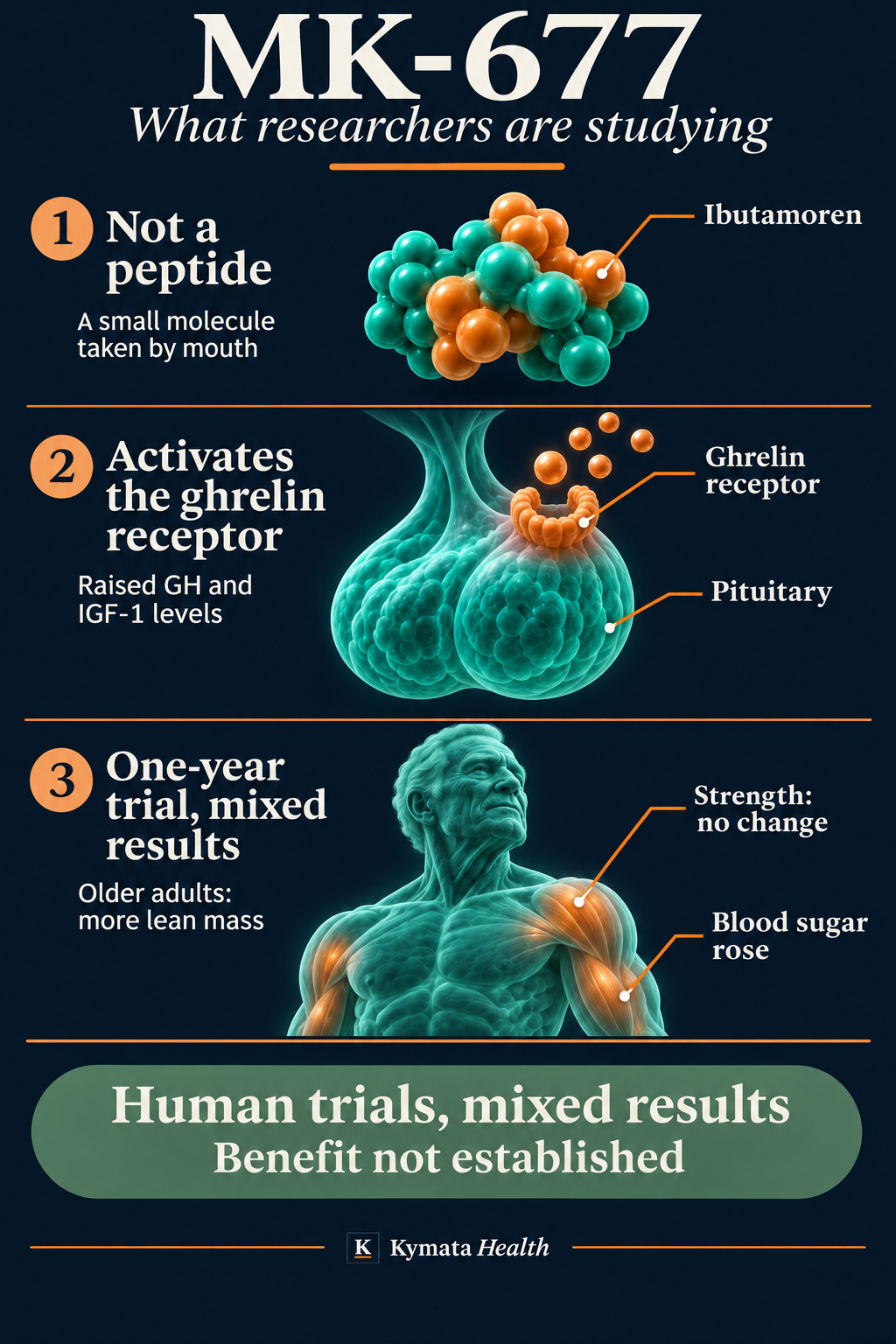
The guide shows MK-677 (ibutamoren) as a small molecule taken by mouth, not a peptide, that activates the ghrelin receptor and raises growth hormone and IGF-1. In a one-year trial in older adults, lean mass rose but strength and function did not, and blood sugar rose (Nass 2008, PMID 18981485). The drawing is a schematic, not a measured molecular structure, a product photograph or a treatment result. Illustration review: 22 November 2026, against this page’s own mechanism, evidence and regulatory records.
This record is not an amino-acid peptide. No peptide sequence model is inferred from its name.
Illustration notes and source record
Read the source record on this page. Laboratory, topical and injected studies are separate evidence; this illustration does not establish an indication or a treatment outcome.

How it works
SourcedMK-677 (ibutamoren) is a non-peptide, orally active growth hormone secretagogue that acts on the ghrelin receptor (GHS-R1a). Taken once a day, it kept 24-hour GH 1.8-fold and IGF-1 1.5-fold higher at 12 months in older adults (Nass 2008, PMID 18981485).
In that trial fat-free mass rose, but strength, function and visceral fat did not change, and femoral-neck bone density fell slightly against placebo. Taken at bedtime for 7 days it increased deep and REM sleep (Copinschi 1997, PMID 9349662). It is discussed with peptides because it targets the same receptor as the peptide GHRPs.
Source: PMID: 9467534
Background & History
MK-677 (ibutamoren) is an oral non-peptide GHS-R1a agonist. Human GH/IGF-1 pharmacology is real. It was never approved as a drug. Appetite and fasting-glucose creep are the usual costs. WADA S2. Not a reconstitution peptide.
05 / Evidence and limits
Evidence and limits
Limits of current evidence
3 limits- Oral. No BAC water. Capsules and liquids are not 5 mg powders.
- Appetite and fasting-glucose creep are the usual costs. This is not a cutting GLP-1.
- WADA S2 (GH secretagogues). Not a loophole around somatropin.
What it is studied for
- Oral GHS-R1a identity vs injectable GHRPs vs macimorelin
- Why glucose watching belongs next to the hunger story
- Not HGH and not a cutting GLP-1
Verdict
MK-677 is Merck’s oral ghrelin-receptor agonist, a small molecule, not a peptide. In a 1-year trial in older adults it raised GH, IGF-1 and fat-free mass but not strength or function, and it raised glucose (PMID 18981485). It did not slow Alzheimer disease (PMID 19015485), and a hip-fracture trial stopped early for heart failure (PMID 21067829). Not HGH. Do not put it in the reconstitution calculator.
Where it is prescribed
Sermorelin is prescribed through US telehealth clinics.
What the human studies measured
Every human study of MK-677 (ibutamoren) we found, what it measured and what it showed, including the negative and the unpublished.
Outcomes
13 findings| Outcome | Who and how long | Result | Source |
|---|---|---|---|
| Older adults, 1 year: body composition | 65 healthy adults aged 60 to 81, 25 mg by mouth daily vs placebo | Fat-free mass rose; visceral and total fat did not change; limb fat rose 1.1 vs 0.24 kg; weight rose 2.7 vs 0.8 kg. | Nass 2008, Ann Intern Med |
| Same trial: strength and function | Same | No change: the extra fat-free mass did not improve strength or function. | Nass 2008, Ann Intern Med |
| Same trial: GH, IGF-1 and bone | Same, at 12 months | 24-hour GH 1.8-fold and IGF-1 1.5-fold higher, back to baseline within a month of stopping. Femoral-neck bone density fell slightly against placebo; spine and hip did not change. | Nass 2008, Ann Intern Med |
| Alzheimer disease, 12 months | 563 people with mild to moderate Alzheimer disease, 25 mg daily | IGF-1 rose 73%, but no cognitive or functional scale improved: the authors called it ineffective at slowing the disease. | Sevigny 2008, Neurology |
| Recovery after hip fracture, 6 months | 161 people aged 65 or over | IGF-1 rose 84% vs 17% on placebo; functional performance did not differ. | Bach 2004, J Am Geriatr Soc |
| Hip fracture, phase IIb | 123 older patients, 25 mg daily, 24 weeks | Gait speed improved; stair-climbing power and several other measures did not. The trial was stopped early for a safety signal of congestive heart failure. | Adunsky 2011, Arch Gerontol Geriatr |
| Obese men, 8 weeks | 24 men aged 18 to 50 | IGF-1 rose about 40% and fat-free mass rose; total and visceral fat did not change; glucose tolerance worsened at 2 and 8 weeks. | Svensson 1998, JCEM |
| Calorie restriction, 1 week | 8 healthy volunteers on 18 kcal/kg a day, crossover | Nitrogen balance +0.31 vs −1.48 g a day on placebo: protein loss was reversed for the week. | Murphy 1998, JCEM |
| Osteoporosis, with alendronate | 292 women aged 64 to 85, 12 to 18 months | Femoral-neck bone density rose more with both (4.2% vs 2.5%); spine, total hip and whole body did not. | Murphy 2001, JCEM |
| Sleep, 7 days at bedtime | Young men and older adults, 25 mg | In young men deep (stage IV) sleep rose about 50% and REM sleep more than 20%; in older adults REM sleep rose nearly 50%. | Copinschi 1997, Neuroendocrinology |
| Fatty liver, 6 months | 12 adults, open label, 25 mg | Registry results only: liver fat did not fall (+3.9 points, p = 0.4). | NCT05364684 (registry results) |
| Children with GH deficiency (as LUM-201) | 104 prepubertal children, 6 months, three doses vs daily GH | Registry results: 6.8 to 8.2 cm a year on LUM-201 vs 10.6 on daily GH injections. | NCT04614337 (registry results) |
| Fibromyalgia, 24 weeks | 64 adults, 25 mg | Completed in 2008. No results posted or published. | NCT00116129 (registry) |
06 / Product forms and access
Product forms and access
Regulatory & legal status
- FDA status (US)
- Research Only
- WADA status (2026)
- Prohibited (S2)Competitive athletes subject to anti-doping controls should not use MK-677.
- US compounding
- Not eligible / not available
07 / Tools and practical checks
Tools and practical checks
No separate record is provided here. Read the linked evidence and limitations for this compound.
08 / Published study use
Published study use
What published studies gave, in whom, and the source. Not a dose for you.
What studies used
Human trials (oral)- 65 healthy adults aged 60 to 81: 25 mg by mouth once a day or placebo for 2 years. GH and IGF-I rose and fat-free mass increased; body weight and fasting glucose also rose. Nass 2008, PMID 18981485 (opens in new tab)
- 563 people with mild to moderate Alzheimer disease: 25 mg a day or placebo for 12 months. It did not slow the disease. Sevigny 2008, PMID 19015485 (opens in new tab)
A record of what researchers gave, in whom; not a dose for you.
Administration
- Route / form
- Route used in studies: by mouth.
Who it is for
3 uses| Category | Fit | What exists |
|---|---|---|
| Raising GH and IGF-1 | Moderate | Raised for a year in older adults (Nass 2008); back to baseline within a month of stopping. |
| Strength, function or body fat | Low | No change in strength, function or visceral fat in the 1-year trial; no functional benefit after hip fracture. |
| Sleep | Low | One 7-day study at bedtime found more deep and REM sleep (Copinschi 1997). No longer sleep trial. |
Timing: bedtime, morning or before exercise
What each study did. No study ranks one time over another; timing is the prescriber's decision.
The evidence No human study has compared a GH secretagogue taken before exercise with one taken before bed, on GH, IGF-1, body composition or anything else. Trials of tesamorelin used the morning in one study and bedtime in another, and the labels name no time.
When the studies dosed
2 studies| Study | When | Finding |
|---|---|---|
| Copinschi 1997, Neuroendocrinology | At bedtime, 7 days | Deep and REM sleep rose; there was no daytime arm. |
| Nass 2008, Ann Intern Med | Once daily (time not stated) | GH and IGF-1 still raised at 12 months. |
09 / Safety and interactions
Safety and interactions
What the record says
Not FDA-approved. In a 1-year trial appetite rose in 67% (vs 36% on placebo), fasting glucose and HbA1c rose, and mild swelling and muscle pain were more common (PMID 18981485). A hip-fracture trial was stopped early for a congestive-heart-failure signal (PMID 21067829). Trials excluded people with diabetes, cancer or heart failure. No reconstitution needed.
Interactions & Contraindications
No interaction study exists. Fasting glucose, HbA1c and insulin sensitivity worsened in trials (PMID 18981485, 9467542), and trials excluded people with diabetes or heart failure.
Side effects in the record
What labels, trials and FDA have reported, with how often where a number exists.
By source
| Effect or signal | What the record says | Source |
|---|---|---|
| Appetite | Increased in 67% vs 36% on placebo over a year; in half it settled within 3 months. | Nass 2008, Ann Intern Med |
| Blood glucose | Fasting glucose +0.3 mmol/L and HbA1c +0.2%; 8 people had HbA1c above 6% at 12 months; insulin sensitivity fell. Four people had the dose cut for glucose or joint pain. | Nass 2008, Ann Intern Med |
| Swelling and muscle pain | Mild, transient swelling 44% vs 27% and muscle pain 33% vs 9% (neither significant). | Nass 2008, Ann Intern Med |
| Heart failure | The hip-fracture trial was stopped early for a congestive-heart-failure signal; FDA cites the same signal. One heart-failure event on drug in a dialysis trial. | Adunsky 2011, Arch Gerontol GeriatrFDA bulk-substance safety-risk listNCT00395291 (registry results) |
| Cortisol | 24-hour cortisol rose 47 nmol/L over a year in older adults; not raised at 2 and 8 weeks in obese men. | Nass 2008, Ann Intern MedSvensson 1998, JCEM |
What the label and trials checked
No label exists, so this is what the trials checked. Trials excluded people with diabetes, cancer, uncontrolled high blood pressure or heart failure. A clinician decides what to measure.
Checks and why
| Check | When | Why |
|---|---|---|
| Fasting glucose and HbA1c | Monthly for 3 months, then every 3 months, in the 2-year trial | Both rose; four people had the dose reduced. (Nass 2008, Ann Intern Med) |
| Insulin sensitivity and cortisol | Every 6 months | Insulin sensitivity fell and cortisol rose on drug. (Nass 2008, Ann Intern Med) |
| Blood count, chemistry, PSA and testosterone in men | With each visit | Routine safety tests in the long trial. (Nass 2008, Ann Intern Med) |
| Glucose tolerance test | At 2 and 8 weeks | It worsened in obese men. (Svensson 1998, JCEM) |
10 / Comparisons and goal guides
Comparisons and goal guides
Combinations: what has been tested
1 pairing- + CJC-1295 DAC →No human study of MK-677 with CJC-1295. Both raise IGF-1, which the MK-677 trials monitored (PMID 18981485).
MK-677 vs. Ipamorelin
6 attributesCanonical comparison: MK-677 vs Ipamorelin · Ipamorelin evidence profile
| Attribute | MK-677 | Ipamorelin |
|---|---|---|
| In human studies | By mouth, once daily | By IV infusion |
| Receptor | Ghrelin receptor (GHS-R1a) | Ghrelin receptor (GHS-R1a), the same one |
| GH and IGF-1 | GH 1.8× and IGF-1 1.5× at 12 months (PMID 18981485) | GH peak about 40 min after one IV dose (PMID 10496658) |
| Appetite | Raised in 67% vs 36% on placebo (PMID 18981485) | Not measured in people |
| Swelling | 44% vs 27% on placebo, mild (PMID 18981485) | Not reported in people |
| Longer trials | Several, mostly null on main outcomes | One negative surgery trial (PMID 25331030) |
What has been tested in combination
What human studies measured when a GHRH analog was given with a ghrelin-receptor agonist, and which pairs have never been tested.
Two receptors, not one
Tesamorelin, sermorelin and CJC-1295 are GHRH analogs: they act on the GHRH receptor of the pituitary, which signals through cAMP (Mayo 1992, Mol Endocrinol). Ipamorelin, GHRP-2, GHRP-6, hexarelin and MK-677 act on a different receptor, the ghrelin receptor (GHS-R1a), found in both the hypothalamus and the pituitary (Howard 1996, Science; Raun 1998, Eur J Endocrinol).
In people, the ghrelin-receptor route works largely through the hypothalamus: with the pituitary stalk cut, GHRP-6 released almost no GH and the combination lost its extra effect (Popovic 1995, JCEM). It also escapes somatostatin, the brake on GH release: under a somatostatin analog, the GH response to GHRH fell by 38% while the response to GHRP-2 was unaffected (Dimaraki 2003, Am J Physiol).
Two GHRH analogs share one receptor. The GH response to GHRH tops out near 1 µg/kg; doses ten times higher made the response last longer but not peak higher (Gelato 1984, JCEM; Vance 1984, JCEM). No study has given two GHRH analogs together; from those dose-response curves a second one would be expected to add little, an inference rather than a trial result.
GHRH, a GHRP, and both, in healthy adults
What has been tested in people
| Combination | Human evidence |
|---|---|
| MK-677 with a GHRH analog | No human study of a combination. |
| MK-677 with ipamorelin | No human study; both act on the same receptor. |
| A GHRH analog with a ghrelin-receptor agonist (other agents) | More GH than either alone in healthy adults, often more than the sum at test doses. (Bowers 1990, JCEM; Popovic 1995, JCEM; Pombo 1995, JCEM; Ramos-Dias 1996, JCEM) |
The growth hormone family
GH itself, the drugs that make the pituitary release more of it, and IGF-1 downstream. Half-lives are human values.
Three ways to raise GH
| Class | Acts on |
|---|---|
| GHRH analog | GHRH receptor on the pituitary (cAMP) |
| Ghrelin-receptor agonist (this page) | Ghrelin receptor (GHS-R1a) in hypothalamus and pituitary |
| Growth hormone (daily) | GH receptor directly; bypasses the pituitary |
| Growth hormone (weekly) | GH receptor directly, released over a week |
| IGF-1 | IGF-1 receptor, downstream of GH |
Compared
16 agents| Agent | Class | Labelled product | Half-life (human) | Taken |
|---|---|---|---|---|
| Somatropin (rhGH) | Growth hormone (daily) | Genotropin, Humatrope, Norditropin, Omnitrope, Zomacton, Serostim | 2 to 3.8 h (SC, across labels) (Humatrope label) | Daily injection (label) |
| Somapacitan | Growth hormone (weekly) | Sogroya | about 2 to 3 days (adults) (Sogroya label) | Weekly injection (label) |
| Somatrogon | Growth hormone (weekly) | Ngenla | 37.7 h (effective, children) (Ngenla label) | Weekly injection (label) |
| Lonapegsomatropin | Growth hormone (weekly) | Skytrofa | about 31 h (prodrug, children) (Skytrofa label) | Weekly injection (label) |
| Tesamorelin | GHRH analog | Egrifta SV, Egrifta WR | 8 to 38 min (by formulation and study) (Egrifta WR label) | Daily injection (label) |
| Sermorelin | GHRH analog | None | 6 to 7 min IV (EU product information) (Geref 50 SPC (HPRA)) | Daily injection in studies |
| CJC-1295 with DAC | GHRH analog | None | 5.8 to 8.1 days (Teichman 2006, JCEM) | Weekly or every other week in studies |
| CJC-1295 without DAC (mod GRF 1-29) | GHRH analog | None | No human value published | No human study published |
| Ipamorelin | Ghrelin-receptor agonist | None | 2 h (IV infusion) (Gobburu 1999, Pharm Res) | Single IV infusions in the human study |
| GHRP-2 | Ghrelin-receptor agonist | GHRP Kaken 100 (Japan) | 0.42 to 0.69 h (IV, Japanese label) (GHRP Kaken 100 label (PMDA, 2025)) | One IV dose, as a diagnostic test (Japanese label) |
| GHRP-6 | Ghrelin-receptor agonist | None | 2.5 h (IV) (Cabrales 2013, Eur J Pharm Sci) | IV test doses in studies |
| Hexarelin | Ghrelin-receptor agonist | None | No human value published | Twice daily under the skin for up to 16 weeks in studies; the GH response fades |
| MK-677 (ibutamoren) | Ghrelin-receptor agonist | None | No human value published | Daily by mouth in studies; GH raised over 24 h |
| Macimorelin | Ghrelin-receptor agonist | Macrilen | 4.1 h (Macrilen label) | One oral dose, as a diagnostic test (label) |
| Mecasermin (rhIGF-1) | IGF-1 | Increlex | 5.8 h (children) (Increlex label) | Twice daily with a meal (label) |
| IGF-1 LR3 | IGF-1 | None | No human value published | No human dosing study identified |
11 / Common questions
Common questions
Common questions
5 answersIs MK-677 a peptide?
No. MK-677 (Ibutamoren) is a non-peptide ghrelin receptor agonist taken orally. Discussed alongside peptides because it activates the same GHS-R1a receptor as peptide GHRPs.
What dose did studies use for MK-677?
Trials in older adults used 25 mg by mouth once a day: 65 healthy adults aged 60 to 81 for 2 years (PMID 18981485) and 563 people with Alzheimer disease for 12 months, where it did not slow the disease (PMID 19015485). Weight and fasting glucose rose in the 2-year trial.
Does the effect of MK-677 fade?
Not over a year in the main trial: 24-hour GH was 1.8-fold and IGF-1 1.5-fold higher at 12 months, and both returned to baseline within a month of stopping (PMID 18981485).
Did MK-677 help in any patient trial?
Not on the main outcomes. It did not slow Alzheimer disease (PMID 19015485) or improve function after hip fracture (PMID 15066065); a second hip-fracture trial improved gait speed only and stopped early for heart failure (PMID 21067829). A fatty-liver pilot found no fall in liver fat (NCT05364684).
Is MK-677 FDA-approved?
No. Not FDA-approved, research chemical.
12 / Sources and references
Sources and references
2 papers cited on this page.
Sources
2 papers- 1“"Two-month treatment of obese subjects with the oral growth hormone (GH) secretagogue MK-677 increases GH secretion, fat-free mass, and energy expenditure".”Svensson J et al. Journal of Clinical Endocrinology & Metabolism (1998). PMID: 9467542
- 2“MK-677, an orally active growth hormone secretagogue, reverses diet-induced catabolism.”Murphy MG, et al. J Clin Endocrinol Metab (1998). PMID: 9467534
14 / Prescription options
Prescription options
Prescription options: compare licensed telehealth providers
Some peptide therapies are available only by prescription after a consult with a licensed clinician.
Compare telehealth →15 / Peptide library
Peptide library
Keep reading: Peptide research library
Peptide research library: every pagePeptide libraryBrowse all topics
- HexarelinPrevious in this topic · GHS-R1a hexapeptide (examorelin) that raises GH, with documented desensitization.
- PT-141Next in this topic · PT-141 is bremelanotide, the active drug in Vyleesi, an FDA-approved autoinjector for acquired, generalized HSDD in premenopausal women; the label says it is not indicated for…
- Melanotan IICyclic α-MSH analog.
- EpitalonEpitalon is a synthetic four-amino-acid peptide, Ala-Glu-Asp-Gly, also called AEDG.
- MOTS-cMOTS-c is a 16-amino-acid mitochondrial-derived peptide investigated in metabolic signaling.
Regulatory and sport classification
- Not FDA-approved, research chemical
- WADA (S2): prohibited in sport at all times