
The peptide field guide
Hexarelin
Hexarelin, also called examorelin, is a synthetic six-residue growth hormone secretagogue.
Hormone-test changes in specific studies do not establish lasting body-composition or heart benefits.
Explore this compoundConceptual editorial illustration; not a measured molecular structure, product photograph or treatment result.
02 / At a glance
At a glance
Key facts
- Also known as
- Examorelin
- Type
- Growth Hormone
- Evidence level
- Early human trials: benefit not yet confirmed.
- US regulatory status
- Not FDA-approved, research chemical
- Updated
Identity
Hexarelin, also called examorelin, is a synthetic six-residue growth hormone secretagogue.
Research context
GH test-response measurements in twelve healthy older adults and separate acute heart-study settings.
Evidence limits
Hormone-test changes in specific studies do not establish lasting body-composition or heart benefits.
Read the technical profile and study-use reference
Quick answer
Evidence: ModerateGHS-R1a hexapeptide (examorelin) that raises GH, with documented desensitization. Cardiac papers are not a DIY heart protocol. The GH response fades with repeated use (PMID 10990150).
- In published studies
- Trial details are recorded under What studies used (PMID 10990150)
Research summary, not medical advice.
At a glance
Kymata peptide profile · Oct 30, 2026- Half-life
- Not measured in people
- Common vials
- 2 mg / 5 mg
- Molecular weight
- 1024.18 g/mol
- CAS
- 140703-51-1
- In published studies
- Trial details are recorded under What studies used (PMID 10990150)
03 / Identity and origin
Identity and origin
Also called Examorelin. Potent GHS-R1a hexapeptide with documented desensitization.
Read the sequence and compound record
Compound card
- Sequence
- His-D-2-methyl-Trp-Ala-Trp-D-Phe-Lys-NH2 (examorelin)
- Class
- Potent GHS-R1a hexapeptide with documented desensitization
- Formula
- C50H69N15O9
- Molecular weight
- 1024.18 g/mol
- CAS
- 140703-51-1
- Described by
- Europeptides / Romano Deghenghi, 1990
- Bioavailability
- 77% under the skin vs IV, judged by GH response (Ghigo 1994)
04 / How it may work
How it may work
Potent GHS-R1a hexapeptide with documented desensitization
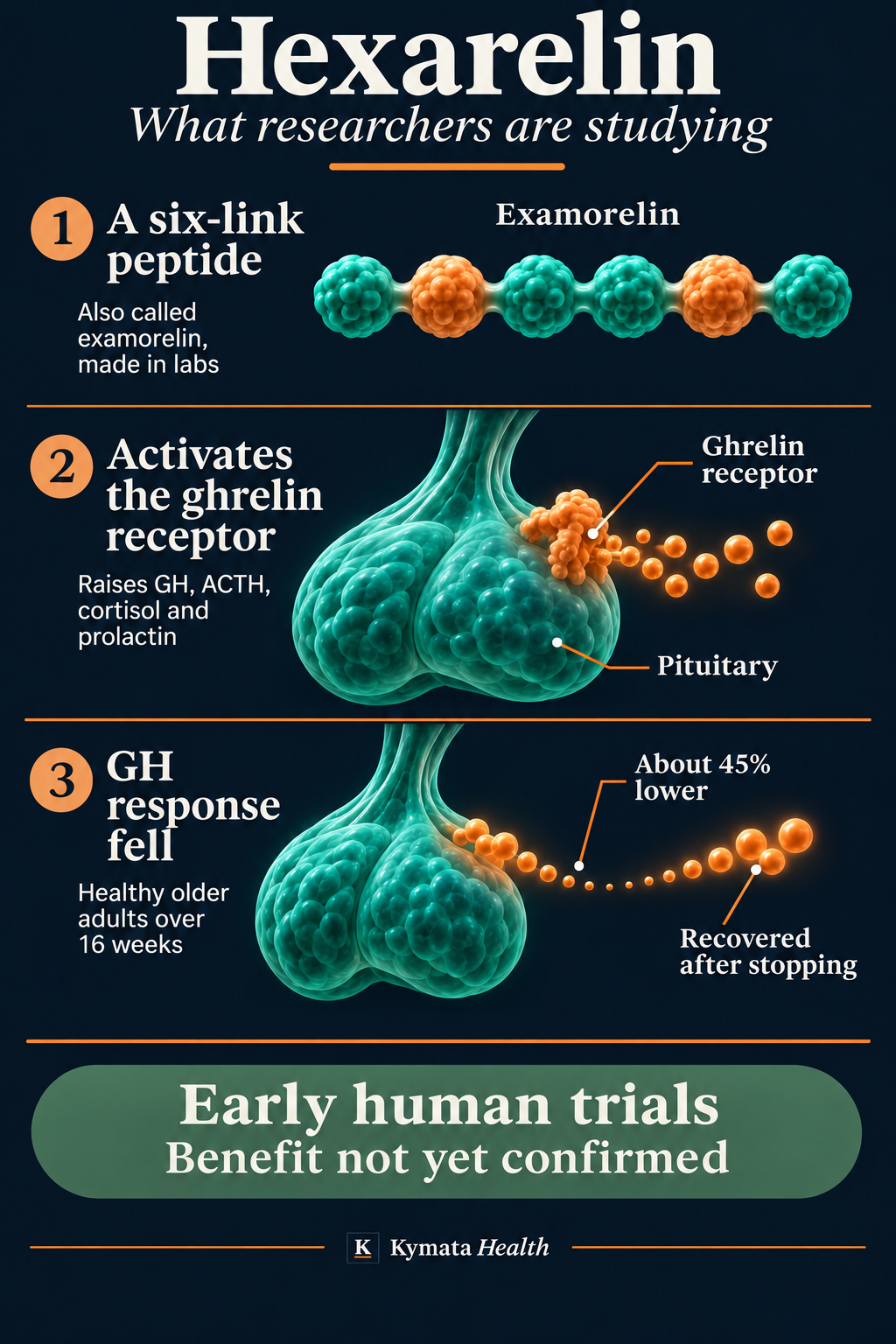
The guide shows hexarelin (examorelin) as a six-amino-acid peptide that activates the ghrelin receptor, raising growth hormone along with ACTH, cortisol and prolactin (PMID 9253314, 8954038). In 12 healthy older adults, the growth hormone response fell about 45% by week 16 and recovered after stopping (PMID 9589671). No trial has measured body composition. The drawing is a schematic, not a measured molecular structure, a product photograph or a treatment result. Illustration review: 22 November 2026, against this page’s own mechanism, evidence and regulatory records.
The recorded chain includes D-amino acids and a methylated tryptophan residue. A standard one-letter model is not used to imply those modifications are represented.
Illustration notes and source record
Read the source record on this page. Laboratory, topical and injected studies are separate evidence; this illustration does not establish an indication or a treatment outcome.

How it works
Hexarelin (examorelin) is a synthetic hexapeptide that activates the ghrelin receptor (GHS-R1a). One IV dose raises GH along with ACTH and cortisol (PMID 9253314) and prolactin (PMID 8954038).
With twice-daily injections the GH response fell significantly by week 4 (the week-1 fall was not significant) and about 45% by week 16, recovered 4 weeks after stopping, and changed neither IGF-1 nor body composition (Rahim 1998, PMID 9589671). Single IV doses raised left-ventricular ejection fraction for about an hour, an effect GH itself did not have (Bisi 1999, PMID 10342360); repeated doses have not been studied for the heart.
Background & History
Hexarelin (examorelin) is a GHS-R1a hexapeptide whose GH response fades with repeated use. Its human heart data are single IV doses in small studies.
05 / Evidence and limits
Evidence and limits
Limits of current evidence
2 limits- The human heart studies are single IV doses, not a reconstitution indication.
- Continuous daily use is the wrong way to read a desensitizing secretagogue.
What it is studied for
- Potent GHRP identity and its documented desensitization
- Not a post-infarction or cardioprotection treatment page
Verdict
Hexarelin raises GH strongly at first; with twice-daily use the response fell significantly by week 4 and about 45% by week 16, recovered 4 weeks after stopping, and changed neither IGF-1 nor body composition (PMID 9589671, 10990150). Its heart effects come from single IV doses. It is not the clean GHRP.
Where it is prescribed
Sermorelin is prescribed through US telehealth clinics.
What the human studies measured
Every human study of Hexarelin we found, what it measured and what it showed, including the negative and the unpublished.
Outcomes
6 findings| Outcome | Who and how long | Result | Source |
|---|---|---|---|
| GH, by route | 12 healthy young adults | Judged by the GH response: 77% as active under the skin as by IV, 4.8% into the nose, 0.3% by mouth. | Ghigo 1994, JCEM |
| Twice daily for 16 weeks | 12 healthy older adults, 1.5 µg/kg under the skin | 19.1 at baseline, 13.1 after a week (not significant), 12.3 by week 4 and 10.5 by week 16 (both significant), back to 19.4 four weeks after stopping. IGF-1, body fat, lean mass and bone density did not change. | Rahim 1998, JCEM |
| Short children, nasal, up to 8 months | 8 prepubertal children, uncontrolled | Growth 5.3 → 8.3 cm a year and IGF-1 rose; in a similar group the GH response halved within a week and then held. | Laron 1995, Clin EndocrinolKlinger 1996, Eur J Endocrinol |
| Older adults, 8 to 15 days nasal or oral | 14 older adults | No loss of the GH response; prolactin and cortisol unchanged; no side effects. | Ghigo 1996, Eur J Endocrinol |
| Heart, single IV doses | Healthy men; GH-deficient adults; heart-failure and bypass patients | Ejection fraction rose within 15 minutes for about an hour in healthy and GH-deficient men; it rose in ischemic but not dilated cardiomyopathy. GH itself had no such effect. No study of repeated doses. | Bisi 1999, J Endocrinol InvestBisi 1999, Eur J PharmacolImazio 2002, Eur J Heart FailBroglio 2002, Eur J Pharmacol |
| Sleep, night-time IV doses | 7 young men | Deep (stage 4) sleep fell, with GH, prolactin, ACTH and cortisol higher overnight. | Frieboes 2004, Psychoneuroendocrinology |
06 / Product forms and access
Product forms and access
Regulatory & legal status
- FDA status (US)
- Research Only
- WADA status (2026)
- Prohibited (S2)Competitive athletes subject to anti-doping controls should not use Hexarelin.
- US compounding
- Not eligible / not available
07 / Tools and practical checks
Tools and practical checks
Dose it
2 mg + 2 mL BAC water → 1 mg/mL · 1 unit (U-100) = 10 mcg.
Reconstitution math
U-100 syringe| Vial | Water | Concentration |
|---|---|---|
| 2 mg lyophilized | 2.0 mL BAC | 1 mg/mL |
08 / Published study use
Published study use
What published studies gave, in whom, and the source. Not a dose for you.
What studies used
Small human studies- 12 healthy older people: injections under the skin twice a day for 16 weeks. The GH response faded partly and came back after a 4-week break. The indexed abstract does not give the dose. Rahim 1998, PMID 10990150 (opens in new tab)
A record of what researchers gave, in whom; not a dose for you.
Administration
- Route / form
- Route used in studies: injection under the skin.
Who it is for
2 uses| Category | Fit | What exists |
|---|---|---|
| Short-term GH release | Moderate | Strong after single doses; fades with twice-daily use (Rahim 1998). |
| Heart function | Low | Ejection fraction rose after single IV doses in small studies; no study of repeated doses. |
Timing: bedtime, morning or before exercise
What each study did. No study ranks one time over another; timing is the prescriber's decision.
The evidence No human study has compared a GH secretagogue taken before exercise with one taken before bed, on GH, IGF-1, body composition or anything else. Trials of tesamorelin used the morning in one study and bedtime in another, and the labels name no time.
When the studies dosed
2 studies| Study | When | Finding |
|---|---|---|
| Rahim 1998, JCEM | Morning and evening injections | The GH response faded whatever the schedule; time of day was not compared. |
| Frieboes 2004, Psychoneuroendocrinology | Night-time IV doses | Deep sleep fell, the opposite of what bedtime MK-677 did. |
09 / Safety and interactions
Safety and interactions
What the record says
Research peptide. Subject to desensitization: the GH response was significantly lower by week 4 of twice-daily use and recovered 4 weeks after stopping (PMID 9589671). One IV dose raised ACTH and cortisol about as much as CRH (PMID 9253314), but 16 weeks of use did not over-stimulate cortisol or prolactin (PMID 10341859).
Interactions & Contraindications
Cortisol, ACTH and prolactin rise after single doses (not after 16 weeks of use). The GH response fades with repeated use.
Side effects in the record
What labels, trials and FDA have reported, with how often where a number exists.
By source
| Effect or signal | What the record says | Source |
|---|---|---|
| ACTH and cortisol | After one IV dose, ACTH rose from 16 to 32 pg/mL and cortisol from 110 to 136 µg/L, similar to CRH. | Ghigo 1997, JCEM |
| Prolactin | Rose with dose after IV doses, levelling off at about +180%. | Massoud 1996, JCEM |
| Over 16 weeks | No over-stimulation: cortisol response fell and recovered off drug; urine cortisol, ACTH and prolactin did not change. | Rahim 1999, Clin Endocrinol |
| Fading response | The GH response fell significantly by week 4 and about 45% by week 16 of twice-daily use, and recovered 4 weeks after stopping. | Rahim 1998, JCEM |
What the label and trials checked
No label exists, so this is what the trials checked. A clinician decides what to measure.
Checks and why
| Check | When | Why |
|---|---|---|
| GH response to a test dose | Weeks 0, 1, 4, 16 and 4 weeks after stopping | How the 16-week study measured the fading response. (Rahim 1998, JCEM) |
| IGF-1, body composition, bone density | Weeks 0 and 16 | None changed. (Rahim 1998, JCEM) |
| Cortisol, ACTH, prolactin, urine cortisol | Weeks 0, 16 and 20 | Checked for over-stimulation; none found. (Rahim 1999, Clin Endocrinol) |
10 / Comparisons and goal guides
Comparisons and goal guides
Combinations: what has been tested
1 pairing- + CJC-1295 no DAC →No human study of hexarelin with a GHRH analog. The GH response fades with repeated use (PMID 9589671).
What has been tested in combination
What human studies measured when a GHRH analog was given with a ghrelin-receptor agonist, and which pairs have never been tested.
Two receptors, not one
Tesamorelin, sermorelin and CJC-1295 are GHRH analogs: they act on the GHRH receptor of the pituitary, which signals through cAMP (Mayo 1992, Mol Endocrinol). Ipamorelin, GHRP-2, GHRP-6, hexarelin and MK-677 act on a different receptor, the ghrelin receptor (GHS-R1a), found in both the hypothalamus and the pituitary (Howard 1996, Science; Raun 1998, Eur J Endocrinol).
In people, the ghrelin-receptor route works largely through the hypothalamus: with the pituitary stalk cut, GHRP-6 released almost no GH and the combination lost its extra effect (Popovic 1995, JCEM). It also escapes somatostatin, the brake on GH release: under a somatostatin analog, the GH response to GHRH fell by 38% while the response to GHRP-2 was unaffected (Dimaraki 2003, Am J Physiol).
Two GHRH analogs share one receptor. The GH response to GHRH tops out near 1 µg/kg; doses ten times higher made the response last longer but not peak higher (Gelato 1984, JCEM; Vance 1984, JCEM). No study has given two GHRH analogs together; from those dose-response curves a second one would be expected to add little, an inference rather than a trial result.
GHRH, a GHRP, and both, in healthy adults
What has been tested in people
| Combination | Human evidence |
|---|---|
| Hexarelin with a GHRH analog | No human study of a repeated-dose combination. |
| A GHRH analog with a ghrelin-receptor agonist (other agents) | More GH than either alone in healthy adults, often more than the sum at test doses. (Bowers 1990, JCEM; Popovic 1995, JCEM; Pombo 1995, JCEM; Ramos-Dias 1996, JCEM) |
| The same pairing at full doses | One study found the combination no greater than the sum: the extra effect is clearest at lower doses. (Tiulpakov 1995, Clin Endocrinol) |
The growth hormone family
GH itself, the drugs that make the pituitary release more of it, and IGF-1 downstream. Half-lives are human values.
Three ways to raise GH
| Class | Acts on |
|---|---|
| GHRH analog | GHRH receptor on the pituitary (cAMP) |
| Ghrelin-receptor agonist (this page) | Ghrelin receptor (GHS-R1a) in hypothalamus and pituitary |
| Growth hormone (daily) | GH receptor directly; bypasses the pituitary |
| Growth hormone (weekly) | GH receptor directly, released over a week |
| IGF-1 | IGF-1 receptor, downstream of GH |
Compared
16 agents| Agent | Class | Labelled product | Half-life (human) | Taken |
|---|---|---|---|---|
| Somatropin (rhGH) | Growth hormone (daily) | Genotropin, Humatrope, Norditropin, Omnitrope, Zomacton, Serostim | 2 to 3.8 h (SC, across labels) (Humatrope label) | Daily injection (label) |
| Somapacitan | Growth hormone (weekly) | Sogroya | about 2 to 3 days (adults) (Sogroya label) | Weekly injection (label) |
| Somatrogon | Growth hormone (weekly) | Ngenla | 37.7 h (effective, children) (Ngenla label) | Weekly injection (label) |
| Lonapegsomatropin | Growth hormone (weekly) | Skytrofa | about 31 h (prodrug, children) (Skytrofa label) | Weekly injection (label) |
| Tesamorelin | GHRH analog | Egrifta SV, Egrifta WR | 8 to 38 min (by formulation and study) (Egrifta WR label) | Daily injection (label) |
| Sermorelin | GHRH analog | None | 6 to 7 min IV (EU product information) (Geref 50 SPC (HPRA)) | Daily injection in studies |
| CJC-1295 with DAC | GHRH analog | None | 5.8 to 8.1 days (Teichman 2006, JCEM) | Weekly or every other week in studies |
| CJC-1295 without DAC (mod GRF 1-29) | GHRH analog | None | No human value published | No human study published |
| Ipamorelin | Ghrelin-receptor agonist | None | 2 h (IV infusion) (Gobburu 1999, Pharm Res) | Single IV infusions in the human study |
| GHRP-2 | Ghrelin-receptor agonist | GHRP Kaken 100 (Japan) | 0.42 to 0.69 h (IV, Japanese label) (GHRP Kaken 100 label (PMDA, 2025)) | One IV dose, as a diagnostic test (Japanese label) |
| GHRP-6 | Ghrelin-receptor agonist | None | 2.5 h (IV) (Cabrales 2013, Eur J Pharm Sci) | IV test doses in studies |
| Hexarelin | Ghrelin-receptor agonist | None | No human value published | Twice daily under the skin for up to 16 weeks in studies; the GH response fades |
| MK-677 (ibutamoren) | Ghrelin-receptor agonist | None | No human value published | Daily by mouth in studies; GH raised over 24 h |
| Macimorelin | Ghrelin-receptor agonist | Macrilen | 4.1 h (Macrilen label) | One oral dose, as a diagnostic test (label) |
| Mecasermin (rhIGF-1) | IGF-1 | Increlex | 5.8 h (children) (Increlex label) | Twice daily with a meal (label) |
| IGF-1 LR3 | IGF-1 | None | No human value published | No human dosing study identified |
11 / Common questions
Common questions
Common questions
4 answersWhy does Hexarelin cause desensitization?
In 12 healthy older people given it twice a day for 16 weeks, the GH response fell partly by week 4 and returned after a 4-week break (PMID 10990150).
What dose did studies use for hexarelin?
In healthy older adults the GH response was significantly lower by week 4 and about 45% lower by week 16, then recovered within 4 weeks of stopping (PMID 9589671); short children were studied with a nasal form (PMID 8548949). The heart studies gave one IV dose.
Does hexarelin protect the heart?
Not shown beyond single doses. One IV dose raised ejection fraction for about an hour in healthy and GH-deficient men and in ischemic, but not dilated, cardiomyopathy (PMID 10342360, 10528131, 11959048). No study has tested repeated doses or heart outcomes.
Is Hexarelin FDA-approved?
No. Not FDA-approved, research chemical.
12 / Sources and references
Sources and references
No separate record is provided here. Read the linked evidence and limitations for this compound.
14 / Prescription options
Prescription options
Prescription options: compare licensed telehealth providers
Some peptide therapies are available only by prescription after a consult with a licensed clinician.
Compare telehealth →15 / Peptide library
Peptide library
Keep reading: Peptide research library
Peptide research library: every pagePeptide libraryBrowse all topics
- GHRP-2Previous in this topic · GHS-R1a hexapeptide (pralmorelin), approved in Japan only as a one-dose GH-deficiency test.
- MK-677Next in this topic · Oral non-peptide GHS-R1a agonist (ibutamoren).
- PT-141PT-141 is bremelanotide, the active drug in Vyleesi, an FDA-approved autoinjector for acquired, generalized HSDD in premenopausal women; the label says it is not indicated for…
- Melanotan IICyclic α-MSH analog.
- EpitalonEpitalon is a synthetic four-amino-acid peptide, Ala-Glu-Asp-Gly, also called AEDG.
Regulatory and sport classification
- Not FDA-approved, research chemical
- WADA (S2): prohibited in sport at all times