
The peptide field guide
Thymosin Alpha-1
A short peptide studied for communication between immune cells.
28 amino acids. Also called thymalfasin. Findings depend on the condition studied.
Explore this compound02 / At a glance
At a glance
Key facts
- Also known as
- Tα1, Zadaxin, Thymalfasin
- Sequence
- Ac–SDAAVDTSSEITTKDLKEKKEVVEEAEN–OH
- Evidence level
- Kymata evidence grade: Strong.
- US regulatory status
- Not FDA-approved, research chemical
- Updated
Identity
Thymosin alpha-1, also called thymalfasin, is a 28-amino-acid peptide. Researchers study how it affects communication between immune cells and whether that changes the course of particular illnesses.
Research interest
It has a substantial clinical literature, unlike several research peptides. The useful question is which condition and outcome a study tested. No single result establishes a universal immune benefit.
What the evidence says
In adults with sepsis, a life-threatening response to infection, the TESTS trial found no significant improvement in 28-day survival with thymosin alpha-1.
See the mechanism ↓Explore the studies ↓Look up the CAS number and other specs ↓
Read the technical profile and study-use reference
At a glance
Kymata peptide profile · Nov 6, 2026- Common vials
- 5 mg / 10 mg / 20 mg
- In published studies
- Trial amounts are recorded under What studies used (PMID 9581695)
- Half-life
- Approximately 2 hours after subcutaneous administration of studied clinical thymalfasin formulations; small human PK study, formulation-specific
03 / Identity and origin
Identity and origin
Also called Tα1, Zadaxin, Thymalfasin. Thymic peptide / thymalfasin (Zadaxin is the branded drug abroad).
Technical specifications
N-acetylated thymosin alpha-1, free peptide. The first serine carries an acetyl group. The last residue, asparagine, has a free acid end. The formula includes the attached acetyl group and excludes any acetate counterions.
Select a field name to see what it means.
CAS registry number
A Chemical Abstracts Service number identifies a substance. Match the named form too, since a seller may reuse the number for a salt.
- 62304-98-7
Other names
These names can help you find the same peptide in chemical records and research papers.
- Thymalfasin · Thymosin α1 · Tα1
Amino acid sequence
Read from the amino end on the left to the acid end on the right. H marks a free amino end, Ac an attached acetyl group, and OH a free acid end. The letters in between describe the amino acids in order.
Ac–SDAAVDTSSEITTKDLKEKKEVVEEAEN–OHChain length
A residue is one amino acid incorporated into the chain. An attached acetyl group does not add a residue.
- 28 residues
Molecular formula
Element symbols and numbers count the atoms in the reference form. This formula excludes added salt counterions and water of hydration. Charge in solution can change with pH.
C129H215N33O55Average molar mass
This is the mass of one mole of the reference form, averaged across naturally occurring isotopes. A salt can weigh more because it also contains a counterion.
- 3,108.3 g/mol
FDA ingredient identifier (UNII)
FDA’s Unique Ingredient Identifier distinguishes substances in its registry. It provides an identity reference, independent of a product’s approval status.
- W0B22ISQ1C
PubChem compound ID
The compound ID opens a public chemical structure record maintained by the US National Library of Medicine.
- 16130571
Identity sources FDA chemistry review, Table 1 (PDF p. 14) · PubChem compound 16130571
04 / How it may work
How it may work
The mechanism, the research and what it means
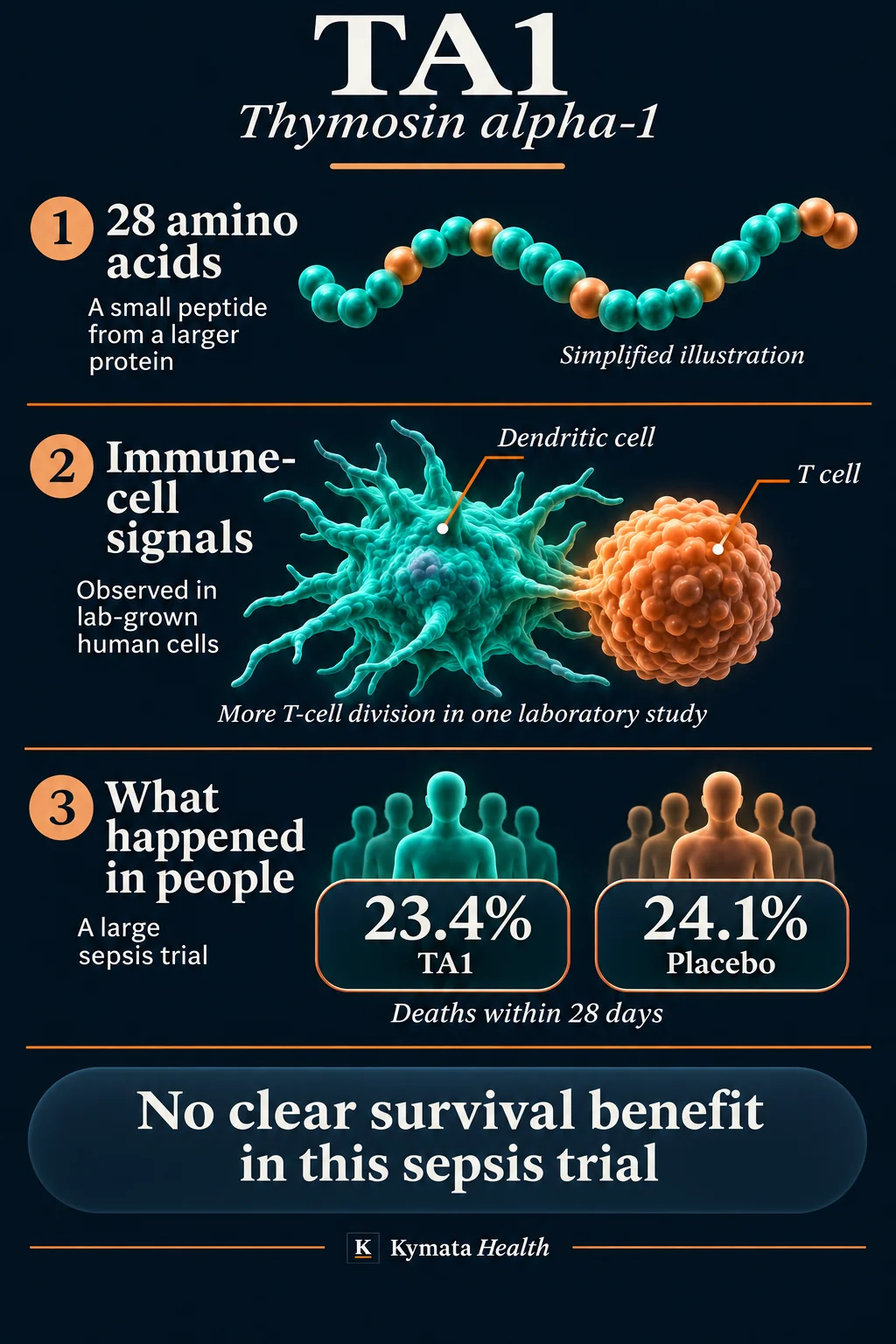
Illustration notes and source record
Can helping immune cells communicate improve survival in sepsis?
How immune cells pass on a signal. Dendritic cells alert T cells to signs of infection. In a lab study, human dendritic cells exposed to thymosin alpha-1 prompted more T cells to divide.
What happened in intensive care. In a trial of 1,089 adults with sepsis, 23.4% given thymosin alpha-1 and 24.1% given placebo died within 28 days. The trial found no clear survival benefit.
A dendritic cell meets a T cell, one of the immune system’s ways of sharing information.
Earlier contextual illustration
Earlier mechanism plate and its source context

The first 28 residues of mature prothymosin alpha
In laboratory experiments, an enzyme cut a longer protein called prothymosin alpha after its twenty-eighth amino acid, releasing thymosin alpha-1. The released peptide has an acetyl group attached to its first amino acid, serine.
Choose Rotate or Pan, then focus the diagram and use the arrow keys. Up and down tilt in Rotate mode. Pinch or use + and − to zoom.
Each bead is one amino acid. Once it is part of the chain, it is called a residue. Drag to rotate or tap a bead. The shape is a schematic illustration.
- Polar
- Acidic
- Nonpolar
- Basic
An oxygen and hydrogen at its tip help it form weak attractions called hydrogen bonds. A small chemical cap called an acetyl group covers the start of this chain (N-acetylation). Numbering here begins at the mature protein’s amino-terminal serine.
Read the full sequence
Mature prothymosin alpha · 110 residues
SDAAVDTSSEITTKDLKEKKEVVEEAENGRDAPANGNAENEENGEQEADNEVDEEEEEGGEEEEEEEEGDGEEEDGDEDEEAESATGKRAAEDDEDDDVDTKKQKTDEDDThe highlighted segment spans parent positions 1–28. This alignment uses the N-terminally processed parent chain. UniProt P06454 records it at positions 2–29.
A peptide bond is a covalent link joining two amino acids in a chain. A hydrogen bond is a weaker attraction, for example between a hydrogen on an oxygen and a nearby oxygen atom. A side chain may form hydrogen bonds without joining another amino acid to the chain. This diagram shows the sequence; it does not measure these interactions. See the IUPAC definitions of peptides and hydrogen bonds.
SDAAVDTSSEITTKDLKEKKEVVEEAEN
- Serine · Mature prothymosin alpha position 1. An oxygen and hydrogen at its tip help it form weak attractions called hydrogen bonds. A small chemical cap called an acetyl group covers the start of this chain (N-acetylation).
- Aspartate · Mature prothymosin alpha position 2. Its side branch usually carries a negative charge near neutral pH, the middle of the acidity scale.
- Alanine · Mature prothymosin alpha position 3. Its short side branch mixes poorly with water. Chemists call this a nonpolar methyl group.
- Alanine · Mature prothymosin alpha position 4. Its short side branch mixes poorly with water. Chemists call this a nonpolar methyl group.
- Valine · Mature prothymosin alpha position 5. Its short, branching side chain mixes poorly with water, a property called hydrophobicity.
- Aspartate · Mature prothymosin alpha position 6. Its side branch usually carries a negative charge near neutral pH, the middle of the acidity scale.
- Threonine · Mature prothymosin alpha position 7. Its branched side chain has a hydroxyl group (an oxygen bonded to hydrogen) that can form hydrogen bonds with nearby molecules.
- Serine · Mature prothymosin alpha position 8. An oxygen and hydrogen at its tip help it form weak attractions called hydrogen bonds.
- Serine · Mature prothymosin alpha position 9. An oxygen and hydrogen at its tip help it form weak attractions called hydrogen bonds.
- Glutamate · Mature prothymosin alpha position 10. Its side branch usually carries a negative charge near neutral pH, the middle of the acidity scale.
- Isoleucine · Mature prothymosin alpha position 11. Its branching side chain mixes poorly with water, a property called hydrophobicity.
- Threonine · Mature prothymosin alpha position 12. Its branched side chain has a hydroxyl group (an oxygen bonded to hydrogen) that can form hydrogen bonds with nearby molecules.
- Threonine · Mature prothymosin alpha position 13. Its branched side chain has a hydroxyl group (an oxygen bonded to hydrogen) that can form hydrogen bonds with nearby molecules.
- Lysine · Mature prothymosin alpha position 14. Its side branch usually carries a positive charge near neutral pH, the middle of the acidity scale.
- Aspartate · Mature prothymosin alpha position 15. Its side branch usually carries a negative charge near neutral pH, the middle of the acidity scale.
- Leucine · Mature prothymosin alpha position 16. Its branching side chain mixes poorly with water, a property called hydrophobicity.
- Lysine · Mature prothymosin alpha position 17. Its side branch usually carries a positive charge near neutral pH, the middle of the acidity scale.
- Glutamate · Mature prothymosin alpha position 18. Its side branch usually carries a negative charge near neutral pH, the middle of the acidity scale.
- Lysine · Mature prothymosin alpha position 19. Its side branch usually carries a positive charge near neutral pH, the middle of the acidity scale.
- Lysine · Mature prothymosin alpha position 20. Its side branch usually carries a positive charge near neutral pH, the middle of the acidity scale.
- Glutamate · Mature prothymosin alpha position 21. Its side branch usually carries a negative charge near neutral pH, the middle of the acidity scale.
- Valine · Mature prothymosin alpha position 22. Its short, branching side chain mixes poorly with water, a property called hydrophobicity.
- Valine · Mature prothymosin alpha position 23. Its short, branching side chain mixes poorly with water, a property called hydrophobicity.
- Glutamate · Mature prothymosin alpha position 24. Its side branch usually carries a negative charge near neutral pH, the middle of the acidity scale.
- Glutamate · Mature prothymosin alpha position 25. Its side branch usually carries a negative charge near neutral pH, the middle of the acidity scale.
- Alanine · Mature prothymosin alpha position 26. Its short side branch mixes poorly with water. Chemists call this a nonpolar methyl group.
- Glutamate · Mature prothymosin alpha position 27. Its side branch usually carries a negative charge near neutral pH, the middle of the acidity scale.
- Asparagine · Mature prothymosin alpha position 28. Its uncharged tip can form weak attractions called hydrogen bonds with nearby molecules.
How to read the mechanism
Biology and evidenceProposed mechanisms include dendritic-cell signaling, TLR9-associated processes and adaptive immune responses. Immune modulation depends on biological context; more activation is not automatically better.
Thymosin alpha-1 is different from thymosin beta-4 and TB-500. Its clinical studies and US regulatory record need to be evaluated separately.
The practical takeaway: In adults with sepsis, a life-threatening response to infection, the TESTS trial found no significant improvement in 28-day survival with thymosin alpha-1.
05 / Evidence and limits
Evidence and limits
Actual study populations, findings and limits
What the studies found
Study design · measured outcomeTESTS phase III sepsis trial
Subcutaneous thymosin alpha-1 or placebo
2025 randomized trial: 1,106 adults enrolled; 1,089 in the modified intention-to-treat analysis.
Finding. 28-day mortality was 23.4% with thymosin alpha-1 versus 24.1% with placebo; hazard ratio 0.97 (95% CI 0.76–1.24), P=0.82.
What the finding means
No significant survival benefit in this trial. This does not establish infection prevention in healthy people or settle every other indication.
Select a group to see its evidence.
Thymosin alpha-1 is absent from Appendix A of the October six-peptide HHS policy. Do not infer its compounding eligibility from that announcement.
Trial FinderRecruiting now: 9 open registrations for thymosin Alpha-1
06 / Product forms and access
Product forms and access
Access and product forms
Editorial check · Nov 6, 2026Thymosin alpha-1 has its own clinical and regulatory record. It is not one of the six peptides listed in the October HHS policy.
07 / Tools and practical checks
Tools and practical checks
Dose it
5 mg + 1 mL BAC water → 5 mg/mL · 1 unit (U-100) = 50 mcg.
Reconstitution math
U-100 syringe| Vial | Water | Concentration |
|---|---|---|
| 5 mg | 1.0 mL BAC | 5 mg/mL |
| 10 mg | 2.0 mL BAC | 5 mg/mL |
08 / Published study use
Published study use
What published studies gave, in whom, and the source. Not a dose for you.
What studies used
Human trials (hepatitis B)- 1.6 mg under the skin twice a week for 26 or 52 weeks, in 98 patients with chronic hepatitis B, against an untreated control group. Chien 1998, PMID 9581695 (opens in new tab)
A record of what researchers gave, in whom; not a dose for you.
09 / Safety and interactions
Safety and interactions
What the record says
Where Zadaxin is a labeled medicine, injection-site reactions are the common complaint and the branded safety file is larger than most research peptides. That file does not automatically transfer to an unlabeled US vial. Do not treat hepatitis, cancer, sepsis, or Lyme on this page. Transplant immunosuppression and active autoimmunity are reasons to stay out unless a physician who knows the labeled product is running it. Sterile reconstitution still matters.
Interactions & Contraindications
Branded thymalfasin has a larger safety file than gray-market powders; that file does not automatically transfer. Checkpoint inhibitors: theoretically additive immune activation. Immunosuppressants: opposing job. Transplant and active autoimmunity belong with a prescriber.
10 / Comparisons and goal guides
Comparisons and goal guides
Combinations: what has been tested
1 pairing- + Thymalin →Thymalin is a Khavinson thymic extract. Tα1 is a defined 28-mer. Same organ story, different material. Not a synergy RCT.
Thymosin Alpha-1 vs. Vilon
Compare evidence profilesCanonical comparison: Thymosin Alpha-1 vs Vilon · Vilon evidence profile
Thymosin Alpha-1 vs. TB-500
Compare evidence profilesCanonical comparison: Thymosin Alpha-1 vs TB-500 · TB-500 evidence profile
Appears in goal guides
2 guidesGoal guides give the evidence and status for each compound, with no doses. A mention here is not a treatment plan.
- GoalImmune HealthThymosin alpha-1, Thymalin, LL-37, KPV and thymopentin: what each has been studied for, in whom, their US status, and why no dose is given.Evidence and status
- GoalThymus Bioregulators and Immune PeptidesThe Khavinson thymus, pineal and bone-marrow capsules, plus thymosin alpha-1, selank, LL-37 and KPV: what each has been studied for, its status, and why no course or dose is given.Evidence and status
11 / Common questions
Common questions
Common questions
5 answersDid thymosin alpha-1 improve survival in the TESTS sepsis trial?
At 28 days, mortality was 23.4% with thymosin alpha-1 and 24.1% with placebo among 1,089 participants in the modified intention-to-treat analysis. The difference was not statistically significant.
What is Thymosin alpha-1 studied for?
Thymosin alpha-1, also called thymalfasin, is a 28-amino-acid peptide. Researchers study how it affects communication between immune cells and whether that changes the course of particular illnesses.
What have human studies of Thymosin alpha-1 shown?
In adults with sepsis, a life-threatening response to infection, the TESTS trial found no significant improvement in 28-day survival with thymosin alpha-1. Thymosin alpha-1 is absent from Appendix A of the October six-peptide HHS policy. Do not infer its compounding eligibility from that announcement.
How does Thymosin alpha-1 work?
Proposed mechanisms include dendritic-cell signaling, TLR9-associated processes and adaptive immune responses. Immune modulation depends on biological context; more activation is not automatically better. Thymosin alpha-1 is different from thymosin beta-4 and TB-500. Its clinical studies and US regulatory record need to be evaluated separately.
Is Thymosin Alpha-1 FDA-approved?
No. Approved in 37+ countries (including Italy, China) as Zadaxin®; not FDA-approved in the US.
12 / Sources and references
Sources and references
Additional background papers. Primary studies and policy sources are linked in the relevant sections.
Sources
5 papers- 1“"Historical review on thymosin α1 in oncology".”Garaci E, Pica F, Matteucci C Expert Opin Biol Ther (2015). PMID: 26096345
- 2“"Jack of all trades: thymosin α1 and its pleiotropy".”Romani L, Moretti S, Fallarino F Ann N Y Acad Sci (2012). PMID: 23045964
- 3“"Safety and efficacy of Thymosin α1 in the treatment of hepatitis B...".”Chen JF, Chen SR, Lei ZY Front Immunol (2022). PMID: 35616850
- 4“"Thymosin alpha-1 (Review)".”Ancell CD, Phipps J, Young L Am J Health Syst Pharm (2001). PMID: 11381492
- 5“Thymosin alpha 1: a comprehensive review of the literature.”Dominari A et al. World J Virol (2020). PMID: 33362999
14 / Prescription options
Prescription options
Prescription options: compare licensed telehealth providers
Some peptide therapies are available only by prescription after a consult with a licensed clinician.
Compare telehealth →15 / Peptide library
Peptide library
Keep reading: Peptide research library
Peptide research library: every pagePeptide libraryBrowse all topics
- HGH Fragment 176-191Previous in this topic · HGH Fragment 176-191 is the last 16 amino acids of mature human growth hormone.
- GonadorelinNext in this topic · Gonadorelin is synthetic native GnRH (pGlu-His-Trp-Ser-Tyr-Gly-Leu-Arg-Pro-Gly-NH2).
- KPVKPV is the three-amino-acid sequence Lys-Pro-Val, taken from the end of alpha-melanocyte-stimulating hormone.
- NAD+NAD+ is a coenzyme that carries electrons during energy metabolism.
- GlutathioneGlutathione is an antioxidant your body makes from glutamate, cysteine and glycine.
Regulatory and sport classification
- WADA (S4): prohibited in sport at all times