
The peptide field guide
HGH Fragment 176-191
HGH fragment 176–191 names a C-terminal portion of growth hormone.
The unmodified fragment, AOD-9604 and full-length GH are separate evidence records.
Explore this compoundEditorial location metaphor only; not a molecular structure, cleavage experiment, measured scale or treatment effect.
02 / At a glance
At a glance
Key facts
- Also known as
- hGH 176-191, Fragment 176-191, Frag 176-191, Somatotropin (176-191)
- Type
- Fat Loss
- Evidence level
- Cell and animal research: human benefit remains unproven.
- US regulatory status
- Not FDA-approved, research chemical
- Updated
Identity
HGH fragment 176–191 names a C-terminal portion of growth hormone.
Research context
A primary-location identity map, separate from a cited 2004 review of AOD-9604 trials.
Evidence limits
The unmodified fragment, AOD-9604 and full-length GH are separate evidence records.
Read the technical profile and study-use reference
Quick answer
Evidence: LowHGH Fragment 176-191 is the last 16 amino acids of mature human growth hormone. A synthetic copy briefly raised blood glucose in rats. We found no human trial showing weight loss with this native sequence. The human obesity trial tested the modified peptide AOD-9604.
- In published studies
- No human dose established
Research summary, not medical advice.
At a glance
Kymata peptide profile · Nov 22, 2026- Molecular weight
- 1799.1 g/mol
- CAS
- 66004-57-7
- In published studies
- No human dose established
- Half-life
- No human half-life established
- Common vials
- Research vial; no sourced vial preset in this calculator
03 / Identity and origin
Identity and origin
Also called hGH 176-191, Fragment 176-191, Frag 176-191, Somatotropin (176-191). Native-sequence C-terminal fragment of human growth hormone.
Read the sequence and compound record
Compound card
- Sequence
- FLRIVQCRSVEGSCGF (mature hGH residues 176–191)
- Class
- Native-sequence C-terminal fragment of human growth hormone
- Formula
- C78H123N23O22S2
- Molecular weight
- 1799.1 g/mol
- CAS
- 66004-57-7
- PubChem CID
- 16131230
- Bioavailability
- No human bioavailability study of the native fragment was identified.
04 / How it may work
How it may work
Native-sequence C-terminal fragment of human growth hormone
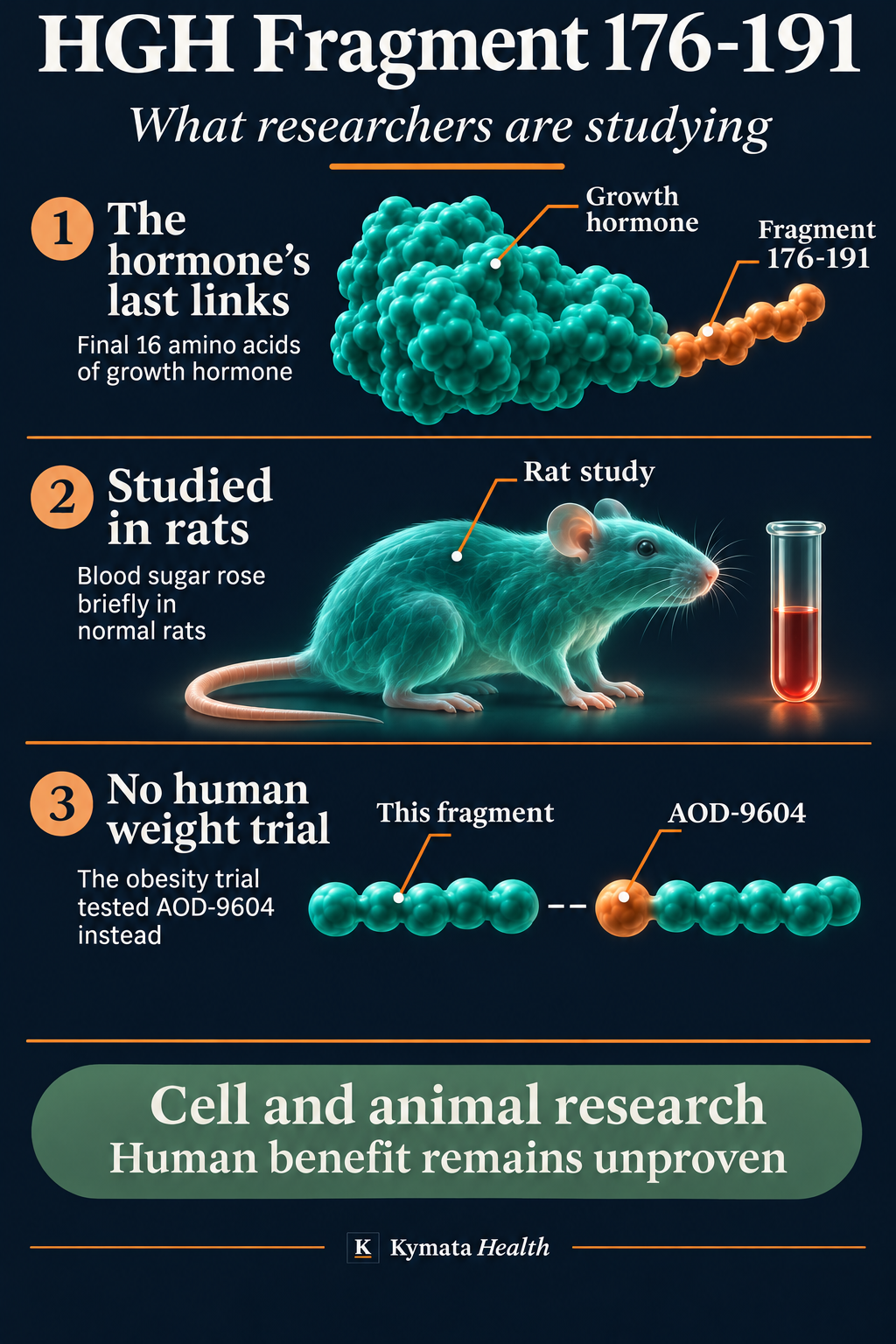
The guide shows HGH Fragment 176-191 as the last 16 amino acids of human growth hormone. In normal rats it raised blood sugar briefly. No human weight-loss trial has tested this native fragment; the human obesity trial tested the modified peptide AOD-9604, a different molecule. The drawing is a schematic, not a measured molecular structure, a product photograph or a treatment result. Illustration review: 22 November 2026, against this page’s own mechanism, evidence and regulatory records.
The retained technical record includes a modified or incompletely specified chain. No simplified residue model is inferred; read the sequence and compound record for its exact scope.
Illustration notes and source record
Read the source record on this page. Laboratory, topical and injected studies are separate evidence; this illustration does not establish an indication or a treatment outcome.

How it works
SourcedThe native sequence starts with phenylalanine (Phe) at position 176 of mature human growth hormone. The next 15 residues, from 177 through 191, form the sequence used for AOD-9401. AOD-9604 starts with tyrosine (Tyr) followed by those same 15 residues.
Ng and Bornstein tested a synthetic copy of the native fragment in rats. Blood glucose rose briefly, plasma insulin rose for longer and insulin sensitivity fell in tolerance testing. Ma 1982 (PMID 6810951) concluded that the hyperglycemia produced by hGH 177–191 and related C-terminal peptides, together with the hyperlactatemia observed, followed inactivation of pyruvate dehydrogenase and glycogen synthase in the target tissues. Neither experiment measured fat loss in people.
Source: PMID: 645904
Background & History
In 1978, Ng and Bornstein compared six synthetic fragments from the end of human growth hormone in rats. Four, including 176–191, briefly raised blood glucose. The two shortest fragments had no effect in those tests. Later fat-metabolism experiments used other preparations, including the shorter AOD-9401.
05 / Evidence and limits
Evidence and limits
The native-fragment studies summarized here measured glucose responses in rats.
Human evidence
The native-fragment studies summarized here measured glucose responses in rats.- Native hGH 176–191. Researchers compared six fragments in normal rats. The 176–191 fragment raised glucose briefly and insulin for longer. The two shortest fragments, 179–191 and 180–191, produced neither response in this experiment.
- AOD-9401. In obese Zucker rats, 20 days of treatment with the shorter 177–191 fragment reduced weight gain. The authors also measured smaller fat cells. This experiment tested a 15-residue molecule.
- AOD-9604. The OPTIONS trial randomized 502 adults with obesity to the oral modified peptide or placebo alongside diet and exercise. FDA’s review reports no significant difference in the primary weight-loss comparison at 12 weeks.
Limits of current evidence
2 limits- The native-fragment experiments measured short-term metabolic changes in rats. They provide no estimate of weight change or adverse effects in people.
- The 20-day Zucker rat study used AOD-9401. The human OPTIONS obesity trial used oral AOD-9604. Each result belongs to the preparation that the researchers administered.
What it is studied for
- How the length of a growth hormone fragment affects glucose and insulin responses in rats
- How to distinguish the native sequence from the preparations used in fat-metabolism and obesity studies
Verdict
The native fragment has been studied for its effects on glucose in rats. A human weight-loss benefit and a safe clinical dose have yet to be established.
06 / Product forms and access
Product forms and access
Regulatory & legal status
- FDA status (US)
- Research OnlyNo FDA-approved drug containing the native hGH 176–191 fragment was identified.
- WADA status (2026)
- Prohibited (S2)Competitive athletes subject to anti-doping controls should not use HGH Fragment 176-191. The 2026 WADA Prohibited List names growth hormone fragments, giving AOD-9604 and hGH 176–191 as examples, in class S2: prohibited at all times, in and out of competition
- US compounding
- The FDA compounding review cited here evaluated AOD-9604. It does not establish eligibility for native hGH 176–191.
07 / Tools and practical checks
Tools and practical checks
No separate record is provided here. Read the linked evidence and limitations for this compound.
08 / Published study use
Published study use
What published studies gave, in whom, and the source. Not a dose for you.
What studies used
Native fragment studied in rats- Researchers gave normal rats synthetic fragments of different lengths. The native-sequence 176–191 fragment briefly raised blood glucose. No human dosing study of this preparation was identified. Ng and Bornstein 1978, PMID 645904 (opens in new tab)
- The OPTIONS obesity trial tested oral AOD-9604, a different sequence: of 536 adults enrolled, 502 were randomized, and at 12 weeks weight loss did not differ significantly from placebo (FDA review of AOD-9604, December 2024, pp. 21-22).
A record of what researchers gave, in whom; not a dose for you.
Administration
- Route / form
- Researchers administered synthetic native-sequence fragments to rats. No human route or dose has been established.
Who it is for
2 uses| Category | Fit | What exists |
|---|---|---|
| Human weight loss | Insufficient human evidence | We found no trial measuring weight loss in people given the native 176–191 fragment. |
| Blood glucose | Rat evidence | Ng and Bornstein 1978 (PMID 645904) recorded a short-lived rise in blood glucose and a longer rise in plasma insulin in normal rats. The size and direction of an effect in people remain unknown. |
09 / Safety and interactions
Safety and interactions
What the record says
In normal rats, native hGH 176–191 affected blood glucose, insulin and insulin sensitivity. The studies reviewed do not establish its human safety, effects on IGF-1, drug interactions or elimination half-life.
Interactions & Contraindications
Human interaction studies of the native fragment were not identified. Rat glucose and insulin measurements cannot predict how it would interact with insulin or other medicines in people.
10 / Comparisons and goal guides
Comparisons and goal guides
There is no separate comparison record on this page. Similar names do not establish that products or their evidence are interchangeable.
11 / Common questions
Common questions
Common questions
6 answersHow do hGH 176–191, AOD-9401 and AOD-9604 differ?
Native hGH 176–191 starts with phenylalanine and is 16 amino acids long. AOD-9401 is the 15-amino-acid 177–191 fragment. AOD-9604 has tyrosine followed by residues 177–191, giving it 16 amino acids and a different first residue from the native fragment.
Has native HGH Fragment 176-191 been shown to reduce weight in people?
We found no human weight-loss trial of the native sequence. The OPTIONS trial tested oral AOD-9604 and found no significant advantage over placebo for weight loss at 12 weeks.
What happened to blood sugar in the native-fragment studies?
In normal rats, blood glucose rose briefly and insulin stayed elevated longer after the native fragment was given. The experiments do not establish how glucose or insulin responds in people.
Is there an established dose or half-life for native hGH 176–191?
The reviewed evidence does not establish a human dose, fasting schedule or elimination half-life for the native fragment.
Is HGH Fragment 176-191 prohibited in sport?
Yes. The 2026 WADA Prohibited List names growth hormone fragments, giving AOD-9604 and hGH 176–191 as examples, in class S2 among substances prohibited at all times, in and out of competition.
Is HGH Fragment 176-191 FDA-approved?
No. No FDA-approved drug containing the native hGH 176–191 fragment was identified.
12 / Sources and references
Sources and references
7 papers cited on this page.
Sources
7 papers- 1“Hyperglycemic action of synthetic C-terminal fragments of human growth hormone.”Ng FM, Bornstein J American Journal of Physiology (1978). PMID: 645904
- 2“The mechanism of the hyperglycaemic action of synthetic peptides related to the C-terminal sequence of human growth hormone.”Ma GY, Macaulay SL, Maggs JA, Armstrong JM, Bornstein J Biochimica et Biophysica Acta (1982). PMID: 6810951
- 3“Molecular and cellular actions of a structural domain of human growth hormone (AOD9401) on lipid metabolism in Zucker fatty rats.”Ng FM, Jiang WJ, Gianello R, Pitt S, Roupas P Journal of Molecular Endocrinology (2000). PMID: 11116208 DOI: 10.1677/jme.0.0250287
- 4“Advisory committee review of AOD-9604, including its structure and the OPTIONS obesity trial (pp. 21-22).”US Food and Drug Administration FDA (2024).
- 5“PubChem CID 16131230: Somatotropin (176-191).”National Center for Biotechnology Information PubChem (current).
- 6“UniProtKB P01241: human somatotropin sequence.”UniProt Consortium UniProtKB (current).
- 7“World Anti-Doping Code: 2026 Prohibited List (class S2 names growth hormone fragments, e.g. AOD-9604 and hGH 176-191).”World Anti-Doping Agency WADA (2026).
14 / Prescription options
Prescription options
Prescription options: compare licensed telehealth providers
Some peptide therapies are available only by prescription after a consult with a licensed clinician.
Compare telehealth →15 / Peptide library
Peptide library
Keep reading: Peptide research library
Peptide research library: every pagePeptide libraryBrowse all topics
- IGF-1 LR3Previous in this topic · IGF-1 LR3 changed the proportions of two kinds of amyloid plaque in the brains of male 5XFAD mice but did not preserve memory.
- Thymosin Alpha-1Next in this topic · Thymosin alpha-1, also called thymalfasin, is a 28-amino-acid peptide studied as an immune modulator.
- GonadorelinGonadorelin is synthetic native GnRH (pGlu-His-Trp-Ser-Tyr-Gly-Leu-Arg-Pro-Gly-NH2).
- KPVKPV is the three-amino-acid sequence Lys-Pro-Val, taken from the end of alpha-melanocyte-stimulating hormone.
- NAD+NAD+ is a coenzyme that carries electrons during energy metabolism.
Regulatory and sport classification
- Not FDA-approved, research chemical
- WADA (S2): prohibited in sport at all times