
The peptide field guide
MOTS-c
MOTS-c is a 16-amino-acid peptide encoded in mitochondrial DNA.
Whether taking extra MOTS-c improves endurance remains an open question.
Explore this compoundConceptual editorial illustration; not a measured molecular structure, product photograph or treatment result.
02 / At a glance
At a glance
Key facts
- Also known as
- Mitochondrial ORF of the 12S rRNA Type-c
- Sequence
- H–MRWQEMGYIFYPRKLR–OH
- Evidence level
- Cell and animal research: human benefit remains unproven.
- US regulatory status
- Not FDA-approved
- Updated
Identity
MOTS-c is a 16-amino-acid peptide encoded in mitochondrial DNA. Mitochondria help cells use energy, and researchers are studying how MOTS-c fits into the body’s response to exercise.
Research interest
In cell and mouse experiments, researchers have studied how MOTS-c interacts with AMPK, a protein that helps cells respond when energy is in short supply.
What the evidence says
In a study of ten men, researchers measured the body’s own MOTS-c during exercise. Whether taking extra MOTS-c improves endurance remains an open question.
See the mechanism ↓Explore the studies ↓Look up the CAS number and other specs ↓
Read the technical profile and study-use reference
At a glance
Kymata peptide profile · Nov 6, 2026- Common vials
- 5 mg / 10 mg
- In published studies
- No human dosing study published
- Half-life
- A reliable human elimination half-life is not established in the sources reviewed here
03 / Identity and origin
Identity and origin
Also called Mitochondrial ORF of the 12S rRNA Type-c. Mitochondrial ORF peptide (16 aa; MDP).
Technical specifications
MOTS-c free peptide. This record covers the 16-residue sequence with two unmodified ends. FDA reports that the free peptide’s CAS number also appears on acetate listings. Check the form as well as the number.
Select a field name to see what it means.
CAS registry number
A Chemical Abstracts Service number identifies a substance. Match the named form too, since a seller may reuse the number for a salt.
- 1627580-64-6
Other names
These names can help you find the same peptide in chemical records and research papers.
- Mitochondrial open reading frame of the 12S rRNA-c
Amino acid sequence
Read from the amino end on the left to the acid end on the right. H marks a free amino end, Ac an attached acetyl group, and OH a free acid end. The letters in between describe the amino acids in order.
H–MRWQEMGYIFYPRKLR–OHChain length
A residue is one amino acid incorporated into the chain. An attached acetyl group does not add a residue.
- 16 residues
Molecular formula
Element symbols and numbers count the atoms in the reference form. This formula excludes added salt counterions and water of hydration. Charge in solution can change with pH.
C101H152N28O22S2Average molar mass
This is the mass of one mole of the reference form, averaged across naturally occurring isotopes. A salt can weigh more because it also contains a counterion.
- 2,174.6 g/mol
FDA ingredient identifier (UNII)
FDA’s Unique Ingredient Identifier distinguishes substances in its registry. It provides an identity reference, independent of a product’s approval status.
- A5CV6JFB78
PubChem compound ID
The compound ID opens a public chemical structure record maintained by the US National Library of Medicine.
- 146675088
Identity sources FDA chemistry review, Table 1 (PDF p. 9) · PubChem compound 146675088 · Original MOTS-c sequence report
04 / How it may work
How it may work
The mechanism, the research and what it means
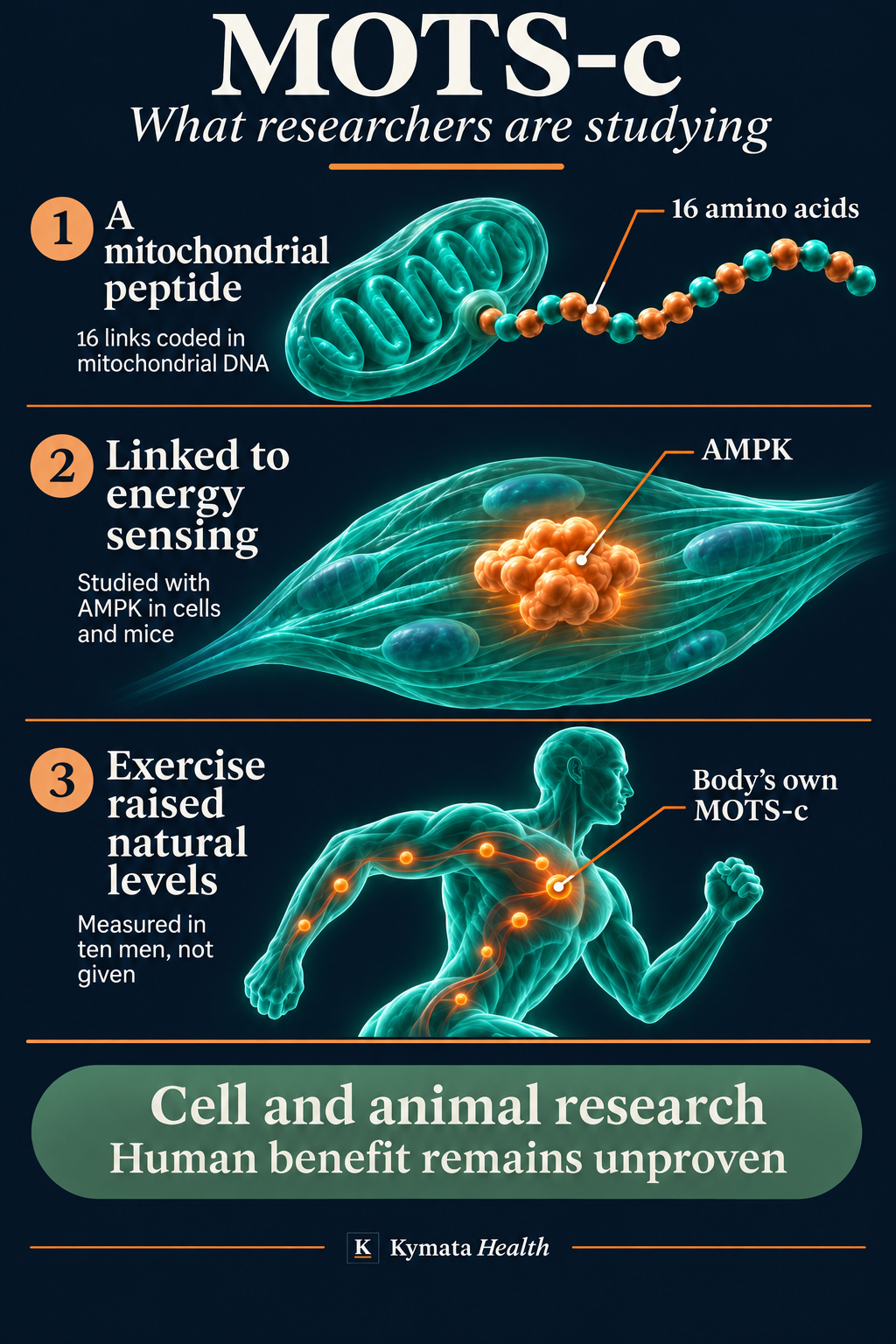
The guide shows MOTS-c as a 16-amino-acid peptide coded in mitochondrial DNA and studied with the AMPK energy sensor in cells and mice (Lee 2015, PMID 25738459). In ten men, exercise raised the body’s own MOTS-c; they were not given MOTS-c (PMID 33473109). Whether taking extra MOTS-c helps people is unknown. The drawing is a schematic, not a measured molecular structure, a product photograph or a treatment result. Illustration review: 22 November 2026, against this page’s own mechanism, evidence and regulatory records.
Illustration notes and source record
What happens to MOTS-c when you exercise?
How muscles use fuel. Mitochondrial DNA encodes MOTS-c. In lab-grown cells, this peptide activated AMPK, a fuel sensor, and increased the cells’ use of sugar.
What the exercise study found. After volunteers cycled, levels of naturally occurring MOTS-c rose in their muscles. In a separate experiment, mice given MOTS-c ran longer on a treadmill than control mice.
Inside a muscle cell · mitochondrion in cross section
Earlier contextual illustration
Earlier mechanism plate and its source context

A short message within mitochondrial DNA
In 2015, researchers identified instructions for making MOTS-c within a mitochondrial gene called 12S ribosomal RNA. Those instructions specify sixteen amino acids.
Choose Rotate or Pan, then focus the diagram and use the arrow keys. Up and down tilt in Rotate mode. Pinch or use + and − to zoom.
Each bead is one amino acid. Once it is part of the chain, it is called a residue. Drag to rotate or tap a bead. The shape is a schematic illustration.
- Nonpolar
- Basic
- Aromatic
- Polar
- Acidic
- Glycine / proline
A sulfur atom sits inside its side branch. This uncharged chemical group is called a thioether. Each letter is one amino acid in the reported human MOTS-c sequence.
Read the full sequence
A peptide bond is a covalent link joining two amino acids in a chain. A hydrogen bond is a weaker attraction, for example between a hydrogen on an oxygen and a nearby oxygen atom. A side chain may form hydrogen bonds without joining another amino acid to the chain. This diagram shows the sequence; it does not measure these interactions. See the IUPAC definitions of peptides and hydrogen bonds.
MRWQEMGYIFYPRKLR
- Methionine. A sulfur atom sits inside its side branch. This uncharged chemical group is called a thioether.
- Arginine. Its tip, called a guanidinium group, usually carries a positive charge near neutral pH.
- Tryptophan. Its two joined rings form a structure called indole. One part of that structure can form a hydrogen bond.
- Glutamine. Its uncharged tip can form weak attractions called hydrogen bonds with nearby molecules.
- Glutamate. Its side branch usually carries a negative charge near neutral pH, the middle of the acidity scale.
- Methionine. A sulfur atom sits inside its side branch. This uncharged chemical group is called a thioether.
- Glycine. Its side branch is a single hydrogen atom, leaving the chain more room to bend here.
- Tyrosine. Six carbon atoms form a loop with an oxygen and hydrogen attached. Chemists call this a phenolic group.
- Isoleucine. Its branching side chain mixes poorly with water, a property called hydrophobicity.
- Phenylalanine. Six carbon atoms form a closed loop in its side branch. Chemists call this an aromatic ring. It mixes poorly with water.
- Tyrosine. Six carbon atoms form a loop with an oxygen and hydrogen attached. Chemists call this a phenolic group.
- Proline. Its side branch loops back onto the main chain, limiting how freely the chain can turn here.
- Arginine. Its tip, called a guanidinium group, usually carries a positive charge near neutral pH.
- Lysine. Its side branch usually carries a positive charge near neutral pH, the middle of the acidity scale.
- Leucine. Its branching side chain mixes poorly with water, a property called hydrophobicity.
- Arginine. Its tip, called a guanidinium group, usually carries a positive charge near neutral pH.
How to read the mechanism
Biology and evidencePreclinical research links MOTS-c with metabolic pathways that help cells respond to stress, including AMPK-associated signaling. The illustration is a simplified map of this research.
Measuring a change in circulating MOTS-c during exercise cannot establish the effect of administering it as a product. Results from an analogue also need to stay separate from the exact peptide.
The practical takeaway: In a study of ten men, researchers measured the body’s own MOTS-c during exercise. Whether taking extra MOTS-c improves endurance remains an open question.
05 / Evidence and limits
Evidence and limits
Actual study populations, findings and limits
What the studies found
Study design · measured outcomeExercise and endogenous MOTS-c
Naturally occurring peptide measured during exercise
The human component of a 2021 experiment studied ten men during exercise.
Finding. Researchers measured endogenous MOTS-c; participants were not given MOTS-c injections.
What the finding means
This supports a biological association, not a treatment claim for endurance, weight loss or longevity.
Administered-product evidence
Nominated substances and an analogue
The July FDA review found no clinical administration study of the exact nominated MOTS-c substances.
Finding. The October HHS policy also discusses an analogue trial in its safety rationale.
What the finding means
An analogue trial cannot establish that the exact marketed peptide improves patient outcomes.
FDA scientific review: MOTS-c (July 2026) ↗ HHS: Enforcement Discretion Policy Regarding 503A Compounding Using Certain Peptide Bulk Drug Substances, with Appendices A and B (PDF, Oct 28, 2026) ↗
Select a group to see its evidence.
Keep animal treatment experiments, human biomarker observations and analogue trials in separate categories.
06 / Product forms and access
Product forms and access
October 2026 compounding update
Editorial check · Nov 6, 2026HHS describes when it intends to exercise enforcement discretion for MOTS-c acetate, in subcutaneous or intramuscular injectable dosage forms under section 503A. Prescribing and quality conditions apply.
The October 30 Federal Register notice calls the interim policy a draft. It is not FDA product approval or proof of clinical benefit.
Forms, conditions and source record ↓Read the dated announcement →
HHS policy, Appendices A and B · announced Oct 28; notice published Oct 30.
The dated policy, covered forms and prescribing conditions
The October policy covers MOTS-c acetate, in subcutaneous or intramuscular injectable dosage forms subject to its conditions. It applies to section 503A prescribing, not 503B outsourcing facilities, research-use-only products or supplements.
Read the policy conditions, source documents and earlier FDA assessment
What did HHS announce on Oct 28, 2026?
Checked Oct 28, 2026HHS says it does not intend to take enforcement action against state-licensed pharmacies, Federal facilities and licensed physicians compounding MOTS-c under section 503A when the stated conditions are met, while FDA’s 503A bulks-list rulemaking continues.
The notice says: “HHS does not intend to take enforcement action against a State-licensed pharmacy, Federal facility, or licensed physician compounding a drug product using a peptide bulk drug substance found in Appendix A.” It adds: “Compounded drugs are not FDA-approved, which means FDA does not review their safety, effectiveness, or quality before they are marketed.” Source: Federal Register document 2026-22192, public-inspection PDF (filed Oct 28, 2026 11:15 am; published Oct 30, 2026, 91 FR 68526)
- Filed for public inspection
- Oct 28, 2026
- Federal Register publication
- Oct 30, 2026
- Comments
- Until two weeks after publication (Nov 13, 2026 by our count), docket HHS-OASH-2026-0496
- Next step
- FDA rulemaking on the 503A bulks list, which may propose adding some or all of the six
Which forms of MOTS-c does the policy cover?
Appendix BPer the HHS policy document (Oct 28, 2026), Appendix B covers MOTS-c acetate, in subcutaneous or intramuscular injectable dosage forms, compounded from a bulk peptide with a certificate of analysis that meets the policy’s conditions. Source: HHS: Enforcement Discretion Policy Regarding 503A Compounding Using Certain Peptide Bulk Drug Substances, with Appendices A and B (PDF, Oct 28, 2026)
Not covered
- Oral or nasal MOTS-c, IV drips and MOTS-c free base
- Blends and IV “cocktails” that combine MOTS-c with other ingredients
- 503B outsourcing facilities: the notice covers section 503A compounding only
- Research-use-only or “not for human consumption” vials, and dietary supplements
- Products not compounded by a state-licensed pharmacy, Federal facility or licensed physician under 503A
- It is not FDA approval: compounded drugs are not FDA-approved, and these remain unapproved drugs.
- It does not add anything to the 503A bulks list, and it is not FDA’s “Category 1”; FDA’s categories list (updated May 14, 2026) does not name these six.
- It is an interim policy: it lasts until FDA addresses each peptide in a final rule on the 503A bulks list, HHS says it may revisit it if a safety signal or product-quality problem arises, and it is not binding.
- It covers section 503A compounding only: not 503B outsourcing facilities, not research-use-only products and not dietary supplements.
What conditions must a pharmacy meet?
All ten must be met- Appendix A: the peptide is on the policy’s “503A Interim Access List” (BPC-157, Epitalon, KPV, MOTS-c, Semax, TB-500).
- Identity and route: the bulk peptide has the identity (amino acid sequence, chemical structure, molecular weight and formula) and the route limits set out in Appendix B.
- Characterization: it comes from an FDA-registered (section 510) facility with a valid certificate of analysis (COA) whose test results meet the Appendix B testing standard.
- Original manufacturer: registered under section 510, compliant with CGMP, and its physical location listed on the COA; a registered repacker, relabeler or reseller must have validated the manufacturer and its COA.
- Reporting: compounded products, serious adverse events (whether or not considered drug-related) and product-quality problems are reported to FDA MedWatch and to the states involved; the patient label explains how to report.
- Label: “This is a compounded drug product. Not for resale.”
- One active ingredient: the product contains only a single API listed in Appendix A, so no blends.
- Oral forms: the compounder keeps documentation that the specific oral formulation achieves an adequate level of oral bioavailability in humans.
- Device: the only drug delivery device co-packaged with, or containing, the drug is an FDA 510(k)-cleared syringe.
- Everything else in the FD&C Act still applies, including no insanitary conditions and section 503A’s patient-specific prescription requirement.
Per the HHS policy document (Oct 28, 2026), in its order. Source: HHS: Enforcement Discretion Policy Regarding 503A Compounding Using Certain Peptide Bulk Drug Substances, with Appendices A and B (PDF, Oct 28, 2026)
What did FDA advisers and staff say about MOTS-c?
PCAC Jul 23, 2026FDA staff recommended against adding MOTS-c to the 503A bulks list, reviewing its use for nominated uses including obesity and osteoporosis. FDA’s Pharmacy Compounding Advisory Committee voted 7–5 (2 abstentions) on Jul 23, 2026 to recommend listing it; the vote is advisory. FDA has not posted minutes; the tally is as reported by press. Source: Pharmacy Times: What the peptide vote actually changes at my counter (Jul 29, 2026)
FDA reviewers: “FDA is particularly concerned about the lack of human data on drug products containing this substance delivered via any route of administration.” Source: FDA briefing document for MOTS-c-related bulk drug substances, PCAC July 23-24, 2026 (PDF)
FDA reviewers: “Although nonclinical pharmacological studies investigated the role of MOTS-c on biological processes that could be relevant to the nominated uses, these studies were limited to in-vitro and in-vivo rodent models.” Source: FDA briefing document for MOTS-c-related bulk drug substances, PCAC July 23-24, 2026 (PDF)
What is the evidence for MOTS-c in people?
Keep animal treatment experiments, human biomarker observations and analogue trials in separate categories.
Sport: Prohibited in sport per FDA’s PCAC briefing document, which says MOTS-c is listed as prohibited in the Global DRO database (WADA hormone and metabolic modulators, S4).
How does the prescription route work?
- A licensed clinician who examines your history decides whether a compounded peptide is appropriate and writes a prescription for you. Section 503A covers a drug that “is compounded for an identified individual patient based on the receipt of a valid prescription order”, and the HHS policy keeps that patient-specific prescription requirement.
- A state-licensed pharmacy (or a licensed physician or Federal facility) compounds it under section 503A, from a bulk peptide listed in the policy’s Appendix A, in a form and route the policy covers, and meeting its conditions.
- Ask the pharmacy which salt form and route it compounds, who manufactured the bulk peptide, and for the certificate of analysis. Expect a single active ingredient and the label line “This is a compounded drug product. Not for resale.” For an oral form, the policy expects the pharmacy to hold documentation of adequate oral bioavailability in humans.
- Check your state: a state board of pharmacy can set stricter rules, and legal commentators say it is unclear whether states will follow the HHS policy.
- Report a serious side effect or a product problem to FDA MedWatch.
Source: 21 U.S.C. 353a (section 503A of the FD&C Act) Source: FDA MedWatch: report a problem
What are the red flags?
- “Research use only”, “not for human consumption” or “for laboratory use” on the vial or website.
- No prescription, no clinician review, or a “prescription” that comes automatically with checkout.
- Two or more peptides in one vial or product (“Wolverine”, GLOW, KLOW and other stacks).
- No certificate of analysis, or one that does not name the manufacturer and where it is made.
- A route the policy does not cover for that peptide, such as nasal BPC-157 or injected KPV.
- Claims that a peptide is “FDA approved”, “now legal” or proven to work for a condition.
We do not list or link sellers of MOTS-c. None of our partners sells it as of Oct 28, 2026.
Sources for this section
Checked Oct 28, 2026- Source: Federal Register document 2026-22192, public-inspection PDF (filed Oct 28, 2026 11:15 am; published Oct 30, 2026, 91 FR 68526)
- Source: Federal Register: Enforcement Discretion Policy Regarding 503A Compounding Using Certain Peptide Bulk Drug Substances (2026-22192, 91 FR 68526, Oct 30, 2026)
- Source: HHS: Enforcement Discretion Policy Regarding 503A Compounding Using Certain Peptide Bulk Drug Substances, with Appendices A and B (PDF, Oct 28, 2026)
- Source: Regulations.gov docket HHS-OASH-2026-0496 (comments)
- Source: FDA: 503A bulk drug substance categories (PDF, updated May 14, 2026)
- Source: FDA: July 23-24, 2026 meeting of the Pharmacy Compounding Advisory Committee
- Source: FDA briefing document for MOTS-c-related bulk drug substances, PCAC July 23-24, 2026 (PDF)
- Source: Hyman, Phelps & McNamara, FDA Law Blog: “The PEPTIDE-L Wave Reaches HHS: Enforcement Discretion … Not the Finish Line” (Oct 28, 2026)
- Source: CNN: FDA scientists opposed the Trump administration’s move to ease peptides access (Oct 28, 2026)
- Source: STAT: HHS enforcement discretion policy allows peptide compounding (Oct 28, 2026)
News, Oct 28: what the HHS peptide compounding policy does and does not do →
Every peptide’s status on FDA’s compounding lists, in one table →
07 / Tools and practical checks
Tools and practical checks
Built from the conditions in the HHS policy document (Oct 28, 2026). No doses, no sellers, not legal advice.
Open the product-policy checker and timeline
Is this MOTS-c product inside the policy?
Conditions from the HHS policy documentAnswer the questions to see a result
The result names the condition of HHS’s policy behind each answer.
Not legal or medical advice, and not a check of any pharmacy or product: it compares what you describe with the conditions in the HHS policy document (Oct 28, 2026). It never gives doses and names no sellers. Nothing you pick leaves this page.
Policy timeline
Checked Oct 28, 2026- Happened
FDA advisory committee voteAs reported
FDA’s Pharmacy Compounding Advisory Committee voted 7–5 (2 abstentions) to recommend adding MOTS-c to the 503A bulks list, as reported by press (FDA has not posted minutes). The vote is advisory; FDA staff had recommended against.
- Happened
HHS announces its interim policy
HHS files its enforcement-discretion policy for public inspection (Federal Register 2026-22192). For MOTS-c, Appendix B covers MOTS-c acetate, in subcutaneous or intramuscular injectable dosage forms. It is not FDA approval.
- Scheduled as of Oct 28, 2026
Federal Register publication
The notice is scheduled to publish in the Federal Register; the two-week comment period runs from publication.
- Scheduled as of Oct 28, 2026
Comment period closes (our count)
Two weeks after publication, by our count; regulations.gov shows the official date for docket HHS-OASH-2026-0496.
- Rulemaking pending
FDA rulemaking on the 503A bulks list
The interim policy lasts until FDA addresses MOTS-c in a final rule on the 503A bulks list. HHS: “FDA’s future rulemakings may propose adding some or all of these peptides to the 503A bulks list based on the available evidence.” HHS may also revisit the policy if a safety signal or product-quality problem arises.
Questions to ask
From the ten conditionsAsk the pharmacy
- Is the bulk peptide MOTS-c, one of the six on Appendix A of HHS’s policy? Condition 1
- Which salt form and route is this? (Appendix B covers MOTS-c acetate, in subcutaneous or intramuscular injectable dosage forms.) Condition 2
- May I see the certificate of analysis for the bulk peptide, from an FDA-registered (section 510) facility? Condition 3
- Who manufactured the bulk peptide, where is it made, and is that location on the certificate of analysis? Condition 4
- How do I report a side effect or a product problem, and is that on the label? Condition 5
- Does the label say “This is a compounded drug product. Not for resale.”? Condition 6
- Is MOTS-c the only active ingredient in this product? Condition 7
- If a device comes with it, is it an FDA 510(k)-cleared syringe? Condition 9
Ask your clinician
- Is this compounded for me, on a prescription you write after reviewing my history? Condition 10
- Why a compounded MOTS-c, which is not FDA-approved, rather than an FDA-approved treatment, if one exists for my condition? Condition 10
- FDA’s reviewers raised concerns about MOTS-c; how do they apply to me? Condition 10
Ask Kymata
Each question fills in Ask Kymata for you to edit; nothing is sent until you press send.
All six peptides under the policy, in the library →News, Oct 28: what the HHS peptide compounding policy does and does not do →
Dose it
10 mg + 2 mL BAC water → 5 mg/mL · 1 unit (U-100) = 50 mcg.
Reconstitution math
U-100 syringe| Vial | Water | Concentration |
|---|---|---|
| 10 mg lyophilized | 2 mL BAC | 5 mg/mL |
08 / Published study use
Published study use
What published studies gave, in whom, and the source. Not a dose for you.
What studies used
No human dosing study- No human dosing study has been published.
- Mice given it developed less diet-induced and age-related insulin resistance. Lee 2015, PMID 25738459 (opens in new tab)
- Mice: injections three times a week, started late in life, raised physical capacity. In people, the study measured MOTS-c the body makes during exercise; it did not give the peptide to anyone. Reynolds 2021, PMID 33473109 (opens in new tab)
- The doses quoted online come from animal work and vendor or forum sources.
A record of what researchers gave, in whom; not a dose for you.
09 / Safety and interactions
Safety and interactions
What the record says
Research peptide. Limited human safety data (primarily rodent models). Naturally occurring endogenous mitochondrial peptide. Monitor blood glucose if diabetic.
Interactions & Contraindications
Research compound. Limited human safety data. AMPK activation may interact with metformin (additive effects on glucose metabolism). Caution with insulin or GLP-1 agonists due to additive insulin sensitization. Available in injectable form; oral bioavailability very limited.
10 / Comparisons and goal guides
Comparisons and goal guides
Combinations: what has been tested
1 pairing- + NAD+ →NAD+ is a cofactor. MOTS-c is an mtDNA ORF with AMPK papers. Complementary marketing is not a mitochondrial-resilience RCT.
Appears in goal guides
5 guidesGoal guides give the evidence and status for each compound, with no doses. A mention here is not a treatment plan.
- GoalPerimenopause and MenopauseKisspeptin, epitalon, MOTS-c and PT-141 as they come up around menopause: what each has been studied for, what is approved, and why the prescriber decides.Evidence and status
- GoalWeight Loss PlateausTesamorelin, AOD-9604 and MOTS-c as they come up for a stalled diet: the one approved use, the failed obesity trials, the mouse data, and why no dose is given.Evidence and status
- GoalAthletic PerformanceMuscle and blood-vessel bioregulator capsules, BPC-157, TB-500, GH secretagogues, MOTS-c and GHK-Cu as they come up in athletic circles: the evidence, the status and the sport rules.Evidence and status
- GoalLongevity Bioregulators and PeptidesThe Khavinson pineal, thymus and bone-marrow capsules, plus epitalon, GHK-Cu, FOXO4-DRI and MOTS-c: what each has been studied for, its status, and why no course or dose is given.Evidence and status
- GoalFitness in Later LifeThe “centenarian decathlon” idea, with the Khavinson muscle, cartilage and blood-vessel capsules and MOTS-c: what is studied, the status, and why training comes first.Evidence and status
11 / Common questions
Common questions
Common questions
7 answersIs MOTS-c FDA-approved?
No. Covered by HHS enforcement-discretion policy (announced Oct 28, 2026; conditions apply) for 503A compounding on a prescription. Not FDA-approved, not on the 503A bulks list; interim, comment period open, revocable (checked Oct 28, 2026). Its HHS listing (HHS policy document, Oct 28, 2026, Appendix B): MOTS-c acetate, in subcutaneous or intramuscular injectable dosage forms.
Can a US pharmacy compound MOTS-c now?
Under an interim policy announced Oct 28, 2026 (Federal Register 2026-22192, published Oct 30, 2026), HHS says it does not intend to take enforcement action against state-licensed pharmacies, Federal facilities and licensed physicians compounding MOTS-c under section 503A when the stated conditions are met, while FDA’s 503A bulks-list rulemaking continues. Per the HHS policy document (Oct 28, 2026), Appendix B covers MOTS-c acetate, in subcutaneous or intramuscular injectable dosage forms; each product may contain only that one active ingredient, the bulk peptide needs a certificate of analysis from an FDA-registered facility. It is not FDA approval, MOTS-c is not on the 503A bulks list, HHS can revisit the policy, and it does not cover 503B outsourcing facilities, research-use-only products or supplements. Comments are open until two weeks after publication.
What did FDA’s reviewers say about MOTS-c?
FDA staff recommended against adding MOTS-c to the 503A bulks list, reviewing its use for nominated uses including obesity and osteoporosis. Their briefing document says: “FDA is particularly concerned about the lack of human data on drug products containing this substance delivered via any route of administration.” FDA’s advisory committee voted 7–5 (2 abstentions) on Jul 23, 2026 (as reported by press) to recommend listing it anyway; the vote is advisory.
How do MOTS-c and SS-31 differ?
MOTS-c is a mitochondrial-derived peptide studied in metabolic signaling. SS-31, or elamipretide, binds cardiolipin. Its US accelerated approval concerns muscle strength in people with Barth syndrome weighing at least 30 kg. That indication applies specifically to elamipretide.
What is MOTS-c studied for?
MOTS-c is a 16-amino-acid peptide encoded in mitochondrial DNA. Mitochondria help cells use energy, and researchers are studying how MOTS-c fits into the body’s response to exercise.
What have human studies of MOTS-c shown?
In a study of ten men, researchers measured the body’s own MOTS-c during exercise. Whether taking extra MOTS-c improves endurance remains an open question. Keep animal treatment experiments, human biomarker observations and analogue trials in separate categories.
How does MOTS-c work?
Preclinical research links MOTS-c with metabolic pathways that help cells respond to stress, including AMPK-associated signaling. The illustration is a simplified map of this research. Measuring a change in circulating MOTS-c during exercise cannot establish the effect of administering it as a product. Results from an analogue also need to stay separate from the exact peptide.
12 / Sources and references
Sources and references
Additional background papers. Primary studies and policy sources are linked in the relevant sections.
Sources
2 papers- 1“The mitochondrial-derived peptide MOTS-c promotes metabolic homeostasis and reduces obesity and insulin resistance.”Lee C et al. Cell Metabolism (2015). PMID: 25738459
- 2“"MOTS-c is an exercise-induced mitochondrial-encoded regulator of age-dependent physical decline and muscle homeostasis".”Reynolds JC et al. Nature Communications (2021). PMID: 33473109
14 / Prescription options
Prescription options
Prescription options: compare licensed telehealth providers
Some peptide therapies are available only by prescription after a consult with a licensed clinician.
Compare telehealth →15 / Peptide library
Peptide library
Keep reading: Peptide research library
Peptide research library: every pagePeptide libraryBrowse all topics
- EpitalonPrevious in this topic · Epitalon is a synthetic four-amino-acid peptide, Ala-Glu-Asp-Gly, also called AEDG.
- SS-31Next in this topic · Elamipretide.
- DihexaDihexa has been tested in animals, but no human trial identified here administered it directly.
- SelankTuftsin analog (TKPRPGP) with a Russian prescription story.
- SemaxSemax is a synthetic seven-amino-acid analogue of an ACTH fragment.
Regulatory and sport classification
- WADA (S4): prohibited in sport, per FDA’s PCAC briefing document