
The peptide field guide
PT-141
PT-141 is bremelanotide, a synthetic melanocortin analogue.
The prescription injection, earlier nasal research and research powders are separate product and evidence records.
Explore this compoundConceptual illustration of discussing patient-reported experience. It does not show a study participant, testimonial, endorsement, real clinical encounter or treatment outcome.
02 / At a glance
At a glance
Key facts
- Also known as
- Bremelanotide, Vyleesi
- Type
- Sexual Health
- Evidence level
- FDA-approved for low desire in women: prescription only.
- US regulatory status
- FDA-approved as Vyleesi® (bremelanotide autoinjector) for acquired, generalized hypoactive sexual desire disorder (HSDD) in premenopausal women; not indicated for postmenopausal women or men. Research-labeled PT-141 is not Vyleesi
- Updated
Identity
PT-141 is bremelanotide, a synthetic melanocortin analogue.
Research context
Two twenty-four-week Vyleesi trials in premenopausal women with acquired, generalized HSDD.
Evidence limits
The prescription injection, earlier nasal research and research powders are separate product and evidence records.
Read the technical profile and study-use reference
Quick answer
Evidence: HighPT-141 is bremelanotide, the active drug in Vyleesi, an FDA-approved autoinjector for acquired, generalized HSDD in premenopausal women; the label says it is not indicated for postmenopausal women or men. Research powders and nasal sprays are not Vyleesi. It acts on melanocortin receptors, not on blood flow like a PDE5 inhibitor. Nausea and transient blood-pressure rises are on the label.
- FDA label dose
- FDA label (Vyleesi): dose set by the prescriber and the label
Research summary, not medical advice.
At a glance
Kymata peptide profile · Nov 21, 2026- CAS
- 189691-06-3
- FDA label dose
- FDA label (Vyleesi): dose set by the prescriber and the label
- Half-life
- About 2.7 hours mean terminal half-life after a single subcutaneous Vyleesi injection (range 1.9 to 4.0 hours; Vyleesi label)
- Common vials
- Ready-to-use solution; no water is added
- Molecular weight
- 1025.2 g/mol (free peptide; PubChem CID 9941379)
03 / Identity and origin
Identity and origin
Also called Bremelanotide, Vyleesi. Cyclic melanocortin agonist (bremelanotide; Vyleesi is the labeled product).
Read the sequence and compound record
Compound card
- Sequence
- Ac-Nle-cyclo[Asp-His-D-Phe-Arg-Trp-Lys]-OH
- Class
- Cyclic melanocortin agonist (bremelanotide; Vyleesi is the labeled product)
- Formula
- C50H68N14O10
- Molecular weight
- 1025.2 g/mol (free peptide; PubChem CID 9941379)
- CAS
- 189691-06-3
- Described by
- Palatin Technologies (derived from Melanotan II, University of Arizona), 1996
- Bioavailability
- About 100% absolute bioavailability for subcutaneous Vyleesi (Vyleesi label)
04 / How it may work
How it may work
Cyclic melanocortin agonist (bremelanotide; Vyleesi is the labeled product)
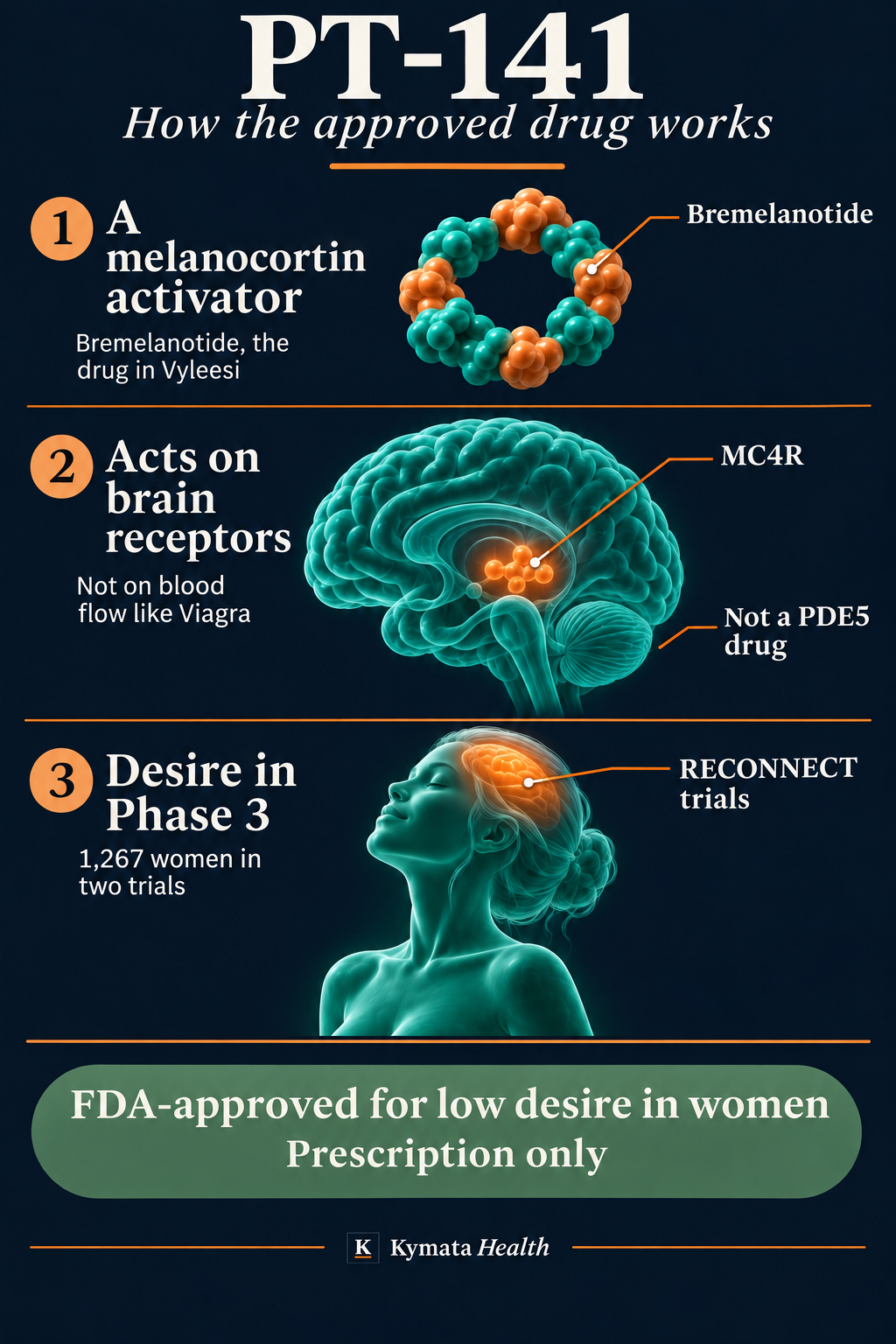
The guide shows PT-141 as bremelanotide, the drug in Vyleesi, which activates melanocortin receptors in the brain rather than acting on blood flow like PDE5 inhibitors. Its approval rests on the two identical phase 3 RECONNECT trials, in which 1,267 premenopausal women with hypoactive sexual desire disorder were randomized to bremelanotide or placebo for 24 weeks (Kingsberg 2019, PMID 31599840). An earlier 18-woman crossover study tested the intranasal formulation in arousal disorder, a different product and a different condition from the approved injection (Diamond 2006, PMID 16839319). Vyleesi is FDA-approved for acquired, generalized hypoactive sexual desire disorder in premenopausal women; research powders and nasal sprays are not that product. The drawing is a schematic, not a measured molecular structure, a product photograph or a treatment result. Illustration review: 22 November 2026, against this page’s own mechanism, evidence and regulatory records.
The retained technical record includes a modified or incompletely specified chain. No simplified residue model is inferred; read the sequence and compound record for its exact scope.
Illustration notes and source record
Is a PT-141 nasal spray the same medicine as the Vyleesi injector?
One research name, different products. PT-141 is an early name for bremelanotide. The US-approved product, Vyleesi, comes as a single-dose autoinjector for a specific low-desire disorder in premenopausal women. Its approval applies to that injection.
Where the nasal spray comes from. An early crossover study tested a nasal formulation against placebo in 18 premenopausal women with sexual arousal disorder. Its results do not establish a spray dose equivalent to Vyleesi or verify the contents of a research vial.
The spray and injector represent two different delivery methods.
Earlier contextual illustration
Read the source record on this page. Laboratory, topical and injected studies are separate evidence; this illustration does not establish an indication or a treatment outcome.

How it works
SourcedPT-141 is the research code for bremelanotide, the active drug in Vyleesi. Bremelanotide nonselectively activates several melanocortin receptors; the Vyleesi label lists MC1R as its strongest target and states that binding at MC1R and MC4R is most relevant at therapeutic levels, and that the mechanism in HSDD is unknown. It does not act on blood flow the way PDE5 inhibitors do.
FDA approved Vyleesi, a bremelanotide autoinjector, for premenopausal women with acquired, generalized hypoactive sexual desire disorder; the label states it is not indicated for postmenopausal women, for men, or to enhance sexual performance. The early PT-141 studies used intranasal formulations, and no conversion exists between those sprays and the injection.
Source: Vyleesi label; Diamond 2006 (PMID 16839319); Kingsberg 2019 (PMID 31599840)
Vyleesi’s approved strength is 1.75 mg/0.3 mL in a single-dose prefilled autoinjector, a ready-to-use solution with nothing to reconstitute. The nasal sprays in the early PT-141 trials were different formulations, and a powder or spray sold as PT-141 is not Vyleesi.
Background & History
PT-141 (Bremelanotide) is a cyclic heptapeptide derived from alpha-MSH (alpha-melanocyte-stimulating hormone) developed by Palatin Technologies. It is a melanocortin-receptor agonist (including MC4R) that acts in the brain, unlike sildenafil and other PDE5 inhibitors, which act on blood flow; the Vyleesi label states that how it improves HSDD is unknown. FDA approved it in 2019 as Vyleesi for acquired, generalized hypoactive sexual desire disorder (HSDD) in premenopausal women, after flibanserin (Addyi, 2015). It is not labeled for men or for postmenopausal women.
05 / Evidence and limits
Evidence and limits
Early nasal and injection studies of PT-141; Vyleesi’s phase 3 trials are on the bremelanotide page
Human evidence
Early nasal and injection studies of PT-141; Vyleesi’s phase 3 trials are on the bremelanotide page- In a 2006 randomized, double-blind crossover study of 18 premenopausal women with female sexual arousal disorder (Diamond et al., PMID 16839319), more women reported moderate or high desire after a single intranasal dose of bremelanotide than after placebo, while vaginal vasocongestion during erotic video did not differ significantly.
- In a 2004 double-blind, placebo-controlled phase 1 evaluation in healthy men and Viagra-responsive men with mild-to-moderate erectile dysfunction (Diamond et al., PMID 14963471), intranasal PT-141 produced statistically significant RigiScan-measured erectile responses compared with placebo at doses above 7 mg, with flushing and nausea the most common adverse events.
- In a 2004 placebo-controlled crossover study (Rosen et al., PMID 14999221), subcutaneous PT-141 at 4 or 6 mg produced statistically significant erectile responses during visual sexual stimulation in men whose erectile dysfunction had responded inadequately to 100 mg Viagra, and it was well tolerated.
- A 2008 randomized, double-blind trial in 342 men with sildenafil-unresponsive erectile dysfunction (Safarinejad and Hosseini, PMID 18206919) reported positive results in 33.5% with intranasal bremelanotide versus 8.5% with placebo, but the journal attached an expression of concern to the paper in 2023 (PMID 36626345), so the result cannot be relied on.
Use-case scores
0–100–10 against the evidence we have, not a gym ranking. Hidden domains do not apply here.
- Sexual / hormonal7.5/10Vyleesi is labeled for premenopausal HSDD on two 24-week phase 3 trials. Ceiling 9; haircut because a vial of unknown fill is not Vyleesi, the Vyleesi label says it is not indicated for men, and nausea and blood-pressure effects limit use.
Limits of current evidence
3 limits- In a 2006 randomized, double-blind crossover study of 18 premenopausal women with female sexual arousal disorder (Diamond et al., PMID 16839319), more women reported moderate or high desire after a single intranasal dose of bremelanotide than after placebo, while vaginal vasocongestion during erotic video did not differ significantly. That was arousal disorder, not HSDD, and a nasal formulation, not Vyleesi.
- The Vyleesi label states it is not indicated for postmenopausal women, for men, or to enhance sexual performance; the male erectile studies used nasal or experimental formulations, and the largest carries a 2023 expression of concern (PMID 36626345).
- The Vyleesi label contains no interaction data for PDE5 inhibitors. Transient blood-pressure rises are on the label.
What it is studied for
- Identity: Vyleesi labeled HSDD vs a research powder
- Why this is not a PDE5 and not a general ED NDA
- Nausea and blood-pressure effects on the Vyleesi label
Goal context
1 goals- Desire vs blood flow
- Bremelanotide acts on melanocortin receptors in the brain; sildenafil acts on blood flow. Small laboratory studies in men with a poor sildenafil response are not evidence that a research vial will work.
Verdict
PT-141 is bremelanotide. Vyleesi, a prefilled autoinjector, is labeled for acquired, generalized HSDD in premenopausal women and not for men. Research vials and nasal sprays are not that product, and it is not a PDE5 inhibitor.
06 / Product forms and access
Product forms and access
Regulatory & legal status
- FDA status (US)
- ApprovedFDA-approved as Vyleesi® (bremelanotide autoinjector) for acquired, generalized hypoactive sexual desire disorder (HSDD) in premenopausal women; not indicated for postmenopausal women or men. Research-labeled PT-141 is not Vyleesi
- WADA status (2026)
- Not ListedNot currently on the WADA 2026 Prohibited List. Policies may change. Verify before competition.
- Classification
- Prescription Drug
- US compounding
- FDA does not review or approve compounded drugs for safety, effectiveness or quality, so a compounded or research-labeled PT-141 product is not Vyleesi
07 / Tools and practical checks
Tools and practical checks
No separate record is provided here. Read the linked evidence and limitations for this compound.
08 / Published study use
Published study use
What the label states, for the patients it is approved for, and the source. Not a dose for you.
What the FDA label says
FDA label- Vyleesi’s approved strength is 1.75 mg/0.3 mL in a single-dose autoinjector for subcutaneous use; the label sets how often it may be used. Vyleesi label, DailyMed (opens in new tab)
The label’s dosing, for the patients it is approved for; the prescriber sets the dose.
Administration
- Route / form
- Vyleesi: subcutaneous prefilled autoinjector (labeled). The early research studies used experimental nasal formulations.
Timeline
2 stages- Single dose, 24-hour follow-up
In Diamond 2006 (PMID 16839319), more women with arousal disorder reported moderate or high desire after one intranasal dose than after placebo; vaginal vasocongestion did not differ.
- Duration of effect
The Vyleesi label states that the duration of efficacy after each dose is unknown; the 2.7-hour plasma half-life describes clearance, not how long an effect lasts.
Who it is for
2 uses| Category | Fit | What exists |
|---|---|---|
| Sexual Dysfunction (Female HSDD) | High | Vyleesi is labeled for acquired, generalized HSDD in premenopausal women. Two 24-week phase 3 trials support that label (PMID 31599840). |
| Erectile dysfunction in men (off-label) | Low | The Vyleesi label says it is not indicated for men. The male studies used nasal or experimental formulations, and the largest carries a 2023 expression of concern (PMID 36626345). |
09 / Safety and interactions
Safety and interactions
What the record says
The Vyleesi label contraindicates use in uncontrolled hypertension or known cardiovascular disease, reports transient blood-pressure rises of up to 6/3 mmHg with heart-rate drops of up to 5 beats per minute after each dose, and advises against use with oral naltrexone products for alcohol or opioid addiction. Nausea, flushing and headache were the most common adverse reactions, and the label reports focal hyperpigmentation. FDA does not review or approve compounded drugs for safety, effectiveness or quality, so a compounded or research-labeled PT-141 product is not Vyleesi.
Interactions & Contraindications
Vyleesi label: nausea and flushing are common, and blood pressure rises transiently after each dose. Contraindicated in uncontrolled hypertension or known cardiovascular disease. It can markedly lower exposure to oral naltrexone, and it may slow gastric emptying and affect other oral medicines. The Vyleesi label contains no interaction data for PDE5 inhibitors.
10 / Comparisons and goal guides
Comparisons and goal guides
Combinations: what has been tested
2 pairings- + Kisspeptin →Different axis: kisspeptin is GnRH/LH, PT-141 is central MC4R. Clinics pair them. That is not a combination trial and not a male-ED NDA.
- + Oxytocin →Pitocin is labor. Intranasal oxytocin is not Vyleesi. Pairing them is a catalog habit, not a sexual-wellness protocol.
PT-141 vs. Melanotan-2
6 attributesCanonical comparison: PT-141 vs Melanotan-2 · Melanotan-2 evidence profile
| Attribute | PT-141 | Melanotan-2 |
|---|---|---|
| FDA Status | Approved as Vyleesi® (HSDD) | Research chemical (not FDA approved) |
| Mechanism | Nonselective melanocortin agonist; MC1R its strongest target, MC1R and MC4R most relevant at therapeutic levels (Vyleesi label) | MC1R + MC4R agonist (tanning + sexual) |
| Primary Effect | Sexual arousal / desire | Skin tanning + sexual arousal |
| Tanning Effect | Focal hyperpigmentation of the face, gums or breasts in 1% of phase 3 patients (Vyleesi label); MC1R is its strongest receptor target | Strong melanin-stimulated tanning |
| Side Effects | Nausea, flushing (self-limiting) | Nausea, erections, pigmentation, moles |
| Dose in studies | Set by the prescriber and the Vyleesi label | 0.01–0.03 mg/kg SC in a single-blind pilot in 3 healthy men (Dorr 1996, PMID 8637402): 2 of 3 developed increased skin pigmentation; mild nausea at most doses, and grade II somnolence and fatigue in 1 of 2 men at 0.03 mg/kg |
Appears in goal guides
2 guidesGoal guides give the evidence and status for each compound, with no doses. A mention here is not a treatment plan.
- GoalSexual Health and LibidoPT-141 (Vyleesi, FDA-approved for one use) and kisspeptin (research only): what the label says, what the kisspeptin studies measured, and what is not known.Evidence and status
- GoalPerimenopause and MenopauseKisspeptin, epitalon, MOTS-c and PT-141 as they come up around menopause: what each has been studied for, what is approved, and why the prescriber decides.Evidence and status
11 / Common questions
Common questions
Common questions
6 answersIs PT-141 the same as Vyleesi?
PT-141 is the research code for bremelanotide, the active drug in Vyleesi. Vyleesi’s approved strength is 1.75 mg/0.3 mL in a single-dose prefilled autoinjector (Vyleesi prescribing information, Cosette Pharmaceuticals 2026), labeled for acquired, generalized HSDD in premenopausal women. A powder or spray sold as PT-141 has its own formulation and is not Vyleesi.
What did the nasal spray study in women measure?
In a 2006 randomized, double-blind crossover study of 18 premenopausal women with female sexual arousal disorder (Diamond et al., PMID 16839319), more women reported moderate or high desire after a single intranasal dose of bremelanotide than after placebo, while vaginal vasocongestion during erotic video did not differ significantly. That population had arousal disorder, not HSDD, the labeled indication.
Has PT-141 been tested for erectile dysfunction in men?
Yes, in small laboratory studies. Intranasal PT-141 produced statistically significant RigiScan-measured erectile responses in healthy and Viagra-responsive men (Diamond et al., PMID 14963471), and subcutaneous PT-141 did so in men with an inadequate response to Viagra (Rosen et al., PMID 14999221). A larger 2008 trial carries a 2023 expression of concern (PMID 36626345). The Vyleesi label says it is not indicated for men.
How long does an effect last?
The Vyleesi label states that the duration of efficacy after each dose is unknown; the 2.7-hour plasma half-life describes clearance, not how long an effect lasts.
Does the Vyleesi label say anything about PDE5 inhibitors?
The Vyleesi label contains no interaction data for PDE5 inhibitors. It does advise against use with oral naltrexone products for alcohol or opioid addiction.
Is PT-141 FDA-approved?
Yes. FDA-approved as Vyleesi® (bremelanotide autoinjector) for acquired, generalized hypoactive sexual desire disorder (HSDD) in premenopausal women; not indicated for postmenopausal women or men. Research-labeled PT-141 is not Vyleesi.
12 / Sources and references
Sources and references
7 sources cited on this page.
Sources
7 sources- 1“An effect on the subjective sexual response in premenopausal women with sexual arousal disorder by bremelanotide (PT-141), a melanocortin receptor agonist.”Diamond LE et al. Journal of Sexual Medicine (2006). PMID: 16839319 DOI: 10.1111/j.1743-6109.2006.00268.x
- 2“Double-blind, placebo-controlled evaluation of the safety, pharmacokinetic properties and pharmacodynamic effects of intranasal PT-141, a melanocortin receptor agonist, in healthy males and patients with mild-to-moderate erectile dysfunction.”Diamond LE et al. International Journal of Impotence Research (2004). PMID: 14963471 DOI: 10.1038/sj.ijir.3901139
- 3“Evaluation of the safety, pharmacokinetics and pharmacodynamic effects of subcutaneously administered PT-141, a melanocortin receptor agonist, in healthy male subjects and in patients with an inadequate response to Viagra.”Rosen RC et al. International Journal of Impotence Research (2004). PMID: 14999221 DOI: 10.1038/sj.ijir.3901200
- 4“Salvage of sildenafil failures with bremelanotide: a randomized, double-blind, placebo controlled study.”Safarinejad MR, Hosseini SY Journal of Urology (2008). PMID: 18206919 DOI: 10.1016/j.juro.2007.10.063
- 5“Expression of Concern: Salvage of Sildenafil Failures With Bremelanotide: A Randomized, Double-Blind, Placebo Controlled Study.”Journal of Urology Journal of Urology (2023). PMID: 36626345 DOI: 10.1097/JU.0000000000003117
- 6“Bremelanotide for the Treatment of Hypoactive Sexual Desire Disorder: Two Randomized Phase 3 Trials.”Kingsberg SA et al. Obstetrics & Gynecology (2019). PMID: 31599840 DOI: 10.1097/AOG.0000000000003500
- 7“Vyleesi (bremelanotide) injection: prescribing information.”Cosette Pharmaceuticals DailyMed (2026). Prescribing information
14 / Prescription options
Prescription options
Prescription options: compare licensed telehealth providers
Some peptide therapies are available only by prescription after a consult with a licensed clinician.
Compare telehealth →15 / Peptide library
Peptide library
Keep reading: Peptide research library
Peptide research library: every pagePeptide libraryBrowse all topics
- MK-677Previous in this topic · Oral non-peptide GHS-R1a agonist (ibutamoren).
- Melanotan IINext in this topic · Cyclic α-MSH analog.
- EpitalonEpitalon is a synthetic four-amino-acid peptide, Ala-Glu-Asp-Gly, also called AEDG.
- MOTS-cMOTS-c is a 16-amino-acid mitochondrial-derived peptide investigated in metabolic signaling.
- SS-31Elamipretide.
Regulatory and sport classification
- FDA-approved