
The peptide field guide
Epitalon
Epitalon is a synthetic chain of four amino acids, also called AEDG.
Whether Epitalon helps people sleep better or live longer remains unknown.
Explore this compoundConceptual editorial illustration; not a measured molecular structure, product photograph or treatment result.
We earn a commission if you buy through some links on this page. You pay the same price. See how we make money.
02 / At a glance
At a glance
Key facts
- Also known as
- Epithalon, AEDG peptide, Ala-Glu-Asp-Gly, Эпиталон
- Sequence
- H–AEDG–OH
- Evidence level
- Early human trials: benefit not yet confirmed.
- US regulatory status
- Not FDA-approved
- Updated
Identity
Epitalon is a synthetic chain of four amino acids, also called AEDG. Researchers study whether it changes telomeres, the protective ends of chromosomes, and melatonin, a hormone involved in the sleep–wake cycle.
Research interest
The scientific interest comes from cultured-cell experiments and smaller studies of biological markers. Epitalon and the pineal extract epithalamin are different substances; a result for one is not automatically a result for the other.
What the evidence says
Human cells grown in a lab showed changes in their telomeres. A short study in women measured a change in a melatonin marker. Whether Epitalon helps people sleep better or live longer remains unknown.
See the mechanism ↓Explore the studies ↓Look up the CAS number and other specs ↓
Read the technical profile and study-use reference
At a glance
Kymata peptide profile · Nov 6, 2026- Common vials
- 10 mg / 50 mg
- In published studies
- No human dose-finding study published
- Half-life
- A reliable human elimination half-life is not established in the sources reviewed here
03 / Identity and origin
Identity and origin
Also called Epithalon, AEDG peptide, Ala-Glu-Asp-Gly, Эпиталон. Synthetic pineal tetrapeptide / Khavinson cytogen.
Technical specifications
Epitalon free peptide. These four amino acids form the free peptide. FDA lists the 1:1 acetate salt under CAS 307297-40-1. Epithalamin is a pineal extract containing multiple peptides.
Select a field name to see what it means.
CAS registry number
A Chemical Abstracts Service number identifies a substance. Match the named form too, since a seller may reuse the number for a salt.
- 307297-39-8
Other names
These names can help you find the same peptide in chemical records and research papers.
- Epithalon · AEDG · Ala–Glu–Asp–Gly
Amino acid sequence
Read from the amino end on the left to the acid end on the right. H marks a free amino end, Ac an attached acetyl group, and OH a free acid end. The letters in between describe the amino acids in order.
H–AEDG–OHChain length
A residue is one amino acid incorporated into the chain. An attached acetyl group does not add a residue.
- 4 residues
Molecular formula
Element symbols and numbers count the atoms in the reference form. This formula excludes added salt counterions and water of hydration. Charge in solution can change with pH.
C14H22N4O9Average molar mass
This is the mass of one mole of the reference form, averaged across naturally occurring isotopes. A salt can weigh more because it also contains a counterion.
- 390.35 g/mol
FDA ingredient identifier (UNII)
FDA’s Unique Ingredient Identifier distinguishes substances in its registry. It provides an identity reference, independent of a product’s approval status.
- O65P17785G
PubChem compound ID
The compound ID opens a public chemical structure record maintained by the US National Library of Medicine.
- 219042
Identity sources FDA chemistry review, Table 1 (PDF p. 10) · PubChem compound 219042
04 / How it may work
How it may work
The mechanism, the research and what it means
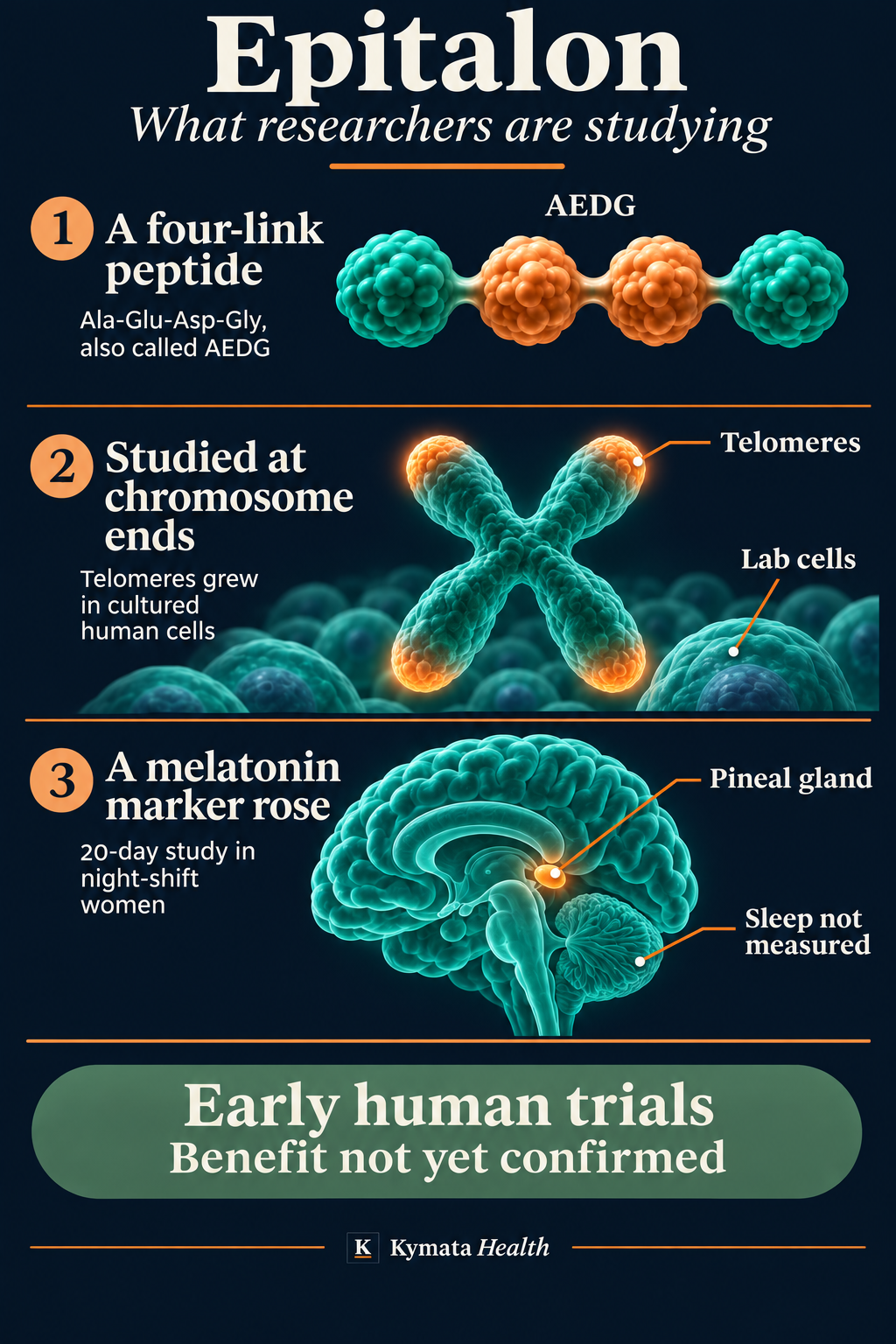
The guide shows Epitalon as the synthetic four-amino-acid peptide Ala-Glu-Asp-Gly (AEDG). Telomeres, the caps at chromosome ends, lengthened in cultured human cells (Khavinson 2003; a 2025 study whose figures were later corrected). In a 20-day study in women working night shifts with low melatonin, a urinary melatonin marker rose; sleep was not measured. The drawing is a schematic, not a measured molecular structure, a product photograph or a treatment result. Illustration review: 22 November 2026, against this page’s own mechanism, evidence and regulatory records.
Illustration notes and source record
Why is Epitalon studied in aging cells?
What a telomere protects. Epitalon is a synthetic peptide made of four amino acids. Telomeres protect the ends of chromosomes and often shorten as cells divide.
What changed in human cells. Researchers added Epitalon to human cells grown in the lab. They measured increased activity of telomerase, the enzyme that extends telomeres, and found longer telomeres in treated cells.
Telomeres at the tips of a chromosome
Earlier contextual illustration
Earlier mechanism plate and its source context

A four-letter design inspired by pineal research
Researchers studied the amino acid makeup of epithalamin, an extract from the pineal gland, and designed a four-residue synthetic peptide called AEDG.
Choose Rotate or Pan, then focus the diagram and use the arrow keys. Up and down tilt in Rotate mode. Pinch or use + and − to zoom.
Each bead is one amino acid. Once it is part of the chain, it is called a residue. Drag to rotate or tap a bead. The shape is a schematic illustration.
- Nonpolar
- Acidic
- Glycine / proline
Its short side branch mixes poorly with water. Chemists call this a nonpolar methyl group. This residue belongs to the defined synthetic AEDG sequence. Epithalamin contains a mixture of peptides.
Read the full sequence
A peptide bond is a covalent link joining two amino acids in a chain. A hydrogen bond is a weaker attraction, for example between a hydrogen on an oxygen and a nearby oxygen atom. A side chain may form hydrogen bonds without joining another amino acid to the chain. This diagram shows the sequence; it does not measure these interactions. See the IUPAC definitions of peptides and hydrogen bonds.
AEDG
- Alanine. Its short side branch mixes poorly with water. Chemists call this a nonpolar methyl group.
- Glutamate. Its side branch usually carries a negative charge near neutral pH, the middle of the acidity scale.
- Aspartate. Its side branch usually carries a negative charge near neutral pH, the middle of the acidity scale.
- Glycine. Its side branch is a single hydrogen atom, leaving the chain more room to bend here.
How to read the mechanism
Biology and evidenceTelomeres are repeated DNA sequences at chromosome ends. A 2025 experiment reported telomere lengthening in cultured human cells. The researchers found evidence for telomerase activity in normal cells and a different maintenance pathway in breast cancer cell lines. The authors subsequently corrected three figures. Human lifespan was outside the scope of the experiment.
Circadian research examines melatonin-related markers. A change in a marker does not by itself establish better sleep, fewer illnesses or longer life.
The practical takeaway: Human cells grown in a lab showed changes in their telomeres. A short study in women measured a change in a melatonin marker. Whether Epitalon helps people sleep better or live longer remains unknown.
05 / Evidence and limits
Evidence and limits
Actual study populations, findings and limits
What the studies found
Study design · measured outcomeNight-shift and melatonin study
Sublingual AEDG
75 mainly night-shift-working women were assessed; 40 with low melatonin received sublingual AEDG or placebo for 20 days, in groups of 20.
Finding. The urinary melatonin metabolite increased 1.7-fold in the AEDG group; it did not change with placebo. The study also reported clock-gene changes.
What the finding means
It did not evaluate sleep outcomes or lifespan extension. A sublingual biomarker result does not establish benefits from the injected forms covered by the policy.
Human cells in the laboratory
Cultured human cells
Cultured human somatic cells, not people receiving treatment.
Finding. An experiment reported telomerase activation and telomere elongation.
What the finding means
A cell-culture finding explains a hypothesis; it is not a clinical longevity outcome.
Select a group to see its evidence.
Limited human exposure reports exist, but routes, substances and endpoints vary. Neither “no human studies” nor “proven life extension” describes the record accurately.
06 / Product forms and access
Product forms and access
October 2026 compounding update
Editorial check · Nov 6, 2026HHS describes when it intends to exercise enforcement discretion for Epitalon acetate, in subcutaneous or intramuscular injectable dosage forms “dispensed in intermittent courses” under section 503A. Prescribing and quality conditions apply.
The October 30 Federal Register notice calls the interim policy a draft. It is not FDA product approval or proof of clinical benefit.
Forms, conditions and source record ↓Read the dated announcement →
HHS policy, Appendices A and B · announced Oct 28; notice published Oct 30.
The dated policy, covered forms and prescribing conditions
The October policy covers Epitalon acetate, in subcutaneous or intramuscular injectable dosage forms “dispensed in intermittent courses” subject to its conditions. It applies to section 503A prescribing, not 503B outsourcing facilities, research-use-only products or supplements.
Read the policy conditions, source documents and earlier FDA assessment
What did HHS announce on Oct 28, 2026?
Checked Oct 28, 2026HHS says it does not intend to take enforcement action against state-licensed pharmacies, Federal facilities and licensed physicians compounding Epitalon under section 503A when the stated conditions are met, while FDA’s 503A bulks-list rulemaking continues.
The notice says: “HHS does not intend to take enforcement action against a State-licensed pharmacy, Federal facility, or licensed physician compounding a drug product using a peptide bulk drug substance found in Appendix A.” It adds: “Compounded drugs are not FDA-approved, which means FDA does not review their safety, effectiveness, or quality before they are marketed.” Source: Federal Register document 2026-22192, public-inspection PDF (filed Oct 28, 2026 11:15 am; published Oct 30, 2026, 91 FR 68526)
- Filed for public inspection
- Oct 28, 2026
- Federal Register publication
- Oct 30, 2026
- Comments
- Until two weeks after publication (Nov 13, 2026 by our count), docket HHS-OASH-2026-0496
- Next step
- FDA rulemaking on the 503A bulks list, which may propose adding some or all of the six
Which forms of Epitalon does the policy cover?
Appendix BPer the HHS policy document (Oct 28, 2026), Appendix B covers Epitalon acetate, in subcutaneous or intramuscular injectable dosage forms “dispensed in intermittent courses”, compounded from a bulk peptide with a certificate of analysis that meets the policy’s conditions. Source: HHS: Enforcement Discretion Policy Regarding 503A Compounding Using Certain Peptide Bulk Drug Substances, with Appendices A and B (PDF, Oct 28, 2026)
Not covered
- Oral or nasal epitalon, epitalon free base and analogs such as N-acetyl epitalon amidate
- Capsule supplements and pineal extracts (Epithalamin, Endoluten), which are not compounded drugs
- Blends with other peptides
- 503B outsourcing facilities: the notice covers section 503A compounding only
- Research-use-only or “not for human consumption” vials, and dietary supplements
- Products not compounded by a state-licensed pharmacy, Federal facility or licensed physician under 503A
- It is not FDA approval: compounded drugs are not FDA-approved, and these remain unapproved drugs.
- It does not add anything to the 503A bulks list, and it is not FDA’s “Category 1”; FDA’s categories list (updated May 14, 2026) does not name these six.
- It is an interim policy: it lasts until FDA addresses each peptide in a final rule on the 503A bulks list, HHS says it may revisit it if a safety signal or product-quality problem arises, and it is not binding.
- It covers section 503A compounding only: not 503B outsourcing facilities, not research-use-only products and not dietary supplements.
What conditions must a pharmacy meet?
All ten must be met- Appendix A: the peptide is on the policy’s “503A Interim Access List” (BPC-157, Epitalon, KPV, MOTS-c, Semax, TB-500).
- Identity and route: the bulk peptide has the identity (amino acid sequence, chemical structure, molecular weight and formula) and the route limits set out in Appendix B.
- Characterization: it comes from an FDA-registered (section 510) facility with a valid certificate of analysis (COA) whose test results meet the Appendix B testing standard.
- Original manufacturer: registered under section 510, compliant with CGMP, and its physical location listed on the COA; a registered repacker, relabeler or reseller must have validated the manufacturer and its COA.
- Reporting: compounded products, serious adverse events (whether or not considered drug-related) and product-quality problems are reported to FDA MedWatch and to the states involved; the patient label explains how to report.
- Label: “This is a compounded drug product. Not for resale.”
- One active ingredient: the product contains only a single API listed in Appendix A, so no blends.
- Oral forms: the compounder keeps documentation that the specific oral formulation achieves an adequate level of oral bioavailability in humans.
- Device: the only drug delivery device co-packaged with, or containing, the drug is an FDA 510(k)-cleared syringe.
- Everything else in the FD&C Act still applies, including no insanitary conditions and section 503A’s patient-specific prescription requirement.
Per the HHS policy document (Oct 28, 2026), in its order. Source: HHS: Enforcement Discretion Policy Regarding 503A Compounding Using Certain Peptide Bulk Drug Substances, with Appendices A and B (PDF, Oct 28, 2026)
What did FDA advisers and staff say about Epitalon?
PCAC Jul 24, 2026FDA staff recommended against adding Epitalon to the 503A bulks list, reviewing its use for insomnia. FDA’s Pharmacy Compounding Advisory Committee voted 7–4 (1 abstention) on Jul 24, 2026 to recommend listing it; the vote is advisory. One outlet reported 7–5; FDA has not posted minutes. Source: Fierce Pharma: Peptide adcomm Day 2: Emideltide voted down (Jul 24, 2026)
FDA reviewers: “Based on available information, we conclude that there are no clinical data to support the safety of epitalon (free base) or epitalon acetate when used in humans.” Source: FDA briefing document for Epitalon-related bulk drug substances, PCAC July 23-24, 2026 (PDF)
FDA reviewers: “Specifically, epitalon has been shown to activate telomerase and lengthen telomeres, and longer telomeres are generally associated with increased risk for cancer.” Source: FDA briefing document for Epitalon-related bulk drug substances, PCAC July 23-24, 2026 (PDF)
What is the evidence for Epitalon in people?
Limited human exposure reports exist, but routes, substances and endpoints vary. Neither “no human studies” nor “proven life extension” describes the record accurately.
How does the prescription route work?
- A licensed clinician who examines your history decides whether a compounded peptide is appropriate and writes a prescription for you. Section 503A covers a drug that “is compounded for an identified individual patient based on the receipt of a valid prescription order”, and the HHS policy keeps that patient-specific prescription requirement.
- A state-licensed pharmacy (or a licensed physician or Federal facility) compounds it under section 503A, from a bulk peptide listed in the policy’s Appendix A, in a form and route the policy covers, and meeting its conditions.
- Ask the pharmacy which salt form and route it compounds, who manufactured the bulk peptide, and for the certificate of analysis. Expect a single active ingredient and the label line “This is a compounded drug product. Not for resale.” For an oral form, the policy expects the pharmacy to hold documentation of adequate oral bioavailability in humans.
- Check your state: a state board of pharmacy can set stricter rules, and legal commentators say it is unclear whether states will follow the HHS policy.
- Report a serious side effect or a product problem to FDA MedWatch.
Source: 21 U.S.C. 353a (section 503A of the FD&C Act) Source: FDA MedWatch: report a problem
What are the red flags?
- “Research use only”, “not for human consumption” or “for laboratory use” on the vial or website.
- No prescription, no clinician review, or a “prescription” that comes automatically with checkout.
- Two or more peptides in one vial or product (“Wolverine”, GLOW, KLOW and other stacks).
- No certificate of analysis, or one that does not name the manufacturer and where it is made.
- A route the policy does not cover for that peptide, such as nasal BPC-157 or injected KPV.
- Claims that a peptide is “FDA approved”, “now legal” or proven to work for a condition.
We do not list or link sellers of Epitalon. None of our partners sells it as of Oct 28, 2026.
Sources for this section
Checked Oct 28, 2026- Source: Federal Register document 2026-22192, public-inspection PDF (filed Oct 28, 2026 11:15 am; published Oct 30, 2026, 91 FR 68526)
- Source: Federal Register: Enforcement Discretion Policy Regarding 503A Compounding Using Certain Peptide Bulk Drug Substances (2026-22192, 91 FR 68526, Oct 30, 2026)
- Source: HHS: Enforcement Discretion Policy Regarding 503A Compounding Using Certain Peptide Bulk Drug Substances, with Appendices A and B (PDF, Oct 28, 2026)
- Source: Regulations.gov docket HHS-OASH-2026-0496 (comments)
- Source: FDA: 503A bulk drug substance categories (PDF, updated May 14, 2026)
- Source: FDA: July 23-24, 2026 meeting of the Pharmacy Compounding Advisory Committee
- Source: FDA briefing document for Epitalon-related bulk drug substances, PCAC July 23-24, 2026 (PDF)
- Source: Hyman, Phelps & McNamara, FDA Law Blog: “The PEPTIDE-L Wave Reaches HHS: Enforcement Discretion … Not the Finish Line” (Oct 28, 2026)
- Source: CNN: FDA scientists opposed the Trump administration’s move to ease peptides access (Oct 28, 2026)
- Source: STAT: HHS enforcement discretion policy allows peptide compounding (Oct 28, 2026)
News, Oct 28: what the HHS peptide compounding policy does and does not do →
Every peptide’s status on FDA’s compounding lists, in one table →
Cytogen (synthetic short peptide) · Pineal gland
Identity
Canonical 41- Class
- Cytogen (synthetic short peptide)
- Organ
- Pineal gland
- Target
- Pineal gland
- System
- Endocrine
- Sequence
- AEDG · Ala-Glu-Asp-Gly
In these Khavinson catalog sets
2 setsManufacturer-style organ combinations, not FDA protocols. Every name links to its own page.
The Khavinson school
Epitalon is filed here as cytogen (synthetic short peptide), targeting the pineal gland. Khavinson's St. Petersburg group moved from organ extracts (Cytamins) to capsule complexes (Cytomaxes) to synthetic short peptides (Cytogens); most of the evidence comes from that one group, with little independent Western replication.
Read the full background, the proposed epigenetic mechanism, the literature limits, and how we count the canonical 41 on the Khavinson bioregulators index.
History of this molecule
AEDG is the flagship cytogen even though it is not on the 12-SKU NPCRIZ cytogen poster the same way Pinealon is: it lives in the core-eight because the papers and the search volume do. Khavinson synthesized it to mimic epithalamin activity with a defined sequence. The 2003 Bulletin paper on telomerase activity and telomere elongation in somatic cells (PMID 12937682) is the one everyone cites. Rodent geroprotection and pineal/melatonin-adjacent work sit around it.
English-language educators (Henry’s public PSI article included) use Epitalon as the TERT-promoter example versus Pinealon/Vilon on other genes. That distinction is in the public essay and in the papers it cites. We cite papers. Peptide Mastery dose sheets are not reproduced here.
N-acetyl-epitalon-amidate is a later stability analog. Parent literature does not automatically transfer.
A defined sequence is not an FDA indication. Pineal cytogens sit in a Russian experimental-gerontology literature with limited Western replication. “Oral bioavailability because PEPT1” is real peptide-transport biology; it is not proof this SKU treats the organ disease. A purity chromatogram alone cannot identify a peptide sequence or establish that a preparation is sterile. Telomere therapy as a consumer product is a claim. Hayflick-limit language in ads is theater.
Full 41-map: Khavinson bioregulators index · Khavinson catalog sets
07 / Tools and practical checks
Tools and practical checks
Built from the conditions in the HHS policy document (Oct 28, 2026). No doses, no sellers, not legal advice.
Open the product-policy checker and timeline
Is this Epitalon product inside the policy?
Conditions from the HHS policy documentAnswer the questions to see a result
The result names the condition of HHS’s policy behind each answer.
Not legal or medical advice, and not a check of any pharmacy or product: it compares what you describe with the conditions in the HHS policy document (Oct 28, 2026). It never gives doses and names no sellers. Nothing you pick leaves this page.
Policy timeline
Checked Oct 28, 2026- Happened
FDA advisory committee voteAs reported
FDA’s Pharmacy Compounding Advisory Committee voted 7–4 (1 abstention) to recommend adding Epitalon to the 503A bulks list, as reported by press (FDA has not posted minutes). One outlet reported 7–5; FDA has not posted minutes. The vote is advisory; FDA staff had recommended against.
- Happened
HHS announces its interim policy
HHS files its enforcement-discretion policy for public inspection (Federal Register 2026-22192). For Epitalon, Appendix B covers Epitalon acetate, in subcutaneous or intramuscular injectable dosage forms “dispensed in intermittent courses”. It is not FDA approval.
- Scheduled as of Oct 28, 2026
Federal Register publication
The notice is scheduled to publish in the Federal Register; the two-week comment period runs from publication.
- Scheduled as of Oct 28, 2026
Comment period closes (our count)
Two weeks after publication, by our count; regulations.gov shows the official date for docket HHS-OASH-2026-0496.
- Rulemaking pending
FDA rulemaking on the 503A bulks list
The interim policy lasts until FDA addresses Epitalon in a final rule on the 503A bulks list. HHS: “FDA’s future rulemakings may propose adding some or all of these peptides to the 503A bulks list based on the available evidence.” HHS may also revisit the policy if a safety signal or product-quality problem arises.
Questions to ask
From the ten conditionsAsk the pharmacy
- Is the bulk peptide Epitalon, one of the six on Appendix A of HHS’s policy? Condition 1
- Which salt form and route is this? (Appendix B covers Epitalon acetate, in subcutaneous or intramuscular injectable dosage forms “dispensed in intermittent courses”.) Condition 2
- May I see the certificate of analysis for the bulk peptide, from an FDA-registered (section 510) facility? Condition 3
- Who manufactured the bulk peptide, where is it made, and is that location on the certificate of analysis? Condition 4
- How do I report a side effect or a product problem, and is that on the label? Condition 5
- Does the label say “This is a compounded drug product. Not for resale.”? Condition 6
- Is Epitalon the only active ingredient in this product? Condition 7
- If a device comes with it, is it an FDA 510(k)-cleared syringe? Condition 9
Ask your clinician
- Is this compounded for me, on a prescription you write after reviewing my history? Condition 10
- Why a compounded Epitalon, which is not FDA-approved, rather than an FDA-approved treatment, if one exists for my condition? Condition 10
- FDA’s reviewers raised concerns about Epitalon; how do they apply to me? Condition 10
Ask Kymata
Each question fills in Ask Kymata for you to edit; nothing is sent until you press send.
All six peptides under the policy, in the library →News, Oct 28: what the HHS peptide compounding policy does and does not do →
Vial strengths
Research vials of Epitalon are listed at 10 mg and 50 mg per vial.
08 / Published study use
Published study use
What published studies gave, in whom, and the source. Not a dose for you.
What studies used
No human dose-finding study- No dose-finding human study has been published. A 2026 review found human evidence limited to small biomarker studies and one older retinitis pigmentosa study, and called the dose-ranging data inadequate. Jain 2026, PMID 42884164 (opens in new tab)
- Mice: 1 µg per mouse (about 30-40 µg/kg) under the skin on 5 days each month, for life. Anisimov 2003, PMID 14501183 (opens in new tab)
- The doses quoted online come from animal work and vendor or forum sources.
A record of what researchers gave, in whom; not a dose for you.
09 / Safety and interactions
Safety and interactions
What the record says
Tetrapeptide. Sold as a research chemical in the US. Decades of Khavinson-group publications report low toxicity in the models they ran. That is not a Western Phase 3 safety database. Sterile reconstitution still matters. Do not treat rodent tumor-incidence papers as a human anti-cancer claim. PMID 11713572 is a tissue-peptide class review, not an Epitalon RCT.
Interactions & Contraindications
Russian clinic history is not a US safety NDA. Cycle language is the school’s, not an FDA duration. This site will not treat cancer from a peptide page.
10 / Comparisons and goal guides
Comparisons and goal guides
Combinations: what has been tested
2 pairings- + Pinealon →AEDG vs EDR. Neighboring pineal/CNS aisle. Not a sequenced longevity drug regimen.
- + Thymalin →Pineal tetrapeptide vs thymic extract. School combination follow-ups are not a 50% mortality label on this SKU.
Epitalon vs. Vilon
Compare evidence profilesCanonical comparison: Epitalon vs Vilon · Vilon evidence profile
Epitalon vs. Thymalin
Compare evidence profilesCanonical comparison: Epitalon vs Thymalin · Thymalin evidence profile
Appears in goal guides
5 guidesGoal guides give the evidence and status for each compound, with no doses. A mention here is not a treatment plan.
- GoalAging and LongevityThe compounds that come up in longevity talk: GH secretagogues, epitalon, GHK-Cu and NAD+ precursors. What each has been studied for, its status, and why no dose is given.Evidence and status
- GoalSleepDSIP and epitalon as they come up for sleep: the small insomnia trial, the melatonin studies, HHS status for epitalon, and why no dose is given.Evidence and status
- GoalPerimenopause and MenopauseKisspeptin, epitalon, MOTS-c and PT-141 as they come up around menopause: what each has been studied for, what is approved, and why the prescriber decides.Evidence and status
- GoalLongevity Bioregulators and PeptidesThe Khavinson pineal, thymus and bone-marrow capsules, plus epitalon, GHK-Cu, FOXO4-DRI and MOTS-c: what each has been studied for, its status, and why no course or dose is given.Evidence and status
- GoalEpitalon, Thymalin and PinealonThree Khavinson-school peptides sold together for “cellular redox”: what each has been studied for, in whom, its status, and why no course or dose is given.Evidence and status
11 / Common questions
Common questions
Common questions
12 answersCan a US pharmacy compound Epitalon now?
Under an interim policy announced Oct 28, 2026 (Federal Register 2026-22192, published Oct 30, 2026), HHS says it does not intend to take enforcement action against state-licensed pharmacies, Federal facilities and licensed physicians compounding Epitalon under section 503A when the stated conditions are met, while FDA’s 503A bulks-list rulemaking continues. Per the HHS policy document (Oct 28, 2026), Appendix B covers Epitalon acetate, in subcutaneous or intramuscular injectable dosage forms “dispensed in intermittent courses”; each product may contain only that one active ingredient, the bulk peptide needs a certificate of analysis from an FDA-registered facility. It is not FDA approval, Epitalon is not on the 503A bulks list, HHS can revisit the policy, and it does not cover 503B outsourcing facilities, research-use-only products or supplements. Comments are open until two weeks after publication.
What did FDA’s reviewers say about Epitalon?
FDA staff recommended against adding Epitalon to the 503A bulks list, reviewing its use for insomnia. Their briefing document says: “Based on available information, we conclude that there are no clinical data to support the safety of epitalon (free base) or epitalon acetate when used in humans.” FDA’s advisory committee voted 7–4 (1 abstention) on Jul 24, 2026 (as reported by press; one outlet reported 7–5; FDA has not posted minutes) to recommend listing it anyway; the vote is advisory.
Does Epitalon extend human lifespan?
Human cell studies measured telomere biology. A separate short study in people measured a melatonin metabolite. Neither study tested whether people lived longer.
Epitalon vs Epithalamin vs Endoluten vs Pinealon?
Epitalon = AEDG synthetic. Epithalamin = pineal pharmaceutical extract. Endoluten = pineal Cytomax complex. Pinealon = EDR CNS cytogen.
Does it lengthen telomeres in people?
The famous paper is somatic cells in vitro / Khavinson-group work. It is not an FDA telomere drug. Treat consumer “telomere kits” as marketing.
NAEA?
N-acetyl-epitalon-amidate is a stability analog. Different SKU, almost no analog-specific human PK. Do not assume Epitalon findings carry over to NAEA as if PK matched.
Capsule or vial?
Both exist: Cytomed AEDG capsules, which are swallowed, and research vials sold as powder for injection; “What studies used” on this page lists what published studies gave, not a dose for you. Endoluten is the pineal Cytomax (mixture). Epithalamin is the IM extract. Not a sublingual tablet.
Melatonin replacement?
Pineal-adjacent claims exist. It is not a 3 mg melatonin gummy with a fancier name.
What is Epitalon studied for?
Epitalon is a synthetic chain of four amino acids, also called AEDG. Researchers study whether it changes telomeres, the protective ends of chromosomes, and melatonin, a hormone involved in the sleep–wake cycle.
What have human studies of Epitalon shown?
Human cells grown in a lab showed changes in their telomeres. A short study in women measured a change in a melatonin marker. Whether Epitalon helps people sleep better or live longer remains unknown. Limited human exposure reports exist, but routes, substances and endpoints vary. Neither “no human studies” nor “proven life extension” describes the record accurately.
How does Epitalon work?
Telomeres are repeated DNA sequences at chromosome ends. A 2025 experiment reported telomere lengthening in cultured human cells. The researchers found evidence for telomerase activity in normal cells and a different maintenance pathway in breast cancer cell lines. The authors subsequently corrected three figures. Human lifespan was outside the scope of the experiment. Circadian research examines melatonin-related markers. A change in a marker does not by itself establish better sleep, fewer illnesses or longer life.
Is Epitalon FDA-approved?
No. Covered by HHS enforcement-discretion policy (announced Oct 28, 2026; conditions apply) for 503A compounding on a prescription. Not FDA-approved, not on the 503A bulks list; interim, comment period open, revocable (checked Oct 28, 2026).
12 / Sources and references
Sources and references
Additional background papers. Primary studies and policy sources are linked in the relevant sections.
Sources
11 papers- 1“Peptides and ageing.”Khavinson VKh Neuroendocrinology Letters (2002). PMID: 12374906
- 2“Peptide bioregulators: the new class of geroprotectors. Communication 1. Results of experimental studies.”Khavinson VKh, Kuznik BI, Ryzhak GA Advances in Gerontology (2012). PMID: 23734519
- 3“Tissue-specific effects of peptides.”Khavinson VKh et al. Bulletin of Experimental Biology and Medicine (2001). PMID: 11713572
- 4“Short peptides regulate gene expression.”Khavinson VKh, Lin’kova NS, Tarnovskaya SI Bulletin of Experimental Biology and Medicine (2016). PMID: 27909961
- 5“Peptides of pineal gland and thymus prolong human life.”Khavinson VKh, Morozov VG Neuroendocrinology Letters (2003). PMID: 14523363
- 6“Epithalon peptide induces telomerase activity and telomere elongation in human somatic cells.”Khavinson VKh, Bondarev IE, Butyugov AA Bulletin of Experimental Biology and Medicine (2003). PMID: 12937682
- 7“Effect of Epitalon on biomarkers of aging, life span and spontaneous tumor incidence in female SHR mice.”Anisimov VN, Khavinson VK, Popovich IG, et al. Biogerontology (2003). PMID: 14501183
- 8“Epitalon increases telomere length in human cell lines through telomerase upregulation or ALT activity.”Al-Dulaimi S, Thomas R, Matta S, et al. Biogerontology (2025). PMID: 40908429
- 9“Overview of Epitalon: highly bioactive pineal tetrapeptide with promising properties.”Araj SK, Brzezik J, Mądra-Gackowska K, Szeleszczuk Ł International Journal of Molecular Sciences (2025). DOI: 10.3390/ijms26062691
- 10“Peptide bioregulation of aging: results and prospects.”Anisimov VN, Khavinson VK Biogerontology (2010). PMID: 19830585
- 11“Peptide regulation of aging: 35-year research experience.”Khavinson VK. Bull Exp Biol Med (2009). PMID: 19902107
14 / Prescription options
Prescription options
Oral tissue-peptide capsules sold by Vita-Stream, house line first: a different product from the Epitalon studied above.
Capsule form
Paid links · we earn a commissionOral capsuleAffiliate links: we earn a commission if you buy, at no extra cost to you.
- Browse Endoluten (paid link, opens in new tab)
Endoluten is a GARMONIA Cytomax pineal gland peptide capsule sold by Vita-Stream. Vita Peptides' house line has no product for this tissue. No trial has tested it.
Epitalon isn't sold under that name at Vita-Stream. Closest match: Endoluten (A-8), the natural pineal Cytomax (not the same compound).
- Per capsule
- 10 mg active natural peptides
Label wording as Vita-Stream's product page states it, read 19 October 2026. Follow the label on the bottle you buy.
- In Khavinson’s lab work, synthetic short peptides modeled on a tissue’s peptide extract stimulated the growth of cultured rat explants of that same tissue. Khavinson 2001, PMID 11713572 (opens in new tab)
- His group proposes that such peptides act on gene expression in the cells they reach; most of that work is in cells and animals. Khavinson 2021 review, PMID 34834147 (opens in new tab)
These statements have not been evaluated by the FDA. These products are not intended to diagnose, treat, cure, or prevent any disease.
Use code KymataLabs at checkout
15 / Peptide library
Peptide library
Keep reading: Peptide research library
Peptide research library: every pagePeptide libraryBrowse all topics
- Melanotan IIPrevious in this topic · Cyclic α-MSH analog.
- MOTS-cNext in this topic · MOTS-c is a 16-amino-acid mitochondrial-derived peptide investigated in metabolic signaling.
- SS-31Elamipretide.
- DihexaDihexa has been tested in animals, but no human trial identified here administered it directly.
- SelankTuftsin analog (TKPRPGP) with a Russian prescription story.