
The peptide field guide
Cortagen
Cortagen is the synthetic AEDP peptide recorded in the catalogue, distinct from Cortexin extract and the Cerluten tissue-derived complex.
The retained rat peripheral-nerve experiment does not establish cognition or memory benefit in people.
Explore this compoundIllustrative research context only; not an actual nerve image, study instrument or evidence of repair in people.
We earn a commission if you buy through some links on this page. You pay the same price. See how we make money.
02 / At a glance
At a glance
Key facts
- Also known as
- Ala-Glu-Asp-Pro, AEDP, Brain Cortex Bioregulator, Кортаген
- Sequence
- AEDP
- Evidence level
- Cell and animal research: human benefit remains unproven.
- US regulatory status
- Not FDA-approved; sold as oral capsules and as research-labelled vials
- Updated
Identity
Cortagen is the synthetic AEDP peptide recorded in the catalogue, distinct from Cortexin extract and the Cerluten tissue-derived complex.
Research context
Turchaninova 2000 (PMID 11276314) describes rats after a cut-and-repaired sciatic nerve; this is not a human cognition trial.
Evidence limits
The retained rat peripheral-nerve experiment does not establish cognition or memory benefit in people.
Read the technical profile and study-use reference
Quick answer
Evidence: LowCortagen has the reported residue sequence AEDP. The sequence identifies the order of amino acids. The package label identifies the formulation and its intended use.
- Class and target
- Cytogen (synthetic short peptide) · Cerebral cortex · sequence AEDP
- In published studies
- No human dosing study published
Research summary, not medical advice.
At a glance
Kymata peptide profile · Nov 19, 2026- Half-life
- Short (tetrapeptide)
- Documented forms
- Research vial
- Molecular weight
- 430.41 g/mol
- CAS
- N/A
- In published studies
- No human dosing study published
03 / Identity and origin
Identity and origin
Also called Ala-Glu-Asp-Pro, AEDP, Brain Cortex Bioregulator, Кортаген. Khavinson cytogen (AEDP).
Read the sequence and compound record
Compound card
1 cell = 1 amino acid- Sequence
- AEDP
- Class
- Khavinson cytogen (AEDP)
- Formula
- C17H26N4O9
- Molecular weight
- 430.41 g/mol
- CAS
- N/A
- PubChem CID
- N/A
- Described by
- Vladimir Khavinson, St. Petersburg Institute of Bioregulation, 1990s
- Bioavailability
- Not established in humans
04 / How it may work
How it may work
Khavinson cytogen (AEDP)
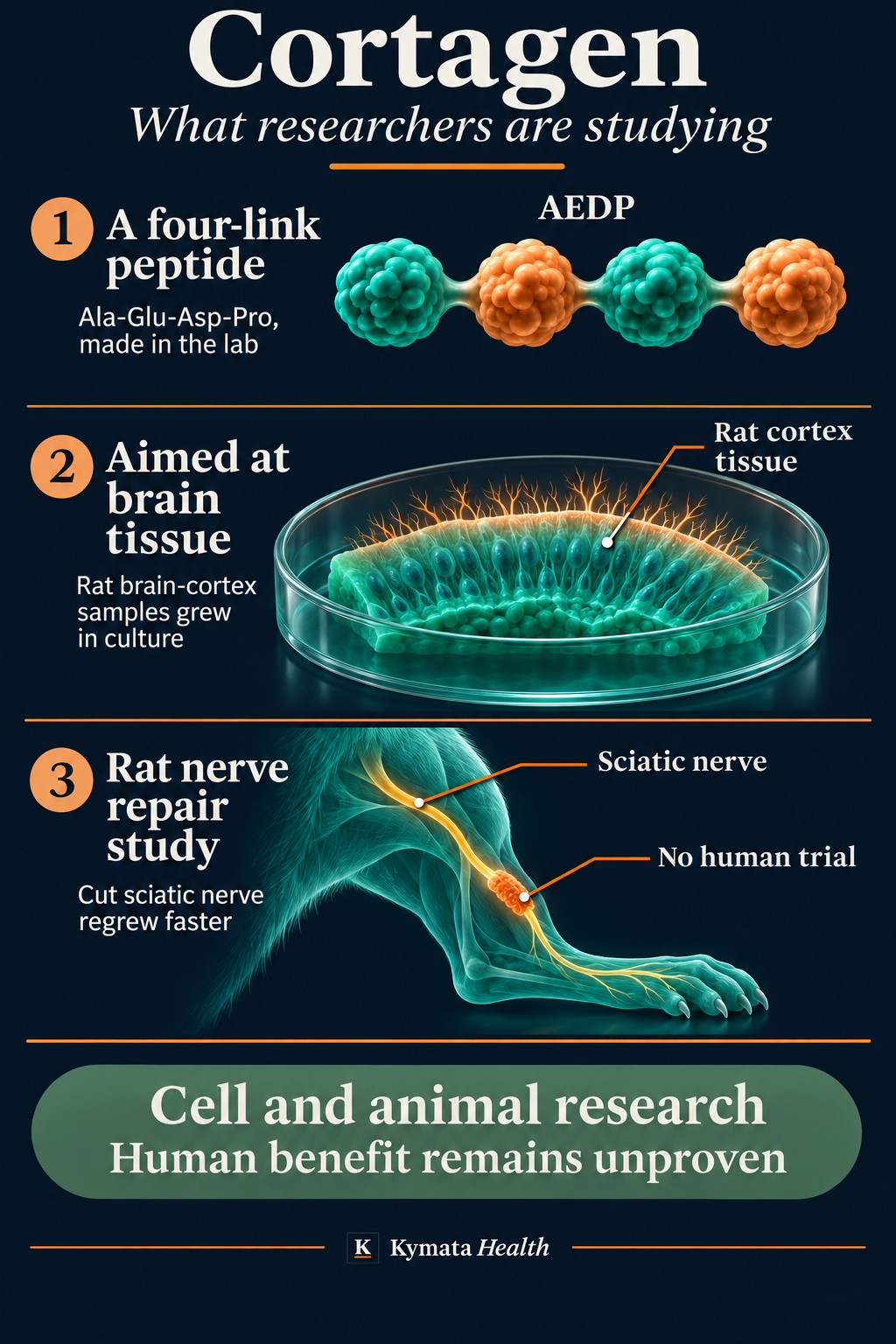
The guide shows Cortagen as the synthetic four-amino-acid peptide Ala-Glu-Asp-Pro (AEDP). In rat tissue culture, brain-cortex samples grew (PMID 11713572), and in rats with a cut and repaired sciatic nerve the group reported faster regrowth (PMID 11276314). No human trial has tested it. The drawing is a schematic, not a measured molecular structure, a product photograph or a treatment result. Illustration review: 22 November 2026, against this page’s own mechanism, evidence and regulatory records.
AEDP is the recorded catalogue letter order. The retained sources do not verify a product lot, terminal chemistry or a measured fold; no exact chemical model is inferred.
Illustration notes and source record
Read the source record on this page. Laboratory, topical and injected studies are separate evidence; this illustration does not establish an indication or a treatment outcome.

How it works
Cortagen (Ala-Glu-Asp-Pro) is a synthetic tetrapeptide the Khavinson group links to the cerebral cortex. In rat organotypic cultures it stimulated growth of brain-cortex explants (PMID 11713572). In rats with a cut and repaired sciatic nerve, the group reported faster growth and conduction in regenerating fibers (PMID 11276314). No controlled human trial has tested cognition or memory.
Cortagen product forms
Form labels checked Nov 7, 2026Cortagen has the reported residue sequence AEDP. The sequence identifies the order of amino acids. The package label identifies the formulation and its intended use.
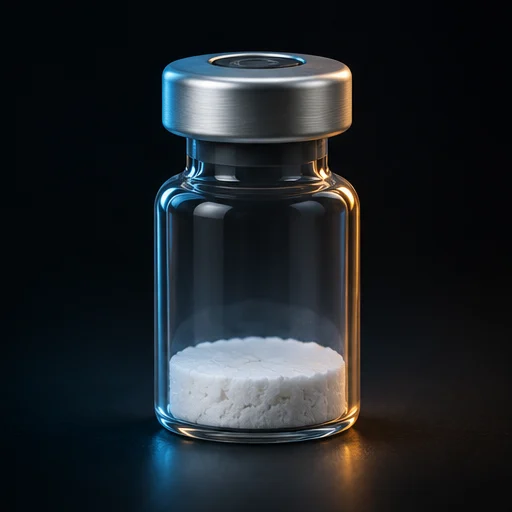
Research vial
The supplier identifies this material for laboratory research. A freeze-dried powder and a purity figure do not establish sterility or a route for human injection. Capsule instructions do not apply.
Laboratory product specificationIllustrations show the type of packaging. Check the name, contents and route on the actual pack.
05 / Evidence and limits
Evidence and limits
Limits of current evidence
4 limits- A defined sequence is not an FDA indication.
- Gray-market identity is a live problem. HPLC beats a blog table.
- Studies on sibling cytogens do not apply to this product.
- This site will not treat the named organ disease from a peptide page.
What it is studied for
- AEDP identity vs Pinealon vs Cerluten
- Not a stroke, dementia, or neurodegeneration treatment page
Verdict
Cortagen is the synthetic AEDP cytogen for Cerebral cortex. Khavinson’s group published in this family. That is a concentrated literature, not a Western Phase 3. Capsules and vials are different SKUs.
06 / Product forms and access
Product forms and access
Regulatory & legal status
- FDA status (US)
- Not approvedNot FDA-approved; sold as oral capsules and as research-labelled vials
- WADA status (2026)
- Not ListedNot currently on the WADA 2026 Prohibited List. Policies may change. Verify before competition.
- Classification
- Research Chemical
- US compounding
- Not eligible / not available
Cytogen (synthetic short peptide) · Cerebral cortex
Identity
Canonical 41- Class
- Cytogen (synthetic short peptide)
- Organ
- Cerebral cortex
- Target
- Brain
- System
- Nervous
- Sequence
- AEDP · Ala-Glu-Asp-Pro
In these Khavinson catalog sets
1 setManufacturer-style organ combinations, not FDA protocols. Every name links to its own page.
The Khavinson school
Cortagen is filed here as cytogen (synthetic short peptide), targeting the cerebral cortex. Khavinson's St. Petersburg group moved from organ extracts (Cytamins) to capsule complexes (Cytomaxes) to synthetic short peptides (Cytogens); most of the evidence comes from that one group, with little independent Western replication.
Read the full background, the proposed epigenetic mechanism, the literature limits, and how we count the canonical 41 on the Khavinson bioregulators index.
History of this molecule
AEDP is the cortex tetrapeptide with a small rat paper trail: cortex explant growth in tissue culture (PMID 11713572) and sciatic-nerve regeneration (PMID 11276314). The name collision with “cortisol/adrenal” and with Cortexin is the buyer trap. Cortex of the brain. Full stop.
Pinealon is EDR. Semax is a different Russian nootropic. Stroke remains tPA/thrombectomy territory, not a capsule.
A defined sequence is not an FDA indication. Cortex cytogens sit in a Russian experimental-gerontology literature with limited Western replication. “Oral bioavailability because PEPT1” is real peptide-transport biology; it is not proof this SKU treats the organ disease. A purity chromatogram alone cannot identify a peptide sequence or establish that a preparation is sterile.
Full 41-map: Khavinson bioregulators index · Khavinson catalog sets
07 / Tools and practical checks
Tools and practical checks
No separate record is provided here. Read the linked evidence and limitations for this compound.
08 / Published study use
Published study use
What published studies gave, in whom, and the source. Not a dose for you.
What studies used
No human study- We found no human dosing study of Cortagen in PubMed.
- Rats after a cut and repaired sciatic nerve: 10 µg/kg by intramuscular injection for 10 days. Turchaninova 2000, PMID 11276314 (opens in new tab)
- The doses quoted online come from animal work and vendor or forum sources.
A record of what researchers gave, in whom; not a dose for you.
Administration
- Route / form
- Research vial. The supplier identifies this material for laboratory research. A freeze-dried powder and a purity figure do not establish sterility or a route for human injection. Capsule instructions do not apply.
- Timing
- Any timing is on the manufacturer’s label; it is not a studied schedule, and this page does not restate it.
- Empty stomach?
- Label only: Food timing, if any, is on the manufacturer’s label. No published study sets it, and this page does not restate it.
Timeline
2 stages- Rat studies
Brain-cortex explant growth in rat tissue culture (PMID 11713572) and sciatic-nerve regeneration measures in rats (PMID 11276314). These are animal measurements, not human outcomes.
- Human outcomes
No human trial has measured this.
Who it is for
1 use| Category | Fit | What exists |
|---|---|---|
| Cognitive Aging / Neuroprotection | Low | Cerebral cortex bioregulator in the Khavinson series. Evidence is rat tissue-culture and nerve-injury work (PMID 11713572, 11276314). |
09 / Safety and interactions
Safety and interactions
What the record says
Not FDA-approved. Published work is mostly small Russian cell, animal and clinical reports from one research group, and it does not establish human safety. Product identity and sterility vary by seller; see the documented product forms on this page.
Interactions & Contraindications
This site will not treat stroke from a peptide page.
10 / Comparisons and goal guides
Comparisons and goal guides
Combinations: what has been tested
2 pairings- + Pinealon →Different sequences, neighboring organs in the school map. Not a combo RCT.
- + Cerluten →Cytogen vs brain Cytomax. Mixture vs sequence. Not interchangeable SKUs.
11 / Common questions
Common questions
Common questions
7 answersWhich forms of Cortagen are documented, and which instructions apply to each?
Research vial. The supplier identifies this material for laboratory research. A freeze-dried powder and a purity figure do not establish sterility or a route for human injection. Capsule instructions do not apply.
Cortagen vs Cortexin vs Cerluten vs Glandokort vs Cardiogen?
Cortagen = AEDP cortex cytogen. Cortexin = brain extract (pharma). Cerluten = brain Cytomax. Glandokort = adrenal Cytomax. Cardiogen = AEDR heart.
Stroke drug?
No. Acute stroke is emergency care.
Sequence?
Ala-Glu-Asp-Pro (AEDP).
Semax?
Different program (ACTH analog).
What does Cortagen target in the brain?
The Khavinson group proposes that Cortagen acts on cerebral cortex cells. The published data are rat studies: cortex explant growth in tissue culture (PMID 11713572) and sciatic-nerve regeneration (PMID 11276314). No controlled human trial has tested cognition or memory.
Is Cortagen FDA-approved?
No. Not FDA-approved; sold as oral capsules and as research-labelled vials.
12 / Sources and references
Sources and references
4 papers cited on this page.
Sources
4 papers- 1“Tissue-specific effects of peptides.”Khavinson VKh et al. Bulletin of Experimental Biology and Medicine (2001). PMID: 11713572
- 2“Short peptides regulate gene expression.”Khavinson VKh, Lin’kova NS, Tarnovskaya SI Bulletin of Experimental Biology and Medicine (2016). PMID: 27909961
- 3“Peptides of pineal gland and thymus prolong human life.”Khavinson VKh, Morozov VG Neuroendocrinology Letters (2003). PMID: 14523363
- 4“Effect of tetrapeptide cortagen on regeneration of sciatic nerve.”Turchaninova LN et al. Bulletin of Experimental Biology and Medicine (2000). PMID: 11276314
14 / Prescription options
Prescription options
Oral tissue-peptide capsules sold by Vita-Stream, house line first: a different product from the Cortagen studied above.
Capsule form
Paid links · we earn a commissionOral capsuleAffiliate links: we earn a commission if you buy, at no extra cost to you.
- Browse Cerluten (paid link, opens in new tab)
Cerluten is a GARMONIA Cytomax brain peptide capsule sold by Vita-Stream. Vita Peptides' house line has no product for this tissue. No trial has tested it.
Cortagen isn't sold under that name at Vita-Stream. Closest match: Cerluten (A-5), the natural brain Cytomax (not the same compound).
- Per capsule
- 10 mg active peptides
Label wording as Vita-Stream's product page states it, read 19 October 2026. Follow the label on the bottle you buy.
- In Khavinson’s lab work, synthetic short peptides modeled on a tissue’s peptide extract stimulated the growth of cultured rat explants of that same tissue. Khavinson 2001, PMID 11713572 (opens in new tab)
- His group proposes that such peptides act on gene expression in the cells they reach; most of that work is in cells and animals. Khavinson 2021 review, PMID 34834147 (opens in new tab)
These statements have not been evaluated by the FDA. These products are not intended to diagnose, treat, cure, or prevent any disease.
Use code KymataLabs at checkout
15 / Peptide library
Peptide library
← Back to Peptide LibraryKhavinson catalog sets
Keep reading: Peptide research library
Peptide research library: every pagePeptide libraryBrowse all topics
- VilonPrevious in this topic · Vilon (Lys-Glu) is a short synthetic peptide (cytogen) from the Khavinson group; its published studies, mostly Russian cell and animal work, examined the thymus and immune cells.
- CrystagenNext in this topic · Crystagen (Glu-Asp-Pro) is a short synthetic peptide (cytogen) from the Khavinson group, listed as an immune-cell bioregulator.
- LivagenLivagen (Lys-Glu-Asp-Ala) is a short synthetic peptide (cytogen) from the Khavinson group; its published studies, mostly Russian cell and animal work, examined liver tissue and…
- CartalaxCartalax (Ala-Glu-Asp) is a short synthetic peptide (cytogen) from the Khavinson group; its published studies, mostly Russian cell and animal work, examined cartilage cells.
- VesugenVesugen (Lys-Glu-Asp) is a short synthetic peptide (cytogen) from the Khavinson group; its published studies, mostly Russian cell and animal work, examined blood-vessel wall cells.
Regulatory and sport classification
- Not FDA-approved; sold as oral capsules and as research-labelled vials