
The peptide field guide
Oxytocin
Oxytocin is a nine-amino-acid hormone used in specific obstetric injection products.
Pitocin’s obstetric label and intranasal behavioral research are separate product, route and evidence records.
Explore this compoundAnatomical context only, not a patient scan, measured histology, contracting uterus, treatment demonstration, birth procedure or maternal/behavioral outcome.
02 / At a glance
At a glance
Key facts
- Also known as
- Pitocin, OXT
- Type
- Sexual Health
- Evidence level
- FDA-approved for labor and bleeding: prescription only.
- US regulatory status
- FDA-approved as an injection for labor and postpartum bleeding (Pitocin® and generics); no US label covers nasal oxytocin, which is compounded off-label
- Updated
Identity
Oxytocin is a nine-amino-acid hormone used in specific obstetric injection products.
Research context
Pitocin injection labeling for labor and postpartum bleeding, alongside separate 2005 and 2009 intranasal studies.
Evidence limits
Pitocin’s obstetric label and intranasal behavioral research are separate product, route and evidence records.
Read the technical profile and study-use reference
Quick answer
Evidence: HighOxytocin is a neurohypophysial hormone, FDA-approved as Pitocin to induce or strengthen labor contractions and to control bleeding after delivery. In a 24-week trial in 290 autistic children and adolescents, an intranasal research formulation did not outperform placebo on the primary social-interaction measure.
- FDA label dose
- FDA label (Pitocin): IV infusion in labor; no nasal label
Research summary, not medical advice.
At a glance
Kymata peptide profile · Nov 22, 2026- Molecular weight
- 1007.19 g/mol
- CAS
- 50-56-6
- FDA label dose
- FDA label (Pitocin): IV infusion in labor; no nasal label
- Half-life
- About 1 to 6 minutes in plasma (Pitocin label); intranasal values are not established here
- Common vials
- Ready-to-use solution; no reconstitution in this calculator
03 / Identity and origin
Identity and origin
Also called Pitocin, OXT. Nine-amino-acid hormone; Pitocin is the obstetric injection.
Read the sequence and compound record
Compound card
- Class
- Nine-amino-acid hormone; Pitocin is the obstetric injection
- Formula
- C43H66N12O12S2
- Molecular weight
- 1007.19 g/mol
- CAS
- 50-56-6
- PubChem CID
- 439302
- Described by
- Vincent du Vigneaud (Nobel Prize 1955), 1953
- Bioavailability
- Not established for intranasal use; the labeled product is given IV or IM
04 / How it may work
How it may work
Nine-amino-acid hormone; Pitocin is the obstetric injection
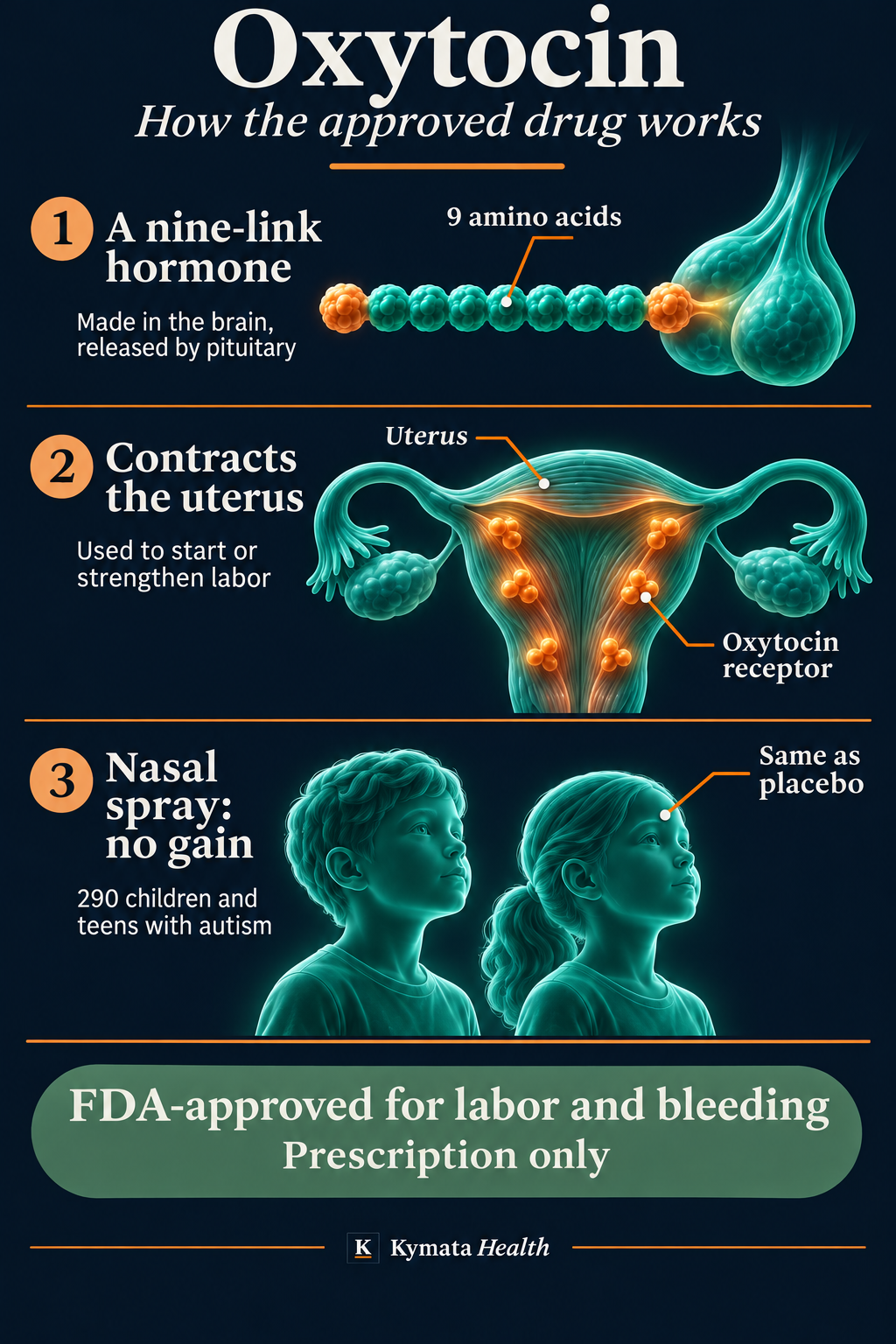
The guide shows oxytocin as a nine-amino-acid hormone made in the brain and released by the pituitary. It acts on receptors in the uterus to start or strengthen contractions, the basis of its FDA approval as Pitocin for labor and bleeding after delivery. In a 24-week trial in 290 children and teens with autism, a nasal spray did no better than placebo on social interaction (PMID 34644471). The drawing is a schematic, not a measured molecular structure, a product photograph or a treatment result. Illustration review: 22 November 2026, against this page’s own mechanism, evidence and regulatory records.
An exact unmodified one-letter chain was not verified for this illustration. No simplified sequence model is inferred from the nine-amino-acid identity.
Illustration notes and source record
Read the source record on this page. Laboratory, topical and injected studies are separate evidence; this illustration does not establish an indication or a treatment outcome.

How it works
SourcedOxytocin is a nine-amino-acid peptide hormone made in the hypothalamus (paraventricular and supraoptic nuclei) and released from the posterior pituitary. It acts on the oxytocin receptor, a G-protein-coupled receptor in the uterus, breast and brain. In the uterus it stimulates contractions, which is the basis of its obstetric use.
In the US, oxytocin is FDA-approved as an injection (Pitocin and generics) to start or strengthen labor for medical reasons and to control bleeding after delivery; it is not indicated for elective induction. No US label covers nasal oxytocin. Intranasal oxytocin has been studied in small laboratory experiments on trust, amygdala responses and couple conflict (PMID 15931222, 16339042, 19027101) and in larger trials, including a 24-week autism trial in 290 children and adolescents that found no difference from placebo (PMID 34644471).
Source: Pitocin prescribing information (revised March 2026); Sikich et al., PMID 34644471
Background & History
Oxytocin is a nine-amino-acid neuropeptide produced in the hypothalamus (supraoptic and paraventricular nuclei) and released by the posterior pituitary. First synthesized in 1953 by Vincent du Vigneaud (Nobel Prize 1955), it was initially known only for its roles in birth (uterine contractions) and lactation. From the 2000s, small intranasal laboratory studies measured trust, amygdala responses and couple-conflict behavior (PMID 15931222, 16339042, 19027101), which popularized the "love hormone" label. Larger clinical trials have been mixed; a 24-week autism trial found no benefit over placebo (PMID 34644471).
05 / Evidence and limits
Evidence and limits
Hospital injection and intranasal research answer different questions
Human evidence
Hospital injection and intranasal research answer different questions- In the SOARS-B randomized, placebo-controlled trial, 290 children and adolescents aged 3 to 17 with autism received intranasal oxytocin or placebo for 24 weeks (277 analyzed), and social-withdrawal scores fell by 3.7 points with oxytocin and 3.5 with placebo (difference −0.2, 95% CI −1.5 to 1.0, P = 0.61; Sikich et al. 2021, PMID 34644471).
- Lower scores on that modified Social Withdrawal subscale mean more social interaction, so the trial did not show an advantage for the spray on its primary measure. It did not test the use of Pitocin injection during childbirth.
Limits of current evidence
2 limits- In a 2026 registered replication of 211 participants, pooled with an earlier replication to 532, equivalence testing found no meaningful effect of intranasal oxytocin on money sent in a trust game (PMID 41880977). A separate preregistered experiment in 359 men selected for low dispositional trust found about 15% higher transfers (PMID 42561025). The populations and comparisons differ.
- A decision in a laboratory game does not show that a spray improves attachment, anxiety or everyday social functioning. The pediatric trial asked a separate clinical question.
Trial FinderRecruiting now: 40 open registrations for oxytocin
What it is studied for
- Uterine contractions and postpartum bleeding in the Pitocin label
- Social interaction measured in the 24-week placebo-controlled nasal trial
- Economic decisions measured in trust-game experiments
Verdict
Pitocin stimulates uterine contractions. A large trial of a nasal spray in autistic children and adolescents did not show improved social interaction compared with placebo.
06 / Product forms and access
Product forms and access
Regulatory & legal status
- FDA status (US)
- ApprovedFDA-approved as an injection for labor and postpartum bleeding (Pitocin® and generics); no US label covers nasal oxytocin, which is compounded off-label
- WADA status (2026)
- Not ListedNot currently on the WADA 2026 Prohibited List. Policies may change. Verify before competition.
- Classification
- Prescription Drug
- US compounding
- Available via licensed pharmacy Rx
07 / Tools and practical checks
Tools and practical checks
No separate record is provided here. Read the linked evidence and limitations for this compound.
08 / Published study use
Published study use
What the label states, for the patients it is approved for, and the source. Not a dose for you.
What the FDA label says
FDA label- Pitocin approved strength: 10 USP units of oxytocin per mL, for IV infusion to induce or strengthen labor and for IV or intramuscular use after delivery, under hospital supervision. Pitocin label, DailyMed (opens in new tab)
- No US label covers nasal oxytocin; Drugs@FDA lists Syntocinon nasal spray as discontinued.
The label’s dosing, for the patients it is approved for; the prescriber sets the dose.
Administration
- Route / form
- Labeled routes: IV infusion or intramuscular injection in hospital (Pitocin). Nasal sprays are research products with no US label.
Timeline
2 stages- Single-session lab studies
Small intranasal experiments measured trust in an investment game (PMID 15931222), amygdala responses to fear images in 15 men (PMID 16339042) and behavior during a couple-conflict discussion (PMID 19027101). These were one-session laboratory measures, not treatment outcomes. A 2026 registered replication pooled to 532 participants found no meaningful trust-game effect (PMID 41880977).
- 24-week trial
In 290 children and adolescents with autism, intranasal oxytocin did not differ from placebo on social withdrawal or other social measures (PMID 34644471).
Who it is for
3 uses| Category | Fit | What exists |
|---|---|---|
| Labor and postpartum bleeding (label) | High | Pitocin injection is labeled for medically indicated induction or strengthening of labor and for postpartum bleeding, given in hospital. It is not indicated for elective induction. |
| Social behavior (intranasal research) | Limited | Small one-session laboratory studies reported changes in trust, amygdala responses and couple-conflict behavior (PMID 15931222, 16339042, 19027101). They do not establish a treatment for anxiety or relationship problems. |
| Autism spectrum disorder | Not supported | A 24-week placebo-controlled trial in 290 children and adolescents found no significant benefit on social or cognitive measures (PMID 34644471). |
09 / Safety and interactions
Safety and interactions
What the record says
Oxytocin is FDA-approved as an injection for labor and postpartum bleeding, given in hospital with medical supervision. The Pitocin label lists serious risks including uterine hyperstimulation or rupture, water intoxication, arrhythmias and anaphylaxis, plus fetal and neonatal harms. No US label covers nasal oxytocin, and long-term safety of daily nasal use is not established. Discuss any use with a clinician.
Interactions & Contraindications
Pitocin label: severe hypertension has been reported when oxytocin was given after a vasoconstrictor used with caudal block anesthesia. Obstetric use is hospital-supervised. No interaction data support a nasal research product.
10 / Comparisons and goal guides
Comparisons and goal guides
Combinations: what has been tested
2 pairings- + PT-141 →PT-141 acts at melanocortin receptors. The oxytocin trials cited here did not establish a clinical benefit for combining the two.
- + Kisspeptin →Kisspeptin participates in reproductive hormone signaling. The cited oxytocin studies did not test a combination with kisspeptin.
11 / Common questions
Common questions
Common questions
5 answersWhat did the large intranasal autism trial find?
In 290 children and adolescents, caregiver-rated social-withdrawal scores improved by a similar amount with nasal oxytocin and placebo over 24 weeks (−3.7 vs −3.5 points, P = 0.61). The prespecified comparison did not show a significant benefit for oxytocin (PMID 34644471).
Does a trust-game result mean that a spray improves relationships?
A trust game measures one financial decision in a laboratory. A 2026 registered replication pooled to 532 participants found no meaningful effect (PMID 41880977), while a preregistered experiment in 359 men with low baseline trust found about 15% higher transfers (PMID 42561025). Neither establishes that a spray improves daily relationships.
Is oxytocin approved for social anxiety?
No. The US label covers oxytocin injection in labor and after delivery (Pitocin), and no US label covers nasal oxytocin. Nasal oxytocin for social anxiety is research use, and it does not cure social anxiety.
Is intranasal oxytocin safe for daily use?
Long-term safety of daily nasal use is not established. In a 24-week autism trial in children and adolescents, adverse events were similar with oxytocin and placebo, but that trial did not show a benefit (PMID 34644471). No US label covers nasal oxytocin.
Is Oxytocin FDA-approved?
Yes. FDA-approved as an injection for labor and postpartum bleeding (Pitocin® and generics); no US label covers nasal oxytocin, which is compounded off-label.
12 / Sources and references
Sources and references
7 sources cited on this page.
Sources
7 sources- 1“Oxytocin increases trust in humans.”Kosfeld M et al. Nature (2005). PMID: 15931222 DOI: 10.1038/nature03701
- 2“Absence of a meaningful effect of intranasal oxytocin on trusting behavior: a registered report with pooled equivalence testing.”Kroll CF et al. Cortex (2026). PMID: 41880977 DOI: 10.1016/j.cortex.2026.03.006
- 3“Oxytocin increases trust in men low in dispositional trust.”Vogt B, Bengart P, Declerck C, Fehr E Proceedings of the National Academy of Sciences (2026). PMID: 42561025 DOI: 10.1073/pnas.2602655123
- 4“Intranasal Oxytocin in Children and Adolescents with Autism Spectrum Disorder.”Sikich L et al. N Engl J Med (2021). PMID: 34644471 DOI: 10.1056/NEJMoa2103583
- 5“Pitocin (oxytocin injection): prescribing information.”Par Health USA DailyMed (2026). Prescribing information
- 6“Intranasal oxytocin increases positive communication and reduces cortisol levels during couple conflict.”Ditzen B, et al. Biol Psychiatry (2009). PMID: 19027101
- 7“Oxytocin modulates neural circuitry for social cognition and fear in humans.”Kirsch P, et al. J Neurosci (2005). PMID: 16339042
14 / Prescription options
Prescription options
Prescription options: compare licensed telehealth providers
Some peptide therapies are available only by prescription after a consult with a licensed clinician.
Compare telehealth →15 / Peptide library
Peptide library
Keep reading: Peptide research library
Peptide research library: every pagePeptide libraryBrowse all topics
- GlutathionePrevious in this topic · Glutathione is an antioxidant your body makes from glutamate, cysteine and glycine.
- VIPNext in this topic · VIP is a 28-amino-acid neuropeptide isolated by Said and Mutt in 1970.
- ThymalinThymalin is a polypeptide extract of calf thymus registered as a medicine in Russia; Russian studies, mostly from the Khavinson group, examined it in immune function, including…
- HumaninHumanin is a 24-amino-acid mitochondrial-derived peptide, identified in 2001 from an Alzheimer's-brain cDNA library, that has been studied for anti-apoptotic and neuroprotective…
- PEG-MGFFDA found no human exposure data for products containing PEG-MGF by any route.
Regulatory and sport classification
- FDA-approved