
The peptide field guide
Kisspeptin
Kisspeptin is a peptide family; the two studies shown here used kisspeptin-10.
These short hormone studies do not establish fertility or sexual-health treatment benefit or equivalence with kisspeptin-54.
Explore this compoundConceptual short-observation-window metaphor, not actual study equipment, a half-life measurement or a treatment schedule. The cited short studies used kisspeptin-10.
02 / At a glance
At a glance
Key facts
- Also known as
- Kisspeptin-10, KP-10, Metastin
- Type
- Sexual Health
- Evidence level
- Early human trials: benefit not yet confirmed.
- US regulatory status
- Not FDA-approved, research chemical
- Updated
Identity
Kisspeptin is a peptide family; the two studies shown here used kisspeptin-10.
Research context
Separate 2011 kisspeptin-10 studies in healthy men and women, with phase- and route-specific findings in women.
Evidence limits
These short hormone studies do not establish fertility or sexual-health treatment benefit or equivalence with kisspeptin-54.
Read the technical profile and study-use reference
Quick answer
Evidence: ModerateKisspeptin is the hypothalamic peptide that stimulates GnRH release through the KISS1R receptor; infusions have been studied in small human physiology trials in healthy volunteers, people with hypogonadism and women undergoing IVF, and it is not an approved drug.
- In published studies
- Trial amounts are recorded under What studies used (PMID 21632807)
Research summary, not medical advice.
At a glance
Kymata peptide profile · Aug 31, 2026- Common vials
- 5 mg
- In published studies
- Trial amounts are recorded under What studies used (PMID 21632807)
- Half-life
- ~28 minutes (Kisspeptin-10 SC)
- Molecular weight
- ~1.3 kDa (Kisspeptin-10)
- CAS
- Kisspeptin-10: 374683-27-9
03 / Identity and origin
Identity and origin
Also called Kisspeptin-10, KP-10, Metastin. KISS1-derived RF-amide (metastin; reproductive research).
Read the sequence and compound record
Compound card
- Class
- KISS1-derived RF-amide (metastin; reproductive research)
- Formula
- Variable: Kisspeptin-10 is the most studied fragment (10 amino acids)
- Molecular weight
- ~1.3 kDa (Kisspeptin-10)
- CAS
- Kisspeptin-10: 374683-27-9
- Described by
- Identified by Muir AI et al. (originally mKiss1), 2001
- Bioavailability
- Intravenous or subcutaneous injection
04 / How it may work
How it may work
KISS1-derived RF-amide (metastin; reproductive research)
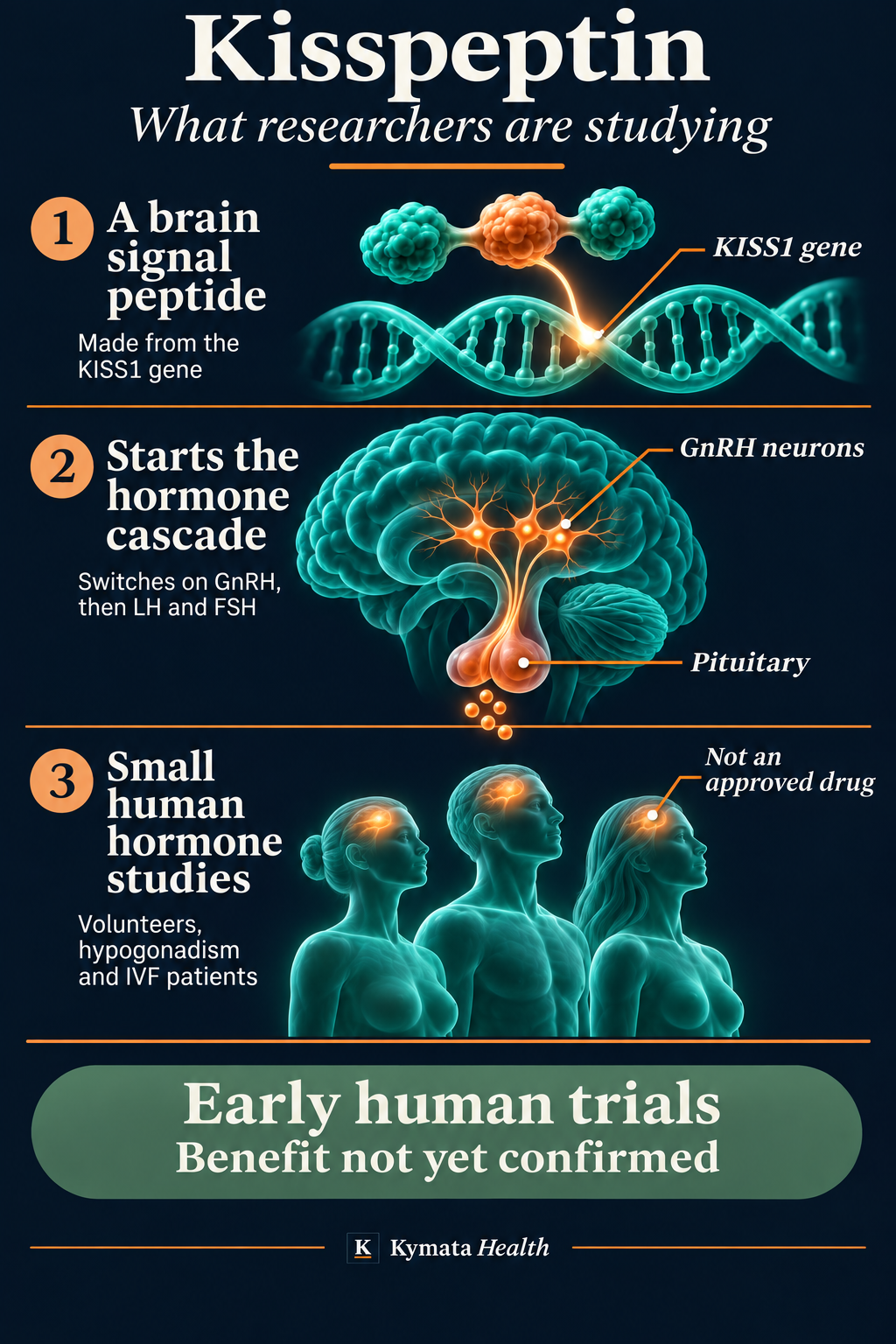
The guide shows kisspeptin as a brain peptide made from the KISS1 gene that switches on GnRH neurons, which in turn drive LH and FSH release from the pituitary. Infusions have been studied in small human physiology studies in healthy volunteers, people with hypogonadism and women undergoing IVF. It is not an approved drug. The drawing is a schematic, not a measured molecular structure, a product photograph or a treatment result. Illustration review: 22 November 2026, against this page’s own mechanism, evidence and regulatory records.
The catalogue combines kisspeptin family aliases while kisspeptin-10 and kisspeptin-54 are distinct forms. No exact, unmodified residue sequence is inferred for this record.
Illustration notes and source record
Read the source record on this page. Laboratory, topical and injected studies are separate evidence; this illustration does not establish an indication or a treatment outcome.

How it works
Kisspeptin is a neuropeptide encoded by the KISS1 gene that acts as the master upstream regulator of the reproductive hormone cascade. It activates GPR54 (KISS1R) receptors on hypothalamic GnRH neurons, triggering pulsatile GnRH release which drives LH and FSH secretion.
Kisspeptin sits at the very top of the HPG axis, above GnRH itself. Loss-of-function mutations in KISS1 or GPR54 cause hypogonadotropic hypogonadism (failure to enter puberty). Exogenous kisspeptin is studied as a diagnostic tool for reproductive disorders and as a therapeutic for functional hypothalamic amenorrhea (FHA), male hypogonadism, and polycystic ovary syndrome (PCOS). Because it acts upstream of GnRH, it can restart the entire reproductive cascade from the top down.
Background & History
Kisspeptin is a 54-amino-acid peptide encoded by the KISS1 gene, first identified in 1996 as a metastasis suppressor by Danny Welch at Pennsylvania State University. Its role as the master regulator of the hypothalamic-pituitary-gonadal (HPG) axis was discovered in 2003 independently by multiple groups who found KISS1 receptor mutations caused hypogonadotropic hypogonadism. Kisspeptin neurons directly activate GnRH neurons: it is upstream of GnRH in the reproductive endocrine hierarchy. It integrates metabolic status, stress, and environmental cues to regulate fertility and sexual function.
05 / Evidence and limits
Evidence and limits
Limits of current evidence
2 limits- Kisspeptin-10 is a shorter SKU. Do not mix the dose tables.
- This site will not treat infertility or hypogonadism from this page.
Trial FinderRecruiting now: 4 open registrations for kisspeptin
What it is studied for
- Identity: KISS1/metastin vs kisspeptin-10 vs GnRH vs hCG
- Human LH-pulse papers are not a TRT replacement
- Not Vyleesi and not a fertility protocol on this site
Verdict
Kisspeptin sits upstream of GnRH. Human LH-pulse papers exist. It is not testosterone, not hCG, and not Vyleesi. Fertility-clinic research is not a libido stack.
06 / Product forms and access
Product forms and access
Regulatory & legal status
- FDA status (US)
- Research Only
- WADA status (2026)
- Prohibited (S2)Competitive athletes subject to anti-doping controls should not use Kisspeptin.
- US compounding
- Not eligible / not available
07 / Tools and practical checks
Tools and practical checks
Dose it
5 mg + 2 mL BAC water → 2.5 mg/mL · 1 unit (U-100) = 25 mcg.
Reconstitution math
U-100 syringe| Vial | Water | Concentration |
|---|---|---|
| 5 mg lyophilized | 2 mL BAC | 2.5 mg/mL |
08 / Published study use
Published study use
What published studies gave, in whom, and the source. Not a dose for you.
What studies used
Short hormone studies- Healthy men: kisspeptin-10 by IV bolus, 0.01 to 3.0 µg/kg; the LH response peaked at 1 µg/kg. George 2011, PMID 21632807 (opens in new tab)
- Healthy women: IV and under-the-skin kisspeptin-10, up to 32 nmol/kg under the skin, did not change reproductive hormones in the follicular phase; an IV dose did in the preovulatory phase. Jayasena 2011, PMID 21976724 (opens in new tab)
- These measured hormone responses over hours, not treatment outcomes.
A record of what researchers gave, in whom; not a dose for you.
Administration
- Route / form
- Route used in studies: IV and under the skin (short hormone studies).
Who it is for
2 uses| Category | Fit | What exists |
|---|---|---|
| Reproductive Endocrinology | Moderate | Strong evidence for LH/FSH stimulation. In clinical trials for FHA and hypogonadism. |
| HPG Axis Restart / PCT | Low | Studied for post-cycle testosterone restoration. Experimental, and less established than triptorelin or gonadorelin for PCT. |
09 / Safety and interactions
Safety and interactions
What the record says
Endogenous neuropeptide with clinical trial safety data. Short half-life limits systemic exposure. May cause transient facial flushing. Chronic pulsatile delivery requires IV access, which is not practical outside clinical research. Not yet FDA-approved for therapeutic use.
Interactions & Contraindications
Kisspeptin pulses are required for efficacy: continuous GnRH output leads to downregulation. Exogenous testosterone suppresses kisspeptin neurons (negative feedback), so it is less effective while on TRT. Elevated estrogen also provides negative feedback. Leptin deficiency blunts kisspeptin response (anorexia, extreme caloric restriction).
10 / Comparisons and goal guides
Comparisons and goal guides
Combinations: what has been tested
2 pairings- + Gonadorelin →Upstream KISS1R vs direct GnRH analog. Different rungs. Not a complete HPG cascade and not a fertility protocol on this site.
- + PT-141 →Kisspeptin is GnRH/LH. PT-141 is central MC4R. Clinics pair them. That is not a combination trial and not a sexual-health NDA.
Appears in goal guides
3 guidesGoal guides give the evidence and status for each compound, with no doses. A mention here is not a treatment plan.
- GoalSexual Health and LibidoPT-141 (Vyleesi, FDA-approved for one use) and kisspeptin (research only): what the label says, what the kisspeptin studies measured, and what is not known.Evidence and status
- GoalPerimenopause and MenopauseKisspeptin, epitalon, MOTS-c and PT-141 as they come up around menopause: what each has been studied for, what is approved, and why the prescriber decides.Evidence and status
- GoalHormone Recovery After SteroidsRecovery of the testosterone axis after anabolic steroids: Khavinson testis, prostate and adrenal capsules, enclomiphene, kisspeptin and hCG. What is studied, the status, and why this belongs with a physician.Evidence and status
11 / Common questions
Common questions
Common questions
3 answersHow is Kisspeptin different from Gonadorelin?
Kisspeptin acts ONE STEP upstream of GnRH: it stimulates GnRH neurons to release GnRH, which then drives LH/FSH. Gonadorelin IS synthetic GnRH. Kisspeptin provides more physiological stimulation because it uses the body's own GnRH neurons as intermediaries.
Has kisspeptin been studied after anabolic steroid use?
No published trial has tested it for that. The human studies measured LH and other hormones for hours after one IV or under-the-skin dose in healthy men and women (PMID 21632807, 21976724).
Is Kisspeptin FDA-approved?
No. Not FDA-approved, research chemical.
12 / Sources and references
Sources and references
No separate record is provided here. Read the linked evidence and limitations for this compound.
14 / Prescription options
Prescription options
Prescription options: compare licensed telehealth providers
Some peptide therapies are available only by prescription after a consult with a licensed clinician.
Compare telehealth →15 / Peptide library
Peptide library
Keep reading: Peptide research library
Peptide research library: every pagePeptide libraryBrowse all topics
- Follistatin 344Previous in this topic · Follistatin-344 is the precursor from which cells make the circulating protein FS315.
- Sermorelin + Ipamorelin ComboNext in this topic · Two peptides in one syringe or compounded vial: GHRH(1-29) plus ipamorelin.
- PinealonPinealon is Glu-Asp-Arg (EDR), a synthetic tripeptide.
- GLOW StackVendor name for a mixed vial, usually GHK-Cu + BPC-157 + TB-500 (7-mer).
- KLOW StackVendor GLOW mix plus KPV.
Regulatory and sport classification
- Not FDA-approved, research chemical
- WADA (S2): prohibited in sport at all times