
The peptide field guide
Humanin
Humanin is a mitochondria-derived peptide studied in cell and animal models.
Human circulating-level measurements do not establish a treatment benefit, and HNG is a separate analogue.
Explore this compoundConceptual discovery context only; not an actual brain scan or a treatment effect. A brain-cDNA origin does not establish human treatment benefit.
02 / At a glance
At a glance
Key facts
- Also known as
- HN, Mitochondrial Peptide Humanin
- Type
- Longevity
- Evidence level
- Cell and animal research: human benefit remains unproven.
- US regulatory status
- Not FDA-approved, research chemical
- Updated
Identity
Humanin is a mitochondria-derived peptide studied in cell and animal models.
Research context
Brain-cDNA discovery in 2001, preclinical research and measurements of circulating humanin in people.
Evidence limits
Human circulating-level measurements do not establish a treatment benefit, and HNG is a separate analogue.
Read the technical profile and study-use reference
Quick answer
Evidence: LowHumanin is a 24-amino-acid mitochondrial-derived peptide, identified in 2001 from an Alzheimer's-brain cDNA library, that has been studied for anti-apoptotic and neuroprotective effects in cell and animal models, with human data limited to measurements of circulating levels.
- In published studies
- No human dosing study published
Research summary, not medical advice.
At a glance
Kymata peptide profile · Aug 31, 2026- Common vials
- 5 mg
- Molecular weight
- ~2.8 kDa
- CAS
- 330798-55-5
- In published studies
- No human dosing study published
- Half-life
- Not established in people (rodent analogue data only)
03 / Identity and origin
Identity and origin
Also called HN, Mitochondrial Peptide Humanin. Mitochondrial ORF peptide (MDP; 24 aa).
Read the sequence and compound record
Compound card
- Class
- Mitochondrial ORF peptide (MDP; 24 aa)
- Formula
- C121H207N39O38S1
- Molecular weight
- ~2.8 kDa
- CAS
- 330798-55-5
- Described by
- Nishimoto I, Hashimoto Y (originally identified), 2001
- Bioavailability
- Subcutaneous injection
04 / How it may work
How it may work
Mitochondrial ORF peptide (MDP; 24 aa)
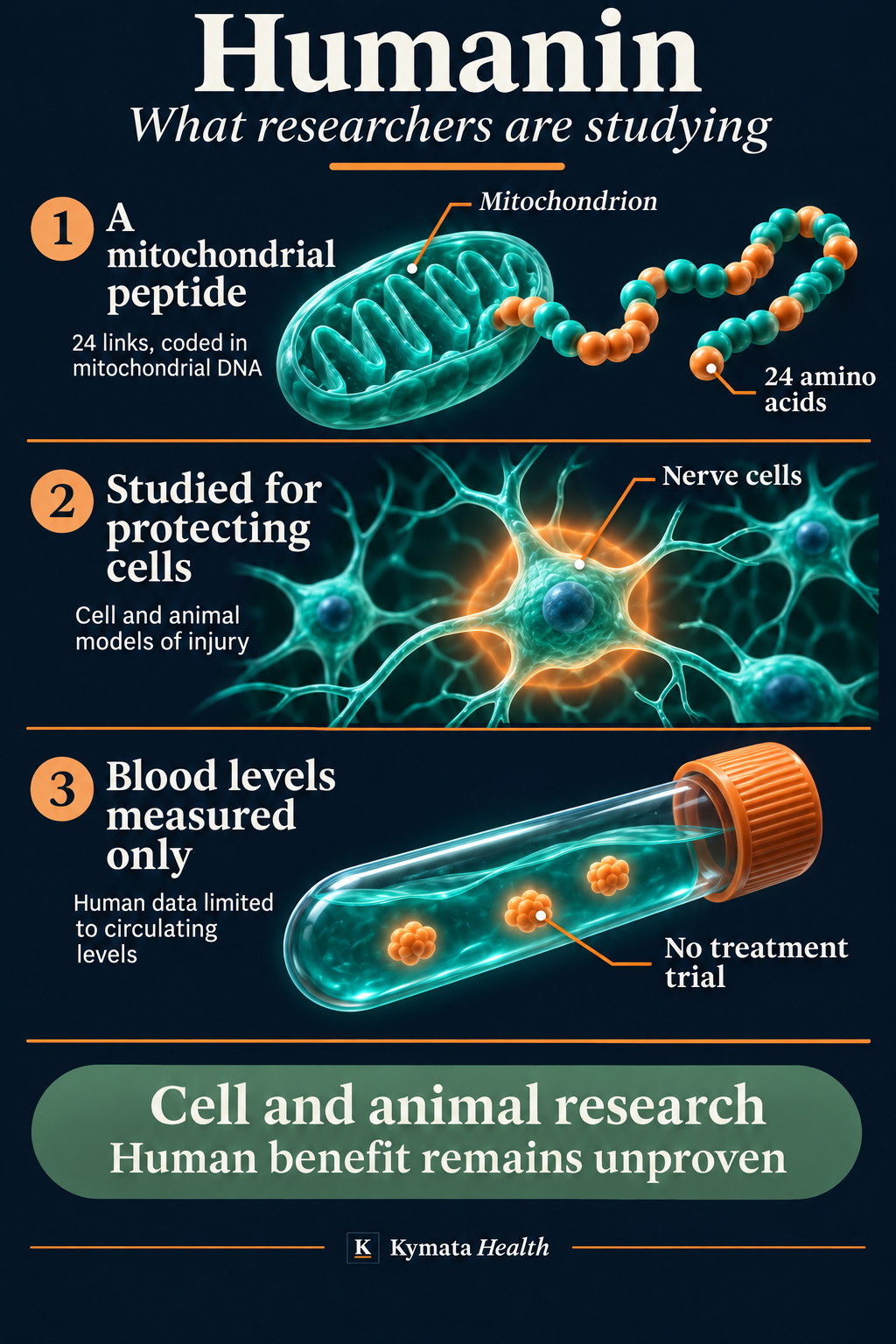
The guide shows humanin as a 24-amino-acid peptide encoded in mitochondrial DNA, identified in 2001. It has been studied for protecting cells in cell and animal models of injury. Human data are limited to measurements of its circulating levels; no treatment trial is reported. The drawing is a schematic, not a measured molecular structure, a product photograph or a treatment result. Illustration review: 22 November 2026, against this page’s own mechanism, evidence and regulatory records.
The source records disagree on the residue count. No count, raw sequence or simplified residue model is inferred for this illustration.
Illustration notes and source record
Read the source record on this page. Laboratory, topical and injected studies are separate evidence; this illustration does not establish an indication or a treatment outcome.

How it works
SourcedHumanin (HN) is a 24-amino-acid mitochondrial-derived peptide (MDP), encoded by the 16S ribosomal RNA gene in mitochondrial DNA. It is the founding member of the mitokine family alongside MOTS-c and SHLPs (Small Humanin-Like Peptides).
Humanin exerts potent cytoprotective effects: it blocks apoptosis by binding IGFBP-3 and BAX (pro-apoptotic proteins), activates STAT3 signaling for cell survival, and provides neuroprotection against β-amyloid toxicity (Alzheimer's disease models). It also improves insulin sensitivity and reduces systemic inflammation through IL-6 modulation. Circulating humanin levels decline ~40% per decade after age 20, correlating with increased susceptibility to metabolic and neurodegenerative disease. Higher humanin levels in centenarians suggest its role in extreme longevity.
Source: PMID: 11371646
Background & History
Humanin is a 21-amino-acid mitochondria-derived peptide (MDP) discovered in 2001 by Nishimoto et al. (BBRC) while screening a human brain cDNA library for factors protecting against Alzheimer's-related neuronal death. It is encoded in the 16S rRNA region of mitochondrial DNA (like MOTS-c), making both of these peptides part of the emerging class of "mitokines" (mitochondria-derived signaling peptides). Circulating humanin levels decline with age and predict metabolic and cognitive health outcomes.
05 / Evidence and limits
Evidence and limits
Limits of current evidence
2 limits- HNG is a more potent analog SKU. HNG doses do not apply to humanin.
- This site will not treat Alzheimer disease from a humanin page.
What it is studied for
- Identity: 16S rRNA MDP vs MOTS-c vs SS-31
- Alzheimer-discovery context is not an Alzheimer NDA
- Not a chemo-gonadal or diabetes protocol on this site
Verdict
Humanin is a 24-aa mitochondrial ORF peptide. Cytoprotection papers exist. It is not MOTS-c, not SHLP2, and not a dementia drug.
06 / Product forms and access
Product forms and access
Regulatory & legal status
- FDA status (US)
- Research Only
- WADA status (2026)
- Not ListedNot currently on the WADA 2026 Prohibited List. Policies may change. Verify before competition.
- US compounding
- Not eligible / not available
07 / Tools and practical checks
Tools and practical checks
Dose it
5 mg + 2 mL BAC water → 2.5 mg/mL · 1 unit (U-100) = 25 mcg.
Reconstitution math
U-100 syringe| Vial | Water | Concentration |
|---|---|---|
| 5 mg lyophilized | 2 mL BAC | 2.5 mg/mL |
08 / Published study use
Published study use
What published studies gave, in whom, and the source. Not a dose for you.
What studies used
No human study- We found no published human dosing study of humanin in PubMed.
- A 2020 review summarizes the rodent work, where rodents given humanin had better insulin sensitivity. Merry 2020, PMID 32776825 (opens in new tab)
- The doses quoted online come from animal work and vendor or forum sources.
A record of what researchers gave, in whom; not a dose for you.
Administration
- Route / form
- Not established: no human study.
Who it is for
3 uses| Category | Fit | What exists |
|---|---|---|
| Neuroprotection / Alzheimer's Prevention | Low | Strong evidence in animal models for β-amyloid protection. Human data is preliminary. |
| Longevity / Mitochondrial Health | Low | Centenarian data suggests correlation with extreme longevity. Mechanism is well-characterized. |
| Metabolic Health | Low | Improves insulin sensitivity in animal models. Human dosing protocols are not yet established. |
09 / Safety and interactions
Safety and interactions
What the record says
Endogenous mitochondrial peptide. Limited human clinical data (research peptide status). Favorable preclinical safety profile. May affect insulin sensitivity; monitor if diabetic. Use with medical supervision.
Interactions & Contraindications
Limited human safety data. IGF-1 receptor signaling involvement: potential theoretical interaction with IGF-1 LR3. No significant drug interactions documented in available research. Injectable form preferred (oral stability uncertain).
10 / Comparisons and goal guides
Comparisons and goal guides
Combinations: what has been tested
2 pairings- + MOTS-c →Two MDPs. Overlapping cytoprotection papers. Not a core mitochondrial stack with a US indication.
- + SS-31 →Cardiolipin-targeted tetrapeptide vs a mitokine paper trail. Complementary mitochondrial marketing is not a protection protocol.
11 / Common questions
Common questions
Common questions
3 answersHow is Humanin related to MOTS-c?
Both are mitochondrial-derived peptides (MDPs) encoded in mitochondrial DNA. MOTS-c activates AMPK for metabolic regulation, while Humanin blocks apoptosis and provides neuroprotection. They represent different arms of mitochondrial stress signaling.
Why do Humanin levels decline with age?
Mitochondrial DNA copy number and mitochondrial function both decline with age. Since Humanin is encoded in mtDNA, its production decreases ~40% per decade. This decline correlates with increased susceptibility to age-related neurodegeneration and metabolic disease.
Is Humanin FDA-approved?
No. Not FDA-approved, research chemical.
12 / Sources and references
Sources and references
No separate record is provided here. Read the linked evidence and limitations for this compound.
14 / Prescription options
Prescription options
Prescription options: compare licensed telehealth providers
Some peptide therapies are available only by prescription after a consult with a licensed clinician.
Compare telehealth →15 / Peptide library
Peptide library
Keep reading: Peptide research library
Peptide research library: every pagePeptide libraryBrowse all topics
- ThymalinPrevious in this topic · Thymalin is a polypeptide extract of calf thymus registered as a medicine in Russia; Russian studies, mostly from the Khavinson group, examined it in immune function, including…
- PEG-MGFNext in this topic · FDA found no human exposure data for products containing PEG-MGF by any route.
- MGFMGF is the IGF-1Ec splice produced locally after mechanical load.
- CerebrolysinPorcine-brain peptide mixture (EVER Pharma), not a single sequence.
- TriptorelinTriptorelin is a D-Trp6 GnRH agonist.
Regulatory and sport classification
- Not FDA-approved, research chemical