
The peptide field guide
Glutathione
Glutathione is an antioxidant your body makes from glutamate, cysteine and glycine.
Whether an injection improves everyday energy is a separate question.
Explore this compoundConceptual editorial illustration; not a measured molecular structure, product photograph or treatment result.
02 / At a glance
At a glance
Key facts
- Also known as
- GSH, L-Glutathione, Reduced Glutathione
- Sequence
- H–γ-Glu–Cys–Gly–OH
- Evidence level
- Human trials, mixed results: benefit not established.
- US regulatory status
- Not FDA-approved
- Updated
Identity
Glutathione is an antioxidant your body makes from glutamate, cysteine and glycine. It helps cells manage oxidative stress and participates in enzyme-driven processing of compounds in the body.
Research interest
Supplements and prescription injections aim to add to that supply. Oral trials show mixed changes in glutathione stores and some modest skin measurements; the molecule’s biological role alone does not establish the energy, immunity or detox claims used to market products.
What the evidence says
One oral trial found higher glutathione levels in blood and cells after six months. A shorter trial found no clear change. Whether an injection improves everyday energy is a separate question.
See the mechanism ↓Explore the studies ↓Look up the CAS number and other specs ↓Compare providers →
Read the technical profile and study-use reference
At a glance
Kymata peptide profile · Nov 19, 2026- Common vials
- 200 mg
- In published studies
- Trial amounts are recorded under What studies used (PMID 19230029)
- Half-life
- Total plasma glutathione averaged 14.1 minutes after IV administration in ten volunteers; not a subcutaneous or intracellular value
03 / Identity and origin
Identity and origin
Also called GSH, L-Glutathione, Reduced Glutathione. Tripeptide antioxidant (GSH), not a drug for disease.
Technical specifications
Reduced L-glutathione (GSH). Glutamate links to cysteine through its side chain (γ). Cysteine has a free sulfur-containing thiol in GSH. Two chains can join through their sulfur atoms to form oxidized glutathione (GSSG).
Select a field name to see what it means.
CAS registry number
A Chemical Abstracts Service number identifies a substance. Match the named form too, since a seller may reuse the number for a salt.
- 70-18-8
Other names
These names can help you find the same peptide in chemical records and research papers.
- GSH · Reduced L-glutathione · γ-glutamylcysteinylglycine
Amino acid sequence
Read from the amino end on the left to the acid end on the right. H marks a free amino end, Ac an attached acetyl group, and OH a free acid end. The letters in between describe the amino acids in order.
H–γ-Glu–Cys–Gly–OHChain length
A residue is one amino acid incorporated into the chain. An attached acetyl group does not add a residue.
- 3 residues
Molecular formula
Element symbols and numbers count the atoms in the reference form. This formula excludes added salt counterions and water of hydration. Charge in solution can change with pH.
C10H17N3O6SAverage molar mass
This is the mass of one mole of the reference form, averaged across naturally occurring isotopes. A salt can weigh more because it also contains a counterion.
- 307.33 g/mol
FDA ingredient identifier (UNII)
FDA’s Unique Ingredient Identifier distinguishes substances in its registry. It provides an identity reference, independent of a product’s approval status.
- GAN16C9B8O
PubChem compound ID
The compound ID opens a public chemical structure record maintained by the US National Library of Medicine.
- 124886
Identity sources FDA substance registry · PubChem compound 124886
04 / How it may work
How it may work
The mechanism, the research and what it means
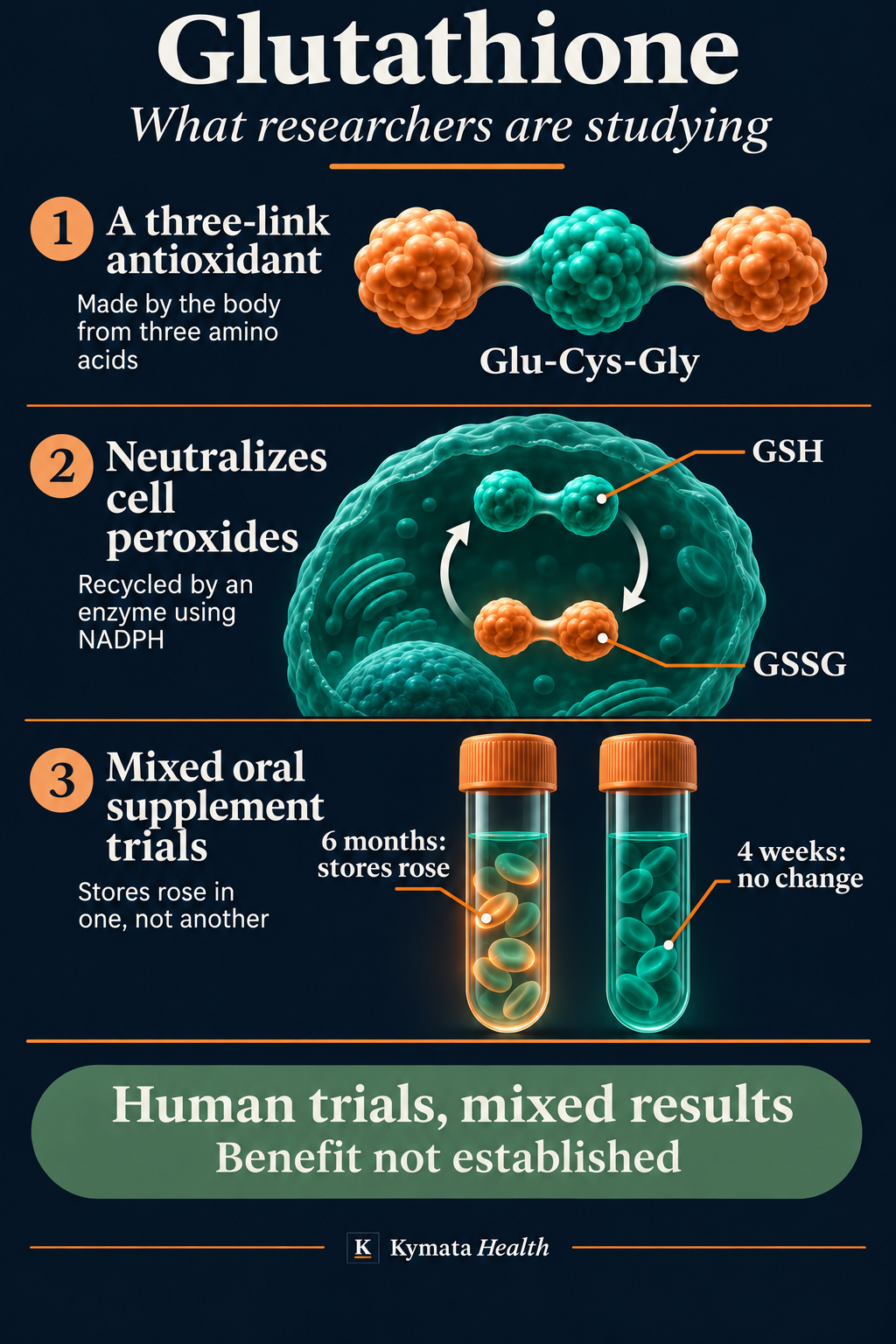
The guide shows glutathione as an antioxidant the body makes from glutamate, cysteine and glycine. Cells use it to neutralize peroxides, turning reduced glutathione (GSH) into its oxidized form (GSSG), which an enzyme recycles using NADPH. Oral supplement trials were mixed: a six-month trial in 54 adults found higher body stores (PMID 24791752), while a four-week trial in 40 adults found no change (PMID 21875351). The drawing is a schematic, not a measured molecular structure, a product photograph or a treatment result. Illustration review: 22 November 2026, against this page’s own mechanism, evidence and regulatory records.
Illustration notes and source record
Can taking glutathione by mouth raise its level in my blood?
How cells handle peroxides. Cells make glutathione from three amino acids. In red blood cells, enzymes use and recycle it to break down peroxides, reactive chemicals that can damage the cell.
What two oral trials found. In a six-month trial, red blood cell glutathione rose 29% from baseline in the lower-dose group. In a separate four-week trial, blood glutathione showed no clear change compared with placebo.
Researchers can measure glutathione inside red blood cells.
Earlier contextual illustration
Earlier mechanism plate and its source context

Three amino acids assembled by the cell
Cells join glutamate and cysteine first, then add glycine. The middle amino acid, cysteine, contains sulfur. A bond between the sulfur atoms of two glutathione molecules joins them into the oxidized form.
Choose Rotate or Pan, then focus the diagram and use the arrow keys. Up and down tilt in Rotate mode. Pinch or use + and − to zoom.
Each bead is one amino acid. Once it is part of the chain, it is called a residue. Drag to rotate or tap a bead. The shape is a schematic illustration.
- Acidic
- Polar
- Glycine / proline
Glutamate joins cysteine through its side branch. This unusual connection is called a γ-glutamyl bond. Its alpha-carboxyl group remains free. Glutamate forms an unusual gamma linkage through its side chain.
Read the full sequence
A peptide bond is a covalent link joining two amino acids in a chain. A hydrogen bond is a weaker attraction, for example between a hydrogen on an oxygen and a nearby oxygen atom. A side chain may form hydrogen bonds without joining another amino acid to the chain. This diagram shows the sequence; it does not measure these interactions. See the IUPAC definitions of peptides and hydrogen bonds.
ECG
- Glutamate. Glutamate joins cysteine through its side branch. This unusual connection is called a γ-glutamyl bond. Its alpha-carboxyl group remains free.
- Cysteine. Its sulfur-containing tip, called a thiol, can take part in reactions that transfer electrons.
- Glycine. Its side branch is a single hydrogen atom, leaving the chain more room to bend here.
How to read the mechanism
Biology and evidenceGlutathione peroxidase uses reduced glutathione (GSH) while handling peroxides, producing oxidized glutathione (GSSG). Glutathione reductase uses NADPH to recycle GSSG back to GSH.
Glutathione also participates in enzyme-mediated conjugation pathways. These normal functions do not prove that purchasing a supplement or injection removes toxins or improves long-term health.
Oral delivery is not universally ineffective: some human trials increased measured stores and others did not. Bypassing digestion with an injection does not establish superior intracellular delivery or clinical outcomes.
The practical takeaway: One oral trial found higher glutathione levels in blood and cells after six months. A shorter trial found no clear change. Whether an injection improves everyday energy is a separate question.
- Richie et al.: oral glutathione stores trial (2015)
- Allen and Bradley: oral glutathione trial (2011)
- Arjinpathana and Asawanonda: oral skin trial (2012)
- Hauser et al.: IV glutathione pilot (2009)
- Liposomal glutathione pilot (2018)
- Oral film versus tablet pharmacokinetic study (2026)
- Aebi et al.: intravenous glutathione pharmacokinetics (1991)
05 / Evidence and limits
Evidence and limits
Actual study populations, findings and limits
What the studies found
Study design · measured outcomeOral glutathione stores
Oral glutathione
54 non-smoking adults; six-month placebo-controlled study.
Finding. The study reported increases in blood and cellular glutathione.
What the finding means
Evidence that oral glutathione can change measured stores, not proof of energy, longevity or disease prevention.
A shorter oral trial
Oral glutathione
40 adults; four-week placebo-controlled trial.
Finding. No significant effect on glutathione or oxidative-stress biomarkers.
What the finding means
Oral results vary across experiments. Duration alone has not been established as the reason.
Skin measurements
Oral glutathione
60 adults; four-week oral trial.
Finding. Between-group melanin-index differences were significant at two of six measured sites.
What the finding means
A modest, site-specific finding. It does not establish lasting complexion change or injection benefits.
Intravenous clinical pilot
Intravenous glutathione or placebo
21 randomized patients with Parkinson’s disease; four-week placebo-controlled pilot.
Finding. No significant between-group difference in the clinical rating outcome.
What the finding means
An injected human trial exists, but it did not establish efficacy and cannot validate a subcutaneous wellness program.
Select a group to see its evidence.
Study populations and routes differ. Do not combine participant counts into a claimed number of people helped. Provider testimonials and customer totals are not treatment-effect estimates.
Trial FinderRecruiting now: 12 open registrations for glutathione
06 / Product forms and access
Product forms and access
Access and product forms
Editorial check · Nov 6, 2026Oral studies measure different outcomes from injection studies. For a compounded injection, ask which pharmacy supplies it and compare the vial’s lot number with the October Greenwich Rx recall, which names the affected lots.
07 / Tools and practical checks
Tools and practical checks
Dose it
200 mg + 2 mL BAC water → 100 mg/mL · 1 unit (U-100) = 1000 mcg.
Reconstitution math
U-100 syringe| Vial | Water | Concentration |
|---|---|---|
| 200 mg lyophilized | 2 mL BAC | 100 mg/mL |
08 / Published study use
Published study use
What published studies gave, in whom, and the source. Not a dose for you.
What studies used
Small IV trials- 21 people with Parkinson disease: 1,400 mg IV three times a week for 4 weeks, against placebo. It was well tolerated; symptom scores did not differ. Hauser 2009, PMID 19230029 (opens in new tab)
A record of what researchers gave, in whom; not a dose for you.
Who it is for
3 uses| Category | Fit | What exists |
|---|---|---|
| Antioxidant biology | Established physiological role | Glutathione participates in redox and conjugation pathways; this does not establish that supplementation improves health. |
| Oral supplementation | Mixed biomarker evidence | Some controlled trials increased measured stores; others did not. Patient-important benefits need separate evidence. |
| Injected wellness products | Clinical benefit uncertain | An IV Parkinson’s pilot found no significant between-group clinical effect. It does not validate a subcutaneous wellness program. |
09 / Safety and interactions
Safety and interactions
What the record says
Safety depends on product, route and clinical context. FDA’s August 27, 2026 alert described adverse events from IV products linked to dietary-supplement-grade starting material. Sterile injections need appropriate ingredients and processes; naturally occurring does not mean every product is safe. Discuss medicines, health history and the dispensing pharmacy with the prescriber.
Interactions & Contraindications
Discuss other medicines and medical conditions with a clinician. Do not change cancer treatment or add glutathione during oncology care without the treating team. Oral absorption and injected-product outcomes differ by formulation; no universal best route is established by the cited trials.
10 / Comparisons and goal guides
Comparisons and goal guides
Combinations: what has been tested
1 pairing- + NAD+ →GR recycling uses NADPH/NADP chemistry. An IV SKU plus a glutathione SKU is not a cellular redox protection system.
11 / Common questions
Common questions
Common questions
5 answersIs intravenous glutathione the same as a subcutaneous injection?
Both deliver glutathione by injection. IV administration delivers it into a vein. Subcutaneous administration delivers it under the skin. Evidence from one route does not determine the exposure, benefits or risks of the other. Verify the prescribed route and dispensing pharmacy.
Does oral glutathione get absorbed?
Some trials increased measured glutathione stores, while others did not. A six-month placebo-controlled trial and a four-week trial reached different biomarker results. Oral delivery is not universally ineffective (PMIDs 24791752 and 21875351).
Are glutathione injections more effective than capsules?
Bypassing digestion does not establish better intracellular delivery or health outcomes. Compare evidence for the exact route and formulation; IV, subcutaneous and oral products are not interchangeable.
What did skin studies find?
Small oral trials reported modest, site-specific skin measurements. In one 60-person trial, between-group melanin-index differences were significant at two of six sites. These findings do not establish guaranteed or lasting complexion change, or efficacy for injected products (PMID 20524875).
Is Glutathione FDA-approved?
No. Not an FDA-approved drug; sold as a dietary supplement and as compounded injections. FDA’s Aug 27, 2026 notice warned compounders not to use supplement-grade glutathione in injectables.
12 / Sources and references
Sources and references
Additional background papers. Primary studies and policy sources are linked in the relevant sections.
Sources
4 papers- 1“Randomized controlled trial of oral glutathione supplementation on body stores of glutathione.”Richie et al. European Journal of Nutrition (2015). PMID: 24791752
- 2“Effects of oral glutathione supplementation on systemic oxidative stress biomarkers in human volunteers.”Allen and Bradley Journal of Alternative and Complementary Medicine (2011). PMID: 21875351
- 3“Randomized, double-blind, pilot evaluation of intravenous glutathione in Parkinson’s disease.”Hauser et al. Movement Disorders (2009). PMID: 19230029
- 4“Glutathione: overview of its protective roles, measurement, and biosynthesis.”Forman HJ, et al. Mol Aspects Med (2009). PMID: 18796312
14 / Prescription options
Prescription options
Prescription options: compare licensed telehealth providers
Some peptide therapies are available only by prescription after a consult with a licensed clinician.
Compare telehealth →15 / Peptide library
Peptide library
Keep reading: Peptide research library
Peptide research library: every pagePeptide libraryBrowse all topics
- NAD+Previous in this topic · NAD+ is a coenzyme that carries electrons during energy metabolism.
- OxytocinNext in this topic · Oxytocin is a neurohypophysial hormone, FDA-approved as Pitocin to induce or strengthen labor contractions and to control bleeding after delivery.
- VIPVIP is a 28-amino-acid neuropeptide isolated by Said and Mutt in 1970.
- ThymalinThymalin is a polypeptide extract of calf thymus registered as a medicine in Russia; Russian studies, mostly from the Khavinson group, examined it in immune function, including…
- HumaninHumanin is a 24-amino-acid mitochondrial-derived peptide, identified in 2001 from an Alzheimer's-brain cDNA library, that has been studied for anti-apoptotic and neuroprotective…