
The peptide field guide
PEG-MGF
PEG-MGF denotes a PEGylated MGF analogue, distinct from native MGF and IGF-1 LR3.
The retained records do not establish measured human product pharmacokinetics or human muscle-growth benefit.
Explore this compoundAbstract modification metaphor, not a PEG structure, release measurement, protective mechanism or treatment effect.
02 / At a glance
At a glance
Key facts
- Also known as
- PEGylated Mechano Growth Factor, PEGylated MGF, Mechano Growth Factor Pegylated
- Type
- Growth Factor
- Evidence level
- Research peptide: little published research.
- US regulatory status
- Not FDA-approved, research chemical
- Updated
Identity
PEG-MGF denotes a PEGylated MGF analogue, distinct from native MGF and IGF-1 LR3.
Research context
The selected Dominikowski 2026 reference (PMID 42395176) is a review, not a human product trial; native MGF splice biology remains a separate evidence record.
Evidence limits
The retained records do not establish measured human product pharmacokinetics or human muscle-growth benefit.
Read the technical profile and study-use reference
Quick answer
Evidence: LowFDA found no human exposure data for products containing PEG-MGF by any route. PEG-MGF is a synthetic peptide related to mechano growth factor (MGF) with polyethylene glycol attached. Whether it improves muscle recovery in people is unknown.
- In published studies
- No established human dose
Research summary, not medical advice.
At a glance
Kymata peptide profile · Nov 22, 2026- In published studies
- No established human dose
- Half-life
- No human half-life established
- Common vials
- Research vial; no sourced vial preset in this calculator
- Molecular weight
- Depends on the peptide and the attached polyethylene glycol
03 / Identity and origin
Identity and origin
Also called PEGylated Mechano Growth Factor, PEGylated MGF, Mechano Growth Factor Pegylated. Synthetic MGF-related peptide modified with polyethylene glycol.
Read the sequence and compound record
Compound card
- Class
- Synthetic MGF-related peptide modified with polyethylene glycol
- Molecular weight
- Depends on the peptide and the attached polyethylene glycol
- Bioavailability
- The proportion of a PEG-MGF dose reaching circulation in people is unknown.
04 / How it may work
How it may work
Synthetic MGF-related peptide modified with polyethylene glycol
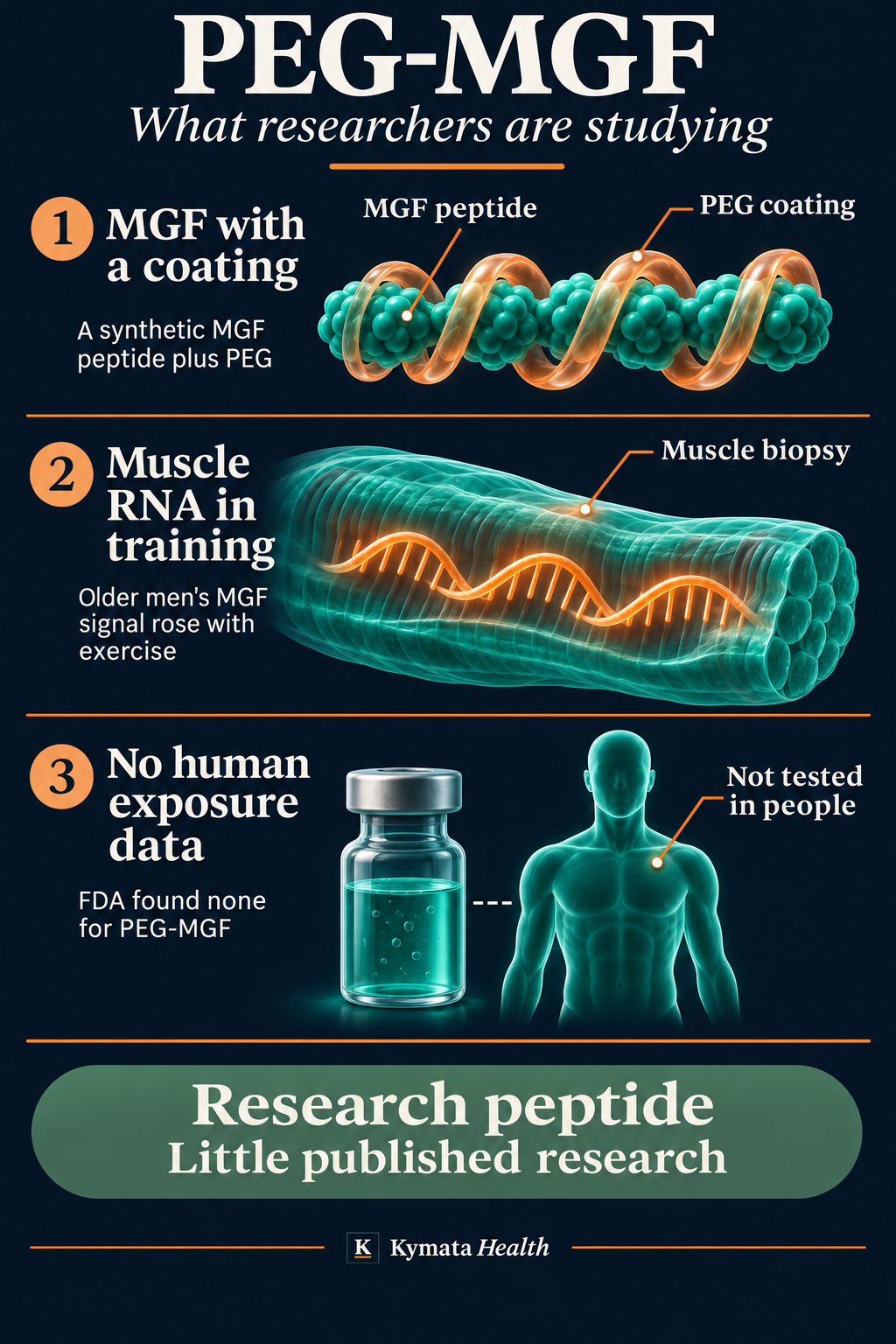
The guide shows PEG-MGF as a synthetic peptide related to mechano growth factor (MGF) with a polyethylene glycol (PEG) coating attached. In 74-year-old men, the muscle’s own MGF messenger RNA rose with resistance training (Hameed 2004, PMID 14565994); none received PEG-MGF. FDA found no human exposure data for PEG-MGF products by any route. The drawing is a schematic, not a measured molecular structure, a product photograph or a treatment result. Illustration review: 22 November 2026, against this page’s own mechanism, evidence and regulatory records.
The peptide fragment and PEG modification are not fully specified in the retained records; no exact chain, molecular weight or structure is inferred.
Illustration notes and source record
Read the source record on this page. Laboratory, topical and injected studies are separate evidence; this illustration does not establish an indication or a treatment outcome.

How it works
SourcedThe IGF-I gene can produce several messenger RNAs. Muscle cells make one called IGF-IEc, also known as mechano growth factor (MGF). Hameed and colleagues measured that particular RNA in thigh-muscle biopsies after resistance training and growth hormone exposure. The amount of RNA in a sample cannot tell us how a PEG-MGF product acts in a person.
Some experiments use a synthetic 24-amino-acid piece of the region at one end of the protein, called the E-domain. PEGylation is a further step that attaches polyethylene glycol to a peptide. To measure how long a PEGylated preparation circulates, researchers would need to identify the preparation and measure its concentration over time.
Source: PMID: 14565994, PMID: 17845560, PMID: 24253050
Background & History
In a study of injured mouse hearts, Peña and colleagues used tiny rods made of polyethylene glycol to release an MGF E-domain peptide locally. Heart function improved in mice that received the peptide-releasing rods. The PEG was part of the delivery material. This experiment did not measure how long a PEG-conjugated peptide circulates.
05 / Evidence and limits
Evidence and limits
The human study followed changes inside muscle. The experiments with synthetic peptides took place in cells or mice.
Human evidence
The human study followed changes inside muscle. The experiments with synthetic peptides took place in cells or mice.- Hameed 2004 (PMID 14565994) studied 19 healthy men aged 74. After five weeks, thigh-muscle MGF messenger RNA rose 163% from baseline in the six men who trained with placebo and 456% in the six who trained with growth hormone. The seven who received growth hormone alone had no significant increase at five weeks. None received PEG-MGF.
- Mills 2007 (PMID 17845560) synthesized the 24-amino-acid MGF-Ct24E peptide and found it enhanced human myogenic precursor cell proliferation in culture and significantly promoted engraftment of those human cells transplanted into mice.
- Fornaro 2014 (PMID 24253050) found MGF peptide failed to increase proliferation of C2C12 cells, primary human skeletal muscle myoblasts or primary mouse muscle stem cells, while the same cells responded to mature IGF-1 or full-length IGF-1Eb. These experiments used different preparations and measured different outcomes. Neither team tested PEG-MGF in people.
What it is studied for
- Expression of the MGF form of IGF-I in thigh muscle after resistance training
- Growth of muscle precursor cells in culture and engraftment of transplanted cells in mice
Verdict
The biopsy study shows that older muscle can change how much MGF messenger RNA it makes during training. Whether administering PEG-MGF improves strength, increases muscle size or shortens recovery in people remains unknown.
06 / Product forms and access
Product forms and access
Regulatory & legal status
- FDA status (US)
- Research Only
- WADA status (2026)
- Prohibited (S2)Competitive athletes subject to anti-doping controls should not use PEG-MGF. Section S2.3 of the 2026 WADA Prohibited List names mechano growth factors. The prohibition applies in and out of competition.
- US compounding
- FDA flags possible immune reactions with some routes of administration and difficulty identifying the active ingredient and peptide-related impurities in compounded PEG-MGF.
07 / Tools and practical checks
Tools and practical checks
No separate record is provided here. Read the linked evidence and limitations for this compound.
08 / Published study use
Published study use
What published studies gave, in whom, and the source. Not a dose for you.
What studies used
No established human PEG-MGF dose- Nineteen older men participated in a study of resistance training, growth hormone or both. The investigators measured MGF messenger RNA in thigh muscle. No participant received PEG-MGF. Hameed 2004, PMID 14565994 (opens in new tab)
- Mills and colleagues studied a synthetic 24-amino-acid MGF fragment and reported better engraftment of human muscle precursor cells transplanted into mice. Mills 2007, PMID 17845560 (opens in new tab)
- Fornaro and colleagues tested an MGF E-domain peptide in cultured muscle cells. Mouse myoblasts and primary human myoblasts showed no increase in proliferation. This work did not establish a human dose. Fornaro 2014, PMID 24253050 (opens in new tab)
A record of what researchers gave, in whom; not a dose for you.
09 / Safety and interactions
Safety and interactions
What the record says
FDA could identify no human exposure data for products containing PEG-MGF by any route. Its compounding review flags possible immune reactions with certain routes and difficulty characterizing the active ingredient and impurities. There are insufficient human data to estimate the frequency of harm.
Interactions & Contraindications
Human exposure data would be needed to assess interactions with medicines or other growth factors. FDA reports that it could identify none for products containing PEG-MGF.
10 / Comparisons and goal guides
Comparisons and goal guides
Appears in goal guides
1 guideGoal guides give the evidence and status for each compound, with no doses. A mention here is not a treatment plan.
11 / Common questions
Common questions
Common questions
6 answersWhat did the human muscle-biopsy study measure?
Hameed and colleagues measured MGF messenger RNA in thigh muscle from 19 older men at baseline and after five and twelve weeks. Six trained with placebo, six trained with growth hormone and seven received growth hormone alone. No one received PEG-MGF.
What did the studies of the short MGF peptide find?
Mills and colleagues reported that a synthetic E-domain peptide helped transplanted human muscle precursor cells engraft in mice. Fornaro and colleagues found no increase in proliferation of mouse or primary human muscle cells exposed to an E-domain peptide in culture. Neither study measured strength or recovery in people given PEG-MGF.
Does the mouse heart study establish how long PEG-MGF lasts?
Peña 2015 (PMID 25678113) delivered a synthetic human MGF E-domain peptide to mouse hearts after coronary artery ligation using poly(ethylene glycol) dimethacrylate hydrogel microrods and reported lower mortality and a smaller decline in hemodynamics in the treated mice. The PEG was the delivery material, not a conjugate on the peptide, and no circulating concentration was measured.
Is there a measured human half-life or a post-workout schedule for PEG-MGF?
FDA found no human exposure data for PEG-MGF products by any route. The research reviewed here provides no measured human half-life, established dose or evidence for a post-workout schedule.
What does the anti-doping list say about MGF?
Section S2.3 of the 2026 World Anti-Doping Agency Prohibited List names mechano growth factors among the substances prohibited in and out of competition. The list identifies the class. It does not verify the contents of a particular product.
Is PEG-MGF FDA-approved?
No. Not FDA-approved, research chemical.
12 / Sources and references
Sources and references
6 papers cited on this page.
Sources
6 papers- 1“The effect of recombinant human growth hormone and resistance training on IGF-I mRNA expression in the muscles of elderly men.”Hameed M, Lange KH, Andersen JL, et al. The Journal of Physiology (2004). PMID: 14565994 DOI: 10.1113/jphysiol.2003.051722
- 2“A synthetic mechano growth factor E peptide enhances myogenic precursor cell transplantation success.”Mills P, Dominique JC, Lafrenière JF, Bouchentouf M, Tremblay JP American Journal of Transplantation (2007). PMID: 17845560 DOI: 10.1111/j.1600-6143.2007.01927.x
- 3“Mechano-growth factor peptide, the COOH terminus of unprocessed insulin-like growth factor 1, has no apparent effect on myoblasts or primary muscle stem cells.”Fornaro M, Hinken AC, Needle S, et al. American Journal of Physiology. Endocrinology and Metabolism (2014). PMID: 24253050 DOI: 10.1152/ajpendo.00408.2013
- 4“Localized delivery of mechano-growth factor E-domain peptide via polymeric microstructures improves cardiac function following myocardial infarction.”Peña JR, Pinney JR, Ayala P, Desai TA, Goldspink PH Biomaterials (2015). PMID: 25678113 DOI: 10.1016/j.biomaterials.2014.12.050
- 5“Certain bulk drug substances for use in compounding that may present significant safety risks (Mechano Growth Factor Pegylated entry).”US Food and Drug Administration FDA (current).
- 6“World Anti-Doping Code: 2026 Prohibited List (S2.3 names mechano growth factors).”World Anti-Doping Agency WADA (2026).
14 / Prescription options
Prescription options
Prescription options: compare licensed telehealth providers
Some peptide therapies are available only by prescription after a consult with a licensed clinician.
Compare telehealth →15 / Peptide library
Peptide library
Keep reading: Peptide research library
Peptide research library: every pagePeptide libraryBrowse all topics
- HumaninPrevious in this topic · Humanin is a 24-amino-acid mitochondrial-derived peptide, identified in 2001 from an Alzheimer's-brain cDNA library, that has been studied for anti-apoptotic and neuroprotective…
- MGFNext in this topic · MGF is the IGF-1Ec splice produced locally after mechanical load.
- CerebrolysinPorcine-brain peptide mixture (EVER Pharma), not a single sequence.
- TriptorelinTriptorelin is a D-Trp6 GnRH agonist.
- FOXO4-DRID-retro-inverso FOXO4/p53 interfering peptide from Baar 2017 mouse senolytic work.
Regulatory and sport classification
- Not FDA-approved, research chemical
- WADA (S2): prohibited in sport at all times