
The peptide field guide
VIP
VIP is vasoactive intestinal peptide, a 28-residue neuropeptide.
The nasal series and IV-aviptadil trial differ in product, route, population and design.
Explore this compoundConceptual pulmonary research context only; not an actual scan or a treatment effect. IV-aviptadil findings are separate from nasal VIP evidence.
02 / At a glance
At a glance
Key facts
- Also known as
- Vasoactive Intestinal Peptide
- Sequence
- 28-aa VIP (HSDAVFTDNYTRLRKQMAVKKYLNSILN-NH2)
- Evidence level
- Human trials, mixed results: benefit not established.
- US regulatory status
- Not FDA-approved, research chemical
- Updated
Identity
VIP is vasoactive intestinal peptide, a 28-residue neuropeptide.
Research context
A 2013 nasal VIP CIRS open-label series and the separate 2023 TESICO IV-aviptadil trial.
Evidence limits
The nasal series and IV-aviptadil trial differ in product, route, population and design.
Read the technical profile and study-use reference
Quick answer
Evidence: LowVIP is a 28-amino-acid neuropeptide isolated by Said and Mutt in 1970. It acts at VPAC1/VPAC2 and is a strong vasodilator with a minutes-class IV half-life. Intranasal research use shows up in Shoemaker CIRS open-label work (n=20, 2013), which is not a Phase 3 trial. Aviptadil (synthetic VIP) had separate pulmonary development. This page covers identity and evidence quality; it makes no mold-illness claim.
- In published studies
- Trial details are recorded under What studies used (PMID 37348524)
Research summary, not medical advice.
At a glance
Kymata peptide profile · Oct 29, 2026- Molecular weight
- 3326.79 g/mol
- CAS
- 37221-79-7
- In published studies
- Trial details are recorded under What studies used (PMID 37348524)
- Half-life
- ~1–2 min IV; intranasal is a different presentation, not a published consumer PK curve
- Common vials
- Investigational injection or inhaled solution; no reconstitution in this calculator
03 / Identity and origin
Identity and origin
Also called Vasoactive Intestinal Peptide. Endogenous VPAC1/VPAC2 neuropeptide.
Read the sequence and compound record
Compound card
- Sequence
- 28-aa VIP (HSDAVFTDNYTRLRKQMAVKKYLNSILN-NH2)
- Class
- Endogenous VPAC1/VPAC2 neuropeptide
- Formula
- C147H237N43O43S
- Molecular weight
- 3326.79 g/mol
- CAS
- 37221-79-7
- Described by
- Said SI, Mutt V (1970), 1970
- Bioavailability
- Intranasal (community CIRS SKUs) or IV (research/drug development). Not a typical lyophilized recovery vial on this site.
04 / How it may work
How it may work
Endogenous VPAC1/VPAC2 neuropeptide
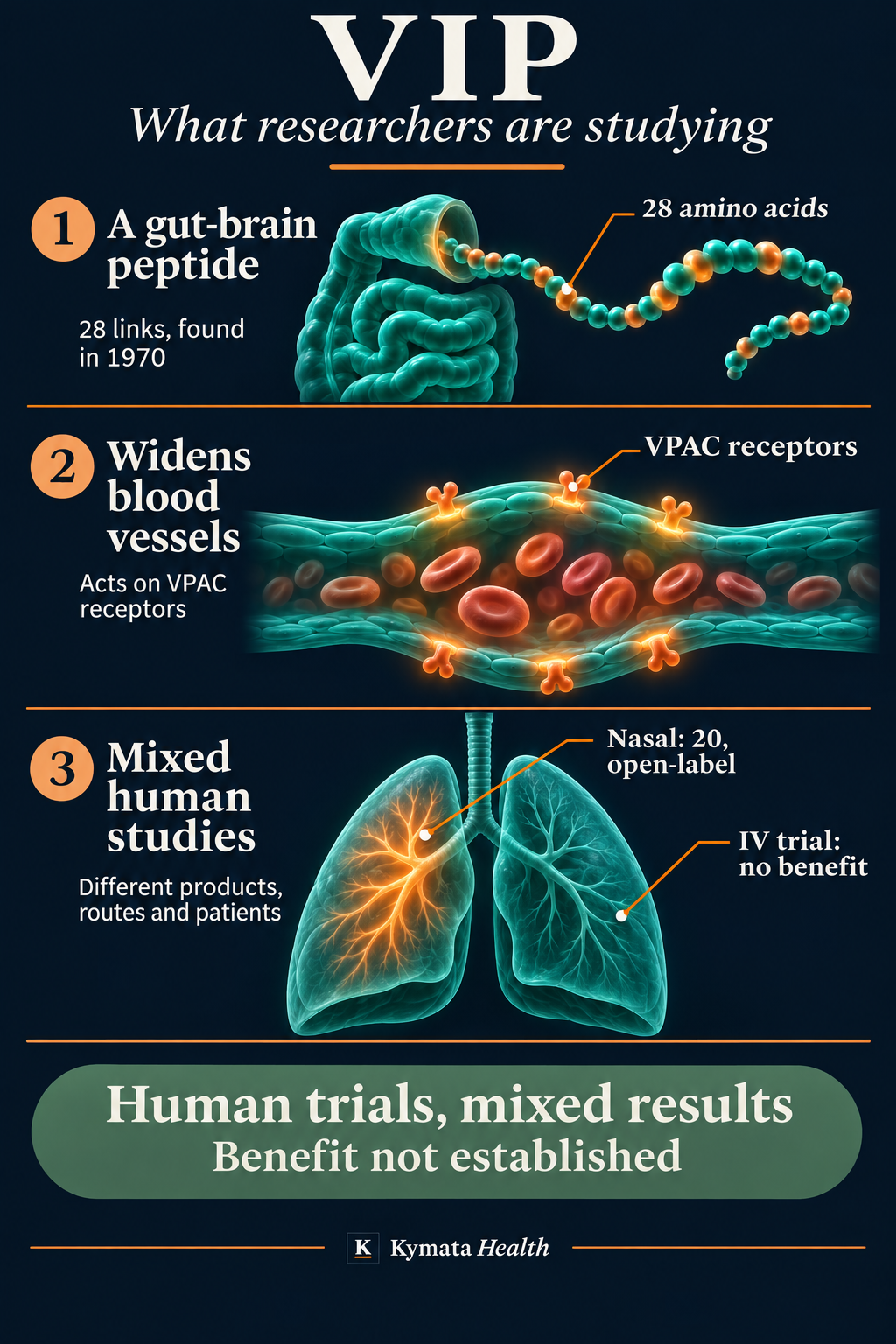
The guide shows vasoactive intestinal peptide (VIP) as a 28-amino-acid neuropeptide first isolated from the gut in 1970 (Said and Mutt, PMID 5450698). It acts on VPAC1 and VPAC2 receptors and widens blood vessels. Human studies differ by product, route and patients: an open-label nasal series included 20 people, while the 2023 TESICO trial of intravenous aviptadil in 461 hospitalized adults found no improvement. The drawing is a schematic, not a measured molecular structure, a product photograph or a treatment result. Illustration review: 22 November 2026, against this page’s own mechanism, evidence and regulatory records.
The retained sequence includes terminal amidation. A simplified unmodified residue model is not inferred; read the sequence and compound record for its exact scope.
Illustration notes and source record
Read the source record on this page. Laboratory, topical and injected studies are separate evidence; this illustration does not establish an indication or a treatment outcome.

How it works
VIP is a 28-residue neuropeptide isolated by Said and Mutt from porcine intestine (Science 1970, PMID 5450698). It is a potent vasodilator and a VPAC1/VPAC2 agonist with a minutes-class IV half-life. That physiology is not in dispute.
What this catalog page is usually asked to do is CIRS / mold / “Shoemaker protocol” nasal VIP. The 2013 open-label series (Health, DOI 10.4236/health.2013.53053, n=20) is that literature. It is not a Phase 3 RCT, not PubMed 28694751 (that PMID was a bad citation on this page), and not a reason to skip the rest of a clinician-run workup. Aviptadil is synthetic VIP in pulmonary development; it is not a research-chem nasal spray.
This site will not treat CIRS, MCAS, PAH, or Long COVID from a peptide page.
VIP is typically a nasal spray in the use-case people search. This database has no vial size. Do not force spray math into the SubQ calculator.
05 / Evidence and limits
Evidence and limits
Limits of current evidence
5 limits- Shoemaker 2013 is open-label n=20 in a non-NEJM journal. Durable-efficacy language in that paper is the authors’. It is not a regulator’s.
- PMID 28694751 does not identify that paper. Cite the 2013 Health DOI instead of a hallucinated PMID.
- Aviptadil / PAH / COVID development is a different product path.
- IV half-life of minutes is why nasal or infusion exists. It is not a SubQ recovery depot.
- The calculator database has no vial fill for it.
What it is studied for
- VIP identity and VPAC physiology
- Understanding why CIRS clinics use a spray (not a SubQ calculator)
- Not a mold-illness, MCAS, PAH, or Long-COVID cure page
Goal context
2 goals- CIRS as a clinic protocol, not a SKU
- Shoemaker’s sequence puts VIP last, after exposure control and other steps, with lipase monitoring in that playbook. A peptide page cannot run that protocol.
- Vasodilation is the side effect and the mechanism
- Flushing and blood-pressure drop are expected pharmacology. First-dose hypotension is why clinic protocols watch the first spray.
Verdict
VIP is a real neuropeptide with a 1970 isolation paper. Nasal CIRS use is an open-label clinic protocol, not a Phase 3. Do not put a spray into the reconstitution calculator, and do not treat mold illness from this page.
06 / Product forms and access
Product forms and access
Regulatory & legal status
- FDA status (US)
- Research Only
- WADA status (2026)
- Not ListedNot currently on the WADA 2026 Prohibited List. Policies may change. Verify before competition.
- US compounding
- Not eligible / not available
07 / Tools and practical checks
Tools and practical checks
No separate record is provided here. Read the linked evidence and limitations for this compound.
08 / Published study use
Published study use
What published studies gave, in whom, and the source. Not a dose for you.
What studies used
Hospital trial (COVID-19)- TESICO: 461 hospitalized adults with COVID-19 respiratory failure, aviptadil by 12-hour IV infusion on 3 days (600, 1,200 and 1,800 pmol/kg), or placebo. It did not improve outcomes up to day 90. Brown 2023, PMID 37348524 (opens in new tab)
- We found no published human dosing study of nasal VIP.
A record of what researchers gave, in whom; not a dose for you.
Administration
- Route / form
- Route used in studies: IV infusion (aviptadil). No controlled trial of nasal VIP.
Who it is for
2 uses| Category | Fit | What exists |
|---|---|---|
| Need VIP identity | Moderate | This is the 28-mer. Physiology is real. |
| Need a mold-illness cure | Low | Wrong page. |
09 / Safety and interactions
Safety and interactions
What the record says
Potent vasodilator. Hypotension, flushing, diarrhea are class effects. Active diarrhea is a reason to stop in clinic playbooks that also watch lipase. Nasal VIP from a pharmacy or vendor is not aviptadil. Native VIP as a CIRS spray is not an FDA-approved mold drug. Not for unsupervised first-dose heroics.
Interactions & Contraindications
Vasodilation / hypotension, especially with antihypertensives. Diarrhea and lipase watching appear in CIRS playbooks. First-dose blood pressure is the practical hazard.
10 / Comparisons and goal guides
Comparisons and goal guides
Combinations: what has been tested
1 pairing- + KPV →Both show up in inflammatory folklore. Different receptors. Not a combination trial.
11 / Common questions
Common questions
Common questions
8 answersIs VIP a recovery peptide?
This catalog filed it there. Physiology is VPAC/vasodilation/immune. The score bar is immune, not tendon.
Does nasal VIP cure CIRS?
The 2013 open-label n=20 paper is what people mean. It is not a Phase 3. Exposure control still comes first in that playbook.
What PMID is the Shoemaker VIP paper?
Do not use 28694751. The paper is Health 2013, DOI 10.4236/health.2013.53053.
Can I reconstitute a VIP vial in the calculator?
This database has no vial fill. The typical product is a spray, so there is no SubQ arithmetic for it.
Is this aviptadil?
Aviptadil is synthetic VIP in pulmonary trials. Different development path, different product.
Why is the half-life 2 minutes?
Native VIP is built to act and vanish. That is why nasal and infusion exist.
First-dose caution?
Vasodilation. Clinic protocols watch blood pressure and, in the CIRS playbook, lipase. Do not freelance that.
Is VIP FDA-approved?
No. Not FDA-approved, research chemical.
12 / Sources and references
Sources and references
2 papers cited on this page.
Sources
2 papers- 1“Polypeptide with broad biological activity: isolation from small intestine.”Said SI, Mutt V Science (1970). PMID: 5450698
- 2“Vasoactive intestinal polypeptide (VIP) corrects chronic inflammatory response syndrome (CIRS) acquired following exposure to water-damaged buildings.”Shoemaker RC, House D, Ryan JC Health (2013). DOI: 10.4236/health.2013.53053
14 / Prescription options
Prescription options
Prescription options: compare licensed telehealth providers
Some peptide therapies are available only by prescription after a consult with a licensed clinician.
Compare telehealth →15 / Peptide library
Peptide library
Keep reading: Peptide research library
Peptide research library: every pagePeptide libraryBrowse all topics
- OxytocinPrevious in this topic · Oxytocin is a neurohypophysial hormone, FDA-approved as Pitocin to induce or strengthen labor contractions and to control bleeding after delivery.
- ThymalinNext in this topic · Thymalin is a polypeptide extract of calf thymus registered as a medicine in Russia; Russian studies, mostly from the Khavinson group, examined it in immune function, including…
- HumaninHumanin is a 24-amino-acid mitochondrial-derived peptide, identified in 2001 from an Alzheimer's-brain cDNA library, that has been studied for anti-apoptotic and neuroprotective…
- PEG-MGFFDA found no human exposure data for products containing PEG-MGF by any route.
- MGFMGF is the IGF-1Ec splice produced locally after mechanical load.
Regulatory and sport classification
- Not FDA-approved, research chemical