
The peptide field guide
Bremelanotide
A melanocortin receptor agonist, the same compound as PT-141, sold as Vyleesi.
FDA-approved as Vyleesi for hypoactive sexual desire disorder (HSDD) in premenopausal women. Prescription only.
Explore this compoundConceptual editorial illustration; not a measured molecular structure, product photograph or treatment result.
02 / At a glance
At a glance
Key facts
- Also known as
- Vyleesi, PT-141, bremelanotide acetate
- Type
- Sexual Health
- Evidence level
- FDA-approved as Vyleesi: prescription only.
- US regulatory status
- FDA-approved as Vyleesi® (2019) for acquired, generalized hypoactive sexual desire disorder (HSDD) in premenopausal women; not indicated for postmenopausal women, for men, or to enhance sexual performance
- Updated
Identity
A melanocortin receptor agonist, the same compound as PT-141, sold as Vyleesi.
Research context
It acts on MC3R and MC4R receptors in the brain rather than on blood flow; approval rests on the RECONNECT Phase 3 trials, and nausea is the most common side effect.
Evidence limits
FDA-approved as Vyleesi for hypoactive sexual desire disorder (HSDD) in premenopausal women. Prescription only.
Read the technical profile and study-use reference
Quick answer
Evidence: HighBremelanotide (Vyleesi, PT-141) is a melanocortin-receptor agonist FDA-approved as an as-needed injection for acquired, generalized hypoactive sexual desire disorder in premenopausal women; nausea is its most common side effect.
- FDA label dose
- FDA label (Vyleesi): dose set by the prescriber and the label
Research summary, not medical advice.
At a glance
Kymata peptide profile · Nov 21, 2026- CAS
- 189691-06-3
- FDA label dose
- FDA label (Vyleesi): dose set by the prescriber and the label
- Half-life
- About 2.7 hours mean terminal half-life after a single subcutaneous Vyleesi injection (range 1.9 to 4.0 hours; Vyleesi label)
- Common vials
- Ready-to-use solution; no water is added
- Molecular weight
- 1025.2 g/mol (free peptide; PubChem CID 9941379)
03 / Identity and origin
Identity and origin
Also called Vyleesi, PT-141, bremelanotide acetate. Cyclic melanocortin receptor agonist (the same molecule as PT-141; Vyleesi is the labeled product).
Read the sequence and compound record
Compound card
- Class
- Cyclic melanocortin receptor agonist (the same molecule as PT-141; Vyleesi is the labeled product)
- Formula
- C50H68N14O10
- Molecular weight
- 1025.2 g/mol (free peptide; PubChem CID 9941379)
- CAS
- 189691-06-3
- Described by
- University of Arizona (Hruby lab) → Palatin Technologies, 1996
- Bioavailability
- About 100% absolute bioavailability for subcutaneous Vyleesi (Vyleesi label)
04 / How it may work
How it may work
Cyclic melanocortin receptor agonist (the same molecule as PT-141; Vyleesi is the labeled product)
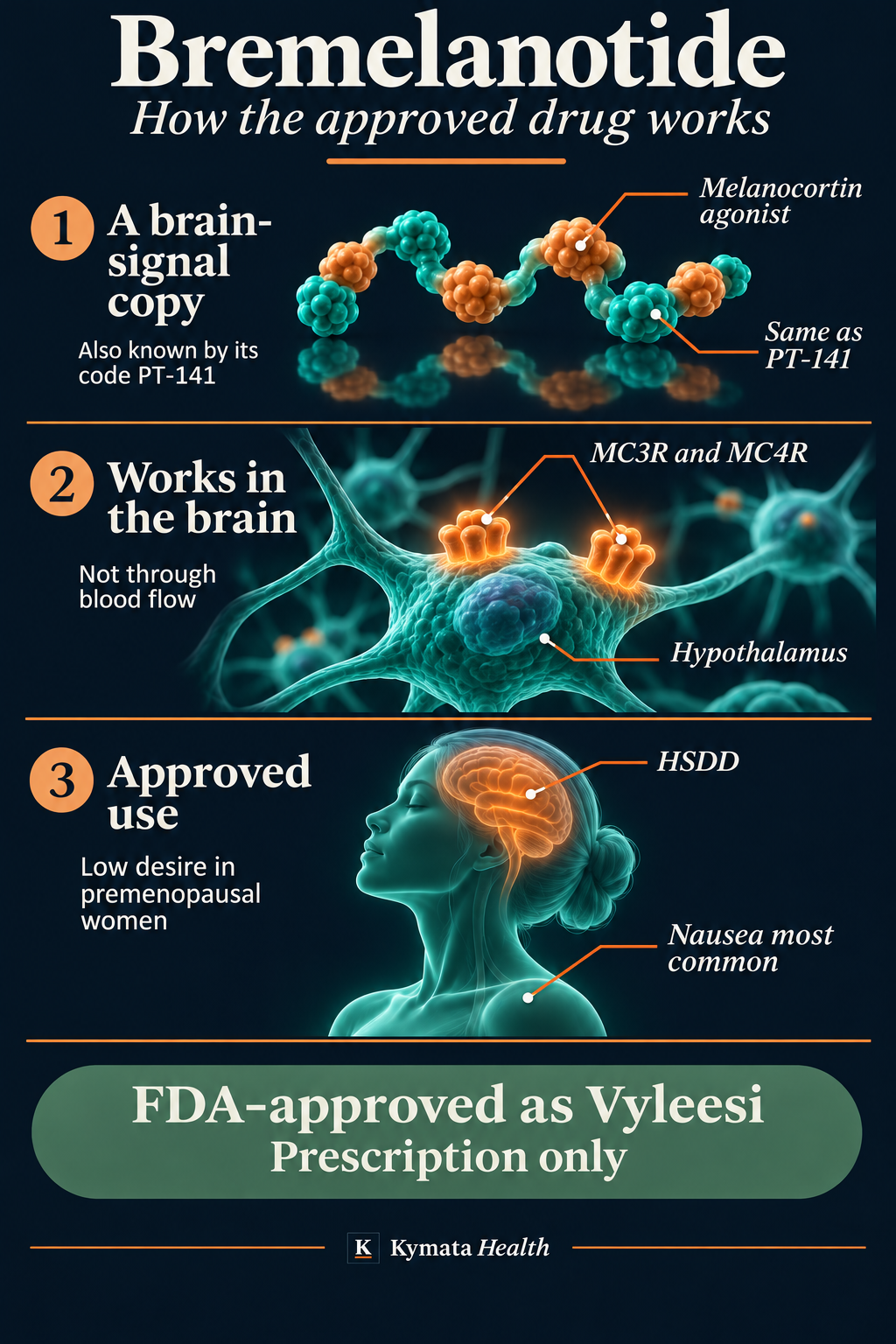
A melanocortin receptor agonist, the same compound as PT-141, sold as Vyleesi. It acts on MC3R and MC4R receptors in the brain rather than on blood flow; approval rests on the RECONNECT Phase 3 trials, and nausea is the most common side effect. FDA-approved as Vyleesi for hypoactive sexual desire disorder (HSDD) in premenopausal women. Prescription only. The drawing is a schematic, not a measured molecular structure, a product photograph or a treatment result. Illustration review: 19 November 2026, against this page’s own mechanism, evidence and regulatory records.
A sequence model is not provided for this record. Read the identity and evidence notes; an illustration does not verify a molecular structure.
Illustration notes and source record
What changes did women report with Vyleesi?
Who the treatment is for. Vyleesi is a prescription injection for premenopausal women whose sexual desire has declined across situations and causes marked distress. Clinicians check for other causes, including medicines and relationship problems.
What the trials measured. Over 24 weeks, women in two trials reported greater improvements in desire and greater relief from distress with bremelanotide than with placebo. The groups reported similar changes in the number of satisfying sexual events.
The trials asked women about their own desire and the distress it caused them.
Earlier contextual illustration
Read the source record on this page. Laboratory, topical and injected studies are separate evidence; this illustration does not establish an indication or a treatment outcome.

How it works
SourcedBremelanotide nonselectively activates melanocortin receptors (potency MC1R > MC4R > MC3R > MC5R > MC2R); MC1R binding on melanocytes drives pigmentation, and the label states the mechanism by which Vyleesi improves HSDD is unknown. It is the same compound as the research code PT-141; bremelanotide is the International Nonproprietary Name.
Vyleesi is indicated for premenopausal women with acquired, generalized HSDD, meaning low desire with marked distress or interpersonal difficulty that is not due to a co-existing medical or psychiatric condition, relationship problems, or a medication or drug substance. The label states it is not indicated for postmenopausal women, for men, or to enhance sexual performance. Vyleesi’s approved strength is 1.75 mg/0.3 mL in a single-dose autoinjector for subcutaneous use.
Source: RECONNECT phase 3 (Kingsberg 2019, PMID 31599840); Vyleesi label
Bremelanotide and PT-141 are the same molecule, and both pages describe the same Vyleesi label. Vyleesi is a prefilled solution with nothing to reconstitute.
05 / Evidence and limits
Evidence and limits
Two 24-week phase 3 trials in premenopausal women with HSDD
Human evidence
Two 24-week phase 3 trials in premenopausal women with HSDD- In the two identical 24-week randomized, double-blind RECONNECT trials of 1,267 premenopausal women with HSDD (Kingsberg et al., PMID 31599840), bremelanotide raised the integrated FSFI desire score by 0.35 points and lowered desire-related distress by 0.33 points more than placebo, while the Vyleesi label reports no significant difference in the number of satisfying sexual events.
- The Vyleesi label reports premature discontinuation in 40% versus 13% (Study 1) and 39% versus 25% (Study 2) of the bremelanotide and placebo groups in those trials.
- In the pooled phase 3 trials, nausea occurred in 40% of Vyleesi-treated patients and led 8% to stop, and focal hyperpigmentation of the face, gums or breasts occurred in 1% and did not resolve in all patients (Vyleesi label).
Use-case scores
0–100–10 against the evidence we have, not a gym ranking. Hidden domains do not apply here.
- Sexual / hormonal7.5/10Same molecule as PT-141. In two 24-week RECONNECT trials (PMID 31599840), desire scores rose 0.35 points and desire-related distress fell 0.33 points more than placebo; satisfying sexual events did not differ significantly (Vyleesi label).
Limits of current evidence
3 limits- The satisfying-sexual-events result was not significant, and premature discontinuation was higher on bremelanotide (40% vs 13% and 39% vs 25%; Vyleesi label).
- The RECONNECT trials allowed more doses a month than the label does; trial frequency is not label frequency.
- Vyleesi is the labeled product. Research powders are not.
What it is studied for
- HSDD (premenopausal women): High
- Postmenopausal women or men: Low
Verdict
Bremelanotide is PT-141, the active drug in Vyleesi, a prefilled autoinjector labeled for acquired, generalized HSDD in premenopausal women. In two 24-week phase 3 trials it improved desire and distress scores modestly versus placebo without a significant difference in satisfying sexual events.
06 / Product forms and access
Product forms and access
Regulatory & legal status
- FDA status (US)
- ApprovedFDA-approved as Vyleesi® (2019) for acquired, generalized hypoactive sexual desire disorder (HSDD) in premenopausal women; not indicated for postmenopausal women, for men, or to enhance sexual performance
- WADA status (2026)
- Not ListedNot currently on the WADA 2026 Prohibited List. Policies may change. Verify before competition.
- Classification
- Prescription Drug
07 / Tools and practical checks
Tools and practical checks
No separate record is provided here. Read the linked evidence and limitations for this compound.
08 / Published study use
Published study use
What the label states, for the patients it is approved for, and the source. Not a dose for you.
What the FDA label says
FDA label- Vyleesi’s approved strength is 1.75 mg/0.3 mL in a single-dose autoinjector for subcutaneous use; the label sets how often it may be used. Vyleesi label, DailyMed (opens in new tab)
The label’s dosing, for the patients it is approved for; the prescriber sets the dose.
Administration
- Route / form
- Subcutaneous prefilled autoinjector (Vyleesi label)
Timeline
1 stage- 24 weeks
In RECONNECT (Kingsberg 2019, PMID 31599840), desire scores rose 0.35 points and desire-related distress fell 0.33 points more than placebo; satisfying sexual events did not differ significantly (Vyleesi label).
Who it is for
2 uses| Category | Fit | What exists |
|---|---|---|
| HSDD (premenopausal women) | High | Vyleesi label: premenopausal women with acquired, generalized HSDD. Two 24-week RECONNECT trials (PMID 31599840). |
| Postmenopausal women or men | Low | The Vyleesi label states it is not indicated for postmenopausal women or for men. |
09 / Safety and interactions
Safety and interactions
What the record says
In the pooled phase 3 trials, nausea occurred in 40% of Vyleesi-treated patients and led 8% to stop, and focal hyperpigmentation of the face, gums or breasts occurred in 1% and did not resolve in all patients (Vyleesi label). The label contraindicates use in uncontrolled hypertension or known cardiovascular disease, reports transient blood-pressure rises with heart-rate drops after each dose, and advises against use with oral naltrexone products for alcohol or opioid addiction. In a clinical lactation study of 10 healthy lactating women given one subcutaneous Vyleesi injection, the relative infant dose through breast milk was 0.132% of the weight-adjusted maternal dose; infant effects and milk production were not studied (Vyleesi label, section 8.2).
10 / Comparisons and goal guides
Comparisons and goal guides
There is no separate comparison record on this page. Similar names do not establish that products or their evidence are interchangeable.
11 / Common questions
Common questions
Common questions
6 answersIs bremelanotide the same as PT-141?
Yes. PT-141 was the research code; bremelanotide is the International Nonproprietary Name (INN). Vyleesi is the brand-name autoinjector, and its use is set by the label and the prescriber.
What did the phase 3 trials show?
In the two identical 24-week randomized, double-blind RECONNECT trials of 1,267 premenopausal women with HSDD (Kingsberg et al., PMID 31599840), bremelanotide raised the integrated FSFI desire score by 0.35 points and lowered desire-related distress by 0.33 points more than placebo, while the Vyleesi label reports no significant difference in the number of satisfying sexual events.
Does bremelanotide cause nausea or hyperpigmentation?
Both are on the label. In the pooled phase 3 trials, nausea occurred in 40% of Vyleesi-treated patients and led 8% to stop, and focal hyperpigmentation of the face, gums or breasts occurred in 1% and did not resolve in all patients.
What if it does not help?
The Vyleesi label states that treatment should be discontinued after 8 weeks if the patient reports no improvement in symptoms.
Is it safe during breastfeeding?
In a clinical lactation study of 10 healthy lactating women given one subcutaneous Vyleesi injection, the relative infant dose through breast milk was 0.132% of the weight-adjusted maternal dose; infant effects and milk production were not studied (Vyleesi label, section 8.2).
Is Bremelanotide FDA-approved?
Yes. FDA-approved as Vyleesi® (2019) for acquired, generalized hypoactive sexual desire disorder (HSDD) in premenopausal women; not indicated for postmenopausal women, for men, or to enhance sexual performance.
12 / Sources and references
Sources and references
2 sources cited on this page.
Sources
2 sources- 1“Bremelanotide for the Treatment of Hypoactive Sexual Desire Disorder: Two Randomized Phase 3 Trials.”Kingsberg SA et al. Obstetrics and Gynecology (2019). PMID: 31599840 DOI: 10.1097/AOG.0000000000003500
- 2“Vyleesi (bremelanotide) injection: prescribing information (DailyMed SPL version 2, November 2026).”Cosette Pharmaceuticals DailyMed (2026). Prescribing information
14 / Prescription options
Prescription options
Prescription options: compare licensed telehealth providers
Some peptide therapies are available only by prescription after a consult with a licensed clinician.
Compare telehealth →15 / Peptide library
Peptide library
Keep reading: Peptide research library
Peptide research library: every pagePeptide libraryBrowse all topics
- SurvodutidePrevious in this topic · Boehringer/Zealand GLP-1/glucagon dual agonist (BI 456906).
- Kisspeptin-10Next in this topic · Kisspeptin-10 is the 10-amino-acid active fragment of kisspeptin, which stimulates GnRH release through KISS1R; it has been studied in small human physiology trials of LH and…
- EnclomipheneEnclomiphene is the trans-isomer of clomiphene citrate, a selective estrogen receptor modulator that raises LH, FSH and testosterone; it was studied in Phase 3 trials in men with…
- Palmitoyl Tripeptide-1Palmitoyl Tripeptide-1 (Pal-GHK) is a widely used cosmetic peptide and an ingredient in blends such as Matrixyl 3000.
- α-Defensin 1 (HNP-1)α-Defensin 1 (HNP-1) is a small cationic antimicrobial peptide stored in human neutrophil granules; it has been studied in laboratory and animal models for killing bacteria and…
Regulatory and sport classification
- FDA-approved