
The peptide field guide
TB-500
TB-500 is the seven-amino-acid fragment LKKTETQ of the 43-amino-acid thymosin beta-4.
No clinical study has given TB-500 itself to people; results from the parent peptide do not transfer.
Explore this compoundConceptual editorial illustration; not a measured molecular structure, product photograph or treatment result.
02 / At a glance
At a glance
Key facts
- Also known as
- Ac-LKKTETQ, Tβ4 fragment 17–23, TB500
- Sequence
- Ac–LKKTETQ–OH
- Evidence level
- Cell and animal research: human benefit remains unproven.
- US regulatory status
- Not FDA-approved
- Updated
Identity
The TB-500 fragment described here is a chain of seven amino acids with an acetyl group attached to one end (Ac-LKKTETQ). Its sequence comes from thymosin beta-4, a 43-amino-acid peptide that interacts with actin, a protein cells use to move and change shape.
Research interest
That relationship motivates research into cell movement and repair processes. The fragment and the full-length peptide are different substances, so parent-peptide trials cannot be presented as proof that TB-500 repairs an injury.
What the evidence says
The dry-eye trial tested the full 43-amino-acid peptide. Whether the seven-amino-acid TB-500 fragment helps an injury heal in people remains unknown.
See the mechanism ↓Explore the studies ↓Look up the CAS number and other specs ↓See stack ingredients ↓
Read the technical profile and study-use reference
At a glance
Kymata peptide profile · Nov 6, 2026- Common vials
- 5 mg / 10 mg
- In published studies
- No human study of TB-500 published
- Half-life
- A reliable human elimination half-life is not established in the sources reviewed here
03 / Identity and origin
Identity and origin
Also called Ac-LKKTETQ, Tβ4 fragment 17–23, TB500. Synthetic N-acetyl heptapeptide fragment of thymosin β4.
Technical specifications
N-acetylated thymosin beta-4 fragment (17–23). An acetyl group is attached to the first residue of this seven-residue fragment. Full-length thymosin beta-4 has 43 residues. An acetate salt adds a separate counterion to the fragment.
Select a field name to see what it means.
CAS registry number
A Chemical Abstracts Service number identifies a substance. Match the named form too, since a seller may reuse the number for a salt.
- 885340-08-9
Other names
These names can help you find the same peptide in chemical records and research papers.
- Ac–LKKTETQ · N-acetyl thymosin β4 (17–23)
Amino acid sequence
Read from the amino end on the left to the acid end on the right. H marks a free amino end, Ac an attached acetyl group, and OH a free acid end. The letters in between describe the amino acids in order.
Ac–LKKTETQ–OHChain length
A residue is one amino acid incorporated into the chain. An attached acetyl group does not add a residue.
- 7 residues
Molecular formula
Element symbols and numbers count the atoms in the reference form. This formula excludes added salt counterions and water of hydration. Charge in solution can change with pH.
C38H68N10O14Average molar mass
This is the mass of one mole of the reference form, averaged across naturally occurring isotopes. A salt can weigh more because it also contains a counterion.
- 889.01 g/mol
FDA ingredient identifier (UNII)
FDA’s Unique Ingredient Identifier distinguishes substances in its registry. It provides an identity reference, independent of a product’s approval status.
- QHK6Z47GTG
PubChem compound ID
The compound ID opens a public chemical structure record maintained by the US National Library of Medicine.
- 62707662
Identity sources FDA chemistry review, Table 1 (PDF p. 10) · PubChem compound 62707662
04 / How it may work
How it may work
The mechanism, the research and what it means
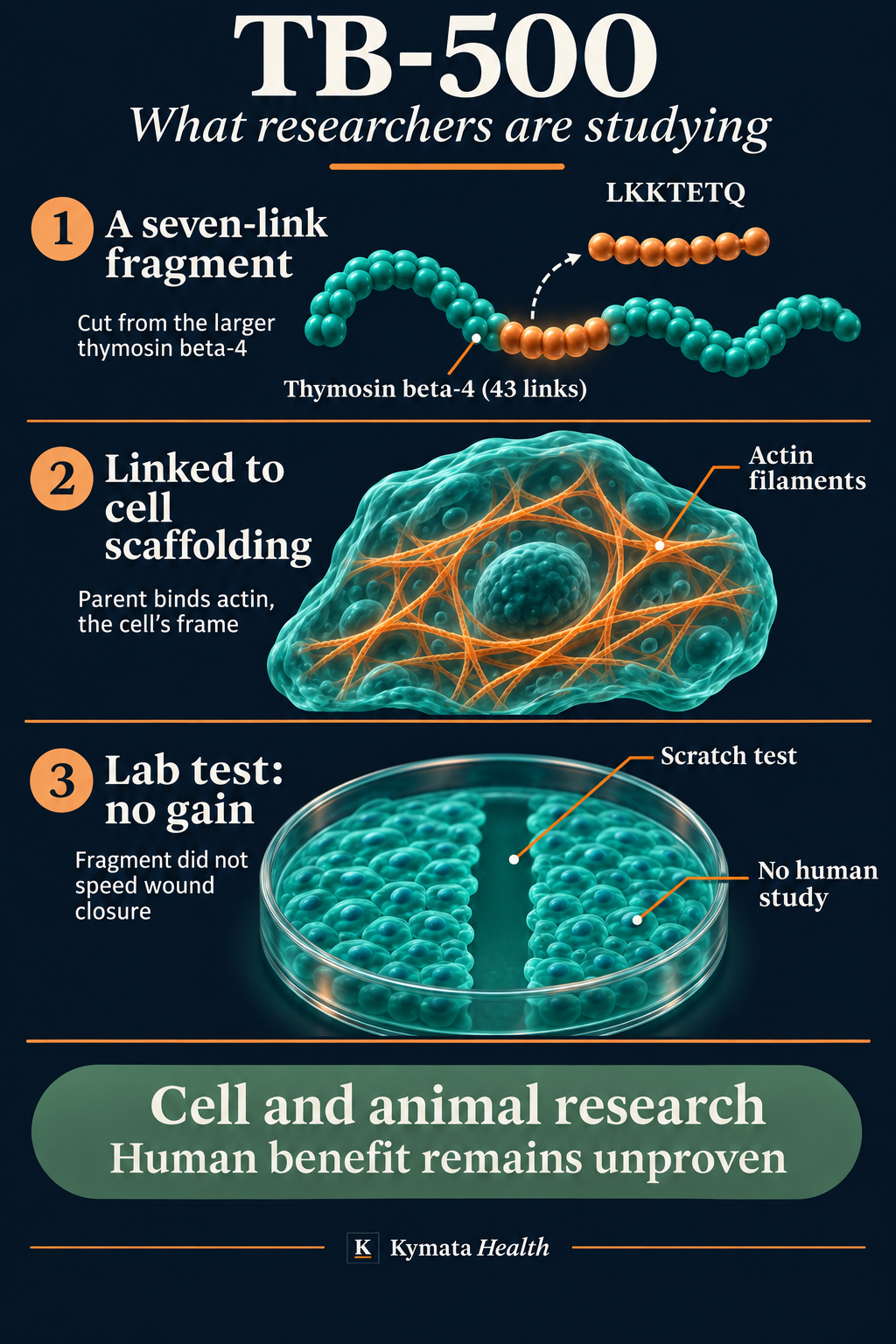
The guide shows TB-500 as the seven-amino-acid fragment LKKTETQ of the 43-amino-acid thymosin beta-4, whose parent peptide binds actin, part of the cell's internal frame. In a laboratory scratch experiment the fragment did not significantly speed wound closure, and no clinical study has given TB-500 itself to people. Results from the parent peptide do not transfer to the fragment. The drawing is a schematic, not a measured molecular structure, a product photograph or a treatment result. Illustration review: 22 November 2026, against this page’s own mechanism, evidence and regulatory records.
Illustration notes and source record
Could it help a wound heal faster?
Where the fragment fits. TB-500 copies seven of thymosin beta-4’s 43 building blocks. In the full peptide, this stretch helps bind a protein called actin.
Why that matters for healing. Cells use actin strands to move across a wound and help close it. Whether TB-500 speeds that repair in people remains an open question.
Cell edge · Actin strands
Earlier contextual illustration
Earlier mechanism plate and its source context

Seven residues from thymosin beta-4
The TB-500 fragment considered here matches positions 17 through 23 of the 43-residue thymosin beta-4 chain. Its first leucine carries an acetyl group.
Choose Rotate or Pan, then focus the diagram and use the arrow keys. Up and down tilt in Rotate mode. Pinch or use + and − to zoom.
Each bead is one amino acid. Once it is part of the chain, it is called a residue. Drag to rotate or tap a bead. The shape is a schematic illustration.
- Nonpolar
- Basic
- Polar
- Acidic
Its branching side chain mixes poorly with water, a property called hydrophobicity. A small chemical cap called an acetyl group covers the start of this chain (N-acetylation). This position maps to the longer parent peptide. Full-length thymosin beta-4 has a separate study record.
Read the full sequence
Mature thymosin beta-4 · 43 residues
SDKPDMAEIEKFDKSKLKKTETQEKNPLPSKETIEQEKQAGESThe highlighted segment spans parent positions 17–23. UniProt counts the removed initiator methionine as position 1. UniProt P62328 records it at positions 18–24.
A peptide bond is a covalent link joining two amino acids in a chain. A hydrogen bond is a weaker attraction, for example between a hydrogen on an oxygen and a nearby oxygen atom. A side chain may form hydrogen bonds without joining another amino acid to the chain. This diagram shows the sequence; it does not measure these interactions. See the IUPAC definitions of peptides and hydrogen bonds.
LKKTETQ
- Leucine · Thymosin beta-4 position 17. Its branching side chain mixes poorly with water, a property called hydrophobicity. A small chemical cap called an acetyl group covers the start of this chain (N-acetylation).
- Lysine · Thymosin beta-4 position 18. Its side branch usually carries a positive charge near neutral pH, the middle of the acidity scale.
- Lysine · Thymosin beta-4 position 19. Its side branch usually carries a positive charge near neutral pH, the middle of the acidity scale.
- Threonine · Thymosin beta-4 position 20. Its branched side chain has a hydroxyl group (an oxygen bonded to hydrogen) that can form hydrogen bonds with nearby molecules.
- Glutamate · Thymosin beta-4 position 21. Its side branch usually carries a negative charge near neutral pH, the middle of the acidity scale.
- Threonine · Thymosin beta-4 position 22. Its branched side chain has a hydroxyl group (an oxygen bonded to hydrogen) that can form hydrogen bonds with nearby molecules.
- Glutamine · Thymosin beta-4 position 23. Its uncharged tip can form weak attractions called hydrogen bonds with nearby molecules.
How to read the mechanism
Biology and evidenceActin is a structural protein involved in the cell’s internal scaffolding and movement. TB-500 corresponds to a region associated with actin binding in the parent peptide.
This motivates a proposed research pathway, not an established clinical healing mechanism. One fragment-specific cell scratch experiment reviewed by FDA did not significantly improve wound closure under its tested conditions.
The practical takeaway: The dry-eye trial tested the full 43-amino-acid peptide. Whether the seven-amino-acid TB-500 fragment helps an injury heal in people remains unknown.
TB-500 in named blends
Wolverine is the two-ingredient starting point. GLOW adds GHK-Cu, and KLOW adds KPV.
| Ingredient | Wolverine | GLOW | KLOW |
|---|---|---|---|
| BPC-157 | Yes | Yes | Yes |
| TB-500 | Yes | Yes | Yes |
| GHK-Cu | No | Yes | Yes |
| KPV | No | No | Yes |
These names follow ingredient lists used by sellers. Check the ingredient list and whether “TB-500” refers to the seven-residue fragment or full-length thymosin beta-4. Published human evidence has yet to establish a benefit for these specific combinations.
The October 2026 HHS policy applies to single active ingredients. These multi-ingredient blends fall outside its scope.
05 / Evidence and limits
Evidence and limits
Actual study populations, findings and limits
What the studies found
Study design · measured outcomeFragment-specific clinical evidence
Clinical evidence review of TB-500
The July 2026 FDA review found no clinical study administering TB-500 itself to people.
Finding. Human studies of the 43-residue parent peptide form a separate evidence base.
What the finding means
A clinical response to thymosin beta-4 is not a verified response to TB-500.
Cell movement experiment
Laboratory scratch experiment
A laboratory scratch experiment using the fragment.
Finding. The exact fragment did not significantly improve wound closure in that experiment.
What the finding means
A useful null result for those conditions; neither proof of clinical benefit nor proof that every possible effect is absent.
Why parent-peptide trials are different
Full-length thymosin beta-4 eye drops
A 72-participant phase 2 trial tested full-length thymosin beta-4 eye drops for dry eye.
Finding. Neither prespecified primary endpoint differed significantly from placebo; some secondary measurements favored treatment.
What the finding means
This is evidence about that full-length ophthalmic formulation, not the seven-residue TB-500 fragment (PMID 26056426).
Select a group to see its evidence.
The October HHS policy discusses historical exposure and parent-peptide information. It does not report a new randomized healing trial of the fragment.
06 / Product forms and access
Product forms and access
October 2026 compounding update
Editorial check · Nov 6, 2026HHS describes when it intends to exercise enforcement discretion for TB-500 acetate, in subcutaneous or intramuscular injectable dosage forms under section 503A. Prescribing and quality conditions apply.
The October 30 Federal Register notice calls the interim policy a draft. It is not FDA product approval or proof of clinical benefit.
Forms, conditions and source record ↓Read the dated announcement →
HHS policy, Appendices A and B · announced Oct 28; notice published Oct 30.
The dated policy, covered forms and prescribing conditions
The October policy covers TB-500 acetate, in subcutaneous or intramuscular injectable dosage forms subject to its conditions. It applies to section 503A prescribing, not 503B outsourcing facilities, research-use-only products or supplements.
Read the policy conditions, source documents and earlier FDA assessment
What did HHS announce on Oct 28, 2026?
Checked Oct 28, 2026HHS says it does not intend to take enforcement action against state-licensed pharmacies, Federal facilities and licensed physicians compounding TB-500 under section 503A when the stated conditions are met, while FDA’s 503A bulks-list rulemaking continues.
The notice says: “HHS does not intend to take enforcement action against a State-licensed pharmacy, Federal facility, or licensed physician compounding a drug product using a peptide bulk drug substance found in Appendix A.” It adds: “Compounded drugs are not FDA-approved, which means FDA does not review their safety, effectiveness, or quality before they are marketed.” Source: Federal Register document 2026-22192, public-inspection PDF (filed Oct 28, 2026 11:15 am; published Oct 30, 2026, 91 FR 68526)
- Filed for public inspection
- Oct 28, 2026
- Federal Register publication
- Oct 30, 2026
- Comments
- Until two weeks after publication (Nov 13, 2026 by our count), docket HHS-OASH-2026-0496
- Next step
- FDA rulemaking on the 503A bulks list, which may propose adding some or all of the six
Which forms of TB-500 does the policy cover?
Appendix BPer the HHS policy document (Oct 28, 2026), Appendix B covers TB-500 acetate, in subcutaneous or intramuscular injectable dosage forms, compounded from a bulk peptide with a certificate of analysis that meets the policy’s conditions. Source: HHS: Enforcement Discretion Policy Regarding 503A Compounding Using Certain Peptide Bulk Drug Substances, with Appendices A and B (PDF, Oct 28, 2026)
Not covered
- Oral, nasal or topical TB-500, and TB-500 free base
- Full-length thymosin beta-4, a different 43-amino-acid molecule that is not on the list
- Blends such as the “Wolverine” stack (BPC-157 plus TB-500), GLOW and KLOW
- 503B outsourcing facilities: the notice covers section 503A compounding only
- Research-use-only or “not for human consumption” vials, and dietary supplements
- Products not compounded by a state-licensed pharmacy, Federal facility or licensed physician under 503A
- It is not FDA approval: compounded drugs are not FDA-approved, and these remain unapproved drugs.
- It does not add anything to the 503A bulks list, and it is not FDA’s “Category 1”; FDA’s categories list (updated May 14, 2026) does not name these six.
- It is an interim policy: it lasts until FDA addresses each peptide in a final rule on the 503A bulks list, HHS says it may revisit it if a safety signal or product-quality problem arises, and it is not binding.
- It covers section 503A compounding only: not 503B outsourcing facilities, not research-use-only products and not dietary supplements.
What conditions must a pharmacy meet?
All ten must be met- Appendix A: the peptide is on the policy’s “503A Interim Access List” (BPC-157, Epitalon, KPV, MOTS-c, Semax, TB-500).
- Identity and route: the bulk peptide has the identity (amino acid sequence, chemical structure, molecular weight and formula) and the route limits set out in Appendix B.
- Characterization: it comes from an FDA-registered (section 510) facility with a valid certificate of analysis (COA) whose test results meet the Appendix B testing standard.
- Original manufacturer: registered under section 510, compliant with CGMP, and its physical location listed on the COA; a registered repacker, relabeler or reseller must have validated the manufacturer and its COA.
- Reporting: compounded products, serious adverse events (whether or not considered drug-related) and product-quality problems are reported to FDA MedWatch and to the states involved; the patient label explains how to report.
- Label: “This is a compounded drug product. Not for resale.”
- One active ingredient: the product contains only a single API listed in Appendix A, so no blends.
- Oral forms: the compounder keeps documentation that the specific oral formulation achieves an adequate level of oral bioavailability in humans.
- Device: the only drug delivery device co-packaged with, or containing, the drug is an FDA 510(k)-cleared syringe.
- Everything else in the FD&C Act still applies, including no insanitary conditions and section 503A’s patient-specific prescription requirement.
Per the HHS policy document (Oct 28, 2026), in its order. Source: HHS: Enforcement Discretion Policy Regarding 503A Compounding Using Certain Peptide Bulk Drug Substances, with Appendices A and B (PDF, Oct 28, 2026)
What did FDA advisers and staff say about TB-500?
PCAC Jul 23, 2026FDA staff recommended against adding TB-500 to the 503A bulks list, reviewing its use for wound healing. FDA’s Pharmacy Compounding Advisory Committee voted 8–6 (1 abstention) on Jul 23, 2026 to recommend listing it; the vote is advisory. FDA has not posted minutes; the tally is as reported by press. Source: Pharmacy Times: What the peptide vote actually changes at my counter (Jul 29, 2026)
FDA reviewers: “The nomination did not include, and FDA did not find any information in the medical literature where TB-500 was administered to patients to treat any disease or condition including its use in wound healing.” Source: FDA briefing document for TB-500-related bulk drug substances, PCAC July 23-24, 2026 (PDF)
FDA reviewers: “FDA is particularly concerned about the absence of human data on drug products containing these substances administered via any route of administration.” Source: FDA briefing document for TB-500-related bulk drug substances, PCAC July 23-24, 2026 (PDF)
What is the evidence for TB-500 in people?
The October HHS policy discusses historical exposure and parent-peptide information. It does not report a new randomized healing trial of the fragment.
Sport: Prohibited at all times (WADA S0).
How does the prescription route work?
- A licensed clinician who examines your history decides whether a compounded peptide is appropriate and writes a prescription for you. Section 503A covers a drug that “is compounded for an identified individual patient based on the receipt of a valid prescription order”, and the HHS policy keeps that patient-specific prescription requirement.
- A state-licensed pharmacy (or a licensed physician or Federal facility) compounds it under section 503A, from a bulk peptide listed in the policy’s Appendix A, in a form and route the policy covers, and meeting its conditions.
- Ask the pharmacy which salt form and route it compounds, who manufactured the bulk peptide, and for the certificate of analysis. Expect a single active ingredient and the label line “This is a compounded drug product. Not for resale.” For an oral form, the policy expects the pharmacy to hold documentation of adequate oral bioavailability in humans.
- Check your state: a state board of pharmacy can set stricter rules, and legal commentators say it is unclear whether states will follow the HHS policy.
- Report a serious side effect or a product problem to FDA MedWatch.
Source: 21 U.S.C. 353a (section 503A of the FD&C Act) Source: FDA MedWatch: report a problem
What are the red flags?
- “Research use only”, “not for human consumption” or “for laboratory use” on the vial or website.
- No prescription, no clinician review, or a “prescription” that comes automatically with checkout.
- Two or more peptides in one vial or product (“Wolverine”, GLOW, KLOW and other stacks).
- No certificate of analysis, or one that does not name the manufacturer and where it is made.
- A route the policy does not cover for that peptide, such as nasal BPC-157 or injected KPV.
- Claims that a peptide is “FDA approved”, “now legal” or proven to work for a condition.
We do not list or link sellers of TB-500. None of our partners sells it as of Oct 28, 2026.
Sources for this section
Checked Oct 28, 2026- Source: Federal Register document 2026-22192, public-inspection PDF (filed Oct 28, 2026 11:15 am; published Oct 30, 2026, 91 FR 68526)
- Source: Federal Register: Enforcement Discretion Policy Regarding 503A Compounding Using Certain Peptide Bulk Drug Substances (2026-22192, 91 FR 68526, Oct 30, 2026)
- Source: HHS: Enforcement Discretion Policy Regarding 503A Compounding Using Certain Peptide Bulk Drug Substances, with Appendices A and B (PDF, Oct 28, 2026)
- Source: Regulations.gov docket HHS-OASH-2026-0496 (comments)
- Source: FDA: 503A bulk drug substance categories (PDF, updated May 14, 2026)
- Source: FDA: July 23-24, 2026 meeting of the Pharmacy Compounding Advisory Committee
- Source: FDA briefing document for TB-500-related bulk drug substances, PCAC July 23-24, 2026 (PDF)
- Source: Hyman, Phelps & McNamara, FDA Law Blog: “The PEPTIDE-L Wave Reaches HHS: Enforcement Discretion … Not the Finish Line” (Oct 28, 2026)
- Source: CNN: FDA scientists opposed the Trump administration’s move to ease peptides access (Oct 28, 2026)
- Source: STAT: HHS enforcement discretion policy allows peptide compounding (Oct 28, 2026)
News, Oct 28: what the HHS peptide compounding policy does and does not do →
Every peptide’s status on FDA’s compounding lists, in one table →
07 / Tools and practical checks
Tools and practical checks
Built from the conditions in the HHS policy document (Oct 28, 2026). No doses, no sellers, not legal advice.
Open the product-policy checker and timeline
Is this TB-500 product inside the policy?
Conditions from the HHS policy documentAnswer the questions to see a result
The result names the condition of HHS’s policy behind each answer.
Not legal or medical advice, and not a check of any pharmacy or product: it compares what you describe with the conditions in the HHS policy document (Oct 28, 2026). It never gives doses and names no sellers. Nothing you pick leaves this page.
Policy timeline
Checked Oct 28, 2026- Happened
FDA advisory committee voteAs reported
FDA’s Pharmacy Compounding Advisory Committee voted 8–6 (1 abstention) to recommend adding TB-500 to the 503A bulks list, as reported by press (FDA has not posted minutes). The vote is advisory; FDA staff had recommended against.
- Happened
HHS announces its interim policy
HHS files its enforcement-discretion policy for public inspection (Federal Register 2026-22192). For TB-500, Appendix B covers TB-500 acetate, in subcutaneous or intramuscular injectable dosage forms. It is not FDA approval.
- Scheduled as of Oct 28, 2026
Federal Register publication
The notice is scheduled to publish in the Federal Register; the two-week comment period runs from publication.
- Scheduled as of Oct 28, 2026
Comment period closes (our count)
Two weeks after publication, by our count; regulations.gov shows the official date for docket HHS-OASH-2026-0496.
- Rulemaking pending
FDA rulemaking on the 503A bulks list
The interim policy lasts until FDA addresses TB-500 in a final rule on the 503A bulks list. HHS: “FDA’s future rulemakings may propose adding some or all of these peptides to the 503A bulks list based on the available evidence.” HHS may also revisit the policy if a safety signal or product-quality problem arises.
Questions to ask
From the ten conditionsAsk the pharmacy
- Is the bulk peptide TB-500, one of the six on Appendix A of HHS’s policy? Condition 1
- Which salt form and route is this? (Appendix B covers TB-500 acetate, in subcutaneous or intramuscular injectable dosage forms.) Condition 2
- May I see the certificate of analysis for the bulk peptide, from an FDA-registered (section 510) facility? Condition 3
- Who manufactured the bulk peptide, where is it made, and is that location on the certificate of analysis? Condition 4
- How do I report a side effect or a product problem, and is that on the label? Condition 5
- Does the label say “This is a compounded drug product. Not for resale.”? Condition 6
- Is TB-500 the only active ingredient in this product? Condition 7
- If a device comes with it, is it an FDA 510(k)-cleared syringe? Condition 9
Ask your clinician
- Is this compounded for me, on a prescription you write after reviewing my history? Condition 10
- Why a compounded TB-500, which is not FDA-approved, rather than an FDA-approved treatment, if one exists for my condition? Condition 10
- FDA’s reviewers raised concerns about TB-500; how do they apply to me? Condition 10
Ask Kymata
Each question fills in Ask Kymata for you to edit; nothing is sent until you press send.
All six peptides under the policy, in the library →News, Oct 28: what the HHS peptide compounding policy does and does not do →
Dose it
10 mg + 2 mL BAC water → 5 mg/mL · 1 unit (U-100) = 50 mcg.
Reconstitution math
U-100 syringe| Vial | Water | Concentration |
|---|---|---|
| 5 mg | 2.0 mL BAC | 2.5 mg/mL |
| 10 mg | 2.0 mL BAC | 5 mg/mL |
08 / Published study use
Published study use
What published studies gave, in whom, and the source. Not a dose for you.
What studies used
No human study- No human study of TB-500 itself, the short thymosin beta-4 fragment sold in vials, has been published.
- The full-length protein, thymosin beta-4, was given by IV at 42 to 1,260 mg a day for 14 days in a phase 1 safety study in healthy volunteers (four groups of 10, with placebo). That is a different molecule from TB-500. Ruff 2010, PMID 20536472 (opens in new tab)
- The doses quoted online come from animal work and vendor or forum sources.
A record of what researchers gave, in whom; not a dose for you.
09 / Safety and interactions
Safety and interactions
What the record says
Synthetic 7-mer. Not the Tβ4 clinical candidate. Not approved for human use. Angiogenesis signaling is why active cancer is a hard no. Equine doping-control literature exists because this fragment showed up in sport, not because it has a human repair label. Sterile reconstitution still matters. WADA S0.
Interactions & Contraindications
Angiogenesis and cell-migration signaling is a theoretical concern with active cancer; no human data. No adequate human DDI package for the 7-mer.
10 / Comparisons and goal guides
Comparisons and goal guides
TB-500 in popular stacks
3 named blendsNamed blends that list TB-500. Each row describes what the blend contains and what has been studied. This is not a recommendation to combine peptides.
| Blend | Contains | Evidence tier | Note |
|---|---|---|---|
| Wolverine Stack | BPC-157, TB-500 | Cell and animal research: human benefit remains unproven. | Uncontrolled human reports and a rat comparison. Each part was studied separately; the combination has never been tested. |
| GLOW Stack | GHK-Cu, BPC-157, TB-500 | Cell and animal research: human benefit remains unproven. | Vendor nickname. Each part was studied separately; the combination has never been tested. |
| KLOW Stack | GHK-Cu, BPC-157, TB-500, KPV | Cell and animal research: human benefit remains unproven. | Vendor nickname. Each part was studied separately; the combination has never been tested. |
Combinations: what has been tested
1 pairing- + BPC-157 →No study has tested TB-500 with BPC-157. Two molecules, two separate evidence files.
TB-500 vs. BPC-157
Compare evidence profilesCanonical comparison: TB-500 vs BPC-157 · BPC-157 evidence profile
Appears in goal guides
3 guidesGoal guides give the evidence and status for each compound, with no doses. A mention here is not a treatment plan.
- GoalInjury RecoveryBPC-157 and TB-500 as they come up for tendons and muscles: the rat evidence, the missing human data, HHS status, and why no dose or “Wolverine” stack is given.Evidence and status
- GoalHealing After SurgeryBPC-157, TB-500 and GHK-Cu as they come up after surgery: the animal evidence, the missing surgical data, HHS status, and why your surgeon’s plan comes first.Evidence and status
- GoalAthletic PerformanceMuscle and blood-vessel bioregulator capsules, BPC-157, TB-500, GH secretagogues, MOTS-c and GHK-Cu as they come up in athletic circles: the evidence, the status and the sport rules.Evidence and status
11 / Common questions
Common questions
Common questions
7 answersCan a US pharmacy compound TB-500 now?
Under an interim policy announced Oct 28, 2026 (Federal Register 2026-22192, published Oct 30, 2026), HHS says it does not intend to take enforcement action against state-licensed pharmacies, Federal facilities and licensed physicians compounding TB-500 under section 503A when the stated conditions are met, while FDA’s 503A bulks-list rulemaking continues. Per the HHS policy document (Oct 28, 2026), Appendix B covers TB-500 acetate, in subcutaneous or intramuscular injectable dosage forms; each product may contain only that one active ingredient, the bulk peptide needs a certificate of analysis from an FDA-registered facility. It is not FDA approval, TB-500 is not on the 503A bulks list, HHS can revisit the policy, and it does not cover 503B outsourcing facilities, research-use-only products or supplements. Comments are open until two weeks after publication.
What did FDA’s reviewers say about TB-500?
FDA staff recommended against adding TB-500 to the 503A bulks list, reviewing its use for wound healing. Their briefing document says: “The nomination did not include, and FDA did not find any information in the medical literature where TB-500 was administered to patients to treat any disease or condition including its use in wound healing.” FDA’s advisory committee voted 8–6 (1 abstention) on Jul 23, 2026 (as reported by press) to recommend listing it anyway; the vote is advisory.
Do thymosin beta-4 eye studies show that TB-500 heals injuries?
The eye trial used full-length thymosin beta-4, which contains 43 amino acids. The TB-500 fragment discussed here has seven. Outcomes for a parent molecule used in the eye cannot establish injury recovery with the fragment.
What is TB-500 studied for?
The TB-500 fragment described here is a chain of seven amino acids with an acetyl group attached to one end (Ac-LKKTETQ). Its sequence comes from thymosin beta-4, a 43-amino-acid peptide that interacts with actin, a protein cells use to move and change shape.
What have human studies of TB-500 shown?
The dry-eye trial tested the full 43-amino-acid peptide. Whether the seven-amino-acid TB-500 fragment helps an injury heal in people remains unknown. The October HHS policy discusses historical exposure and parent-peptide information. It does not report a new randomized healing trial of the fragment.
How does TB-500 work?
Actin is a structural protein involved in the cell’s internal scaffolding and movement. TB-500 corresponds to a region associated with actin binding in the parent peptide. This motivates a proposed research pathway, not an established clinical healing mechanism. One fragment-specific cell scratch experiment reviewed by FDA did not significantly improve wound closure under its tested conditions.
Is TB-500 FDA-approved?
No. Covered by HHS enforcement-discretion policy (announced Oct 28, 2026; conditions apply) for 503A compounding on a prescription. Not FDA-approved, not on the 503A bulks list; interim, comment period open, revocable (checked Oct 28, 2026).
12 / Sources and references
Sources and references
Additional background papers. Primary studies and policy sources are linked in the relevant sections.
Sources
3 papers- 1“Doping control analysis of TB-500, a synthetic version of an active region of thymosin β4, in equine urine and plasma by liquid chromatography-mass spectrometry.”Ho EN, Kwok WH, Lau MY, et al. Journal of Chromatography A (2012). PMID: 23084823
- 2“Thymosin β4 Promotes Dermal Healing.”Kleinman HK et al. Vitam Horm (2016). PMID: 27450738
- 3“Thymosin beta-4 activates integrin-linked kinase and promotes cardiac cell migration, survival, and cardiac repair.”Bock-Marquette I et al. Nature (2004). PMID: 15565145
14 / Prescription options
Prescription options
Prescription options: compare licensed telehealth providers
Some peptide therapies are available only by prescription after a consult with a licensed clinician.
Compare telehealth →15 / Peptide library
Peptide library
Keep reading: Peptide research library
Peptide research library: every pagePeptide libraryBrowse all topics
- BPC-157Previous in this topic · BPC-157 is a synthetic 15-amino-acid peptide studied in tissue-injury and gastrointestinal research.
- SemaglutideNext in this topic · Once-weekly GLP-1 receptor agonist.
- TirzepatideDual GIP/GLP-1 agonist.
- RetatrutideLilly triple GLP-1/GIP/glucagon analog (LY3437943).
- CJC-1295 with DACCJC-1295 with DAC raised growth hormone and IGF-I for days in healthy adults.
Regulatory and sport classification
- WADA (S0): prohibited in sport at all times