
The peptide field guide
BPC-157
A synthetic 15-amino-acid peptide (GEPPPGKPADDAGLV) described by the Zagreb group as a piece of a gastric-juice protein; sold as BPC-157 acetate.
Mostly rat studies. No adequate human trial. Not FDA-approved.
Explore this compoundConceptual editorial illustration; not a measured molecular structure, product photograph or treatment result.
02 / At a glance
At a glance
Key facts
- Also known as
- Body Protection Compound-157, Pentadecapeptide
- Sequence
- H–GEPPPGKPADDAGLV–OH
- Evidence level
- Cell and animal research: human benefit remains unproven.
- US regulatory status
- Not FDA-approved
- Updated
Identity
BPC-157 is a synthetic chain of 15 amino acids. Researchers study how injured tissues and the digestive tract respond to it. In cell and animal experiments, it has affected blood vessels and the signals cells use during repair.
Research interest
Researchers are exploring whether those laboratory findings translate into useful treatment for injuries or gastrointestinal conditions. The human reports so far use different routes and designs, so they answer narrower questions than the broad recovery claims often made online.
What the evidence says
In a small uncontrolled knee study, 11 of 12 people who received BPC-157 alone reported less pain. The study did not measure cartilage regrowth or compare oral BPC-157 with an injection.
See the mechanism ↓Explore the studies ↓Look up the CAS number and other specs ↓See stack ingredients ↓
Read the technical profile and study-use reference
At a glance
Kymata peptide profile · Nov 6, 2026- Common vials
- 5 mg
- In published studies
- No controlled human dosing trial published (PMID 42885452)
- Half-life
- A reliable human elimination half-life is not established in the sources reviewed here
03 / Identity and origin
Identity and origin
Also called Body Protection Compound-157, Pentadecapeptide. Synthetic gastric pentadecapeptide (BPC-157 acetate).
Technical specifications
BPC-157 free peptide. The BPC-157 chain has unmodified ends. BPC-157 acetate has its own CAS number (216441-37-1). Its mass depends on how much acetate is present.
Select a field name to see what it means.
CAS registry number
A Chemical Abstracts Service number identifies a substance. Match the named form too, since a seller may reuse the number for a salt.
- 137525-51-0
Other names
These names can help you find the same peptide in chemical records and research papers.
- BPC 157 · Body protection compound 157
Amino acid sequence
Read from the amino end on the left to the acid end on the right. H marks a free amino end, Ac an attached acetyl group, and OH a free acid end. The letters in between describe the amino acids in order.
H–GEPPPGKPADDAGLV–OHChain length
A residue is one amino acid incorporated into the chain. An attached acetyl group does not add a residue.
- 15 residues
Molecular formula
Element symbols and numbers count the atoms in the reference form. This formula excludes added salt counterions and water of hydration. Charge in solution can change with pH.
C62H98N16O22Average molar mass
This is the mass of one mole of the reference form, averaged across naturally occurring isotopes. A salt can weigh more because it also contains a counterion.
- 1,419.5 g/mol
FDA ingredient identifier (UNII)
FDA’s Unique Ingredient Identifier distinguishes substances in its registry. It provides an identity reference, independent of a product’s approval status.
- 8ED8NXK95P
PubChem compound ID
The compound ID opens a public chemical structure record maintained by the US National Library of Medicine.
- 9941957
Identity sources FDA chemistry review, Table 1 (PDF p. 11) · PubChem compound 9941957
04 / How it may work
How it may work
The mechanism, the research and what it means
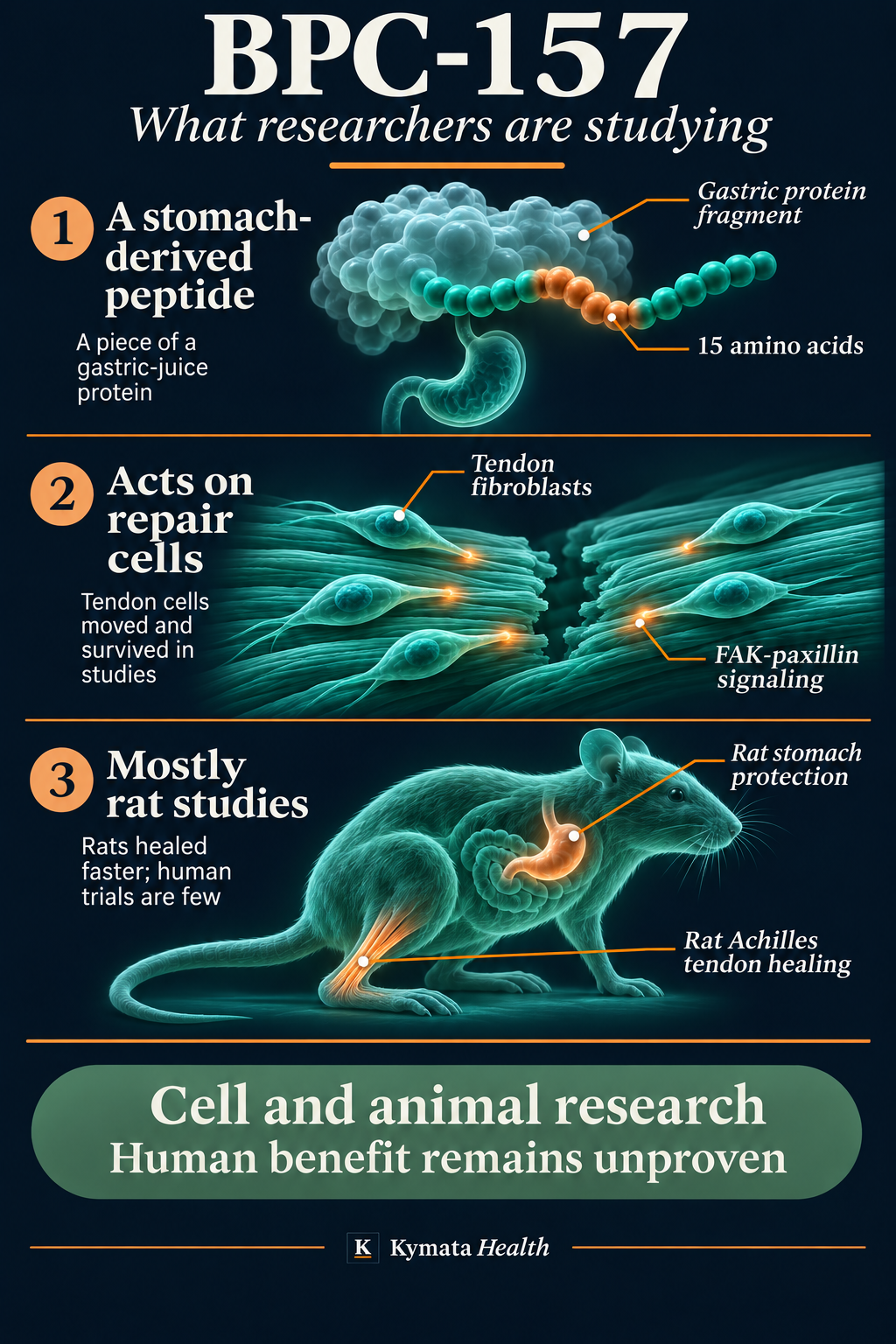
A synthetic 15-amino-acid peptide (GEPPPGKPADDAGLV) described by the Zagreb group as a piece of a gastric-juice protein; sold as BPC-157 acetate. In animal and cell models it is reported to drive tendon-cell outgrowth, survival and migration through FAK-paxillin (Chang 2011, rat Achilles tendon) and to protect the stomach lining in rodents; in rats and dogs its plasma half-life is minutes (He 2022), and the one randomized human study, 53 people with ulcerative colitis, found no clear difference from placebo. Mostly rat studies. No adequate human trial. Not FDA-approved. The drawing is a schematic, not a measured molecular structure, a product photograph or a treatment result. Illustration review: 19 November 2026, against this page’s own mechanism, evidence and regulatory records.
Illustration notes and source record
Why do researchers study BPC-157 for tendon injuries?
Inside a tendon. BPC-157 is a lab-made chain of 15 amino acids. Tendons transfer force from muscle to bone. Between their collagen fibers sit fibroblasts, the cells that maintain that tissue.
What changed after injury. Cells grew out of rat tendon samples sooner when researchers added BPC-157. In a separate experiment, rats with a cut Achilles tendon scored better on a test of tendon function during the first four days.
Tendon cells between collagen fibers
Earlier contextual illustration
Earlier mechanism plate and its source context

From gastric research to a synthetic peptide
Early studies investigated a compound thought to protect the stomach. BPC-157 is the specific sequence of fifteen amino acids that researchers can make in the lab. The sources reviewed do not establish where those fifteen letters would sit in a longer human protein.
Choose Rotate or Pan, then focus the diagram and use the arrow keys. Up and down tilt in Rotate mode. Pinch or use + and − to zoom.
Each bead is one amino acid. Once it is part of the chain, it is called a residue. Drag to rotate or tap a bead. The shape is a schematic illustration.
- Glycine / proline
- Acidic
- Basic
- Nonpolar
Its side branch is a single hydrogen atom, leaving the chain more room to bend here. Glycine and glutamate precede the chain’s run of three prolines.
Read the full sequence
A peptide bond is a covalent link joining two amino acids in a chain. A hydrogen bond is a weaker attraction, for example between a hydrogen on an oxygen and a nearby oxygen atom. A side chain may form hydrogen bonds without joining another amino acid to the chain. This diagram shows the sequence; it does not measure these interactions. See the IUPAC definitions of peptides and hydrogen bonds.
GEPPPGKPADDAGLV
- Glycine. Its side branch is a single hydrogen atom, leaving the chain more room to bend here.
- Glutamate. Its side branch usually carries a negative charge near neutral pH, the middle of the acidity scale.
- Proline. Its side branch loops back onto the main chain, limiting how freely the chain can turn here.
- Proline. Its side branch loops back onto the main chain, limiting how freely the chain can turn here.
- Proline. Its side branch loops back onto the main chain, limiting how freely the chain can turn here.
- Glycine. Its side branch is a single hydrogen atom, leaving the chain more room to bend here.
- Lysine. Its side branch usually carries a positive charge near neutral pH, the middle of the acidity scale.
- Proline. Its side branch loops back onto the main chain, limiting how freely the chain can turn here.
- Alanine. Its short side branch mixes poorly with water. Chemists call this a nonpolar methyl group.
- Aspartate. Its side branch usually carries a negative charge near neutral pH, the middle of the acidity scale.
- Aspartate. Its side branch usually carries a negative charge near neutral pH, the middle of the acidity scale.
- Alanine. Its short side branch mixes poorly with water. Chemists call this a nonpolar methyl group.
- Glycine. Its side branch is a single hydrogen atom, leaving the chain more room to bend here.
- Leucine. Its branching side chain mixes poorly with water, a property called hydrophobicity.
- Valine. Its short, branching side chain mixes poorly with water, a property called hydrophobicity.
How to read the mechanism
Biology and evidenceIn laboratory models, BPC-157 has been associated with growth-factor signaling, nitric-oxide-related pathways and vascular responses. These observations help explain the interest in tissue repair.
Its molecular target is not established. A diagram of these pathways is a research map, not proof that an injection causes faster recovery in a person.
The practical takeaway: In a small uncontrolled knee study, 11 of 12 people who received BPC-157 alone reported less pain. The study did not measure cartilage regrowth or compare oral BPC-157 with an injection.
BPC-157 in named blends
Wolverine is the two-ingredient starting point. GLOW adds GHK-Cu, and KLOW adds KPV.
| Ingredient | Wolverine | GLOW | KLOW |
|---|---|---|---|
| BPC-157 | Yes | Yes | Yes |
| TB-500 | Yes | Yes | Yes |
| GHK-Cu | No | Yes | Yes |
| KPV | No | No | Yes |
These names follow ingredient lists used by sellers. Check the ingredient list and whether “TB-500” refers to the seven-residue fragment or full-length thymosin beta-4. Published human evidence has yet to establish a benefit for these specific combinations.
The October 2026 HHS policy applies to single active ingredients. These multi-ingredient blends fall outside its scope.
05 / Evidence and limits
Evidence and limits
Actual study populations, findings and limits
What the studies found
Study design · measured outcomeGastrointestinal research
Rectal-enema report and ulcerative-colitis trial abstract
24 healthy participants in a rectal-enema report; a separate 53-person randomized ulcerative-colitis trial reported as a meeting abstract.
Finding. The ulcerative-colitis abstract reported a 3.2-point fall in disease activity with BPC-157 versus 1.6 points with placebo. Its reported between-group confidence interval crossed zero; 46 of 53 participants completed the study.
What the finding means
Limited reporting and a different route prevent a reliable conclusion about oral products or injected tendon recovery.
Knee-pain follow-up
Injection into the knee joint
Retrospective report: 17 patients identified, 16 reached by telephone; 12 had received BPC-157 alone.
Finding. Eleven of those 12 reported improvement in knee pain. Three of four receiving BPC-157 with full-length TB4 also reported improvement.
What the finding means
An encouraging self-reported signal, with no control group or validated function measure. It does not establish structural healing or a predictable success rate.
Bladder-pain pilot
Treatment delivered into the bladder
Twelve women with interstitial cystitis; single-arm, intravesical treatment report.
Finding. Ten reported complete symptom resolution; the other two reported about 80% improvement.
What the finding means
The report warrants controlled follow-up. With no comparison group, it cannot establish how much improvement was caused by the peptide or predict the outcome of another route.
IV pilot
Intravenous exposure
Two participants; pilot report published in 2025.
Finding. A very small exposure report, not a trial powered to establish benefit or uncommon harms.
What the finding means
Two people cannot establish general safety or effectiveness.
Select a group to see its evidence.
These are five reports catalogued in the July FDA assessment, not five equivalent efficacy trials. Counts should not be added into a claimed number of people helped.
Trial FinderRecruiting now: 2 open registrations for BPC-157
06 / Product forms and access
Product forms and access
October 2026 compounding update
Editorial check · Nov 6, 2026HHS describes when it intends to exercise enforcement discretion for BPC-157 acetate, in subcutaneous, intramuscular, oral and topical dosage forms under section 503A. Prescribing and quality conditions apply.
The October 30 Federal Register notice calls the interim policy a draft. It is not FDA product approval or proof of clinical benefit.
Forms, conditions and source record ↓Read the dated announcement →
HHS policy, Appendices A and B · announced Oct 28; notice published Oct 30.
The dated policy, covered forms and prescribing conditions
The October policy covers BPC-157 acetate, in subcutaneous, intramuscular, oral and topical dosage forms subject to its conditions. It applies to section 503A prescribing, not 503B outsourcing facilities, research-use-only products or supplements.
Read the policy conditions, source documents and earlier FDA assessment
What did HHS announce on Oct 28, 2026?
Checked Oct 28, 2026HHS says it does not intend to take enforcement action against state-licensed pharmacies, Federal facilities and licensed physicians compounding BPC-157 under section 503A when the stated conditions are met, while FDA’s 503A bulks-list rulemaking continues.
The notice says: “HHS does not intend to take enforcement action against a State-licensed pharmacy, Federal facility, or licensed physician compounding a drug product using a peptide bulk drug substance found in Appendix A.” It adds: “Compounded drugs are not FDA-approved, which means FDA does not review their safety, effectiveness, or quality before they are marketed.” Source: Federal Register document 2026-22192, public-inspection PDF (filed Oct 28, 2026 11:15 am; published Oct 30, 2026, 91 FR 68526)
- Filed for public inspection
- Oct 28, 2026
- Federal Register publication
- Oct 30, 2026
- Comments
- Until two weeks after publication (Nov 13, 2026 by our count), docket HHS-OASH-2026-0496
- Next step
- FDA rulemaking on the 503A bulks list, which may propose adding some or all of the six
Which forms of BPC-157 does the policy cover?
Appendix BPer the HHS policy document (Oct 28, 2026), Appendix B covers BPC-157 acetate, in subcutaneous, intramuscular, oral and topical dosage forms, compounded from a bulk peptide with a certificate of analysis that meets the policy’s conditions. Source: HHS: Enforcement Discretion Policy Regarding 503A Compounding Using Certain Peptide Bulk Drug Substances, with Appendices A and B (PDF, Oct 28, 2026)
Not covered
- Other salts and forms, such as BPC-157 free base or the arginine salt sold as “pentadeca arginate”
- Routes not in Appendix B, such as nasal sprays
- Blends such as the “Wolverine” stack (BPC-157 plus TB-500), GLOW and KLOW
- 503B outsourcing facilities: the notice covers section 503A compounding only
- Research-use-only or “not for human consumption” vials, and dietary supplements
- Products not compounded by a state-licensed pharmacy, Federal facility or licensed physician under 503A
- It is not FDA approval: compounded drugs are not FDA-approved, and these remain unapproved drugs.
- It does not add anything to the 503A bulks list, and it is not FDA’s “Category 1”; FDA’s categories list (updated May 14, 2026) does not name these six.
- It is an interim policy: it lasts until FDA addresses each peptide in a final rule on the 503A bulks list, HHS says it may revisit it if a safety signal or product-quality problem arises, and it is not binding.
- It covers section 503A compounding only: not 503B outsourcing facilities, not research-use-only products and not dietary supplements.
What conditions must a pharmacy meet?
All ten must be met- Appendix A: the peptide is on the policy’s “503A Interim Access List” (BPC-157, Epitalon, KPV, MOTS-c, Semax, TB-500).
- Identity and route: the bulk peptide has the identity (amino acid sequence, chemical structure, molecular weight and formula) and the route limits set out in Appendix B.
- Characterization: it comes from an FDA-registered (section 510) facility with a valid certificate of analysis (COA) whose test results meet the Appendix B testing standard.
- Original manufacturer: registered under section 510, compliant with CGMP, and its physical location listed on the COA; a registered repacker, relabeler or reseller must have validated the manufacturer and its COA.
- Reporting: compounded products, serious adverse events (whether or not considered drug-related) and product-quality problems are reported to FDA MedWatch and to the states involved; the patient label explains how to report.
- Label: “This is a compounded drug product. Not for resale.”
- One active ingredient: the product contains only a single API listed in Appendix A, so no blends.
- Oral forms: the compounder keeps documentation that the specific oral formulation achieves an adequate level of oral bioavailability in humans.
- Device: the only drug delivery device co-packaged with, or containing, the drug is an FDA 510(k)-cleared syringe.
- Everything else in the FD&C Act still applies, including no insanitary conditions and section 503A’s patient-specific prescription requirement.
Per the HHS policy document (Oct 28, 2026), in its order. Source: HHS: Enforcement Discretion Policy Regarding 503A Compounding Using Certain Peptide Bulk Drug Substances, with Appendices A and B (PDF, Oct 28, 2026)
What did FDA advisers and staff say about BPC-157?
PCAC Jul 23, 2026FDA staff recommended against adding BPC-157 to the 503A bulks list, reviewing its use for ulcerative colitis. FDA’s Pharmacy Compounding Advisory Committee voted 8–6 (1 abstention) on Jul 23, 2026 to recommend listing it; the vote is advisory. FDA has not posted minutes; the tally is as reported by press. Source: RAPS: FDA advisory committee backs two controversial peptides (Jul 23, 2026) Source: ABC News: FDA advisory committee votes to add popular peptide BPC-157 (Jul 23, 2026)
FDA reviewers: “We found no studies that administered BPC-157 to humans via the proposed oral, SC, nasal, or transdermal ROA.” Source: FDA briefing document for BPC-157-related bulk drug substances, PCAC July 23-24, 2026 (PDF)
FDA reviewers: “As a peptide with 15 amino acids that is administered through a parenteral or nasal ROA, BPC-157 may pose a significant risk for immunogenicity, potentially amplified by aggregation as well as potential peptide-related impurities.” Source: FDA briefing document for BPC-157-related bulk drug substances, PCAC July 23-24, 2026 (PDF)
What is the evidence for BPC-157 in people?
These are five reports catalogued in the July FDA assessment, not five equivalent efficacy trials. Counts should not be added into a claimed number of people helped.
Sport: Prohibited at all times (WADA S0).
How does the prescription route work?
- A licensed clinician who examines your history decides whether a compounded peptide is appropriate and writes a prescription for you. Section 503A covers a drug that “is compounded for an identified individual patient based on the receipt of a valid prescription order”, and the HHS policy keeps that patient-specific prescription requirement.
- A state-licensed pharmacy (or a licensed physician or Federal facility) compounds it under section 503A, from a bulk peptide listed in the policy’s Appendix A, in a form and route the policy covers, and meeting its conditions.
- Ask the pharmacy which salt form and route it compounds, who manufactured the bulk peptide, and for the certificate of analysis. Expect a single active ingredient and the label line “This is a compounded drug product. Not for resale.” For an oral form, the policy expects the pharmacy to hold documentation of adequate oral bioavailability in humans.
- Check your state: a state board of pharmacy can set stricter rules, and legal commentators say it is unclear whether states will follow the HHS policy.
- Report a serious side effect or a product problem to FDA MedWatch.
Source: 21 U.S.C. 353a (section 503A of the FD&C Act) Source: FDA MedWatch: report a problem
What are the red flags?
- “Research use only”, “not for human consumption” or “for laboratory use” on the vial or website.
- No prescription, no clinician review, or a “prescription” that comes automatically with checkout.
- Two or more peptides in one vial or product (“Wolverine”, GLOW, KLOW and other stacks).
- No certificate of analysis, or one that does not name the manufacturer and where it is made.
- A route the policy does not cover for that peptide, such as nasal BPC-157 or injected KPV.
- Claims that a peptide is “FDA approved”, “now legal” or proven to work for a condition.
We do not list or link sellers of BPC-157. None of our partners sells it as of Oct 28, 2026.
Sources for this section
Checked Oct 28, 2026- Source: Federal Register document 2026-22192, public-inspection PDF (filed Oct 28, 2026 11:15 am; published Oct 30, 2026, 91 FR 68526)
- Source: Federal Register: Enforcement Discretion Policy Regarding 503A Compounding Using Certain Peptide Bulk Drug Substances (2026-22192, 91 FR 68526, Oct 30, 2026)
- Source: HHS: Enforcement Discretion Policy Regarding 503A Compounding Using Certain Peptide Bulk Drug Substances, with Appendices A and B (PDF, Oct 28, 2026)
- Source: Regulations.gov docket HHS-OASH-2026-0496 (comments)
- Source: FDA: 503A bulk drug substance categories (PDF, updated May 14, 2026)
- Source: FDA: July 23-24, 2026 meeting of the Pharmacy Compounding Advisory Committee
- Source: FDA briefing document for BPC-157-related bulk drug substances, PCAC July 23-24, 2026 (PDF)
- Source: Hyman, Phelps & McNamara, FDA Law Blog: “The PEPTIDE-L Wave Reaches HHS: Enforcement Discretion … Not the Finish Line” (Oct 28, 2026)
- Source: CNN: FDA scientists opposed the Trump administration’s move to ease peptides access (Oct 28, 2026)
- Source: STAT: HHS enforcement discretion policy allows peptide compounding (Oct 28, 2026)
News, Oct 28: what the HHS peptide compounding policy does and does not do →
Every peptide’s status on FDA’s compounding lists, in one table →
07 / Tools and practical checks
Tools and practical checks
Built from the conditions in the HHS policy document (Oct 28, 2026). No doses, no sellers, not legal advice.
Open the product-policy checker and timeline
Is this BPC-157 product inside the policy?
Conditions from the HHS policy documentAnswer the questions to see a result
The result names the condition of HHS’s policy behind each answer.
Not legal or medical advice, and not a check of any pharmacy or product: it compares what you describe with the conditions in the HHS policy document (Oct 28, 2026). It never gives doses and names no sellers. Nothing you pick leaves this page.
Policy timeline
Checked Oct 28, 2026- Happened
Off FDA’s Category 2 table
FDA’s page on bulk substances that may present significant safety risks (content current as of Apr 22, 2026) lists BPC-157 among substances previously in Category 2 whose nominations were withdrawn: “This list of bulk drug substances previously in category 2 of the interim policies were withdrawn by the nominators.” Leaving Category 2 is not approval and not a move to Category 1.
- Happened
FDA advisory committee voteAs reported
FDA’s Pharmacy Compounding Advisory Committee voted 8–6 (1 abstention) to recommend adding BPC-157 to the 503A bulks list, as reported by press (FDA has not posted minutes). The vote is advisory; FDA staff had recommended against.
- FDA: July 23-24, 2026 meeting of the Pharmacy Compounding Advisory Committee
- FDA briefing document for BPC-157-related bulk drug substances, PCAC July 23-24, 2026 (PDF)
- RAPS: FDA advisory committee backs two controversial peptides (Jul 23, 2026)
- ABC News: FDA advisory committee votes to add popular peptide BPC-157 (Jul 23, 2026)
- Happened
HHS announces its interim policy
HHS files its enforcement-discretion policy for public inspection (Federal Register 2026-22192). For BPC-157, Appendix B covers BPC-157 acetate, in subcutaneous, intramuscular, oral and topical dosage forms. It is not FDA approval.
- Scheduled as of Oct 28, 2026
Federal Register publication
The notice is scheduled to publish in the Federal Register; the two-week comment period runs from publication.
- Scheduled as of Oct 28, 2026
Comment period closes (our count)
Two weeks after publication, by our count; regulations.gov shows the official date for docket HHS-OASH-2026-0496.
- Rulemaking pending
FDA rulemaking on the 503A bulks list
The interim policy lasts until FDA addresses BPC-157 in a final rule on the 503A bulks list. HHS: “FDA’s future rulemakings may propose adding some or all of these peptides to the 503A bulks list based on the available evidence.” HHS may also revisit the policy if a safety signal or product-quality problem arises.
Questions to ask
From the ten conditionsAsk the pharmacy
- Is the bulk peptide BPC-157, one of the six on Appendix A of HHS’s policy? Condition 1
- Which salt form and route is this? (Appendix B covers BPC-157 acetate, in subcutaneous, intramuscular, oral and topical dosage forms.) Condition 2
- May I see the certificate of analysis for the bulk peptide, from an FDA-registered (section 510) facility? Condition 3
- Who manufactured the bulk peptide, where is it made, and is that location on the certificate of analysis? Condition 4
- How do I report a side effect or a product problem, and is that on the label? Condition 5
- Does the label say “This is a compounded drug product. Not for resale.”? Condition 6
- Is BPC-157 the only active ingredient in this product? Condition 7
- For an oral form: do you hold documentation that this formulation achieves adequate oral bioavailability in humans? Condition 8
- If a device comes with it, is it an FDA 510(k)-cleared syringe? Condition 9
Ask your clinician
- Is this compounded for me, on a prescription you write after reviewing my history? Condition 10
- Why a compounded BPC-157, which is not FDA-approved, rather than an FDA-approved treatment, if one exists for my condition? Condition 10
- FDA’s reviewers raised concerns about BPC-157; how do they apply to me? Condition 10
Ask Kymata
Each question fills in Ask Kymata for you to edit; nothing is sent until you press send.
All six peptides under the policy, in the library →News, Oct 28: what the HHS peptide compounding policy does and does not do →
Dose it
10 mg + 2 mL BAC water → 5 mg/mL · 1 unit (U-100) = 50 mcg.
Reconstitution math
U-100 syringe| Vial | Water | Concentration |
|---|---|---|
| 5 mg | 2.0 mL BAC | 2.5 mg/mL |
| 5 mg | 1.0 mL BAC | 5 mg/mL |
08 / Published study use
Published study use
What published studies gave, in whom, and the source. Not a dose for you.
What studies used
Limited human reports; routes differ- FDA’s July 2026 review includes a 53-person randomized ulcerative-colitis study reported as a meeting abstract: an 80 mg rectal enema once daily for two weeks, with 46 completers. This is a study record, not an oral or injected recovery regimen. FDA BPC-157 review, July 2026 (opens in new tab)
- Rats with a surgically cut Achilles tendon: 10 µg/kg once a day, injected into the abdominal cavity. Staresinic 2003, PMID 14554208 (opens in new tab)
- A two-person safety pilot: 10 mg, then 20 mg the next day, by IV infusion, in adults who had used it before. Lee 2025, PMID 40131143 (opens in new tab)
- The doses quoted online come from animal work and vendor or forum sources.
A record of what researchers gave, in whom; not a dose for you.
09 / Safety and interactions
Safety and interactions
What the record says
Pentadecapeptide. It is not FDA-approved. Animal papers spanning decades report low toxicity in the models those groups ran. That is not a Western Phase 3 safety database. FDA reviewers in July 2026 cited impurity and immunogenicity concerns. The registered oral Phase 1 (NCT02637284) did not publish results. Angiogenesis signaling is a theoretical concern with active cancer; no human data. Do not treat rodent GI or tendon histology as a human disease indication.
Interactions & Contraindications
Angiogenesis signaling is why active malignancy is a hard no. NSAID overlap is a mechanistic caution from the GI papers, not a labeled interaction table. No adequate human DDI package.
10 / Comparisons and goal guides
Comparisons and goal guides
BPC-157 in popular stacks
3 named blendsNamed blends that list BPC-157. Each row describes what the blend contains and what has been studied. This is not a recommendation to combine peptides.
| Blend | Contains | Evidence tier | Note |
|---|---|---|---|
| Wolverine Stack | BPC-157, TB-500 | Cell and animal research: human benefit remains unproven. | Uncontrolled human reports and a rat comparison. Each part was studied separately; the combination has never been tested. |
| GLOW Stack | GHK-Cu, BPC-157, TB-500 | Cell and animal research: human benefit remains unproven. | Vendor nickname. Each part was studied separately; the combination has never been tested. |
| KLOW Stack | GHK-Cu, BPC-157, TB-500, KPV | Cell and animal research: human benefit remains unproven. | Vendor nickname. Each part was studied separately; the combination has never been tested. |
Combinations: what has been tested
1 pairing- + TB-500 →No study has tested BPC-157 with TB-500, and HHS’s Oct 2026 policy covers BPC-157 only as a single ingredient, so a blend is outside it. TB-500 as sold is usually Ac-LKKTETQ, not full Tβ4.
BPC-157 vs. TB-500
Compare evidence profilesCanonical comparison: BPC-157 vs TB-500 · TB-500 evidence profile
Appears in goal guides
4 guidesGoal guides give the evidence and status for each compound, with no doses. A mention here is not a treatment plan.
- GoalGut HealthBPC-157 and KPV as they come up for the gut: the rat and mouse evidence, the one ulcerative colitis trial FDA reviewed, HHS status, and why no dose is given.Evidence and status
- GoalInjury RecoveryBPC-157 and TB-500 as they come up for tendons and muscles: the rat evidence, the missing human data, HHS status, and why no dose or “Wolverine” stack is given.Evidence and status
- GoalHealing After SurgeryBPC-157, TB-500 and GHK-Cu as they come up after surgery: the animal evidence, the missing surgical data, HHS status, and why your surgeon’s plan comes first.Evidence and status
- GoalAthletic PerformanceMuscle and blood-vessel bioregulator capsules, BPC-157, TB-500, GH secretagogues, MOTS-c and GHK-Cu as they come up in athletic circles: the evidence, the status and the sport rules.Evidence and status
11 / Common questions
Common questions
Common questions
8 answersIs BPC-157 FDA-approved?
No. Covered by HHS enforcement-discretion policy (announced Oct 28, 2026; conditions apply) for 503A compounding on a prescription. Not FDA-approved, not on the 503A bulks list; interim, comment period open, revocable (checked Oct 28, 2026). Its HHS listing (HHS policy document, Oct 28, 2026, Appendix B): BPC-157 acetate, in subcutaneous, intramuscular, oral and topical dosage forms.
Can a US pharmacy compound BPC-157 now?
Under an interim policy announced Oct 28, 2026 (Federal Register 2026-22192, published Oct 30, 2026), HHS says it does not intend to take enforcement action against state-licensed pharmacies, Federal facilities and licensed physicians compounding BPC-157 under section 503A when the stated conditions are met, while FDA’s 503A bulks-list rulemaking continues. Per the HHS policy document (Oct 28, 2026), Appendix B covers BPC-157 acetate, in subcutaneous, intramuscular, oral and topical dosage forms; each product may contain only that one active ingredient, the bulk peptide needs a certificate of analysis from an FDA-registered facility, and an oral form needs documented oral bioavailability in humans. It is not FDA approval, BPC-157 is not on the 503A bulks list, HHS can revisit the policy, and it does not cover 503B outsourcing facilities, research-use-only products or supplements. Comments are open until two weeks after publication.
What did FDA’s reviewers say about BPC-157?
FDA staff recommended against adding BPC-157 to the 503A bulks list, reviewing its use for ulcerative colitis. Their briefing document says: “We found no studies that administered BPC-157 to humans via the proposed oral, SC, nasal, or transdermal ROA.” FDA’s advisory committee voted 8–6 (1 abstention) on Jul 23, 2026 (as reported by press) to recommend listing it anyway; the vote is advisory.
Can oral or injected BPC-157 regrow knee cartilage?
The small knee study recorded pain reported by telephone. It did not measure cartilage regrowth or compare oral and injected BPC-157. The results cannot identify a better route for cartilage repair.
Oral or SubQ?
No human study has compared routes, and human PK is unpublished by any route. HHS’s Oct 2026 policy lists BPC-157 acetate in subcutaneous, intramuscular, oral and topical forms, on a prescription; the route for a patient is the prescriber’s decision. NCT02637284 (oral PCO-02) did not post results. For arginine-salt oral marketing, use the pentadeca arginate page.
What is BPC-157 studied for?
BPC-157 is a synthetic chain of 15 amino acids. Researchers study how injured tissues and the digestive tract respond to it. In cell and animal experiments, it has affected blood vessels and the signals cells use during repair.
What have human studies of BPC-157 shown?
In a small uncontrolled knee study, 11 of 12 people who received BPC-157 alone reported less pain. The study did not measure cartilage regrowth or compare oral BPC-157 with an injection. These are five reports catalogued in the July FDA assessment, not five equivalent efficacy trials. Counts should not be added into a claimed number of people helped.
How does BPC-157 work?
In laboratory models, BPC-157 has been associated with growth-factor signaling, nitric-oxide-related pathways and vascular responses. These observations help explain the interest in tissue repair. Its molecular target is not established. A diagram of these pathways is a research map, not proof that an injection causes faster recovery in a person.
12 / Sources and references
Sources and references
Additional background papers. Primary studies and policy sources are linked in the relevant sections.
Sources
5 papers- 1“Pharmacokinetics, distribution, metabolism, and excretion of body-protective compound 157 in rats and dogs.”He L, Feng D, Guo H, et al. Frontiers in Pharmacology (2022). PMID: 36588717 DOI: 10.3389/fphar.2022.1026182
- 2“The promoting effect of pentadecapeptide BPC 157 on tendon healing involves tendon outgrowth, cell survival, and cell migration.”Chang CH, Tsai WC, Lin MS, et al. Journal of Applied Physiology (2011). PMID: 21030672
- 3“Stable gastric pentadecapeptide BPC 157: novel therapy in gastrointestinal tract.”Sikiric P, Seiwerth S, Rucman R, et al. Current Pharmaceutical Design (2011). PMID: 21548867
- 4“Stable gastric pentadecapeptide BPC 157 in trials for inflammatory bowel disease (PL-10, PLD-116, PL 14736, Pliva, Croatia).”Sikiric P et al. Inflammopharmacology (2006). PMID: 17186181
- 5“Pentadecapeptide BPC 157 enhances the growth hormone receptor expression in tendon fibroblasts.”Chang CH, et al. Molecules (2014). PMID: 25415472
14 / Prescription options
Prescription options
Prescription options: compare licensed telehealth providers
Some peptide therapies are available only by prescription after a consult with a licensed clinician.
Compare telehealth →15 / Peptide library
Peptide library
What changed on this pageLast change
- : Added the visual mechanism guide, study-specific outcomes and current source checks; reorganized detailed policy and corrected the human PK description.
- : Status updated for HHS’s interim 503A enforcement-discretion policy (Federal Register 2026-22192), with what it covers, what it does not, and FDA reviewers’ concerns.
- : Regulatory status now sits once in the status box, each fact with its source; repeated status lines removed elsewhere on the page.
- : Citable summary added; FDA category corrected (no longer in Category 2; not in Category 1); PCAC July 2026 vote and FDA reviewer findings added.
Keep reading: Peptide research library
Peptide research library: every pagePeptide libraryBrowse all topics
- The 520-Person Vilon Study: What the Regevil Placebo Trial Found and What It Cannot ShowPrevious in this topic · The “biggest human Vilon study” is Trofimova and colleagues, Vrach 2021: 520 adults aged 43 to 76 recovering from respiratory, bacterial or viral illness got Regevil (a Russian…
- SemaglutideOnce-weekly GLP-1 receptor agonist.
- TirzepatideDual GIP/GLP-1 agonist.
- RetatrutideLilly triple GLP-1/GIP/glucagon analog (LY3437943).
Regulatory and sport classification
- WADA (S0): prohibited in sport at all times