
The peptide field guide
KLOW Stack
KLOW is a vendor nickname for the GLOW mix (GHK-Cu, BPC-157 and TB-500) plus KPV, the alpha-MSH tripeptide Lys-Pro-Val; not an IBD drug.
No published trial of the four together. None of the four is FDA-approved.
Explore this compoundConceptual editorial illustration; not a measured molecular structure, product photograph or treatment result.
02 / At a glance
At a glance
Key facts
- Also known as
- KLOW peptide blend, GHK-Cu BPC-157 TB-500 KPV stack, regenerative anti-inflammatory stack, klow peptide
- Type
- Peptide Stack
- Evidence level
- Cell and animal research: human benefit remains unproven.
- US regulatory status
- Not FDA-approved, research chemical
- Updated
Identity
KLOW is a vendor nickname for the GLOW mix (GHK-Cu, BPC-157 and TB-500) plus KPV, the alpha-MSH tripeptide Lys-Pro-Val; not an IBD drug.
Research context
KPV’s literature is mouse colitis work (Dalmasso 2008, Kannengiesser 2008); GHK-Cu has skin-biology papers, BPC-157 an animal repair file and the TB-500 fragment no human study, and no study has tested the four-peptide mix.
Evidence limits
No published trial of the four together. None of the four is FDA-approved.
Read the technical profile and study-use reference
Quick answer
Evidence: LowVendor GLOW mix plus KPV. Common advertised SKU is 80 mg at 50/10/10/10. Still a catalog pairing. Not an IBD drug, not a leaky-gut reset, not a synergy RCT.
- In published studies
- No study of the combination published
Research summary, not medical advice.
At a glance
Kymata peptide profile · Oct 28, 2026- Half-life
- Not measured as a mix.
- Common vials
- 20 mg / 80 mg
- CAS
- N/A (Blend)
- In published studies
- No study of the combination published
- Molecular weight
- Four molecules. Not a single MW.
03 / Identity and origin
Identity and origin
Also called KLOW peptide blend, GHK-Cu BPC-157 TB-500 KPV stack, regenerative anti-inflammatory stack, klow peptide. Vendor blend (GLOW components + KPV).
Read the sequence and compound record
Compound card
- Class
- Vendor blend (GLOW components + KPV)
- Formula
- GHK-Cu + KPV + BPC-157 + TB-500 7-mer (vendor mix)
- Molecular weight
- Four molecules. Not a single MW.
- CAS
- N/A (Blend)
- PubChem CID
- N/A
- Described by
- Catalog nickname. No single developer., 2020s
- Bioavailability
- Not established: no study of the blend.
04 / How it may work
How it may work
Vendor blend (GLOW components + KPV)
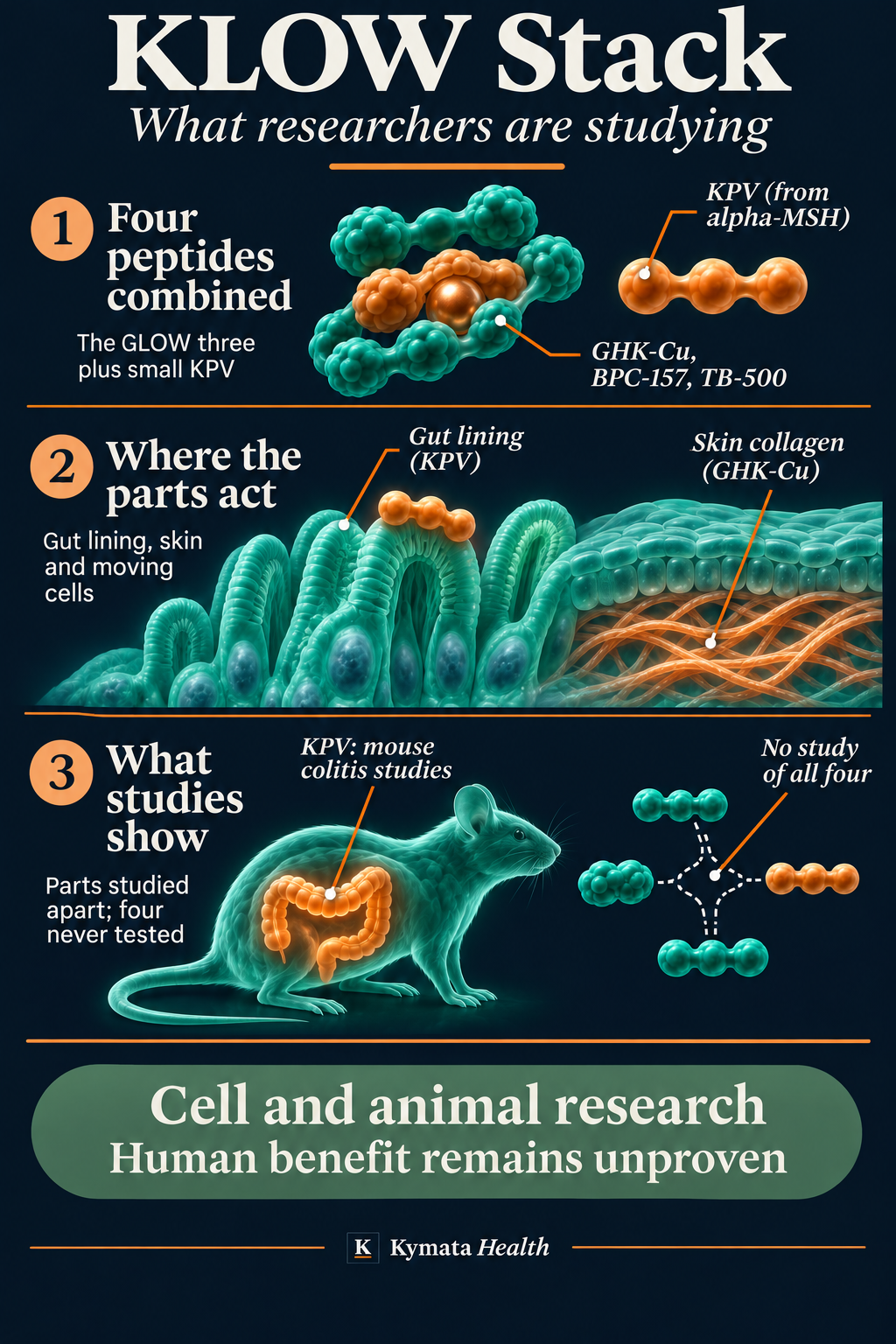
KLOW is a vendor nickname for the GLOW mix (GHK-Cu, BPC-157 and TB-500) plus KPV, the alpha-MSH tripeptide Lys-Pro-Val; not an IBD drug. KPV’s literature is mouse colitis work (Dalmasso 2008, Kannengiesser 2008); GHK-Cu has skin-biology papers, BPC-157 an animal repair file and the TB-500 fragment no human study, and no study has tested the four-peptide mix. No published trial of the four together. None of the four is FDA-approved. The drawing is a schematic, not a measured molecular structure, a product photograph or a treatment result. Illustration review: 19 November 2026, against this page’s own mechanism, evidence and regulatory records.
A sequence model is not provided for this record. Read the identity and evidence notes; an illustration does not verify a molecular structure.
Illustration notes and source record
Read the source record on this page. Laboratory, topical and injected studies are separate evidence; this illustration does not establish an indication or a treatment outcome.

How it works
SourcedKLOW is the GLOW powder plus KPV. Four lyophilized research SKUs: GHK-Cu, BPC-157, TB-500 as sold (usually Ac-LKKTETQ), and KPV (α-MSH residues 11–13, Lys-Pro-Val). The common advertised split is 80 mg at 50/10/10/10, so GHK-Cu is still 62.5% of the powder.
KPV’s literature is mouse colitis and NF-κB work (Dalmasso 2008, Kannengiesser 2008). That is not Crohn’s, not UC, not mast-cell activation syndrome, and not a reason this bottle is an “anti-inflammatory stack.” Adding a fourth powder does not create synergy. There is no published trial of the four together.
TB-500 identity stays the 7-mer problem. BPC-157 stays WADA S0, and a blend is outside HHS’s Oct 2026 single-peptide compounding policy (per the HHS policy document, Oct 28, 2026). GHK-Cu stays copper and injection-site pain. Read the four pages. Then read the COA.
Source: PMID: 18644225 (GHK-Cu), PMID: 23084823 (TB-500 7-mer), PMID: 18061177 (KPV mouse colitis)
Four-peptide convenience is not a gastroenterology protocol. Mouse colitis papers on KPV stay on the KPV page. Titration tables you see elsewhere are milligram arithmetic of a 50/10/10/10 powder, not a studied schedule, and we do not repeat them. HHS’s Oct 2026 policy covers single ingredients only, so the blend is not covered.
Background & History
KLOW is GLOW with KPV poured into the same powder so a product page can say inflammation. The advertised 80 mg 50/10/10/10 split keeps GHK-Cu at 62.5% of the powder. Mouse colitis papers on KPV (Dalmasso 2008, Kannengiesser 2008) do not describe this bottle and are not Crohn’s or UC approvals. The four-way mix has not been studied as a mix.
05 / Evidence and limits
Evidence and limits
Limits of current evidence
3 limits- No combination trial of the four peptides. Titration tables are milligram arithmetic, not a studied schedule.
- This site will not treat IBD or “leaky gut” from a KLOW page.
- Dalmasso 2008 and Kannengiesser 2008 stay on the KPV page. They do not describe this bottle.
What it is studied for
- Identity: GLOW components plus KPV, usually 50/10/10/10
- Why GHK-Cu is most of the powder
- Why KPV in a blend is outside HHS’s single-ingredient policy
- Not IBD, not mast cell, not autoimmune care
Verdict
KLOW is a vendor name for GHK-Cu + BPC-157 + TB-500 + KPV. Common advertised SKU is 80 mg at 50/10/10/10. Not a gut-disease drug. KPV is not an IBD indication on this site.
06 / Product forms and access
Product forms and access
Regulatory & legal status
- FDA status (US)
- Research OnlyVendor blend typically GLOW components + KPV. HHS’s Oct 28, 2026 compounding policy covers BPC-157, TB-500 and KPV each alone, excludes blends and does not include GHK-Cu (per the HHS policy document, Oct 28, 2026). The named blend is not an approved product
- WADA status (2026)
- Prohibited (S0)Competitive athletes subject to anti-doping controls should not use KLOW Stack.
- US compounding
- Not eligible / not available
This blend is outside HHS’s Oct 28, 2026 policy for BPC-157, TB-500 and KPV: the HHS policy document (Oct 28, 2026) allows only a single active ingredient per product, and GHK-Cu is not covered. None of these is FDA-approved.
News, Oct 28: what the HHS peptide compounding policy does and does not do →
07 / Tools and practical checks
Tools and practical checks
Blend calculator
80 mg + 3 mL BAC water → 26.67 mg/mL · concentration of the advertised powder, not a dose. No study has tested the blend.
Reconstitution math
U-100 syringe| Vial | Water | Concentration |
|---|---|---|
| 80 mg advertised powder (50/10/10/10) | 3 mL BAC | 26.7 mg/mL total |
08 / Published study use
Published study use
What published studies gave, in whom, and the source. Not a dose for you.
What studies used
No study of the combination- No published study has tested GHK-Cu, BPC-157, TB-500 and KPV together.
- GHK-Cu: A topical copper-tripeptide cream did not improve venous ulcer size over vehicle. Bishop et al., venous ulcers, PMID 1495150 (opens in new tab)
- GHK-Cu: An Iamin GHK-Cu gel with standard care improved median wound-area closure over vehicle in diabetic plantar ulcers. Mulder et al., diabetic ulcers, PMID 17147644 (opens in new tab)
- GHK-Cu: A human scalp injection study used copper tripeptide-1 in a mixture with several growth factors. This study did not isolate an injectable dose of GHK-Cu. Kapoor and Shome, combination scalp injection, PMID 29482481 (opens in new tab)
- BPC-157: FDA’s July 2026 review includes a 53-person randomized ulcerative-colitis study reported as a meeting abstract: an 80 mg rectal enema once daily for two weeks, with 46 completers. This is a study record, not an oral or injected recovery regimen. FDA BPC-157 review, July 2026 (opens in new tab)
- BPC-157: Rats with a surgically cut Achilles tendon: 10 µg/kg once a day, injected into the abdominal cavity. Staresinic 2003, PMID 14554208 (opens in new tab)
- BPC-157: A two-person safety pilot: 10 mg, then 20 mg the next day, by IV infusion, in adults who had used it before. Lee 2025, PMID 40131143 (opens in new tab)
- TB-500: No human study of TB-500 itself, the short thymosin beta-4 fragment sold in vials, has been published.
- TB-500: The full-length protein, thymosin beta-4, was given by IV at 42 to 1,260 mg a day for 14 days in a phase 1 safety study in healthy volunteers (four groups of 10, with placebo). That is a different molecule from TB-500. Ruff 2010, PMID 20536472 (opens in new tab)
- KPV: No human study has been published.
- KPV: It has been tested in mouse models of colitis. Kannengiesser 2008, PMID 18092346 (opens in new tab)
- The doses quoted online come from animal work and vendor or forum sources.
A record of what researchers gave, in whom; not a dose for you.
Administration
- Route / form
- Not established: no study of the blend. HHS’s Oct 2026 policy covers its components one at a time only, so a blend is outside it.
Who it is for
3 uses| Category | Fit | What exists |
|---|---|---|
| GLOW plus KPV | Low | The only structural difference from GLOW is KPV. Difference is not superiority. Still a catalog pairing. |
| Gut / autoimmune marketing | Low | This site will not treat IBD, “leaky gut,” or autoimmunity from a KLOW page. KPV mouse papers stay on the KPV page. |
| Skin / wound marketing | Low | GHK-Cu collagen papers exist. Blend copy is not a wound protocol. |
09 / Safety and interactions
Safety and interactions
What the record says
GLOW components plus KPV. Contains BPC-157 (not FDA-approved, WADA S0); a blend is outside HHS’s Oct 2026 single-peptide compounding policy (per the HHS policy document, Oct 28, 2026). GHK-Cu is the usual injection-site pain and the copper-handling issue. Angiogenesis signaling: active malignancy is a hard no. Wilson’s and pregnancy: no. Four powders in one powder means four COA lines to verify. Not an autoimmune protocol.
Interactions & Contraindications
Same BPC-157 WADA S0 flag as GLOW, and a blend is outside HHS’s Oct 2026 single-ingredient policy. Copper handling from GHK-Cu. No four-peptide PK. Not IBD care.
10 / Comparisons and goal guides
Comparisons and goal guides
Combinations: what has been tested
2 pairings- + GLOW Stack →Drop KPV and you are back at GLOW. Neither has been tested as a combination.
- + KPV →The only structural difference. Read the mouse-colitis page. Do not upgrade it because it sat in KLOW.
KLOW Stack vs. GLOW Stack
5 attributesCanonical comparison: KLOW Stack vs GLOW Stack · GLOW Stack evidence profile
| Attribute | KLOW Stack | GLOW Stack |
|---|---|---|
| Components | GHK-Cu + KPV + BPC-157 + TB-500 | GHK-Cu + BPC-157 + TB-500 |
| Common advertised mass | 80 mg at 50/10/10/10 | 70 mg at 50/10/10 |
| Why people pick it | KPV inflammation story | Fewer powders, same copper-peptide majority |
| KPV evidence in the mix | None. Mouse papers stay on the KPV page. | Not in the bottle |
| Combo trial | None | None |
No published trial has tested GHK-Cu + KPV + BPC-157 + TB-500 together. Dalmasso 2008 and Kannengiesser 2008 are mouse colitis papers on KPV, not Crohn’s or UC approvals, and not a reason this bottle is “for inflammation.” TB-500 as sold is still usually the 7-mer.
What is in the vial
4 componentsKLOW is GLOW with a fourth lyophilized powder in the powder: KPV (α-MSH 11–13). The common advertised SKU is 80 mg at 50/10/10/10. GHK-Cu is still 62.5% of the powder by mass. Adding KPV does not create a gut, mast-cell, or autoimmune indication.
- GHK-Cu62.5% of a 50/10/10/10 vial by mass.Same copper tripeptide as GLOW. Still the majority of the powder and the usual cause of injection-site pain.50 mg in the advertised SKU
- KPVLys-Pro-Val. This is the only structural difference from GLOW. Difference ≠ superiority trial.α-MSH C-terminal tripeptide. Murine NF-κB / colitis models. Not a human IBD drug.10 mg in the advertised SKU
- BPC-157Does not become a gut protocol because KPV is in the same powder.Same 15-mer as GLOW. In a blend it is outside HHS’s Oct 2026 single-peptide compounding policy (per the HHS policy document, Oct 28, 2026). WADA S0.10 mg in the advertised SKU
- TB-500No human study of TB-500 itself; the full-length protein’s trials describe a different molecule.Same 7-mer identity problem as GLOW.10 mg in the advertised SKU
Concentration for the advertised ratio, not a dose. No study has tested the blend.
Vial arithmetic
Concentration only, not a doseCommon advertised powder: 50 mg GHK-Cu + 10 mg KPV + 10 mg BPC-157 + 10 mg TB-500. In 3 mL of liquid that is 26.7 mg/mL total blend. “KLOW 80 mg” is a vendor convention, not a monograph. If a vial is 20 mg or a different split, this arithmetic does not describe it; the label wins.
- Common advertised SKU
- 80 mg · 50 / 10 / 10 / 10
- Concentration (arithmetic)
- 80 mg in 3.0 mL → 26.7 mg/mL total
- GHK-Cu share
- 50 of 80 mg (62.5%)
- Research status
- No combo trial. WADA S0.
- HHS Oct 2026 policy
- Not covered (single ingredients only)
HHS’s interim enforcement-discretion policy (Oct 28, 2026) covers BPC-157, TB-500 and KPV only as single-ingredient products, in specific forms, on a prescription. A product that mixes them is not covered, and the policy is not FDA approval. Talk to a licensed prescriber; we give no dose. What the HHS policy does and does not do
The components on their own
Each component has its own page with its evidence and its US status. No study has tested them together.
GLOW vs KLOW vs Wolverine
Ingredient count is not evidence quality. All three are vendor pairings. None has a combination RCT, and none is covered by HHS’s single-ingredient policy.
| Feature | Wolverine | GLOW | KLOW |
|---|---|---|---|
| In the bottle (typical vendor story) | BPC-157 + TB-500 7-mer | GHK-Cu + BPC-157 + TB-500 7-mer | GLOW four-way: adds KPV |
| Common advertised mass | Often 10–20 mg total | Often 70 mg (50/10/10) | Often 80 mg (50/10/10/10) |
| What the marketing is selling | Two-peptide recovery pair | Recovery pair plus copper-peptide skin story | GLOW plus an α-MSH fragment inflammation story |
| KPV | No | No | Yes (usually 10 mg) |
| GHK-Cu | No | Yes (usually the majority by mass) | Yes (usually the majority by mass) |
| Combination RCT | None | None | None |
| WADA | S0 via BPC-157 (and TB-500 as sold) | S0 via BPC-157 | S0 via BPC-157 |
| HHS Oct 2026 policy | Not covered: single ingredients only | Not covered: single ingredients only | Not covered: single ingredients only |
- GLOWSame three peptides without KPV. Also untested as a combination.
- WolverineBPC-157 + TB-500 only. No copper peptide. No KPV.
- KPVMouse colitis studies only; HHS’s policy covers it alone in topical and oral forms, not in a blend.
- GHK-CuMajority of the powder by mass; no human injection study.
- BPC-157WADA S0; HHS’s policy covers it alone, not in a blend.
- TB-5007-mer, not Tβ4.
11 / Common questions
Common questions
Common questions
11 answersWhat is the difference between GLOW and KLOW?
KLOW is GLOW plus KPV. Four SKUs instead of three. Typical advertised masses are 70 mg vs 80 mg. Neither has a combination RCT. Neither is a gut, mast-cell, or autoimmune protocol.
Does KPV make KLOW an IBD treatment?
No. Dalmasso 2008 (PMID 18061177) and Kannengiesser 2008 (PMID 18092346) are mouse colitis papers. They are not Crohn’s or UC approvals, and they do not describe this four-peptide powder.
What is the 80 mg 50/10/10/10 vial?
A common advertised split: 50 mg GHK-Cu and 10 mg each of KPV, BPC-157, and TB-500. In 3 mL of liquid that is 26.7 mg/mL total, as arithmetic. GHK-Cu is 62.5% of the powder. No study has tested the blend, so there is no dose to convert.
Why do other sites list 7.5, 15, and 22.5 unit steps?
Those steps are milligram arithmetic of this ratio presented as a titration schedule. No study has tested KLOW, so there is no schedule, and we do not repeat one.
Why is GHK-Cu most of the powder?
Because it is 50 of 80 mg in the advertised split. The ratio is fixed by the vendor; no study has tested it.
Has the four-peptide mix been studied?
No. Extrapolating four literatures into one syringe is community reasoning, not evidence.
Why does the injection burn so much?
GHK-Cu solutions are acidic; that is the usual cause. No study has measured ways to prevent it, and we give no injection advice.
Is KLOW WADA-safe?
No. BPC-157 is S0. The extra KPV does not wash that off.
Is KLOW better than GLOW for inflammation?
No study has tested either blend. KPV’s evidence is mouse colitis work, and HHS’s Oct 2026 policy covers KPV only on its own, in topical and oral forms. Talk to a licensed prescriber.
How stable is a KLOW vial?
No stability study of this four-peptide mix has been published. Vendor 14–28 day claims are not a stability study.
Is KLOW Stack FDA-approved?
No. Vendor blend typically GLOW components + KPV. HHS’s Oct 28, 2026 compounding policy covers BPC-157, TB-500 and KPV each alone, excludes blends and does not include GHK-Cu (per the HHS policy document, Oct 28, 2026). The named blend is not an approved product.
12 / Sources and references
Sources and references
5 papers cited on this page.
Sources
5 papers- 1“PepT1-mediated tripeptide KPV uptake reduces intestinal inflammation.”Dalmasso G, Charrier-Hisamuddin L, Nguyen HT, et al. Gastroenterology (2008). PMID: 18061177
- 2“Melanocortin-derived tripeptide KPV has anti-inflammatory potential in murine models of inflammatory bowel disease.”Kannengiesser K, et al. Inflamm Bowel Dis (2008). PMID: 18092346
- 3“GHK peptide as a natural modulator of multiple cellular pathways in skin biology.”Pickart L, Margolina A. Biomed Res Int (2015). PMID: 26236730
- 4“Novel cytoprotective mediator, stable gastric pentadecapeptide BPC 157. Vascular recruitment and gastrointestinal tract healing.”Sikiric P, et al. Curr Pharm Des (2018). PMID: 29879879
- 5“Doping control analysis of TB-500, a synthetic version of an active region of thymosin β4, in equine urine and plasma by LC-MS.”Ho EN, et al. Drug Test Anal (2012). PMID: 23084823
14 / Prescription options
Prescription options
Prescription options: compare licensed telehealth providers
Some peptide therapies are available only by prescription after a consult with a licensed clinician.
Compare telehealth →15 / Peptide library
Peptide library
Keep reading: Peptide research library
Peptide research library: every pagePeptide libraryBrowse all topics
- GLOW StackPrevious in this topic · Vendor name for a mixed vial, usually GHK-Cu + BPC-157 + TB-500 (7-mer).
- 5-Amino-1MQNext in this topic · Small-molecule NNMT inhibitor, not a peptide.
- LiraglutideOnce-daily GLP-1 RA.
- CagrilintideLong-acting amylin analog, not a GLP-1.
- CagriSemaNovo's combination of cagrilintide 2.4 mg and semaglutide 2.4 mg, studied in the REDEFINE trials.
Regulatory and sport classification
- Not FDA-approved, research chemical
- WADA (S0): prohibited in sport at all times