
The peptide field guide
GLOW Stack
GLOW is a vendor nickname for a mix of GHK-Cu (copper tripeptide), BPC-157 (a 15-amino-acid gastric peptide) and TB-500 as sold (the 7-amino-acid thymosin beta-4 fragment); not Argireline and not Matrixyl.
No published human or animal study of the three together. None of the three is FDA-approved.
Explore this compoundConceptual editorial illustration; not a measured molecular structure, product photograph or treatment result.
02 / At a glance
At a glance
Key facts
- Also known as
- GLOW peptide blend, GHK-Cu BPC-157 TB-500 stack, regenerative stack, glow peptide
- Type
- Peptide Stack
- Evidence level
- Cell and animal research: human benefit remains unproven.
- US regulatory status
- Not FDA-approved, research chemical
- Updated
Identity
GLOW is a vendor nickname for a mix of GHK-Cu (copper tripeptide), BPC-157 (a 15-amino-acid gastric peptide) and TB-500 as sold (the 7-amino-acid thymosin beta-4 fragment); not Argireline and not Matrixyl.
Research context
GHK-Cu has topical collagen and skin-biology papers (Pickart 2015), BPC-157 has an animal repair literature linked to blood-vessel signaling (Sikiric 2018), and no human study of the TB-500 fragment has been published; no study has tested the blend.
Evidence limits
No published human or animal study of the three together. None of the three is FDA-approved.
Read the technical profile and study-use reference
Quick answer
Evidence: LowVendor name for a mixed vial, usually GHK-Cu + BPC-157 + TB-500 (7-mer). Common advertised SKU is 70 mg at 50/10/10. Not Argireline, not Matrixyl. Not a synergy RCT. Use the blend calculator.
- In published studies
- No study of the combination published
Research summary, not medical advice.
At a glance
Kymata peptide profile · Oct 28, 2026- Common vials
- 10 mg / 50 mg / 70 mg
- In published studies
- No study of the combination published
- Half-life
- Not measured as a mix. Do not average component slogans.
- Molecular weight
- Three molecules. Not a single MW.
- CAS
- N/A (multi-component stack)
03 / Identity and origin
Identity and origin
Also called GLOW peptide blend, GHK-Cu BPC-157 TB-500 stack, regenerative stack, glow peptide. Vendor blend (typically GHK-Cu + BPC-157 + TB-500 7-mer).
Read the sequence and compound record
Compound card
- Class
- Vendor blend (typically GHK-Cu + BPC-157 + TB-500 7-mer)
- Formula
- GHK-Cu + BPC-157 + TB-500 7-mer (vendor mix)
- Molecular weight
- Three molecules. Not a single MW.
- CAS
- N/A (multi-component stack)
- PubChem CID
- N/A
- Described by
- No single developer. Catalog nickname., N/A
- Bioavailability
- Not established: no study of the blend.
04 / How it may work
How it may work
Vendor blend (typically GHK-Cu + BPC-157 + TB-500 7-mer)
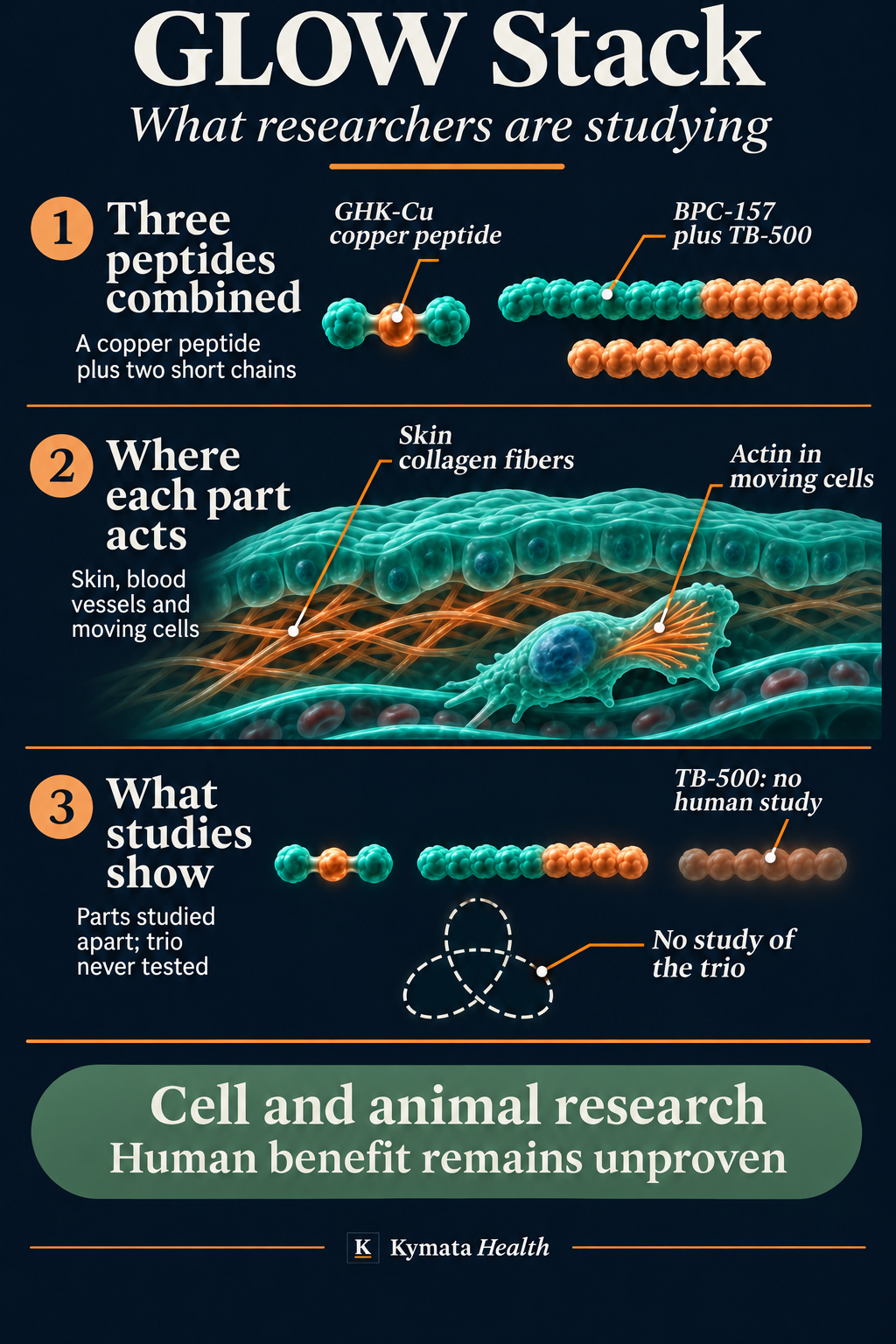
GLOW is a vendor nickname for a mix of GHK-Cu (copper tripeptide), BPC-157 (a 15-amino-acid gastric peptide) and TB-500 as sold (the 7-amino-acid thymosin beta-4 fragment); not Argireline and not Matrixyl. GHK-Cu has topical collagen and skin-biology papers (Pickart 2015), BPC-157 has an animal repair literature linked to blood-vessel signaling (Sikiric 2018), and no human study of the TB-500 fragment has been published; no study has tested the blend. No published human or animal study of the three together. None of the three is FDA-approved. The drawing is a schematic, not a measured molecular structure, a product photograph or a treatment result. Illustration review: 19 November 2026, against this page’s own mechanism, evidence and regulatory records.
A sequence model is not provided for this record. Read the identity and evidence notes; an illustration does not verify a molecular structure.
Illustration notes and source record
Read the source record on this page. Laboratory, topical and injected studies are separate evidence; this illustration does not establish an indication or a treatment outcome.

How it works
SourcedGLOW is a vendor nickname, not an INN. The usual research-chem powder is three lyophilized powders in one bottle: GHK-Cu (copper tripeptide), BPC-157 (15-mer GEPPPGKPADDAGLV), and TB-500 as sold (usually the actin-loop heptapeptide Ac-LKKTETQ, not full-length thymosin β4).
Complementary marketing is not a combination trial. There is no published human or animal study of the three together. GHK-Cu topical collagen papers (Pickart) do not transfer to a subcutaneous mix. BPC-157 remains a Zagreb-heavy animal file with independent PK in minutes, not the internet’s 4-hour half-life. Full-length Tβ4 cardiac and wound trials do not describe the 7-mer in this vial.
Not Argireline. Not Matrixyl. Those are topical cosmetics on other pages. A 5:1:1 70 mg label is a common advertised split, not a monograph. Read each milligram on the COA. No study has tested the blend, and HHS’s Oct 2026 policy covers single ingredients only, so a blend is not covered.
Source: PMID: 18644225 (GHK-Cu)
The arithmetic on this page is concentration only, for a common advertised 70 mg 5:1:1 powder. No study has tested the blend, and we give no dose. Active malignancy is a hard no on angiogenesis-signaling components. Competitive athletes: this bottle is not sport-safe.
Background & History
GLOW showed up as a checkout nickname, not as a trial arm. Vendors needed a word for GHK-Cu plus the Wolverine pair in one freeze-dried powder. The split that stuck in ads is 70 mg at 50/10/10 (GHK-Cu dominant). That ratio is convenience and skin-story mass, not a synergy finding. Argireline and Matrixyl are different cosmetics that sometimes get the same nickname in spa menus. This page is the research-chem three-peptide powder.
05 / Evidence and limits
Evidence and limits
None · no combination trial of the three
Human evidence
None · no combination trial of the three- No published human or animal trial of GHK-Cu + BPC-157 + TB-500 together.
- Component papers stay on their own pages. A mixed powder does not inherit those results.
- A 70 mg 5:1:1 label is a common advertised split, not a monograph.
Limits of current evidence
3 limits- No published trial of GHK-Cu + BPC-157 + TB-500 together. Component papers are not stack papers.
- Do not treat full-length thymosin β4 papers as the 7-mer in the blend.
- Copper + multiple lyophilized peptides: confirm each mg on the COA. If the split is not 50/10/10, ignore the example tables.
What it is studied for
- Identity: which three powders are in a bottle labeled GLOW
- The advertised 70 mg 5:1:1 split as concentration arithmetic, and why the COA wins
- Why TB-500 is a small share of the powder
- Not a reason to skip the GHK-Cu, BPC-157, or TB-500 pages
User reports
Anecdote, not evidence- What people report anyway
- Injection-site sting from GHK-Cu, sometimes a copper-blue tint. Recovery and skin stories are anecdote stacked on three separate literatures.
Verdict
GLOW on vendor menus is usually GHK-Cu + BPC-157 + TB-500, not Argireline + Matrixyl. A 70 mg 5:1:1 label is a common advertised split, not a monograph. A mixed vial is not a synergy trial. Use the blend calculator.
06 / Product forms and access
Product forms and access
Regulatory & legal status
- FDA status (US)
- Research OnlyVendor blend typically GHK-Cu + BPC-157 + TB-500. HHS’s Oct 28, 2026 compounding policy covers BPC-157 and TB-500 each alone, excludes blends and does not include GHK-Cu (per the HHS policy document, Oct 28, 2026). The named blend is not an approved product
- WADA status (2026)
- Prohibited (S0)Competitive athletes subject to anti-doping controls should not use GLOW Stack.
- US compounding
- Not eligible / not available
This blend is outside HHS’s Oct 28, 2026 policy for BPC-157 and TB-500: the HHS policy document (Oct 28, 2026) allows only a single active ingredient per product, and GHK-Cu is not covered. None of these is FDA-approved.
News, Oct 28: what the HHS peptide compounding policy does and does not do →
07 / Tools and practical checks
Tools and practical checks
Blend calculator
70 mg + 3 mL BAC water → 23.33 mg/mL · concentration of the advertised powder, not a dose. No study has tested the blend.
Reconstitution math
U-100 syringe| Vial | Water | Concentration |
|---|---|---|
| 70 mg advertised powder (50/10/10) | 3 mL BAC | 23.3 mg/mL total |
08 / Published study use
Published study use
What published studies gave, in whom, and the source. Not a dose for you.
What studies used
No study of the combination- No published study has tested GHK-Cu, BPC-157 and TB-500 together.
- GHK-Cu: A topical copper-tripeptide cream did not improve venous ulcer size over vehicle. Bishop et al., venous ulcers, PMID 1495150 (opens in new tab)
- GHK-Cu: An Iamin GHK-Cu gel with standard care improved median wound-area closure over vehicle in diabetic plantar ulcers. Mulder et al., diabetic ulcers, PMID 17147644 (opens in new tab)
- GHK-Cu: A human scalp injection study used copper tripeptide-1 in a mixture with several growth factors. This study did not isolate an injectable dose of GHK-Cu. Kapoor and Shome, combination scalp injection, PMID 29482481 (opens in new tab)
- BPC-157: FDA’s July 2026 review includes a 53-person randomized ulcerative-colitis study reported as a meeting abstract: an 80 mg rectal enema once daily for two weeks, with 46 completers. This is a study record, not an oral or injected recovery regimen. FDA BPC-157 review, July 2026 (opens in new tab)
- BPC-157: Rats with a surgically cut Achilles tendon: 10 µg/kg once a day, injected into the abdominal cavity. Staresinic 2003, PMID 14554208 (opens in new tab)
- BPC-157: A two-person safety pilot: 10 mg, then 20 mg the next day, by IV infusion, in adults who had used it before. Lee 2025, PMID 40131143 (opens in new tab)
- TB-500: No human study of TB-500 itself, the short thymosin beta-4 fragment sold in vials, has been published.
- TB-500: The full-length protein, thymosin beta-4, was given by IV at 42 to 1,260 mg a day for 14 days in a phase 1 safety study in healthy volunteers (four groups of 10, with placebo). That is a different molecule from TB-500. Ruff 2010, PMID 20536472 (opens in new tab)
- The doses quoted online come from animal work and vendor or forum sources.
A record of what researchers gave, in whom; not a dose for you.
Administration
- Route / form
- Not established: no study of the blend. HHS’s Oct 2026 policy covers its components one at a time only, so a blend is outside it.
Who it is for
3 uses| Category | Fit | What exists |
|---|---|---|
| One powder, three compounds | Low | The ratio is fixed by the vendor, and TB-500 is one tenth of the powder. No study has tested the mix. |
| Skin / cosmetic | Low | GHK-Cu topical papers exist. A SubQ blend is not those papers. Not Argireline, not Matrixyl. |
| Soft-tissue recovery | Low | Wolverine-adjacent marketing. Component animal files plus forum logs. No stack trial. TB-500 is one tenth of the powder. |
09 / Safety and interactions
Safety and interactions
What the record says
Three research SKUs in one bottle. No combination safety file. BPC-157 is not FDA-approved and is WADA S0; a blend is outside HHS’s Oct 2026 single-peptide compounding policy (per the HHS policy document, Oct 28, 2026). Angiogenesis signaling in the BPC and Tβ4 families is why active malignancy is a hard no. GHK-Cu is copper: Wilson’s disease and other copper-handling disorders are a hard no. Pregnancy and breastfeeding have no safety file. GHK-Cu is the usual post-injection pain. Confirm each mg on the COA. Quality risk scales with how many powders sat in the powder.
Interactions & Contraindications
No mix DDI package. BPC-157 is WADA S0, and a blend is outside HHS’s Oct 2026 single-peptide compounding policy (per the HHS policy document, Oct 28, 2026). Angiogenesis signaling: active malignancy is a hard no. GHK-Cu is copper (Wilson’s). Confirm each mg on the COA.
10 / Comparisons and goal guides
Comparisons and goal guides
Combinations: what has been tested
2 pairings- + Wolverine Stack →Wolverine is the two-peptide core. GLOW adds GHK-Cu. Neither has been tested as a combination.
- + KLOW Stack →KLOW is this powder plus KPV. Four SKUs. Still no combo trial.
GLOW Stack vs. KLOW Stack
6 attributesCanonical comparison: GLOW Stack vs KLOW Stack · KLOW Stack evidence profile
| Attribute | GLOW Stack | KLOW Stack |
|---|---|---|
| Components | GHK-Cu + BPC-157 + TB-500 7-mer | GLOW four-way: adds KPV |
| Common advertised mass | 70 mg at 50/10/10 | 80 mg at 50/10/10/10 |
| GHK-Cu share | ~71% of a 5:1:1 powder | 62.5% of a 50/10/10/10 powder |
| KPV | No | Yes (usually 10 mg) |
| Combo trial | None | None |
| WADA / FDA flag | S0; blend outside HHS’s Oct 2026 policy (per the HHS policy document, Oct 28, 2026) | Same inheritance |
GLOW Stack vs. Wolverine Stack
4 attributesCanonical comparison: GLOW Stack vs Wolverine Stack · Wolverine Stack evidence profile
| Attribute | GLOW Stack | Wolverine Stack |
|---|---|---|
| Components | GHK-Cu + BPC-157 + TB-500 | BPC-157 + TB-500 only |
| Copper peptide | Yes. Usual PIP source. | No |
| Job in the ads | Recovery plus skin/ECM story | Two-peptide recovery pair |
| Evidence | Component preclinical; no blend RCT | One rat tendon study of the pair (no added benefit, PMID 42542926) |
No published human (or animal) trial has tested GHK-Cu + BPC-157 + TB-500 together. Component papers are not stack papers. TB-500 as sold is usually Ac-LKKTETQ, not full-length thymosin β4. Not Argireline. Not Matrixyl.
What is in the vial
3 componentsGLOW is a catalog name, not an INN and not a trial arm. Most grey-market bottles that use the word are GHK-Cu-heavy three-peptide powders. The arithmetic below describes a common advertised 70 mg 5:1:1 SKU, as concentration only. Your COA is the only ratio that matters.
- GHK-CuGly-His-Lys copper complex. Most of the advertised GLOW powder by mass, which is why injection-site pain and copper handling dominate the questions about it.Copper tripeptide. Topical collagen and gene-expression literature exists. That literature is not an injectable blend NDA.50 mg in the advertised SKU
- BPC-157GEPPPGKPADDAGLV. Not FDA-approved; HHS’s Oct 2026 compounding policy covers it alone, not in a blend (per the HHS policy document, Oct 28, 2026). WADA S0. Human PK is not the internet’s “4-hour half-life.”Synthetic 15-mer with a large Zagreb-heavy animal file. Not a proven healing drug.10 mg in the advertised SKU
- TB-500Usually Ac-LKKTETQ (CAS 885340-08-9), not 43-aa thymosin β4. Equine doping-control papers exist because sport was already using it.Actin-binding 7-mer as sold. Do not launder full-length Tβ4 cardiac or wound trials onto this SKU.10 mg in the advertised SKU
Concentration for the advertised ratio, not a dose. No study has tested the blend.
Vial arithmetic
Concentration only, not a doseCommon advertised powder: 50 mg GHK-Cu + 10 mg TB-500 + 10 mg BPC-157. In 3 mL of liquid that is 23.3 mg/mL total blend. Lots advertised as “GLOW” are not 70 mg and not 5:1:1. If the label disagrees with this arithmetic, the label wins.
- Common advertised SKU
- 70 mg · 50 / 10 / 10
- Concentration (arithmetic)
- 70 mg in 3.0 mL → 23.3 mg/mL total
- GHK-Cu share
- 50 of 70 mg (about 71%)
- Research status
- No combo trial. WADA S0.
- HHS Oct 2026 policy
- Not covered (single ingredients only)
HHS’s interim enforcement-discretion policy (Oct 28, 2026) covers BPC-157, TB-500 and KPV only as single-ingredient products, in specific forms, on a prescription. A product that mixes them is not covered, and the policy is not FDA approval. Talk to a licensed prescriber; we give no dose. What the HHS policy does and does not do
The components on their own
Each component has its own page with its evidence and its US status. No study has tested them together.
GLOW vs KLOW vs Wolverine
Ingredient count is not evidence quality. All three are vendor pairings. None has a combination RCT, and none is covered by HHS’s single-ingredient policy.
| Feature | Wolverine | GLOW | KLOW |
|---|---|---|---|
| In the bottle (typical vendor story) | BPC-157 + TB-500 7-mer | GHK-Cu + BPC-157 + TB-500 7-mer | GLOW four-way: adds KPV |
| Common advertised mass | Often 10–20 mg total | Often 70 mg (50/10/10) | Often 80 mg (50/10/10/10) |
| What the marketing is selling | Two-peptide recovery pair | Recovery pair plus copper-peptide skin story | GLOW plus an α-MSH fragment inflammation story |
| KPV | No | No | Yes (usually 10 mg) |
| GHK-Cu | No | Yes (usually the majority by mass) | Yes (usually the majority by mass) |
| Combination RCT | None | None | None |
| WADA | S0 via BPC-157 (and TB-500 as sold) | S0 via BPC-157 | S0 via BPC-157 |
| HHS Oct 2026 policy | Not covered: single ingredients only | Not covered: single ingredients only | Not covered: single ingredients only |
- WolverineThe two-peptide core without GHK-Cu. Same missing evidence, no copper peptide.
- KLOWGLOW plus KPV. Four SKUs. Still no combo trial. Still not an IBD protocol.
- GHK-CuThe copper-peptide page: topical human data, no injection study.
- BPC-157Not FDA-approved; not covered in a blend by HHS’s Oct 2026 policy (per the HHS policy document, Oct 28, 2026). WADA S0, minutes-scale animal PK.
- TB-5007-mer identity. Full Tβ4 trials stay on a different molecule.
11 / Common questions
Common questions
Common questions
11 answersWhat is the GLOW stack?
A vendor nickname, usually GHK-Cu + BPC-157 + TB-500 (Ac-LKKTETQ, not full Tβ4) in one vial. Not a combination trial. Not Argireline. Not Matrixyl.
Has anyone tested the three peptides together?
No published human or animal trial of the combination. Component papers stay on their own pages. A mixed powder does not inherit those results.
What is the 70 mg 5:1:1 vial?
A common advertised split: 50 mg GHK-Cu, 10 mg TB-500, 10 mg BPC-157. In 3 mL bacteriostatic water that is 23.3 mg/mL total. No study has tested the blend, so there is no dose to convert, and the blend is outside HHS’s Oct 2026 single-ingredient policy.
Why is TB-500 so small a share of the pre-blend?
Because GHK-Cu is 50 of 70 mg, so TB-500 is one tenth of the powder. No human study of TB-500 has been published (the full protein was tested by IV, PMID 20536472).
GLOW vs Wolverine vs KLOW?
Wolverine is BPC-157 + TB-500. GLOW adds GHK-Cu. KLOW adds KPV on top of GLOW. More powders is not more evidence. All three are catalog pairings with no combo RCT, all three carry BPC-157’s WADA S0 flag, and none is covered by HHS’s Oct 2026 policy, which covers single ingredients only.
Can separate vials be mixed in one syringe?
No study has tested the three together, mixed or not, or their stability in one syringe. A blend is outside HHS’s Oct 2026 single-ingredient policy. We give no mixing advice; talk to a licensed prescriber.
Why does the injection burn?
GHK-Cu solutions are acidic and are the usual cause. No study has measured ways to prevent it, and we give no injection advice.
Is GLOW allowed in tested sport?
No. BPC-157 is WADA S0 (non-approved substance). The nickname on the bottle does not create a therapeutic-use exemption.
Is this the same as Argireline or Matrixyl?
No. Those are topical cosmetics on other pages. GLOW as sold in research-chem catalogs is the copper-peptide + BPC + 7-mer powder.
What if a vial is not 70 mg 5:1:1?
Then the arithmetic on this page does not describe it; the COA is the source. Concentration arithmetic is not a dose, and no study has tested the blend.
Is GLOW Stack FDA-approved?
No. Vendor blend typically GHK-Cu + BPC-157 + TB-500. HHS’s Oct 28, 2026 compounding policy covers BPC-157 and TB-500 each alone, excludes blends and does not include GHK-Cu (per the HHS policy document, Oct 28, 2026). The named blend is not an approved product.
12 / Sources and references
Sources and references
4 papers cited on this page.
Sources
4 papers- 1“GHK peptide as a natural modulator of multiple cellular pathways in skin biology.”Pickart L, Margolina A. Biomed Res Int (2015). PMID: 26236730
- 2“Novel cytoprotective mediator, stable gastric pentadecapeptide BPC 157. Vascular recruitment and gastrointestinal tract healing.”Sikiric P, et al. Curr Pharm Des (2018). PMID: 29879879
- 3“Pharmacokinetics, distribution, metabolism, and excretion of body-protective compound 157, a potential drug for treating various wounds, in rats and dogs.”He L, et al. Front Pharmacol (2022). PMID: 36588717
- 4“Doping control analysis of TB-500, a synthetic version of an active region of thymosin β4, in equine urine and plasma by LC-MS.”Ho EN, et al. Drug Test Anal (2012). PMID: 23084823
14 / Prescription options
Prescription options
Prescription options: compare licensed telehealth providers
Some peptide therapies are available only by prescription after a consult with a licensed clinician.
Compare telehealth →15 / Peptide library
Peptide library
Keep reading: Peptide research library
Peptide research library: every pagePeptide libraryBrowse all topics
Regulatory and sport classification
- Not FDA-approved, research chemical
- WADA (S0): prohibited in sport at all times