
The peptide field guide
Pentadeca arginate
The arginine salt of BPC-157: the same 15-amino-acid chain (GEPPPGKPADDAGLV) with arginine in place of acetate; not a new peptide.
No study of the salt itself. Evidence is BPC-157 animal work. Not FDA-approved.
Explore this compoundConceptual editorial illustration; not a measured molecular structure, product photograph or treatment result.
02 / At a glance
At a glance
Key facts
- Also known as
- PDA, BPC-157 arginate, BPC-157 arginine salt, pentadecapeptide arginate
- Type
- Healing & Recovery
- Evidence level
- Cell and animal research: human benefit remains unproven.
- US regulatory status
- Not FDA-approved, research chemical
- Updated
Identity
The arginine salt of BPC-157: the same 15-amino-acid chain (GEPPPGKPADDAGLV) with arginine in place of acetate; not a new peptide.
Research context
Vendors sell it as a separate product and claim better gut stability; the published animal work, including a rat and dog pharmacokinetics study (He 2022), used BPC-157 acetate or the free peptide.
Evidence limits
No study of the salt itself. Evidence is BPC-157 animal work. Not FDA-approved.
Read the technical profile and study-use reference
Quick answer
Evidence: Strong preclinicalArginine salt of BPC-157 (the same 15-aa gastric peptide), sold as a distinct SKU from BPC-157 acetate. Vendors claim better oral/gastric stability. There is no separate human PK package for the arginate salt. Treat identity as BPC-157 with a different counterion. FDA compounding status follows the peptide, not the salt name.
- In published studies
- No published study found
Research summary, not medical advice.
At a glance
Kymata peptide profile · Oct 30, 2026- Common vials
- 5 mg / 10 mg
- CAS
- N/A (salt)
- In published studies
- No published study found
- Half-life
- Not published for the salt; BPC IV PK is minutes
- Molecular weight
- ~1.4 kDa peptide + arginine
03 / Identity and origin
Identity and origin
Also called PDA, BPC-157 arginate, BPC-157 arginine salt, pentadecapeptide arginate. BPC-157 arginine salt (not a new INN).
Read the sequence and compound record
Compound card
- Sequence
- GEPPPGKPADDAGLV (arginine salt)
- Class
- BPC-157 arginine salt (not a new INN)
- Formula
- BPC-157 arginine salt
- Molecular weight
- ~1.4 kDa peptide + arginine
- CAS
- N/A (salt)
- Described by
- BPC-157: Sikiric / Zagreb; salt: formulation vendors
- Bioavailability
- Claimed oral advantage vs acetate, not a dedicated human PK package
04 / How it may work
How it may work
BPC-157 arginine salt (not a new INN)
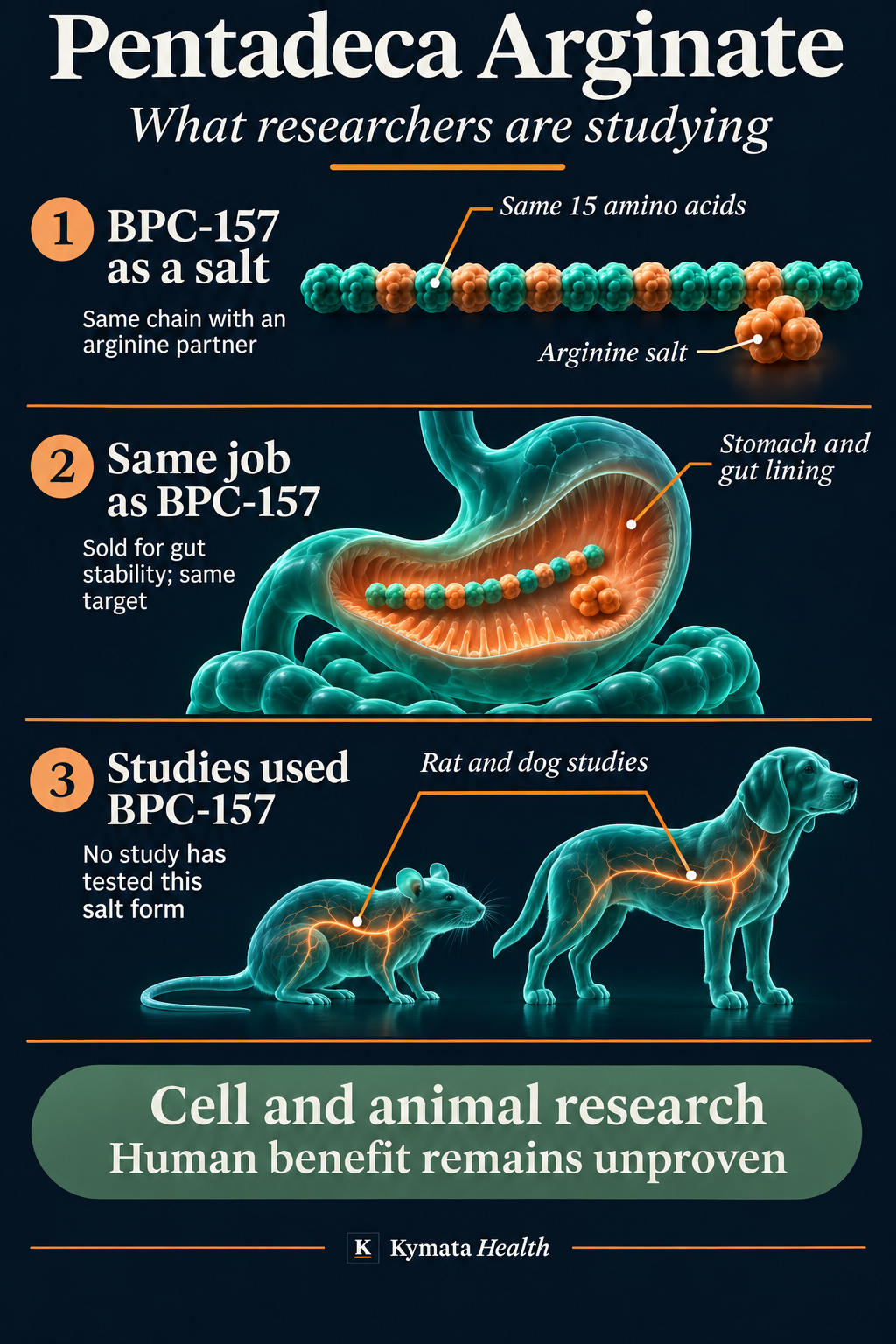
The arginine salt of BPC-157: the same 15-amino-acid chain (GEPPPGKPADDAGLV) with arginine in place of acetate; not a new peptide. Vendors sell it as a separate product and claim better gut stability; the published animal work, including a rat and dog pharmacokinetics study (He 2022), used BPC-157 acetate or the free peptide. No study of the salt itself. Evidence is BPC-157 animal work. Not FDA-approved. The drawing is a schematic, not a measured molecular structure, a product photograph or a treatment result. Illustration review: 19 November 2026, against this page’s own mechanism, evidence and regulatory records.
A sequence model is not provided for this record. Read the identity and evidence notes; an illustration does not verify a molecular structure.
Illustration notes and source record
Read the source record on this page. Laboratory, topical and injected studies are separate evidence; this illustration does not establish an indication or a treatment outcome.

How it works
SourcedPentadeca arginate is BPC-157 as the arginine salt instead of acetate. Sequence is the same pentadecapeptide. Oral-stability claims are formulation marketing. Published animal PK and repair papers are almost entirely BPC-157 acetate or free peptide. FDA compounding status follows the peptide, not the salt name. If the question is mechanism or PK, read the BPC-157 page.
Source: BPC-157: PMID: 30915550. Arginate salt: vendor chemistry, not a separate INN.
If your question is mechanism or FDA status, use the BPC-157 page. This page exists because vendors sell PDA as a separate SKU (often oral). Do not double-count it as a new INN.
05 / Evidence and limits
Evidence and limits
Limits of current evidence
3 limits- No dedicated human PK package for the arginate salt.
- Animal repair literature is almost entirely acetate or free BPC-157.
- Oral SKUs do not inherit SubQ mixing math. Check the label for route.
What it is studied for
- Why this leaf exists
Goal context
1 goals- Why this leaf exists
- Vendors sell PDA as a distinct catalog item, often with oral claims. The sequence is BPC-157. This page is an identity warning, not a second profile.
Verdict
PDA is a salt SKU, not a new peptide. Use it when that is what is in the bottle. Do not treat oral-stability ads as a second PK package. Mechanism, FDA compounding status, and WADA S0 are the BPC-157 story.
06 / Product forms and access
Product forms and access
Regulatory & legal status
- FDA status (US)
- Research OnlyArginine salt of BPC-157, same peptide, different counterion. HHS’s Oct 28, 2026 compounding policy names BPC-157 acetate (per the HHS policy document, Oct 28, 2026), not this salt
- WADA status (2026)
- Prohibited (S0)Competitive athletes subject to anti-doping controls should not use Pentadeca arginate.
- US compounding
- Not eligible / not available
The arginine salt is outside HHS’s Oct 28, 2026 policy for BPC-157: per the HHS policy document, Appendix B names BPC-157 acetate. Neither salt is FDA-approved.
News, Oct 28: what the HHS peptide compounding policy does and does not do →
07 / Tools and practical checks
Tools and practical checks
Dose it
5 mg + 2 mL BAC water → 2.5 mg/mL · 1 unit (U-100) = 25 mcg.
Reconstitution math
U-100 syringe| Vial | Water | Concentration |
|---|---|---|
| 5 mg (injectable SKU) | 2.0 mL BAC | 2.5 mg/mL |
08 / Published study use
Published study use
What published studies gave, in whom, and the source. Not a dose for you.
What studies used
No published study- We found no study of pentadeca arginate (the BPC-157 arginine salt) in PubMed.
- The doses quoted online come from animal work and vendor or forum sources.
A record of what researchers gave, in whom; not a dose for you.
Administration
- Route / form
- Not established: no published study.
Pentadeca arginate: capsule vs research vial
2 routesInjectable arginate vial
- Bioavailability
- Same 15-mer as BPC-157 acetate. Salt-specific human PK is unpublished. Treat parenteral exposure as the parent peptide until someone publishes otherwise. He 2022 is acetate/free peptide in animals, not this salt.
- Advantages
- Parenteral identity is BPC-157 with arginine as the counterion. Concentration math applies to a powder.
- Separates this SKU from oral-only vendor bottles.
- Considerations
- Not a new INN. Do not double-count animal acetate papers as salt-specific proof.
- Not FDA-approved, outside HHS’s Oct 2026 policy for the acetate (per the HHS policy document, Oct 28, 2026), and WADA S0.
Oral PDA (vendor)
- Bioavailability
- Oral-stability ads are why this SKU exists. There is no dedicated human oral PK package for the arginate salt. No oral bioavailability (F%) is published. Parent acetate oral Phase 1 (NCT02637284) posted no results either.
- Advantages
- This is the catalog reason people search “PDA” instead of BPC-157.
- Considerations
- Formulation marketing is not a second evidence base.
- Same peptide, same compounding problem, same missing human RCT.
Who it is for
1 use| Category | Fit | What exists |
|---|---|---|
| BPC-157 salt SKU | Low | Catalog differentiation. Evidence is the parent peptide. |
09 / Safety and interactions
Safety and interactions
What the record says
Same caveats as BPC-157: not FDA-approved, angiogenic theoretical risk. HHS’s Oct 2026 compounding policy names BPC-157 acetate (per the HHS policy document, Oct 28, 2026), not this salt. Salt change is not a safety database.
10 / Comparisons and goal guides
Comparisons and goal guides
Pentadeca arginate vs. BPC-157
4 attributesCanonical comparison: Pentadeca arginate vs BPC-157 · BPC-157 evidence profile
| Attribute | Pentadeca arginate | BPC-157 |
|---|---|---|
| Identity | Arginine salt of the same 15-aa peptide | Acetate / free pentadecapeptide in most papers |
| FDA | Not FDA-approved; not the acetate HHS’s Oct 2026 policy names (per the HHS policy document, Oct 28, 2026) | Not FDA-approved; acetate covered by HHS’s interim 503A policy (per the HHS policy document, Oct 28, 2026; conditions apply) |
| Oral claims | Marketed for GI stability | Also used oral in community; gastric origin is the story |
| PK | Salt-specific human PK unpublished | IV animal PK is minutes (not 4 hours) |
11 / Common questions
Common questions
Common questions
5 answersOral PDA or injectable?
Pentadeca arginate is the arginine salt of BPC-157, outside HHS’s Oct 2026 policy (which names BPC-157 acetate). No published human study covers either form of it, oral or injected, and we give no route or dose.
Is PDA stronger than BPC-157?
It is BPC-157 with arginine as the counterion. Strength claims beyond acetate are not a second evidence base.
Can I put oral PDA in the reconstitution calculator?
Only if the SKU is a lyophilized injectable vial. Capsules are swallowed. Do not force oral product into SubQ math.
Can a pharmacy compound it?
Not under HHS’s Oct 28, 2026 interim 503A policy for BPC-157: per the HHS policy document, Appendix B names BPC-157 acetate, not the arginine salt. BPC-157 is not FDA-approved and not on the 503A bulks list (FDA list, May 14, 2026).
Is Pentadeca arginate FDA-approved?
No. Arginine salt of BPC-157, same peptide, different counterion. HHS’s Oct 28, 2026 compounding policy names BPC-157 acetate (per the HHS policy document, Oct 28, 2026), not this salt.
12 / Sources and references
Sources and references
1 paper cited on this page.
Sources
1 paper- 1“Pharmacokinetics, distribution, metabolism, and excretion of body-protective compound 157 in rats and dogs.”He L, Feng D, Guo H, et al. Frontiers in Pharmacology (2022). PMID: 36588717
14 / Prescription options
Prescription options
Prescription options: compare licensed telehealth providers
Some peptide therapies are available only by prescription after a consult with a licensed clinician.
Compare telehealth →15 / Peptide library
Peptide library
Keep reading: Peptide research library
Peptide research library: every pagePeptide libraryBrowse all topics
- Tesamorelin + IpamorelinPrevious in this topic · Clinic-style blend pairing FDA-approved tesamorelin (Egrifta, GHRH analog for HIV-associated lipodystrophy) with ipamorelin.
- AHK-CuNext in this topic · Copper-complexed tripeptide Ala-His-Lys, the GHK-Cu sibling used in hair and cosmetic SKUs.
- CetrorelixGnRH antagonist FDA-approved (Cetrotide, 2000) for the inhibition of premature LH surges in women undergoing controlled ovarian stimulation.
- OctreotideSomatostatin analog, FDA-approved in 1988 (Sandostatin) for acromegaly when surgery, irradiation and bromocriptine fall short, and for the diarrhea and flushing of metastatic…
- AdamaxAdamax is a name used for different Semax-related peptides.
Regulatory and sport classification
- Not FDA-approved, research chemical
- WADA (S0): prohibited in sport at all times