
The peptide field guide
Retatrutide
Retatrutide is a peptide studied at GLP-1, GIP and glucagon receptors.
Results belong to the named study population, dose group and duration; they do not validate research powders.
Explore this compoundConceptual editorial illustration; not a measured molecular structure, product photograph or treatment result.
02 / At a glance
At a glance
Key facts
- Also known as
- LY3437943
- Type
- Weight Management
- Evidence level
- Investigational drug: not FDA-approved.
- US regulatory status
- Investigational, not FDA-approved; Phase 3 results published 2026; Lilly plans to file Q1 2027. Available only in Lilly trials
- Updated
Identity
Retatrutide is a peptide studied at GLP-1, GIP and glucagon receptors.
Research context
A dated 2023 phase 2 body-weight trial, kept separate from later studies and a liver-fat substudy.
Evidence limits
Results belong to the named study population, dose group and duration; they do not validate research powders.
Read the technical profile and study-use reference
Retatrutide: the short answer
Evidence grade ARetatrutide is Eli Lilly’s investigational once-weekly agonist of the GIP, GLP-1 and glucagon receptors. In the Phase 3 TRIUMPH-1 trial, 12 mg weekly lowered body weight 25.0% at 80 weeks, versus 3.9% on placebo (PMID 42814954). Lilly plans to file in 2027.
By Kymata Health Editorial Sources cited inline Sources checked
At a glance
Kymata peptide profile · Oct 29, 2026- Half-life
- 144 hours (~6 days)
- Common vials
- 5 mg / 10 mg
- Molecular weight
- 4731.34 g/mol
- CAS
- 2381089-83-2
- In published studies
- Trial amounts are recorded under What studies used (PMID 42814954)
03 / Identity and origin
Identity and origin
Also called LY3437943. Once-weekly triple agonist (Lilly).
Read the sequence and compound record
Compound card
- Sequence
- Triple GLP-1/GIP/glucagon analog (LY3437943)
- Class
- Once-weekly triple agonist (Lilly)
- Formula
- C221H342N46O68
- Molecular weight
- 4731.34 g/mol
- CAS
- 2381089-83-2
- PubChem CID
- 171390338
- Described by
- Eli Lilly and Company, 2020
- Bioavailability
- ~80% (subcutaneous)
04 / How it may work
How it may work
Once-weekly triple agonist (Lilly)
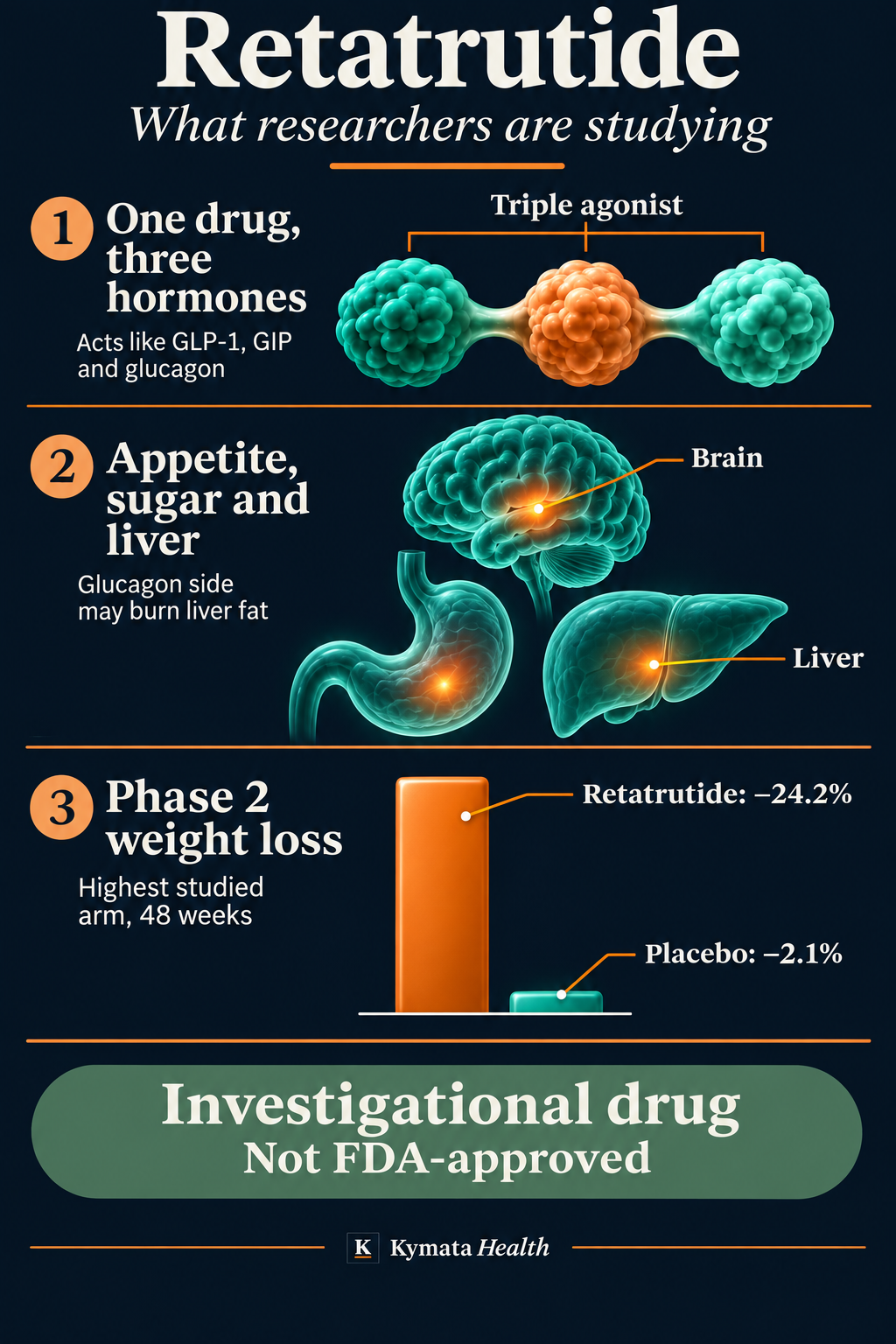
The guide shows retatrutide as one investigational molecule that activates the GLP-1, GIP and glucagon receptors, acting on appetite, blood sugar and, through the glucagon receptor, possibly liver fat. In the phase 2 obesity trial, the highest studied arm lost 24.2% of body weight at 48 weeks against 2.1% on placebo (PMID 37366315). The bars are drawn to scale from zero. It is not FDA-approved. The drawing is a schematic, not a measured molecular structure, a product photograph or a treatment result. Illustration review: 22 November 2026, against this page’s own mechanism, evidence and regulatory records.
The record identifies the triple-agonist analogue rather than giving a complete verified residue sequence and modifications. A residue model is not inferred from the receptor targets.
Illustration notes and source record
Read the source record on this page. Laboratory, topical and injected studies are separate evidence; this illustration does not establish an indication or a treatment outcome.

How it works
SourcedRetatrutide (LY3437943) is an investigational peptide that activates the GLP-1, GIP, and glucagon receptors. GLP-1 and GIP agonism lower appetite and blood glucose and slow gastric emptying; glucagon receptor activation is proposed to add liver fat oxidation and energy expenditure.
In the Phase 2 obesity trial, 12 mg lowered body weight 24.2% at 48 weeks (2.1% on placebo; PMID 37366315). In the Phase 3 TRIUMPH-1 trial, 12 mg lowered weight 25.0% at 80 weeks (3.9% on placebo; PMID 42814954). Lilly’s December 2025 topline for TRIUMPH-4 (68 weeks, obesity with knee osteoarthritis) reported 28.7% on 12 mg and 26.4% on 9 mg (efficacy estimand; 2.1% on placebo). No head-to-head trial against semaglutide or tirzepatide has been published. Retatrutide has a half-life of about 6 days, supporting once-weekly dosing.
Source: PMID: 37366315 (Phase II)
Background & History
Retatrutide (LY3437943) is Lilly’s triple GLP-1/GIP/glucagon analog. Phase 2 NEJM 2023 numbers are large. TRIUMPH is ongoing. Gray-market “reta” is not trial material. Glucagon-arm hepatic-fat observations are not a MASH indication on this page.
05 / Evidence and limits
Evidence and limits
What the sources say
Sources checkedEvidence grade A
Grade scale: A: several randomized trials or a meta-analysis. Several randomized trials, including Phase 3, for weight and blood sugar. Long-term safety and outcome data are not yet published.
- TRIUMPH-1 (NEJM 2026): 2,339 adults with obesity, no diabetes: -17.6%, -23.7% and -25.0% body weight on 4, 9 and 12 mg at 80 weeks vs -3.9% on placebo. PMID 42814954
- TRIUMPH-2 (Lancet 2026): 1,152 adults with obesity and type 2 diabetes: -11.9%, -16.8% and -18.8% on 4, 9 and 12 mg at 80 weeks. PMID 42810372
- TRANSCEND-T2D-1 (Lancet 2026): 537 adults with type 2 diabetes: HbA1c fell 1.69-1.94 points vs 0.81 on placebo at 40 weeks. PMID 42250575
- Phase 2 obesity (NEJM 2023): 338 adults: -24.2% at 48 weeks on 12 mg vs -2.1% on placebo; heart rate rose with dose, peaking at 24 weeks. PMID 37366315
Doses used in trials and labels (not advice)
- Phase 3 trials tested 4, 9 or 12 mg once weekly by injection. Phase 2 tested 1 to 12 mg, with lower starting doses (2 mg) reducing stomach side effects. Source: PubMed 42814954 and 37366315
Interactions
- No approved label exists, so there is no official interaction list. Products sold online as retatrutide have unknown contents and dose, per Lilly. Source: Lilly: What to know about retatrutide (Sep 2026)
Who should not use it
- Anyone outside a Lilly clinical trial: there is no legal, quality-controlled source. Source: Lilly: What to know about retatrutide (Sep 2026)
Use-case scores
0–100–10 against the evidence we have, not a gym ranking. Hidden domains do not apply here.
- Metabolic / weight8/10Phase 2 plus TRIUMPH-4 Phase 3 readouts. Ceiling 8 for Phase 2–3. Not 8.5–9 until there is a US label. Glucagon arm is extra efficacy and extra heart-rate/glycogen theoretical cost.
Limits of current evidence
2 limits- Glucagon receptor agonism is the extra lever and the extra monitoring conversation (HR, glycogen, lean mass).
- Gray-market “retatrutide” identity is unverified. Parent trial material is not a 10 mg powder.
Key Clinical Metrics
3 metrics- Weight Loss (TRIUMPH-1)
- 25.0%
- 12 mg weekly for 80 weeks, vs 3.9% on placebo (Phase 3; PMID 42814954).
- Receptor Targets
- GLP-1, GIP, Glucagon
- Triple agonist; investigational.
- Liver Fat (Phase 2a)
- -82.4%
- 12 mg at 24 weeks in people with MASLD; 86% reached normal liver fat (PMID 38858523).
Published Trial Data
4 trials| Study | Phase | Summary | Source |
|---|---|---|---|
| Retatrutide for Obesity (NEJM 2026) | Phase 3 (TRIUMPH-1) | 2,339 adults with obesity, no diabetes: 17.6%, 23.7% and 25.0% body weight reduction on 4, 9 and 12 mg at 80 weeks vs 3.9% on placebo. | Source |
| Retatrutide in Obesity and Knee Osteoarthritis | Phase 3 (TRIUMPH-4, topline) | Lilly topline (Dec 2025, not yet peer reviewed): 28.7% on 12 mg and 26.4% on 9 mg at 68 weeks vs 2.1% on placebo (efficacy estimand). | Source |
| Triple-Hormone-Receptor Agonist Retatrutide for Obesity | Phase 2 | 338 adults: 24.2% body weight reduction on 12 mg at 48 weeks vs 2.1% on placebo. | Source |
| Retatrutide for Fatty Liver Disease (MASLD) | Phase 2a substudy | 98 people with ≥10% liver fat: liver fat fell 82.4% at 24 weeks on 12 mg (placebo +0.3%); 86% reached normal liver fat (<5%). | Source |
Trial FinderRecruiting now: 2 open registrations for retatrutide
What it is studied for
- Identity: triple agonist vs tirzepatide vs semaglutide
- Why Phase 2 percents do not transfer to an unknown powder
- Not a NAFLD/NASH or T2D treatment page
Goal context
1 goals- Triple is not “semaglutide plus two”
- GLP-1, GIP, and glucagon are different receptors. The glucagon piece is why energy-expenditure language shows up. It is also why this is not a casual DIY escalation.
Verdict
Retatrutide is the triple-agonist Lilly program, not a research-chem toy. Phase 3 numbers are large. Do not treat a gray-market “reta” vial as TRIUMPH-4.
06 / Product forms and access
Product forms and access
Regulatory & legal status
- FDA status (US)
- Phase 3
- WADA status (2026)
- Not ListedNot currently on the WADA 2026 Prohibited List. Policies may change. Verify before competition.
- US compounding
- Not eligible / not available
- Not FDA-approved; Lilly says it is legal only in its trials. Source: Lilly: What to know about retatrutide (Sep 2026)
- Lilly plans to file with FDA in early 2027. Source: Lilly press release, Jul 23, 2026
- Compounding: no lawful US route. Source: FDA 503A bulk drug substance categories (updated May 14, 2026)
07 / Tools and practical checks
Tools and practical checks
Dose it
10 mg + 2 mL BAC water → 5 mg/mL · 1 unit (U-100) = 50 mcg.
Reconstitution math
U-100 syringe| Vial | Water | Concentration |
|---|---|---|
| Unlabeled vial | Vendor-dependent | Do the math on the COA |
08 / Published study use
Published study use
What published studies gave, in whom, and the source. Not a dose for you.
What studies used
Phase 3 trials- Phase 3 (TRIUMPH-1): 4, 9 or 12 mg once a week under the skin for 80 weeks, in 2,339 adults with obesity who did not have diabetes. Jastreboff 2026, PMID 42814954 (opens in new tab)
- Phase 2: 1, 4, 8 or 12 mg once a week for 48 weeks, in adults with obesity, or overweight plus a weight-related condition. Jastreboff 2023, PMID 37366315 (opens in new tab)
- These are trial doses given under trial monitoring, not a schedule for anyone outside a trial.
A record of what researchers gave, in whom; not a dose for you.
Administration
- Route / form
- Route used in studies: injection under the skin (phase 2 and 3 trials).
Retatrutide: Lilly trial product (no US pen yet) vs Compounded / research vial
2 routesLilly trial product (no US pen yet)
- Bioavailability
- There is no US commercial pen on this page’s date. Trial material is a finished investigational product, not a research vial.
- Advantages
- Phase 2/3 numbers describe Lilly trial product. That is a real program. It is not a research-chem SKU.
- TRIUMPH-4 is a Phase 3 readout. Phase 3 is not a commercial FlexPen in a US pharmacy.
- Considerations
- No finished US obesity pen exists on this page’s date. Phase 3 is not a label.
Compounded / research vial
- Bioavailability
- Same INN story is not the same product. A freeze-dried powder has no device, no STEP/SURMOUNT pharmacovigilance, and often no trustworthy fill. Branded F% does not transfer to an unread COA.
- Advantages
- If you actually have a powder, concentration math is what this site will do; it is not a dose.
- Gray-market “reta” identity is unverified. Do not treat it as Lilly trial fill.
- Considerations
- A powder is not the pen. Identity, sterility, and dose accuracy are on you and the compounder.
- Do not stack with another GLP-1/GIP agonist.
- Boxed-warning class (MTC/MEN2) still applies to the receptor, not only to the brand name.
Who it is for
2 uses| Category | Fit | What exists |
|---|---|---|
| Obesity / Severe Overweight | Emerging | TRIUMPH-1 (Phase 3): 25.0% body weight reduction on 12 mg at 80 weeks vs 3.9% on placebo (PMID 42814954). |
| MASLD / MASH (fatty liver disease) | Low | Investigational. A Phase 2 substudy (98 people) cut liver fat up to 82% at 24 weeks; no liver outcome or approval exists. |
09 / Safety and interactions
Safety and interactions
What the record says
Retatrutide is in Phase III clinical trials (TRIUMPH program). Lilly says anything sold to consumers outside its trials is illegal. Side effect profile is consistent with other incretin therapies (nausea, diarrhea, decreased appetite, predominantly during dose escalation). Not recommended during pregnancy.
Interactions & Contraindications
Investigational. Same MTC/MEN2 class caution as GLP-1 RAs. Glucagon agonism can move glucose. Not combined with other incretin agents.
10 / Comparisons and goal guides
Comparisons and goal guides
Combinations: what has been tested
1 pairing- + Tirzepatide →Do not stack incretins. Two agonists is GI risk without a labeled combo.
Retatrutide vs. Tirzepatide
5 attributesCanonical comparison: Retatrutide vs Tirzepatide · Tirzepatide evidence profile
| Attribute | Retatrutide | Tirzepatide |
|---|---|---|
| Mechanism | GLP-1 + GIP + Glucagon (triple) | GIP + GLP-1 (dual) |
| Weight Loss | 25.0% at 80 weeks (TRIUMPH-1, 12 mg; PMID 42814954) | 20.9% at 72 weeks (SURMOUNT-1, 15 mg; PMID 35658024) |
| FDA Status | Phase 3 (not approved) | Approved (Mounjaro® / Zepbound®) |
| Availability | Lilly clinical trials only | Branded pens |
| Safety Data | Phase 3 emerging | Extensive Phase 3 + 3yr real-world |
Appears in goal guides
1 guideGoal guides give the evidence and status for each compound, with no doses. A mention here is not a treatment plan.
11 / Common questions
Common questions
Common questions
4 answersPen or compounded vial?
There is no US commercial retatrutide pen on this page’s date. Phase 3 numbers describe Lilly trial product. A gray-market powder is not TRIUMPH-4 material. A powder has unverified identity, and we give no dose.
How is retatrutide different from tirzepatide?
Retatrutide is a triple agonist (GLP-1 + GIP + glucagon), while tirzepatide is a dual agonist (GLP-1 + GIP only). The added glucagon activity is thought to raise energy use and liver fat burning. In the Phase 3 TRIUMPH-1 trial (NEJM 2026), 12 mg weekly lowered weight 25.0% at 80 weeks vs 3.9% on placebo (PMID 42814954). No head-to-head trial against tirzepatide has been published.
What did the retatrutide trials test?
There is no approved dosing. In TRIUMPH-1, 12 mg weekly lowered body weight 25.0% at 80 weeks versus 3.9% on placebo in adults with obesity (PMID 42814954); that is a trial record under trial monitoring, not a schedule.
Is retatrutide FDA-approved?
No. It is investigational and legally available only in Lilly clinical trials. Lilly has published Phase 3 results (TRIUMPH-1 in NEJM, TRIUMPH-2 and TRANSCEND-T2D-1 in The Lancet) and plans to submit it to FDA in the first quarter of 2027.
12 / Sources and references
Sources and references
3 papers cited on this page.
Sources
3 papers- 1“"Retatrutide, a GIP, GLP-1 and glucagon receptor agonist, for people with type 2 diabetes".”Rosenstock et al. The Lancet (2023). PMID: 37385280
- 2“"Triple-Hormone-Receptor Agonist Retatrutide for Obesity - A Phase 2 Trial".”Jastreboff et al. New England Journal of Medicine (2023). PMID: 37366315
- 3“"Triple hormone receptor agonist retatrutide for metabolic dysfunction-associated steatotic liver disease: a randomized phase 2a trial".”Sanyal et al. Nature Medicine (2024). PMID: 38858523
14 / Prescription options
Prescription options
Prescription options: compare licensed telehealth providers
Some peptide therapies are available only by prescription after a consult with a licensed clinician.
Compare telehealth →15 / Peptide library
Peptide library
What changed on this pageLast change
- : Regulatory status now sits once in the status box, each fact with its source; repeated status lines removed elsewhere on the page.
- : Citable summary added; replaced the 2025 topline figure with peer-reviewed Phase 3 results; corrected compounding status (not compoundable) and filing date (Q1 2027).
Keep reading: Peptide research library
Peptide research library: every pagePeptide libraryBrowse all topics
- TirzepatidePrevious in this topic · Dual GIP/GLP-1 agonist.
- CJC-1295 with DACNext in this topic · CJC-1295 with DAC raised growth hormone and IGF-I for days in healthy adults.
- CJC-1295 (no DAC)CJC-1295 without DAC, also called modified GRF(1–29), lacks the albumin-binding group used in the long-acting human trials.
- IpamorelinGhrelin-receptor pentapeptide.
- GHRP-6First-generation GHS-R1a hexapeptide.
Regulatory and sport classification
- Investigational, not FDA-approved; Phase 3 results published 2026; Lilly plans to file Q1 2027. Available only in Lilly trials