
The peptide field guide
Wolverine Stack
Wolverine is a named blend of BPC-157, a 15-amino-acid gastric peptide, and TB-500, a 7-amino-acid fragment of thymosin beta-4; GLOW adds GHK-Cu and KLOW adds KPV.
No controlled human study has tested the pair; a rat tendon study found no added benefit. Neither part is FDA-approved, and HHS’s Oct 2026 compounding policy covers each only on its own, not as a blend.
Explore this compoundConceptual editorial illustration; not a measured molecular structure, product photograph or treatment result.
02 / At a glance
At a glance
Key facts
- Also known as
- BPC-157 + TB-500, Wolverine blend, BPC/TB stack
- Type
- Peptide Stack
- Evidence level
- Cell and animal research: human benefit remains unproven.
- US regulatory status
- Not FDA-approved, research chemical
- Updated
Identity
Wolverine is a named blend of BPC-157, a 15-amino-acid gastric peptide, and TB-500, a 7-amino-acid fragment of thymosin beta-4; GLOW adds GHK-Cu and KLOW adds KPV.
Research context
BPC-157 is studied for blood-vessel (VEGF and nitric oxide) linked repair in animal models, including rats with a cut Achilles tendon (Staresinic 2003); TB-500 binds actin and is studied for cell migration, and no human study of the fragment has been published.
Evidence limits
No controlled human study has tested the pair; a rat tendon study found no added benefit. Neither part is FDA-approved, and HHS’s Oct 2026 compounding policy covers each only on its own, not as a blend.
Read the technical profile and study-use reference
Quick answer
Evidence: LowNamed research blend of BPC-157 plus TB-500, sold as a two-peptide recovery stack. A rat tendon study found no extra benefit from the pair, two uncontrolled human reports describe people receiving both, and no controlled human study has tested the blend. GLOW and KLOW add GHK-Cu ± KPV. This page is the blend SKU itself. No component is FDA-approved; HHS’s Oct 2026 compounding policy covers BPC-157 and TB-500 only one at a time, not as a blend (per the HHS policy document, Oct 28, 2026). No combined clinical trial.
- In published studies
- No human dose established for this blend
Research summary, not medical advice.
At a glance
Kymata peptide profile · Nov 22, 2026- Molecular weight
- Multi-component
- CAS
- N/A (blend)
- In published studies
- No human dose established for this blend
- Half-life
- Not established for the blend
- Common vials
- Research blend vial; no sourced vial preset in this calculator
03 / Identity and origin
Identity and origin
Also called BPC-157 + TB-500, Wolverine blend, BPC/TB stack. Named blend of BPC-157 and a TB-500-labelled peptide.
Read the sequence and compound record
Compound card
- Class
- Named blend of BPC-157 and a TB-500-labelled peptide
- Formula
- BPC-157 + TB-500 (blend)
- Molecular weight
- Multi-component
- CAS
- N/A (blend)
- Described by
- Community name
- Bioavailability
- Not established for the blend
04 / How it may work
How it may work
Named blend of BPC-157 and a TB-500-labelled peptide
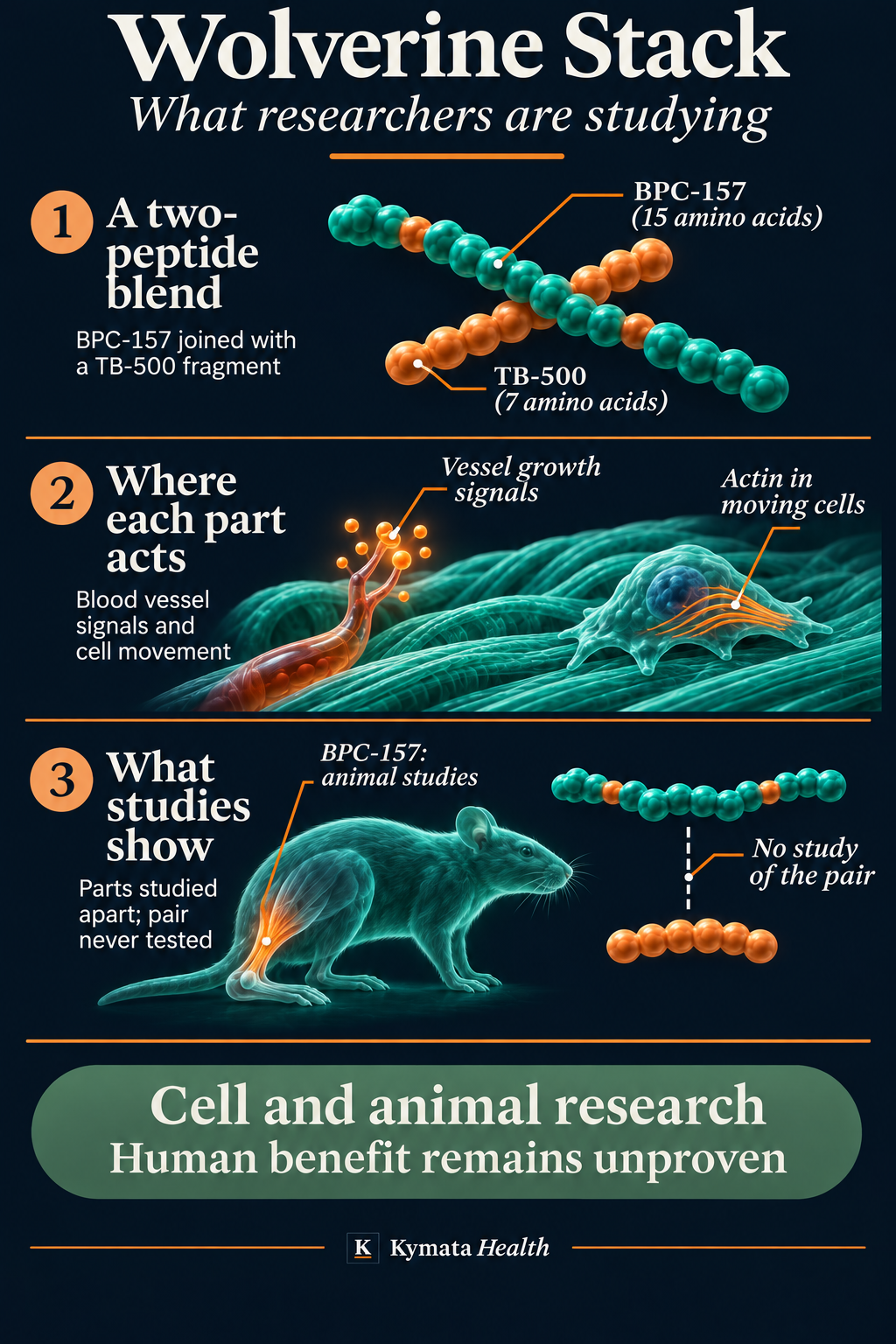
Wolverine is a named blend of BPC-157, a 15-amino-acid gastric peptide, and TB-500, a 7-amino-acid fragment of thymosin beta-4; GLOW adds GHK-Cu and KLOW adds KPV. BPC-157 is studied for blood-vessel (VEGF and nitric oxide) linked repair in animal models, including rats with a cut Achilles tendon (Staresinic 2003); TB-500 binds actin and is studied for cell migration, and no human study of the fragment has been published. No controlled human study has tested the pair; a rat tendon study found no added benefit. Neither part is FDA-approved, and HHS’s Oct 2026 compounding policy covers each only on its own, not as a blend. The drawing is a schematic, not a measured molecular structure, a product photograph or a treatment result. Illustration review: 19 November 2026, against this page’s own mechanism, evidence and regulatory records.
A sequence model is not provided for this record. Read the identity and evidence notes; an illustration does not verify a molecular structure.
Illustration notes and source record
Read the source record on this page. Laboratory, topical and injected studies are separate evidence; this illustration does not establish an indication or a treatment outcome.

How it works
SourcedWolverine is BPC-157 plus TB-500 in one named stack. BPC-157 is a 15-amino-acid gastric peptide with extensive animal repair literature and no Phase 3. Using high-resolution mass spectrometry on a formulation sold as TB-500 (Esposito 2012, PMID 22962027), anti-doping chemists identified the N-acetylated heptapeptide Ac-LKKTETQ, which corresponds to residues 17 to 23 of the 43-residue thymosin beta-4. A label alone cannot confirm what a particular vial contains.
In a randomized, placebo-controlled phase 1 study of four cohorts of 10 healthy volunteers each (Ruff 2010, PMID 20536472), intravenous full-length synthetic thymosin beta-4 given once and then daily for 14 days produced only infrequent, mild to moderate adverse events with no dose-limiting toxicity. That is the 43-residue parent peptide, not the TB-500 heptapeptide, BPC-157 or the blend.
The pair has been tested together in animals: a 2026 rat Achilles tendon study (PMID 42542926) found no added benefit from the combination over either peptide alone. There is no controlled human trial of the combination. GLOW adds GHK-Cu; KLOW adds KPV. HHS’s Oct 2026 enforcement-discretion policy covers BPC-157 and TB-500 only as single ingredients, in specific forms, on a prescription, so a blend is not covered; that policy is not FDA approval.
Source: Esposito 2012 (PMID 22962027), Lee and Padgett 2021 (PMID 34324435), Biçer 2026 (PMID 42542926), Froum 2026 (PMID 42876687)
05 / Evidence and limits
Evidence and limits
Uncontrolled observations · no controlled human study of the blend
Human evidence
Uncontrolled observations · no controlled human study of the blend- In a retrospective one-clinic chart review (Lee and Padgett 2021, PMID 34324435), 11 of 12 patients given intra-articular BPC-157 alone and 3 of 4 given BPC-157 with a preparation the authors call thymosin beta-4 (TB4) reported knee-pain relief when phoned months later, with no control group and no standardized pain or function instrument.
- In three uncontrolled cases of inferior alveolar nerve injury after dental implant or extraction surgery (Froum 2026, PMID 42876687), patients given weekly local injections of ARA-290, TB-500, BPC-157, dexamethasone and bupivacaine showed sensory recovery during follow-up, which the authors say cannot be attributed to the treatment because spontaneous recovery is common and no standardized quantitative sensory testing was performed.
Limits of current evidence
3 limits- In 32 male Sprague-Dawley rats randomly assigned to four groups after Achilles tendon transection and repair (Biçer 2026, PMID 42542926), load to failure at four weeks rose significantly only in the TB-500 group, both single peptides improved histology scores, and the combination gave no additional benefit over either peptide alone.
- The knee review describes TB4 and the dental report names TB-500; neither verifies the seven-residue sequence in the patients’ injections.
- No controlled human study of the exact two-peptide preparation was identified. The published reports do not establish a human dose, mixing ratio, half-life or long-term safety for it.
What it is studied for
- Recovery stack: Low
Verdict
Wolverine is BPC-157 plus TB-500 as sold; the fragment identified in an analyzed TB-500 product is Ac-LKKTETQ, not full-length thymosin beta-4. A rat tendon study found no added benefit from the pair, and the human record is two uncontrolled reports. Not a fracture drug.
06 / Product forms and access
Product forms and access
Regulatory & legal status
- FDA status (US)
- Research OnlyContains BPC-157 and TB-500. HHS’s Oct 28, 2026 compounding policy covers each one alone and excludes blends (per the HHS policy document, Oct 28, 2026). Not an approved product
- WADA status (2026)
- Prohibited (S0)Competitive athletes subject to anti-doping controls should not use Wolverine Stack. The WADA 2026 Prohibited List gives BPC-157 as an example under S0, non-approved substances, and lists thymosin-beta-4 and its derivatives such as TB-500 under the S2 growth-factor section, both prohibited at all times.
- US compounding
- Not eligible / not available
This blend is outside HHS’s Oct 28, 2026 policy for BPC-157 and TB-500: the HHS policy document (Oct 28, 2026) allows only a single active ingredient per product. BPC-157 and TB-500 are not FDA-approved.
News, Oct 28: what the HHS peptide compounding policy does and does not do →
07 / Tools and practical checks
Tools and practical checks
No separate record is provided here. Read the linked evidence and limitations for this compound.
08 / Published study use
Published study use
What published studies gave, in whom, and the source. Not a dose for you.
What studies used
Two uncontrolled human reports and a rat comparison- In a retrospective knee chart review, 4 patients received intra-articular BPC-157 with a preparation the authors call TB4 and 12 received BPC-157 alone; relief was reported by telephone, with no control group. Lee and Padgett 2021, PMID 34324435 (opens in new tab)
- Three patients with inferior alveolar nerve injury received local injections of BPC-157, TB-500, ARA-290, dexamethasone and bupivacaine; the authors say recovery cannot be attributed to the treatment. Froum 2026, PMID 42876687 (opens in new tab)
- After Achilles tendon repair, 32 rats were randomized to four groups; the combination gave no additional benefit over either peptide alone at four weeks. Biçer 2026, PMID 42542926 (opens in new tab)
A record of what researchers gave, in whom; not a dose for you.
Administration
- Route / form
- Not established: no controlled human study of the blend. HHS’s Oct 2026 policy covers BPC-157 and TB-500 one at a time only, so a blend is outside it.
Who it is for
1 use| Category | Fit | What exists |
|---|---|---|
| Recovery stack | Low | Two research peptides. A BPC-157 + TB-500 blend is outside HHS’s Oct 2026 single-peptide compounding policy (per the HHS policy document, Oct 28, 2026). This is a name, not a drug. |
09 / Safety and interactions
Safety and interactions
What the record says
FDA’s BPC-157 review describes adverse-event report 26053573, in which a 40-year-old woman using a research-labeled subcutaneous product containing BPC-157 and TB-500 developed diffuse skin darkening and gum darkening that returned identically when she restarted the product, which FDA judged likely related to the product while noting that the two peptides could not be told apart as the cause. One report cannot tell how often this happens. Theoretical risk in active cancer from blood-vessel growth signaling in animal studies. Banned in tested sport. Talk to a licensed prescriber; we give no dose.
10 / Comparisons and goal guides
Comparisons and goal guides
Wolverine Stack vs. GLOW Stack
4 attributesCanonical comparison: Wolverine Stack vs GLOW Stack · GLOW Stack evidence profile
| Attribute | Wolverine Stack | GLOW Stack |
|---|---|---|
| Components | BPC-157 + TB-500 | GHK-Cu + BPC-157 + TB-500 |
| Job | Two-peptide recovery | Recovery plus copper-peptide skin/ECM |
| Evidence | Rat tendon study of the pair found no added benefit (Biçer 2026, PMID 42542926); two uncontrolled human reports | No study of the three together; that rat study had no GHK-Cu arm |
| PIP | Usually milder (no GHK-Cu) | GHK-Cu sting is the rate limiter |
11 / Common questions
Common questions
Common questions
6 answersWolverine vs GLOW vs KLOW?
Wolverine = BPC + TB-500. GLOW adds GHK-Cu. KLOW adds KPV. Escalating ingredient lists, not escalating evidence.
What did the knee study actually show?
In a retrospective chart review, three of the four people who received BPC-157 plus a product the authors called TB4 reported knee-pain relief by telephone, as did 11 of 12 who received BPC-157 alone (PMID 34324435). There was no control group and no standardized pain or function scale, and the paper does not show that the TB4 product was the TB-500 fragment.
Did combining the peptides improve tendon healing in rats?
No. In 32 rats after Achilles tendon repair, the combination gave no additional benefit over either peptide alone at four weeks (PMID 42542926). The study did not measure recovery in people.
Can I mix both in one syringe?
No controlled human study has tested the pair, mixed or not, or their stability in one syringe; a rat tendon study found no added benefit from the combination (PMID 42542926). A blend is outside HHS’s Oct 2026 single-ingredient policy. We give no mixing advice.
Is the Wolverine Stack prohibited in tested sport?
Yes. The WADA 2026 Prohibited List gives BPC-157 as an example under S0, non-approved substances, and lists thymosin-beta-4 and its derivatives such as TB-500 under the S2 growth-factor section, both prohibited at all times.
Is Wolverine Stack FDA-approved?
No. Contains BPC-157 and TB-500. HHS’s Oct 28, 2026 compounding policy covers each one alone and excludes blends (per the HHS policy document, Oct 28, 2026). Not an approved product.
12 / Sources and references
Sources and references
5 papers cited on this page.
Sources
5 papers- 1“Intra-Articular Injection of BPC 157 for Multiple Types of Knee Pain.”Lee E, Padgett B Alternative Therapies in Health and Medicine (2021). PMID: 34324435
- 2“Case Report: Regenerative peptides for Inferior alveolar nerve injury: a narrative review with hypothesis-generating three clinical cases.”Froum S, et al. Frontiers in Oral Health (2026). PMID: 42876687 DOI: 10.3389/froh.2026.1907109
- 3“Effects of BPC-157 and TB-500 on Achilles tendon healing in rats: A histopathological and biomechanical study.”Biçer O, et al. Joint Diseases and Related Surgery (2026). PMID: 42542926 DOI: 10.52312/jdrs.2026.2951
- 4“Synthesis and characterization of the N-terminal acetylated 17-23 fragment of thymosin beta 4 identified in TB-500, a product suspected to possess doping potential.”Esposito S, Deventer K, Goeman J, Van der Eycken J, Van Eenoo P Drug Testing and Analysis (2012). PMID: 22962027 DOI: 10.1002/dta.1402
- 5“A randomized, placebo-controlled, single and multiple dose study of intravenous thymosin beta4 in healthy volunteers.”Ruff D, Crockford D, Girardi G, Zhang Y Annals of the New York Academy of Sciences (2010). PMID: 20536472 DOI: 10.1111/j.1749-6632.2010.05474.x
14 / Prescription options
Prescription options
Prescription options: compare licensed telehealth providers
Some peptide therapies are available only by prescription after a consult with a licensed clinician.
Compare telehealth →15 / Peptide library
Peptide library
Keep reading: Peptide research library
Peptide research library: every pagePeptide libraryBrowse all topics
- The Wolverine stack (BPC-157 + TB-500), explained honestlyPrevious in this topic · What the Wolverine stack (BPC-157 + TB-500) is, what the research actually shows, side effects and unknowns, FDA and WADA status in 2026, and an evidence-first recovery stack you…
- TB-500TB-500, in the identity reviewed here, is the N-acetylated seven-amino-acid fragment Ac-LKKTETQ.
- The “Godzilla” Recovery Stack: What It Is and Why It Is UntestedThe Godzilla stack is a forum name for BPC-157 and TB-500 combined with growth-hormone-raising peptides and IGF-1 LR3.
- BPC-157 Oral vs Injectable: What Is Known About Each RouteWhat is known about oral and injected BPC-157: rat and dog pharmacokinetics, no human route study, the routes HHS’s October 2026 policy lists, and why we give no dose.
Regulatory and sport classification
- Not FDA-approved, research chemical
- WADA (S0): prohibited in sport, BPC-157 under S0 and TB-500 under S2