
The peptide field guide
SS-31
SS-31, or elamipretide, is a modified four-residue peptide.
Controlled and open-label findings answer different questions. Research powder is not the labelled Forzinity product.
Explore this compoundConceptual editorial illustration; not a measured molecular structure, product photograph or treatment result.
02 / At a glance
At a glance
Key facts
- Also known as
- Elamipretide, Bendavia, MTP-131, Forzinity
- Sequence
- D-Arg-Dmt-Lys-Phe-NH2
- Evidence level
- FDA-approved for Barth syndrome: prescription only.
- US regulatory status
- Accelerated approval Sep 19, 2025 as Forzinity™ (elamipretide, NDA 215244) to improve muscle strength in Barth syndrome patients weighing at least 30 kg; continued approval may depend on a confirmatory trial (due Mar 31, 2030). Research vials are not that product
- Updated
Identity
SS-31, or elamipretide, is a modified four-residue peptide.
Research context
Forzinity label population and distinct controlled versus open-label Barth syndrome study findings.
Evidence limits
Controlled and open-label findings answer different questions. Research powder is not the labelled Forzinity product.
Read the technical profile and study-use reference
Quick answer
Evidence: ModerateElamipretide. Forzinity has FDA accelerated approval (September 2025) to improve muscle strength in Barth syndrome patients weighing at least 30 kg, based on knee strength as an intermediate endpoint; the randomized TAZPOWER trial missed its primary endpoints, and a confirmatory trial is under way. Forzinity is a ready-to-use solution, not a research powder. Controlled trials in mitochondrial myopathy, heart failure and dry AMD missed their primary endpoints.
- FDA label dose
- FDA label (Forzinity): dose and schedule set by the prescriber and the label
Research summary, not medical advice.
At a glance
Kymata peptide profile · Nov 21, 2026- CAS
- 736992-21-5
- FDA label dose
- FDA label (Forzinity): dose and schedule set by the prescriber and the label
- Half-life
- About 3 to 4 hours elimination half-life (FDA review); the label itself gives no half-life
- Common vials
- Ready-to-use solution; no water is added
- Molecular weight
- 639.8 g/mol for elamipretide, 749.2 g/mol for its hydrochloride salt (Forzinity label)
03 / Identity and origin
Identity and origin
Also called Elamipretide, Bendavia, MTP-131, Forzinity. Mitochondria-targeted tetrapeptide (elamipretide; Forzinity is the labeled Barth product).
Read the sequence and compound record
Compound card
- Sequence
- D-Arg-Dmt-Lys-Phe-NH2
- Class
- Mitochondria-targeted tetrapeptide (elamipretide; Forzinity is the labeled Barth product)
- Formula
- C32H49N9O5 (elamipretide); C32H49N9O5·3HCl (Forzinity label)
- Molecular weight
- 639.8 g/mol for elamipretide, 749.2 g/mol for its hydrochloride salt (Forzinity label)
- CAS
- 736992-21-5
- PubChem CID
- 11764719
- Described by
- Hazel Szeto, Weill Cornell Medical College, 2002
- Bioavailability
- About 92% absolute subcutaneous bioavailability (Forzinity label)
04 / How it may work
How it may work
Mitochondria-targeted tetrapeptide (elamipretide; Forzinity is the labeled Barth product)
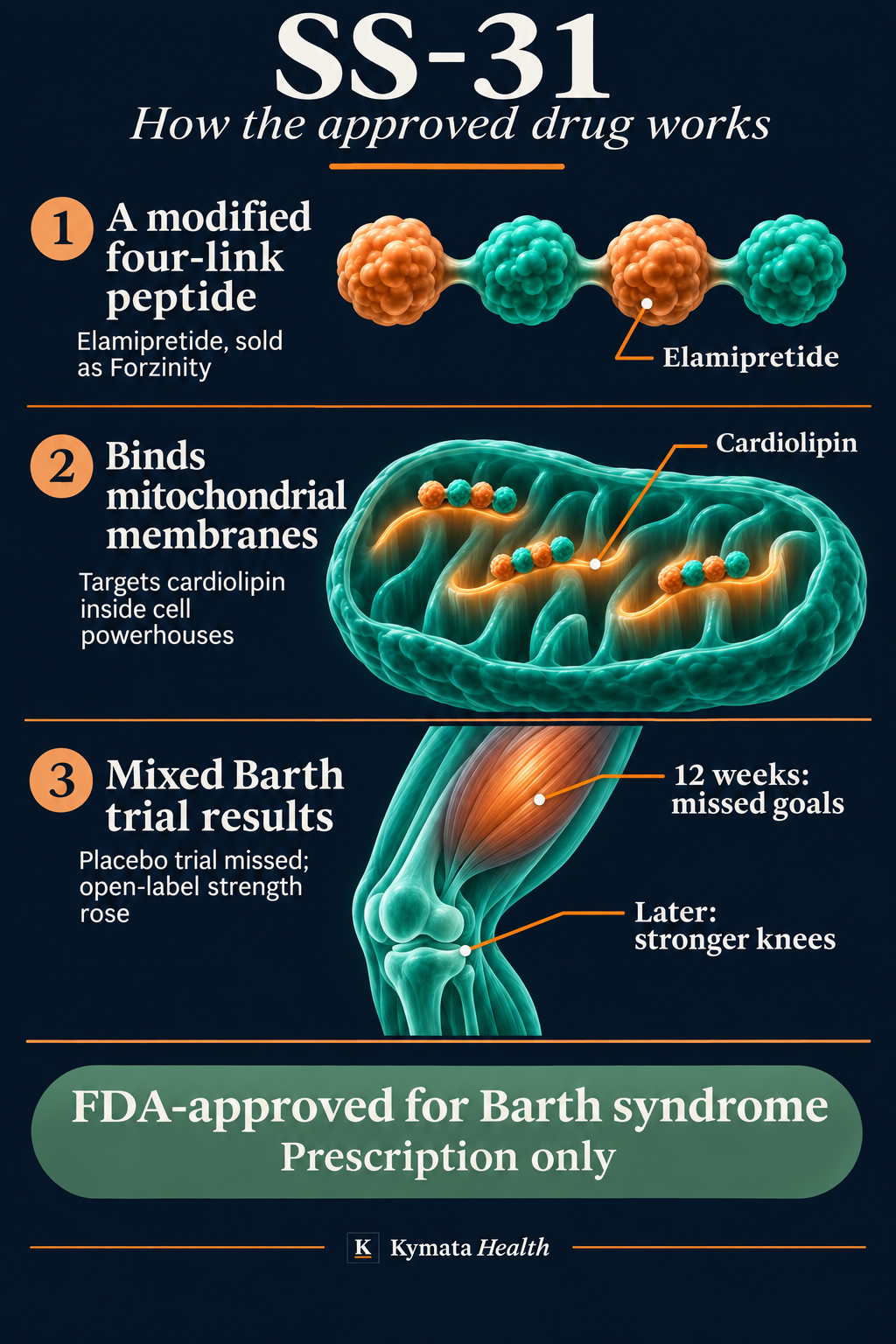
The guide shows SS-31 as elamipretide, a modified four-amino-acid peptide sold as Forzinity, which binds cardiolipin in the inner membrane of mitochondria. In the 12-week placebo-controlled TAZPOWER crossover in 12 males with Barth syndrome, it met neither primary endpoint (PMID 33077895); in the open-label extension, knee strength rose (PMID 38602181), which supported FDA accelerated approval for Barth syndrome. The drawing is a schematic, not a measured molecular structure, a product photograph or a treatment result. Illustration review: 22 November 2026, against this page’s own mechanism, evidence and regulatory records.
The recorded D-Arg–Dmt–Lys–Phe-NH₂ form includes non-standard chemistry. A plain tyrosine or unmodified one-letter chain is not substituted for it.
Illustration notes and source record
Which kind of strength did researchers measure in Barth syndrome?
A specific mitochondrial condition. SS-31 is elamipretide. It binds to cardiolipin, a fat in the inner membrane of mitochondria. The FDA granted Forzinity accelerated approval to improve muscle strength in people with Barth syndrome who weigh at least 30 kg.
How researchers tested strength. Researchers measured how hard participants could push to straighten the knee. Strength rose in the longer follow-up, when everyone received Forzinity. The initial 12-week comparison showed no clear difference from placebo.
The quadriceps muscles at the front of the thigh straighten the knee.
Earlier contextual illustration
Read the source record on this page. Laboratory, topical and injected studies are separate evidence; this illustration does not establish an indication or a treatment outcome.

How it works
SourcedElamipretide binds to cardiolipin, a fat in the inner membrane of mitochondria. In Barth syndrome, changes in cardiolipin affect how cells make energy. FDA granted Forzinity (elamipretide) accelerated approval on September 19, 2025, to improve muscle strength in adult and pediatric patients with Barth syndrome weighing at least 30 kg, based on knee extensor strength as an intermediate endpoint; continued approval may depend on a confirmatory trial.
Forzinity’s approved strength is 280 mg/3.5 mL (80 mg/mL), a ready-to-use solution in single-patient-use vials that the label says to discard 8 days after first opening. Forzinity is the hydrochloride salt; the pivotal trial used an acetate salt, which FDA bridged with a separate pharmacokinetic study. A research-vendor 5 mg powder is neither.
Source: Forzinity label; TAZPOWER (PMID 33077895); MMPOWER-3 (PMID 37268435)
Background & History
SS-31 (Elamipretide, MTP-131) is a tetrapeptide targeting cardiolipin, a phospholipid found mainly in the inner mitochondrial membrane and involved in electron transport chain function. It was developed by Hazel Szeto and Peter Schiller; laboratory studies report that it associates with cardiolipin. Clinical trials have evaluated it in heart failure, kidney disease, primary mitochondrial myopathy and Barth syndrome, with mixed results. In September 2025 FDA granted accelerated approval to Forzinity for muscle strength in Barth syndrome.
05 / Evidence and limits
Evidence and limits
Accelerated approval on an intermediate endpoint; randomized primary endpoints not met
Human evidence
Accelerated approval on an intermediate endpoint; randomized primary endpoints not met- In TAZPOWER (Reid Thompson 2021, PMID 33077895), a randomized double-blind placebo-controlled crossover trial in 12 males with genetically confirmed Barth syndrome, 12 weeks of 40 mg daily elamipretide met neither primary endpoint, six-minute walk distance or Barth fatigue score, versus placebo.
- In the 168-week open-label TAZPOWER extension (Thompson 2024, PMID 38602181), 8 of 10 participants reached week 168, and with no placebo group the FDA label reports a median 63-newton gain in knee extensor strength from the original pre-dose baseline (Forzinity label, Table 3).
- In MMPOWER-3 (Karaa 2023, PMID 37268435), a phase 3 randomized placebo-controlled trial in 218 adults with primary mitochondrial myopathy, elamipretide did not improve six-minute walk distance (between-group difference -3.2 m, 95% CI -18.7 to 12.3) or total fatigue at 24 weeks.
- In PROGRESS-HF (Butler 2020, PMID 32068002), a phase 2 randomized placebo-controlled trial in 71 adults with heart failure with reduced ejection fraction, neither elamipretide dose changed left ventricular end-systolic volume versus placebo after 4 weeks.
- In ReCLAIM-2 (Ehlers 2025, PMID 39605874), a phase 2 randomized placebo-controlled trial in 176 adults with dry age-related macular degeneration and geographic atrophy, elamipretide met neither primary endpoint, low-luminance visual acuity or geographic atrophy growth, at 48 weeks.
- The confirmatory 4TAZPower trial (NCT07531251) was recruiting with no posted results as of November 21, 2026; its primary endpoint is the 72-week change in a composite score of six-minute walk, triple timed up-and-go and five-times sit-to-stand tests.
Use-case scores
0–100–10 against the evidence we have, not a gym ranking. Hidden domains do not apply here.
- Longevity / aging4/10Forzinity has FDA accelerated approval (September 2025) for muscle strength in Barth syndrome at 30 kg or more, on an intermediate endpoint from an uncontrolled extension. That is a rare-disease label, not an anti-aging approval, and gray-market SS-31 is not Forzinity. Haircut to 4.
- Injury & tissue3.5/10Controlled trials in primary mitochondrial myopathy (MMPOWER-3, PMID 37268435), heart failure (PROGRESS-HF, PMID 32068002) and dry AMD (ReCLAIM-2, PMID 39605874) missed their primary endpoints.
Limits of current evidence
3 limits- In TAZPOWER (Reid Thompson 2021, PMID 33077895), a randomized double-blind placebo-controlled crossover trial in 12 males with genetically confirmed Barth syndrome, 12 weeks of 40 mg daily elamipretide met neither primary endpoint, six-minute walk distance or Barth fatigue score, versus placebo.
- The knee-strength gain behind the approval (a median 63 newtons in 8 participants at week 168, Forzinity label Table 3) had no placebo group.
- Controlled trials in primary mitochondrial myopathy (MMPOWER-3, PMID 37268435), heart failure (PROGRESS-HF, PMID 32068002) and dry AMD (ReCLAIM-2, PMID 39605874) missed their primary endpoints.
Trial FinderRecruiting now: 2 open registrations for SS-31
What it is studied for
- Identity: Forzinity Barth label vs a research powder
- Cardiolipin targeting, not a general anti-aging serum
- Why mixed cardiomyopathy programs matter
Verdict
SS-31 is elamipretide. Forzinity has accelerated approval to improve muscle strength in Barth syndrome at 30 kg or more, based on knee strength in an uncontrolled extension after the randomized trial missed its primary endpoints. A research powder is not that product, and cardiolipin binding is the mechanism, not a lifespan claim.
06 / Product forms and access
Product forms and access
Regulatory & legal status
- FDA status (US)
- ApprovedAccelerated approval Sep 19, 2025 as Forzinity™ (elamipretide, NDA 215244) to improve muscle strength in Barth syndrome patients weighing at least 30 kg; continued approval may depend on a confirmatory trial (due Mar 31, 2030). Research vials are not that product
- WADA status (2026)
- Not ListedNot currently on the WADA 2026 Prohibited List. Policies may change. Verify before competition.
- Classification
- Prescription Drug
- US compounding
- Not eligible / not available
07 / Tools and practical checks
Tools and practical checks
No separate record is provided here. Read the linked evidence and limitations for this compound.
08 / Published study use
Published study use
What the label states, for the patients it is approved for, and the source. Not a dose for you.
What the FDA label says
FDA label- Forzinity’s approved strength is 280 mg/3.5 mL (80 mg/mL) in single-patient-use vials; the prescribing information sets the regimen, including a reduced regimen in severe renal impairment not on dialysis. Forzinity label, DailyMed (opens in new tab)
The label’s dosing, for the patients it is approved for; the prescriber sets the dose.
Administration
- Route / form
- Subcutaneous injection (Forzinity label)
Timeline
2 stages- 12-week placebo comparison
In TAZPOWER (PMID 33077895), elamipretide met neither primary endpoint, six-minute walk distance or Barth fatigue score, versus placebo.
- Week 168, open-label
With no placebo group, the Forzinity label reports a median 63-newton gain in knee extensor strength in the 8 participants who reached week 168; this intermediate endpoint supported accelerated approval.
Who it is for
2 uses| Category | Fit | What exists |
|---|---|---|
| Muscle strength in Barth syndrome | Accelerated approval | Forzinity is labeled for adults and children with Barth syndrome who weigh at least 30 kg. Continued approval may depend on the confirmatory 4TAZPower trial (NCT07531251). |
| Mitochondrial myopathy, heart failure, dry AMD | Low | Controlled trials missed their primary endpoints (PMID 37268435; PMID 32068002; PMID 39605874). |
09 / Safety and interactions
Safety and interactions
What the record says
The Forzinity label lists injection-site reactions as the most common adverse reactions, warns of serious hypersensitivity reactions and of benzyl alcohol toxicity in neonates, and contraindicates use after serious hypersensitivity to elamipretide or any excipient. The label gives a reduced regimen for adults with eGFR below 30 mL/min not on dialysis and states there is insufficient information for adults on dialysis or for children with renal impairment.
Interactions & Contraindications
The Forzinity label lists injection-site reactions as the most common adverse reactions and warns of serious hypersensitivity reactions and of benzyl alcohol toxicity in neonates. Gray-market SS-31 is not that product. Controlled heart-failure, mitochondrial-myopathy and dry-AMD trials missed their primary endpoints.
10 / Comparisons and goal guides
Comparisons and goal guides
Combinations: what has been tested
1 pairing- + MOTS-c →Cardiolipin tetrapeptide vs AMPK mtDNA ORF. Complementary mitochondrial marketing is not a combination trial.
11 / Common questions
Common questions
Common questions
6 answersWhat is SS-31 used for?
SS-31 is elamipretide, sold in the US as the prescription injection Forzinity, which has FDA accelerated approval to improve muscle strength in people with Barth syndrome who weigh at least 30 kg. FDA granted Forzinity (elamipretide) accelerated approval on September 19, 2025, to improve muscle strength in adult and pediatric patients with Barth syndrome weighing at least 30 kg, based on knee extensor strength as an intermediate endpoint; continued approval may depend on a confirmatory trial. Its label does not cover other mitochondrial conditions.
Did elamipretide work in the randomized Barth trial?
Not on its primary endpoints. In TAZPOWER (Reid Thompson 2021, PMID 33077895), a randomized double-blind placebo-controlled crossover trial in 12 males with genetically confirmed Barth syndrome, 12 weeks of 40 mg daily elamipretide met neither primary endpoint, six-minute walk distance or Barth fatigue score, versus placebo. The knee-strength gain behind the approval comes from the uncontrolled extension.
Is the confirmatory trial done?
No. The confirmatory 4TAZPower trial (NCT07531251) was recruiting with no posted results as of November 21, 2026; its primary endpoint is the 72-week change in a composite score of six-minute walk, triple timed up-and-go and five-times sit-to-stand tests.
How is Forzinity supplied?
Forzinity’s approved strength is 280 mg/3.5 mL (80 mg/mL), a ready-to-use solution in single-patient-use vials that the label says to discard 8 days after first opening (Forzinity prescribing information, Stealth BioTherapeutics 2026). Nothing is reconstituted, and the prescribing information sets the regimen.
How does SS-31 differ from MOTS-c?
Elamipretide binds to cardiolipin in the inner mitochondrial membrane. MOTS-c is a different peptide encoded by mitochondrial DNA and studied in energy signaling. Forzinity studies evaluated elamipretide alone. The 2026 WADA Prohibited List does not name elamipretide, while it does list MOTS-c.
Is SS-31 FDA-approved?
Yes. Accelerated approval Sep 19, 2025 as Forzinity™ (elamipretide, NDA 215244) to improve muscle strength in Barth syndrome patients weighing at least 30 kg; continued approval may depend on a confirmatory trial (due Mar 31, 2030). Research vials are not that product.
12 / Sources and references
Sources and references
10 sources cited on this page.
Sources
10 sources- 1“A phase 2/3 randomized clinical trial followed by an open-label extension to evaluate the effectiveness of elamipretide in Barth syndrome, a genetic disorder of mitochondrial cardiolipin metabolism.”Reid Thompson W et al. Genetics in Medicine (2021). PMID: 33077895 DOI: 10.1038/s41436-020-01006-8
- 2“Long-term efficacy and safety of elamipretide in patients with Barth syndrome: 168-week open-label extension results of TAZPOWER.”Thompson WR et al. Genetics in Medicine (2024). PMID: 38602181 DOI: 10.1016/j.gim.2024.101138
- 3“Efficacy and Safety of Elamipretide in Individuals With Primary Mitochondrial Myopathy: The MMPOWER-3 Randomized Clinical Trial.”Karaa A et al. Neurology (2023). PMID: 37268435 DOI: 10.1212/WNL.0000000000207402
- 4“Effects of Elamipretide on Left Ventricular Function in Patients With Heart Failure With Reduced Ejection Fraction: The PROGRESS-HF Phase 2 Trial.”Butler J et al. Journal of Cardiac Failure (2020). PMID: 32068002 DOI: 10.1016/j.cardfail.2020.02.001
- 5“ReCLAIM-2: A Randomized Phase II Clinical Trial Evaluating Elamipretide in Age-related Macular Degeneration, Geographic Atrophy Growth, Visual Function, and Ellipsoid Zone Preservation.”Ehlers JP et al. Ophthalmology Science (2025). PMID: 39605874 DOI: 10.1016/j.xops.2024.100628
- 6“Forzinity prescribing information.”Stealth BioTherapeutics Inc. DailyMed (2026). Prescribing information
- 7“Drug Trials Snapshots: Forzinity.”US Food and Drug Administration FDA (2025).
- 8“Forzinity clinical pharmacology review.”US Food and Drug Administration FDA (2025).
- 9“Forzinity integrated review, NDA 215244.”US Food and Drug Administration FDA (2025).
- 10“4TAZPower: confirmatory trial of elamipretide in Barth syndrome (NCT07531251).”Stealth BioTherapeutics ClinicalTrials.gov (2026).
14 / Prescription options
Prescription options
Prescription options: compare licensed telehealth providers
Some peptide therapies are available only by prescription after a consult with a licensed clinician.
Compare telehealth →15 / Peptide library
Peptide library
Keep reading: Peptide research library
Peptide research library: every pagePeptide libraryBrowse all topics
- MOTS-cPrevious in this topic · MOTS-c is a 16-amino-acid mitochondrial-derived peptide investigated in metabolic signaling.
- DihexaNext in this topic · Dihexa has been tested in animals, but no human trial identified here administered it directly.
- SelankTuftsin analog (TKPRPGP) with a Russian prescription story.
- SemaxSemax is a synthetic seven-amino-acid analogue of an ACTH fragment.
- DSIPNine-residue peptide from 1970s delta-sleep literature.
Regulatory and sport classification
- FDA-approved