
The peptide field guide
Humanin-HNG
HNG, humanin with serine-14 swapped for glycine; an analog of a 24-amino-acid mitochondrial peptide.
Cell and animal research only. No human study.
Explore this compoundConceptual editorial illustration; not a measured molecular structure, product photograph or treatment result.
02 / At a glance
At a glance
Key facts
- Also known as
- S14G-humanin, HNG, Gly14-humanin
- Type
- Longevity
- Evidence level
- Cell and animal research: human benefit remains unproven.
- US regulatory status
- Not FDA-approved, research chemical
- Updated
Identity
HNG, humanin with serine-14 swapped for glycine; an analog of a 24-amino-acid mitochondrial peptide.
Research context
In published models the swap makes it more potent than native humanin, which binds a CNTFR/WSX-1/gp130 receptor complex; the work is nerve-protection research in cells and animals.
Evidence limits
Cell and animal research only. No human study.
Read the technical profile and study-use reference
Quick answer
Evidence: LowS14G substitution on humanin (HNG): an analog with stronger activity than the mitochondrial 24-aa peptide we already list. Used in cell and animal neuroprotection papers. Activity in a dish is not a human dose table.
- In published studies
- No human study published
Research summary, not medical advice.
At a glance
Kymata peptide profile · Oct 29, 2026- Half-life
- Short (parent ~30 min)
- Common vials
- 5 mg
- CAS
- N/A
- In published studies
- No human study published
- Molecular weight
- ~2.7 kDa class (24-aa analog)
03 / Identity and origin
Identity and origin
Also called S14G-humanin, HNG, Gly14-humanin. S14G-humanin analog (HNG).
Read the sequence and compound record
Compound card
- Class
- S14G-humanin analog (HNG)
- Formula
- S14G-humanin
- Molecular weight
- ~2.7 kDa class (24-aa analog)
- CAS
- N/A
04 / How it may work
How it may work
S14G-humanin analog (HNG)
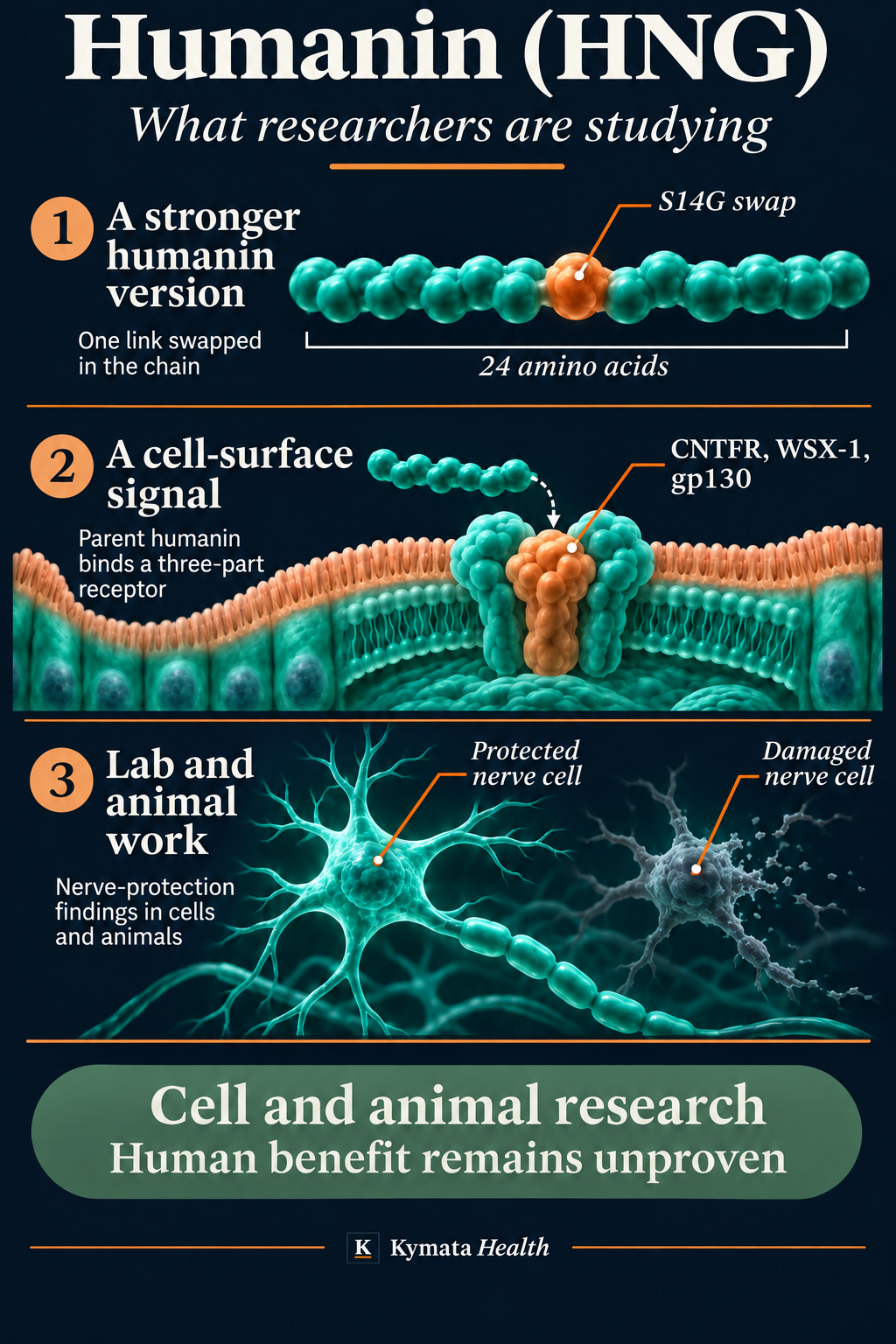
HNG, humanin with serine-14 swapped for glycine; an analog of a 24-amino-acid mitochondrial peptide. In published models the swap makes it more potent than native humanin, which binds a CNTFR/WSX-1/gp130 receptor complex; the work is nerve-protection research in cells and animals. Cell and animal research only. No human study. The drawing is a schematic, not a measured molecular structure, a product photograph or a treatment result. Illustration review: 19 November 2026, against this page’s own mechanism, evidence and regulatory records.
A sequence model is not provided for this record. Read the identity and evidence notes; an illustration does not verify a molecular structure.
Illustration notes and source record
Read the source record on this page. Laboratory, topical and injected studies are separate evidence; this illustration does not establish an indication or a treatment outcome.

How it works
SourcedHNG is humanin with serine-14 replaced by glycine. In published models that substitution increases potency versus native humanin. Parent humanin is a 24-aa mitochondrial ORF peptide (PMID 11371646).
Potency in a dish is not a milligram conversion table. Do not treat HNG as “humanin but you use less” unless a paper says so for that exact endpoint.
Source: Humanin PMID: 11371646; HNG analog literature (S14G)
05 / Evidence and limits
Evidence and limits
Limits of current evidence
1 limit- No human study has tested HNG, and we give no dose.
What it is studied for
- MDP analog identity: Low
Verdict
HNG is S14G-humanin. Potency in assays is not a human dose table. Not parent humanin.
06 / Product forms and access
Product forms and access
Regulatory & legal status
- FDA status (US)
- Research OnlyS14G humanin analog. Not an approved MDP drug
- WADA status (2026)
- Not ListedNot currently on the WADA 2026 Prohibited List. Policies may change. Verify before competition.
- US compounding
- Not eligible / not available
07 / Tools and practical checks
Tools and practical checks
Dose it
5 mg + 2 mL BAC water → 2.5 mg/mL · 1 unit (U-100) = 25 mcg.
Reconstitution math
U-100 syringe| Vial | Water | Concentration |
|---|---|---|
| 5 mg lyophilized | 2 mL BAC | 2.5 mg/mL |
08 / Published study use
Published study use
What published studies gave, in whom, and the source. Not a dose for you.
What studies used
No human study- We found no published human study of HNG (humanin G). The published work is in cells and animals.
- The doses quoted online come from animal work and vendor or forum sources.
A record of what researchers gave, in whom; not a dose for you.
Administration
- Route / form
- Not established: no human study.
Who it is for
1 use| Category | Fit | What exists |
|---|---|---|
| MDP analog identity | Low | We list native humanin separately. This is the S14G SKU. |
09 / Safety and interactions
Safety and interactions
What the record says
Research analog. Mitochondrial peptides are not gentle longevity vitamins. No approved indication.
10 / Comparisons and goal guides
Comparisons and goal guides
Humanin-HNG vs. Humanin
3 attributesCanonical comparison: Humanin-HNG vs Humanin · Humanin evidence profile
| Attribute | Humanin-HNG | Humanin |
|---|---|---|
| Sequence | S14G substitution (HNG) | Native 24-aa MDP |
| Potency (models) | Higher in published cell/animal work | Parent MDP |
| Human dose | No human study | No human dosing study |
11 / Common questions
Common questions
Common questions
2 answersIs HNG just stronger humanin?
In some models, S14G is more potent. That does not establish a human dose or a longer half-life.
Is Humanin-HNG FDA-approved?
No. S14G humanin analog. Not an approved MDP drug.
12 / Sources and references
Sources and references
No separate record is provided here. Read the linked evidence and limitations for this compound.
14 / Prescription options
Prescription options
Prescription options: compare licensed telehealth providers
Some peptide therapies are available only by prescription after a consult with a licensed clinician.
Compare telehealth →15 / Peptide library
Peptide library
Keep reading: Peptide research library
Peptide research library: every pagePeptide libraryBrowse all topics
- B7-33Previous in this topic · B7-33 is a 27-amino-acid peptide modeled on one chain of human relaxin-2.
- FGLNext in this topic · Synthetic peptide from the NCAM FG loop, studied as an FGFR-modulating neural cell-adhesion mimetic.
- LeuphasylPentapeptide-18, an enkephalin-related expression-line peptide sold next to Argireline and SNAP-8.
- SYN-AKEWaglerin-1-inspired tripeptide (DSM/Pentapharm SYN-AKE) for expression lines.
- Orexin-AEndogenous 33-aa wake peptide (hypocretin-1).
Regulatory and sport classification
- Not FDA-approved, research chemical