
The peptide field guide
SYN-AKE
SYN-AKE (dipeptide diaminobutyroyl benzylamide diacetate) is a synthetic cosmetic peptide modeled on waglerin-1 from Temple viper venom; it is not venom and not botulinum toxin.
Cosmetic ingredient, not a drug. No published human study.
Explore this compoundConceptual editorial illustration; not a measured molecular structure, product photograph or treatment result.
02 / At a glance
At a glance
Key facts
- Also known as
- Tripeptide-3, Dipeptide diaminobutyroyl benzylamide diacetate, Waglerin-1 analog
- Type
- Cosmetic Peptide
- Evidence level
- Cosmetic ingredient: not a drug.
- US regulatory status
- Cosmetic ingredient, not a drug
- Updated
Identity
SYN-AKE (dipeptide diaminobutyroyl benzylamide diacetate) is a synthetic cosmetic peptide modeled on waglerin-1 from Temple viper venom; it is not venom and not botulinum toxin.
Research context
It is claimed to quiet the muscle nicotinic receptor in a cosmetic model, a different route from Argireline’s SNARE decoy; the published work so far is computer modeling and laboratory tests (Gok 2024).
Evidence limits
Cosmetic ingredient, not a drug. No published human study.
Read the technical profile and study-use reference
Quick answer
Evidence: LowWaglerin-1-inspired tripeptide (DSM/Pentapharm SYN-AKE) for expression lines. Topical cosmetic next to Argireline/SNAP-8/Leuphasyl. Not snake venom, not a neuromuscular drug, not injectable Botox.
- In published studies
- No human study published
Research summary, not medical advice.
At a glance
Kymata peptide profile · Aug 31, 2026- Half-life
- Topical cosmetic
- In published studies
- No human study published
- Common vials
- Topical cosmetic ingredient; not a calculator product
03 / Identity and origin
Identity and origin
Also called Tripeptide-3, Dipeptide diaminobutyroyl benzylamide diacetate, Waglerin-1 analog. Waglerin-1 analog tripeptide (topical cosmetic).
Read the sequence and compound record
Compound card
- Class
- Waglerin-1 analog tripeptide (topical cosmetic)
- Formula
- Dipeptide diaminobutyroyl benzylamide diacetate (tripeptide-3 class)
- Described by
- Pentapharm / DSM
- Bioavailability
- Topical
04 / How it may work
How it may work
Waglerin-1 analog tripeptide (topical cosmetic)
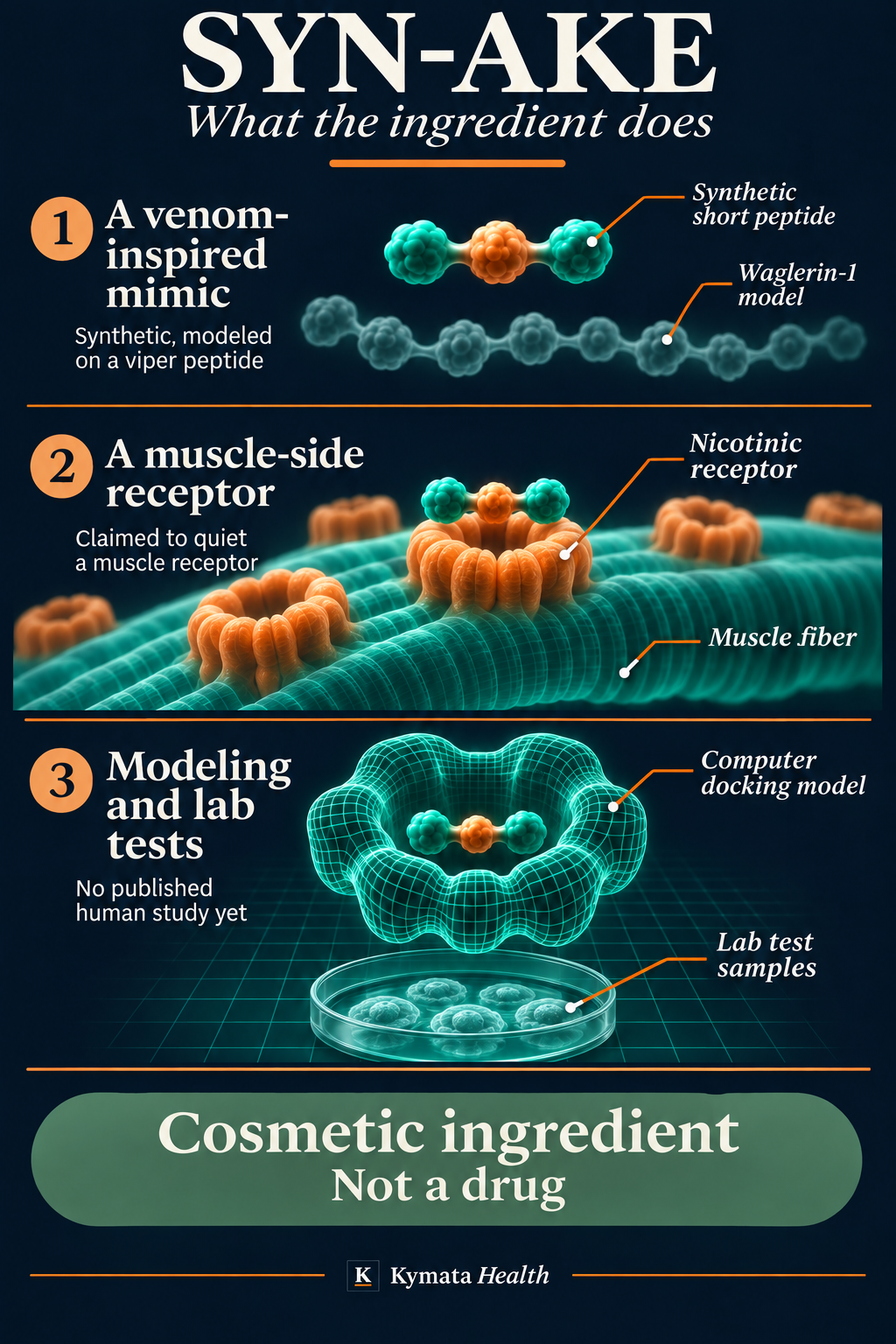
SYN-AKE (dipeptide diaminobutyroyl benzylamide diacetate) is a synthetic cosmetic peptide modeled on waglerin-1 from Temple viper venom; it is not venom and not botulinum toxin. It is claimed to quiet the muscle nicotinic receptor in a cosmetic model, a different route from Argireline’s SNARE decoy; the published work so far is computer modeling and laboratory tests (Gok 2024). Cosmetic ingredient, not a drug. No published human study. The drawing is a schematic, not a measured molecular structure, a product photograph or a treatment result. Illustration review: 19 November 2026, against this page’s own mechanism, evidence and regulatory records.
A sequence model is not provided for this record. Read the identity and evidence notes; an illustration does not verify a molecular structure.
Illustration notes and source record
Read the source record on this page. Laboratory, topical and injected studies are separate evidence; this illustration does not establish an indication or a treatment outcome.

How it works
SourcedSYN-AKE is a waglerin-1-inspired tripeptide (DSM/Pentapharm) used in topical expression-line formulas. The claimed mechanism is nicotinic-receptor antagonism in a cosmetic model. It is not snake venom, not botulinum toxin, and not Argireline’s SNARE decoy.
Source: Pentapharm / DSM SYN-AKE technical literature
05 / Evidence and limits
Evidence and limits
Limits of current evidence
1 limit- INCI cosmetic.
What it is studied for
- Cosmetic catalog completeness: Low
Verdict
SYN-AKE is a topical waglerin analog. Not venom and not an injectable neuromuscular drug.
06 / Product forms and access
Product forms and access
Regulatory & legal status
- FDA status (US)
- Not approvedDipeptide diaminobutyroyl benzylamide diacetate, a topical cosmetic ingredient modeled on a snake-venom peptide, not an FDA-approved drug. Cosmetic ingredients do not need FDA approval before sale; a product intended for a therapeutic use or to affect the body's structure or function is regulated as a drug (FDA, checked Nov 22, 2026)
- WADA status (2026)
- Not ListedNot currently on the WADA 2026 Prohibited List. Policies may change. Verify before competition.
- US compounding
- Not eligible / not available
07 / Tools and practical checks
Tools and practical checks
No separate record is provided here. Read the linked evidence and limitations for this compound.
08 / Published study use
Published study use
What published studies gave, in whom, and the source. Not a dose for you.
What studies used
Lab work only- We found no published human study of Syn-Ake. The work we found is computer modeling and laboratory tests. Gok 2024, PMID 37349941 (opens in new tab)
A record of what researchers gave, in whom; not a dose for you.
Administration
- Route / form
- Not established: no human study; sold as a cosmetic ingredient.
Who it is for
1 use| Category | Fit | What exists |
|---|---|---|
| Cosmetic catalog completeness | Low | Shelf-mate of Argireline, SNAP-8, Leuphasyl. |
09 / Safety and interactions
Safety and interactions
What the record says
Cosmetic ingredient. Not venom. Not a neuromuscular drug. Patch-test finished formulas.
10 / Comparisons and goal guides
Comparisons and goal guides
SYN-AKE vs. Argireline
3 attributesCanonical comparison: SYN-AKE vs Argireline · Argireline evidence profile
| Attribute | SYN-AKE | Argireline |
|---|---|---|
| Inspiration | Waglerin-1 (nAChR cosmetic analog) | SNAP-25 SNARE decoy |
| INCI | Tripeptide-3 / dipeptide diaminobutyroyl benzylamide diacetate | Acetyl hexapeptide-8 |
| Use | Topical expression lines | Topical expression lines |
11 / Common questions
Common questions
Common questions
2 answersIs SYN-AKE snake venom?
No. It is a synthetic analog inspired by waglerin-1, used topically in cosmetics.
Is SYN-AKE FDA-approved?
No. Dipeptide diaminobutyroyl benzylamide diacetate, a topical cosmetic ingredient modeled on a snake-venom peptide, not an FDA-approved drug. Cosmetic ingredients do not need FDA approval before sale; a product intended for a therapeutic use or to affect the body's structure or function is regulated as a drug (FDA, checked Nov 22, 2026).
12 / Sources and references
Sources and references
No separate record is provided here. Read the linked evidence and limitations for this compound.
14 / Prescription options
Prescription options
Prescription options: compare licensed telehealth providers
Some peptide therapies are available only by prescription after a consult with a licensed clinician.
Compare telehealth →15 / Peptide library
Peptide library
Keep reading: Peptide research library
Peptide research library: every pagePeptide libraryBrowse all topics
- LeuphasylPrevious in this topic · Pentapeptide-18, an enkephalin-related expression-line peptide sold next to Argireline and SNAP-8.
- Orexin-ANext in this topic · Endogenous 33-aa wake peptide (hypocretin-1).
- SHLP2SHLP2 is a 26-amino-acid peptide reported from the mitochondrial 16S ribosomal RNA region.
- GPL ManGPL Man is a boxed Cytomed-style geroprotector kit, not a peptide.
- GPL FemmeGPL Femme is a boxed geroprotector kit: thyroid, vessels, brain, liver, and pineal (Thyreogen, Ventfort, Cerluten, Svetinorm, Endoluten).
Regulatory and sport classification
- Cosmetic ingredient, not a drug