
The peptide field guide
B7-33
A single-chain analog of the H2-relaxin B-chain, designed to keep RXFP1 signaling; not serelaxin and not BPC-157.
Cell, serum-sample and rodent studies. No human study of B7-33. Not FDA-approved.
Explore this compoundConceptual editorial illustration; not a measured molecular structure, product photograph or treatment result.
02 / At a glance
At a glance
Key facts
- Also known as
- B733, B7–33, VIKLSGRELVRAQIAISGMSTWSKRSL
- Type
- Healing & Recovery
- Evidence level
- Cell and animal research: human benefit remains unproven.
- US regulatory status
- Not FDA-approved, research chemical
- Updated
Identity
A single-chain analog of the H2-relaxin B-chain, designed to keep RXFP1 signaling; not serelaxin and not BPC-157.
Research context
It was designed as a simpler single-chain relaxin analog for anti-fibrotic research; it raised MMP-2 in cultured human cardiac fibroblasts (Hossain 2016), and in mice after a heart attack (ischemia-reperfusion) it reduced adverse remodeling of the heart (Devarakonda 2020).
Evidence limits
Cell, serum-sample and rodent studies. No human study of B7-33. Not FDA-approved.
Read the technical profile and study-use reference
Quick answer
Evidence: LowB7-33 is a 27-amino-acid peptide modeled on one chain of human relaxin-2. Researchers tested it in cultured human fibroblasts and in rodents with heart or lung injury. The reviewed studies establish no treatment for people with fibrosis or heart failure.
- In published studies
- No human dose established for B7-33
Research summary, not medical advice.
At a glance
Kymata peptide profile · Nov 22, 2026- In published studies
- No human dose established for B7-33
- Half-life
- No elimination half-life measured in people
- Common vials
- Research vial; no sourced vial preset in this calculator
03 / Identity and origin
Identity and origin
Also called B733, B7–33, VIKLSGRELVRAQIAISGMSTWSKRSL. Single-chain relaxin-2 B-chain analog acting at RXFP1.
Read the sequence and compound record
Compound card
- Sequence
- VIKLSGRELVRAQIAISGMSTWSKRSL-NH₂ (27 amino acids)
- Class
- Single-chain relaxin-2 B-chain analog acting at RXFP1
- Described by
- Hossain and colleagues, 2016 publication
04 / How it may work
How it may work
Single-chain relaxin-2 B-chain analog acting at RXFP1
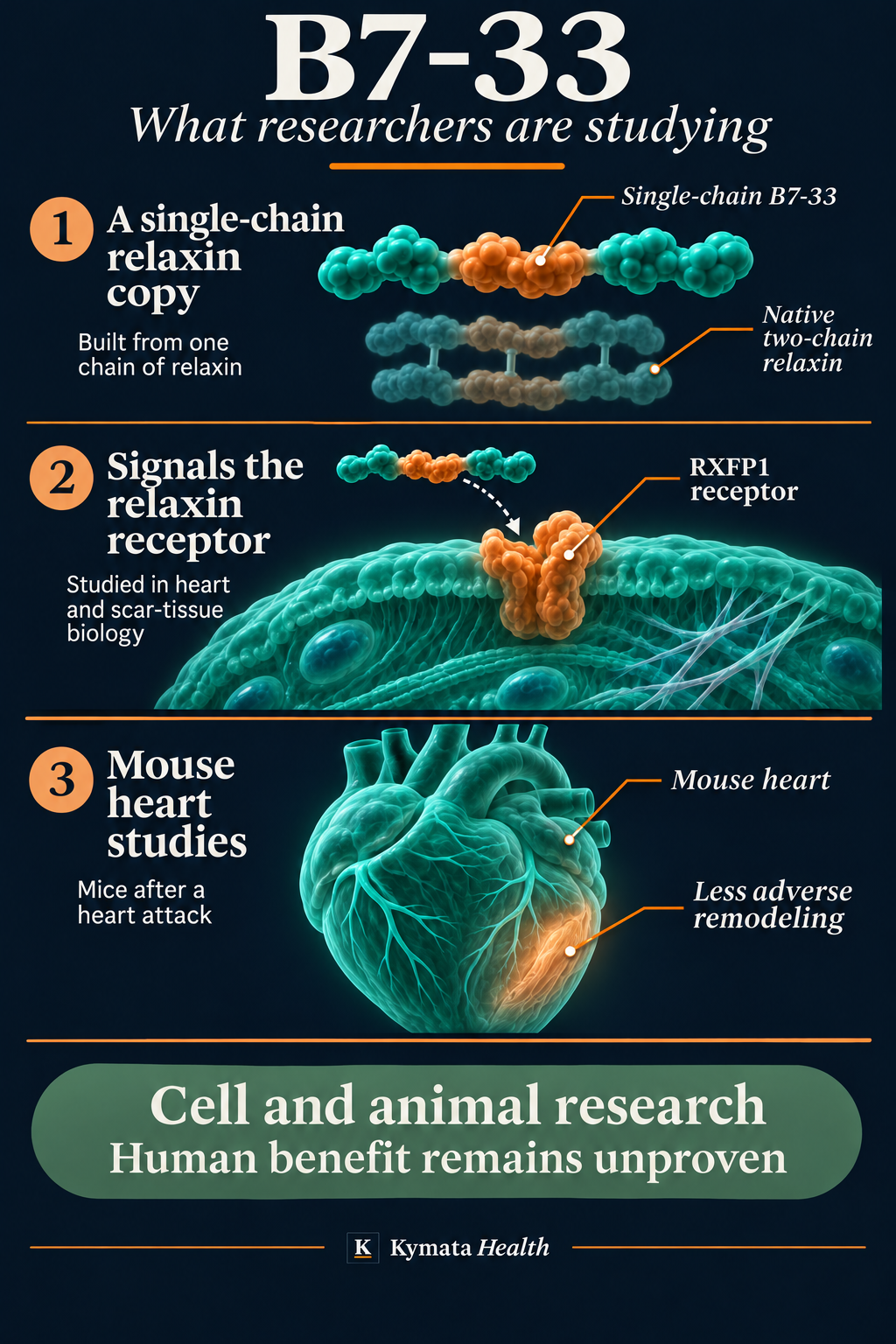
A single-chain analog of the H2-relaxin B-chain, designed to keep RXFP1 signaling; not serelaxin and not BPC-157. It was designed as a simpler single-chain relaxin analog for anti-fibrotic research; it raised MMP-2 in cultured human cardiac fibroblasts (Hossain 2016), and in mice after a heart attack (ischemia-reperfusion) it reduced adverse remodeling of the heart (Devarakonda 2020). Cell, serum-sample and rodent studies. No human study of B7-33. Not FDA-approved. The drawing is a schematic, not a measured molecular structure, a product photograph or a treatment result. Illustration review: 19 November 2026, against this page’s own mechanism, evidence and regulatory records.
A sequence model is not provided for this record. Read the identity and evidence notes; an illustration does not verify a molecular structure.
Illustration notes and source record
Read the source record on this page. Laboratory, topical and injected studies are separate evidence; this illustration does not establish an indication or a treatment outcome.

How it works
SourcedHuman relaxin-2 has two chains joined by disulfide bonds. Hossain and colleagues made B7-33 from residues 7 through 33 of a relaxin B-chain isoform. They replaced two cysteines with serines and synthesized the chain with a terminal amide. In cultured human cardiac fibroblasts, B7-33 increased MMP-2, an enzyme that breaks down components of the tissue matrix. The receptor response depended on the cells and the signaling pathway measured.
Source: Hossain et al., Chemical Science (2016), PMID 30155023. Devarakonda et al. (2020), PMID 32295457. Praveen et al. (2023), PMID 37047588.
05 / Evidence and limits
Evidence and limits
The studies measured responses in cells, serum samples and animals.
Human evidence
The studies measured responses in cells, serum samples and animals.- Hossain and colleagues reported increased MMP-2 in human cardiac fibroblasts in culture and less tissue fibrosis in rat and mouse models of heart or lung disease.
- In mice with temporarily blocked coronary blood flow, infarcted tissue at 24 hours averaged 21.99% of the at-risk area in seven mice given B7-33 and 45.32% in eight vehicle controls.
- A 2026 study exposed cultured human hypertrophic scar fibroblasts to B7-33. The cells showed lower expression of COL1A1, a collagen gene. The authors also tested a peptide-releasing dressing in the laboratory. They did not measure scar healing in patients.
Limits of current evidence
3 limits- In a human serum sample outside the body, Praveen and colleagues measured a six-minute half-life for B7-33 and 60 minutes for a separate fatty-acid-linked derivative. Neither value measures drug elimination in a person.
- RELAX-AHF-2 (NCT01870778) tested recombinant two-chain relaxin-2 (serelaxin) in 6,545 patients hospitalized for acute heart failure. It found no significant reduction in cardiovascular death at 180 days or worsening heart failure at five days.
- R2R01 is a separate fatty-acid-modified relaxin receptor agonist. Its completed heart-failure registry record (NCT06264310) reports 33 enrolled participants and no posted results.
What it is studied for
- Reference page for B7-33. Concentration arithmetic is not a treatment protocol.
Verdict
B7-33 reduced injury in rodent models and changed fibrosis-related markers in cultured human cells. We found no published study in which people received B7-33.
06 / Product forms and access
Product forms and access
Regulatory & legal status
- FDA status (US)
- Research OnlyRelaxin B-chain analog. Not serelaxin. No FDA approval
- WADA status (2026)
- Not ListedThe 2026 WADA List does not name B7-33. Section S0 covers pharmacological substances without governmental approval for human therapeutic use when no later section applies. Verify before competition.
- US compounding
- The October 2026 HHS interim 503A policy does not name B7-33.
07 / Tools and practical checks
Tools and practical checks
No separate record is provided here. Read the linked evidence and limitations for this compound.
08 / Published study use
Published study use
What published studies gave, in whom, and the source. Not a dose for you.
What studies used
Cell and rodent studies. No human dose established.- B7-33 was tested in cultured human cardiac fibroblasts and rodent models of heart and lung fibrosis. Hossain et al., original B7-33 experiments, PMID 30155023 (opens in new tab)
- In a mouse coronary injury model, B7-33 reduced the proportion of threatened heart muscle that infarcted at 24 hours. Devarakonda et al., mouse study, PMID 32295457 (opens in new tab)
- RELAX-AHF-2 gave hospitalized patients serelaxin, a different two-chain molecule. Its infusion does not supply a B7-33 dose. Metra et al., serelaxin trial, PMID 31433919 (opens in new tab)
A record of what researchers gave, in whom; not a dose for you.
Administration
- Route / form
- No clinical route, dose or schedule has been established for B7-33.
09 / Safety and interactions
Safety and interactions
What the record says
We found no study in which people received B7-33 that established adverse effects, a safe dose or drug interactions. Experiments in human-derived cells cannot measure those outcomes.
10 / Comparisons and goal guides
Comparisons and goal guides
B7-33 vs. BPC-157
3 attributesCanonical comparison: B7-33 vs BPC-157 · BPC-157 evidence profile
| Attribute | B7-33 | BPC-157 |
|---|---|---|
| Identity | Relaxin B-chain analog (RXFP1) | Gastric pentadecapeptide |
| Literature | Human fibroblasts in culture and rodent heart or lung injury models | Animal repair / VEGF-NO papers |
| FDA | No FDA-approved product identified | Not FDA-approved; HHS’s interim 503A policy (conditions apply) |
11 / Common questions
Common questions
Common questions
5 answersHas B7-33 treated fibrosis or scars in people?
We found experiments in rodents and in cultured human heart and scar fibroblasts. The scar study measured gene expression and tested a dressing in the laboratory. It did not report a patient treatment outcome.
Is B7-33 the peptide used in the RELAX-AHF-2 trial?
That trial used serelaxin, the recombinant two-chain human hormone. B7-33 is a shorter, modified single chain. The serelaxin findings cannot establish whether B7-33 helps people with heart failure.
How long does B7-33 last?
Researchers measured about six minutes for B7-33 in a human serum sample and about 60 minutes for a lipidated derivative in the same assay. A human elimination half-life has not been established for B7-33.
Is there an established B7-33 dose?
We found no clinical trial that administered B7-33 to people. The amounts used in cell cultures and rodents do not establish a human dose, route or schedule.
Is B7-33 FDA-approved?
No. Relaxin B-chain analog. Not serelaxin. No FDA approval.
12 / Sources and references
Sources and references
6 papers cited on this page.
Sources
6 papers- 1“A single-chain derivative of the relaxin hormone is a functionally selective agonist of the G protein-coupled receptor, RXFP1.”Hossain MA et al. Chemical Science (2016). PMID: 30155023
- 2“B7-33, a Functionally Selective Relaxin Receptor 1 Agonist, Attenuates Myocardial Infarction-Related Adverse Cardiac Remodeling in Mice.”Devarakonda T et al. Journal of the American Heart Association (2020). PMID: 32295457
- 3“A Lipidated Single-B-Chain Derivative of Relaxin Exhibits Improved In Vitro Serum Stability without Altering Activity.”Praveen P et al. International Journal of Molecular Sciences (2023). PMID: 37047588
- 4“B7-33 modulates fibrotic signalling in hypertrophic scar fibroblasts: An in vitro study supporting a novel therapeutic strategy.”Tamburriello M et al. Journal of Drug Delivery Science and Technology (2026). DOI: 10.1016/j.jddst.2026.108327
- 5“Effects of Serelaxin in Patients with Acute Heart Failure.”Metra M et al. New England Journal of Medicine (2019). PMID: 31433919
- 6“R2R01: A long-acting single-chain peptide agonist of RXFP1 for renal and cardiovascular diseases.”Poirier B et al. British Journal of Pharmacology (2024). PMID: 38450758
14 / Prescription options
Prescription options
Prescription options: compare licensed telehealth providers
Some peptide therapies are available only by prescription after a consult with a licensed clinician.
Compare telehealth →15 / Peptide library
Peptide library
Keep reading: Peptide research library
Peptide research library: every pagePeptide libraryBrowse all topics
- PTD-DBMPrevious in this topic · Protein-transduction-domain + Dishevelled-binding motif peptide that competes with CXXC5 for Dvl, intended to lift a brake on Wnt/β-catenin in hair-follicle models.
- Humanin-HNGNext in this topic · S14G substitution on humanin (HNG): an analog with stronger activity than the mitochondrial 24-aa peptide we already list.
- FGLSynthetic peptide from the NCAM FG loop, studied as an FGFR-modulating neural cell-adhesion mimetic.
- LeuphasylPentapeptide-18, an enkephalin-related expression-line peptide sold next to Argireline and SNAP-8.
- SYN-AKEWaglerin-1-inspired tripeptide (DSM/Pentapharm SYN-AKE) for expression lines.
Regulatory and sport classification
- Not FDA-approved, research chemical