
The peptide field guide
FGL
FGL is a 15-amino-acid peptide from the FG loop of the nerve adhesion protein NCAM; it is not P21 and not Semax.
No published human study. Not FDA-approved.
Explore this compoundConceptual editorial illustration; not a measured molecular structure, product photograph or treatment result.
02 / At a glance
At a glance
Key facts
- Also known as
- NCAM FG-loop, FG loop peptide, FGL peptide
- Type
- Cognitive & Nootropic
- Evidence level
- Research peptide: little published research.
- US regulatory status
- Not FDA-approved, research chemical
- Updated
Identity
FGL is a 15-amino-acid peptide from the FG loop of the nerve adhesion protein NCAM; it is not P21 and not Semax.
Research context
It was published in 2003 as an NCAM mimetic that can interact with FGF receptors, and later work studied it in neural plasticity; no human study has been published.
Evidence limits
No published human study. Not FDA-approved.
Read the technical profile and study-use reference
Quick answer
Evidence: LowSynthetic peptide from the NCAM FG loop, studied as an FGFR-modulating neural cell-adhesion mimetic. Research-chem nootropic SKU. Not a stroke drug. Distinct from P21 (CNTF-derived), which we already list.
- In published studies
- No human study published
Research summary, not medical advice.
At a glance
Kymata peptide profile · Oct 29, 2026- Common vials
- 5 mg / 10 mg
- CAS
- N/A
- In published studies
- No human study published
- Half-life
- Short (SKU unpublished)
03 / Identity and origin
Identity and origin
Also called NCAM FG-loop, FG loop peptide, FGL peptide. FGFR-interacting NCAM mimetic (not P21).
Read the sequence and compound record
Compound card
- Sequence
- NCAM FG-loop peptide
- Class
- FGFR-interacting NCAM mimetic (not P21)
- Formula
- NCAM FG-loop peptide
- CAS
- N/A
04 / How it may work
How it may work
FGFR-interacting NCAM mimetic (not P21)
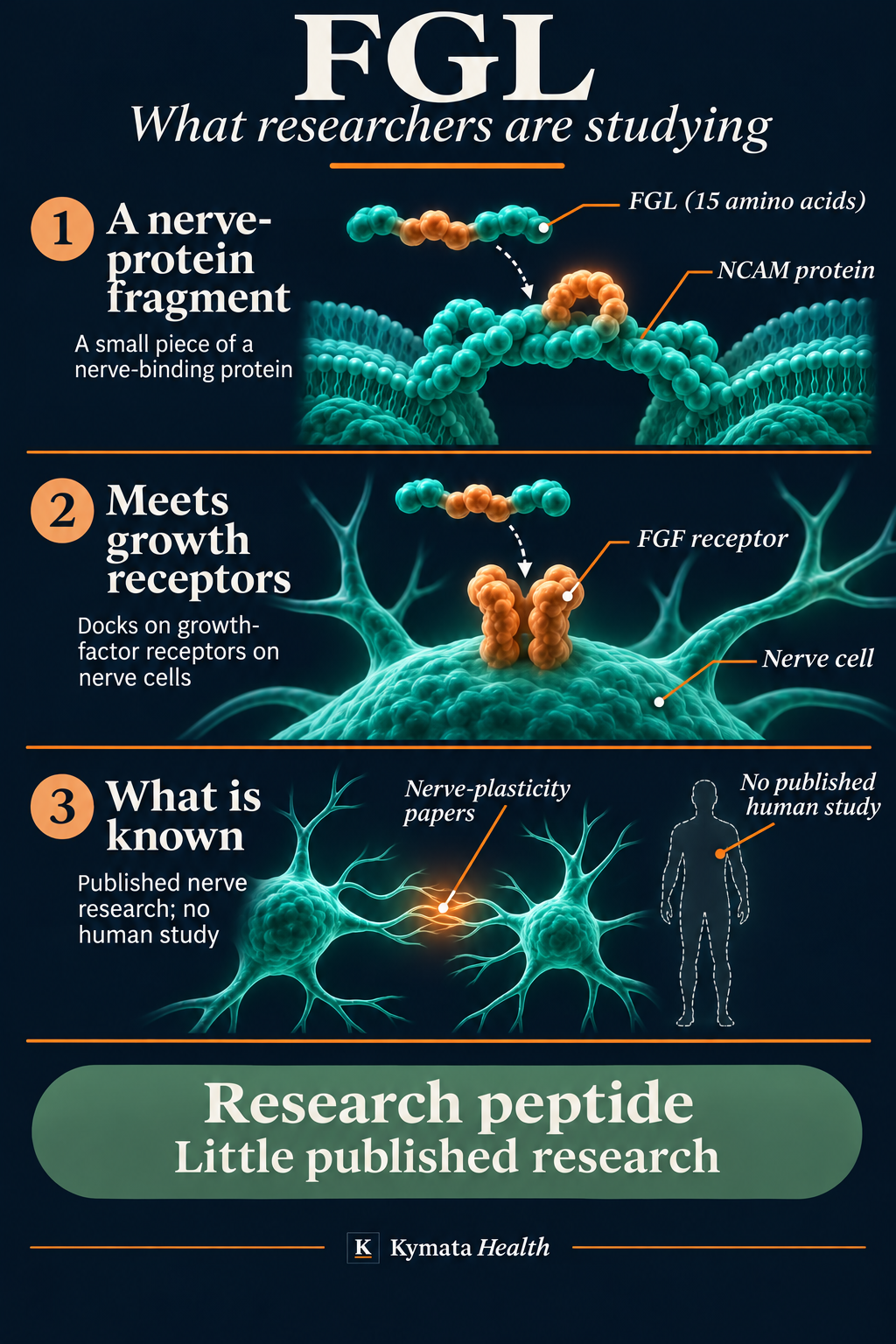
FGL is a 15-amino-acid peptide from the FG loop of the nerve adhesion protein NCAM; it is not P21 and not Semax. It was published in 2003 as an NCAM mimetic that can interact with FGF receptors, and later work studied it in neural plasticity; no human study has been published. No published human study. Not FDA-approved. The drawing is a schematic, not a measured molecular structure, a product photograph or a treatment result. Illustration review: 19 November 2026, against this page’s own mechanism, evidence and regulatory records.
A sequence model is not provided for this record. Read the identity and evidence notes; an illustration does not verify a molecular structure.
Illustration notes and source record
Read the source record on this page. Laboratory, topical and injected studies are separate evidence; this illustration does not establish an indication or a treatment outcome.

How it works
FGL is a peptide from the NCAM FG loop, published as an FGFR-interacting neural cell-adhesion mimetic. It is a different molecule from P21 (CNTF-derived), which we already list.
Nootropic vendor SKUs are not stroke or dementia care.
05 / Evidence and limits
Evidence and limits
Limits of current evidence
2 limits- The FGL literature is identity/mechanism, not a reconstitution hobby.
- This site will not treat stroke or dementia from this leaf.
What it is studied for
- Nootropic research identity: Low
Verdict
FGL is an NCAM FG-loop peptide, not P21, not Semax. A paper exists. A stroke protocol does not.
06 / Product forms and access
Product forms and access
Regulatory & legal status
- FDA status (US)
- Research OnlyNCAM FG-loop mimetic. Research-only
- WADA status (2026)
- Not ListedNot currently on the WADA 2026 Prohibited List. Policies may change. Verify before competition.
- US compounding
- Not eligible / not available
07 / Tools and practical checks
Tools and practical checks
Dose it
5 mg + 2.5 mL BAC water → 2 mg/mL · 1 unit (U-100) = 20 mcg.
Reconstitution example
100-unit insulin syringe- Vial
- 5 mg
- Diluent
- 2.5 mL
- Concentration
- 2 mg/mL
- Per Unit (100u syringe)
- 20 mcg
08 / Published study use
Published study use
What published studies gave, in whom, and the source. Not a dose for you.
What studies used
Animal studies only- We found no published human study of FGL.
- A 2018 review covers it among NCAM-mimetic peptides tested in animal models of neurological disease. Chu 2018, PMID 30003388 (opens in new tab)
A record of what researchers gave, in whom; not a dose for you.
Administration
- Route / form
- Not established: no human study.
Who it is for
1 use| Category | Fit | What exists |
|---|---|---|
| Nootropic research identity | Low | Listed because Pepdex-class catalogs include it. Distinct from P21. |
09 / Safety and interactions
Safety and interactions
What the record says
Research peptide. FGF-adjacent signaling is not a toy. Not a substitute for neurology care.
10 / Comparisons and goal guides
Comparisons and goal guides
FGL vs. P21
3 attributesCanonical comparison: FGL vs P21 · P21 evidence profile
| Attribute | FGL | P21 |
|---|---|---|
| Origin | NCAM FG loop | CNTF-derived (P021) |
| Claimed job | FGFR / neural CAM mimetic | Neurotrophic CNTF fragment |
| Human PK | SKU unpublished | Estimated / research |
11 / Common questions
Common questions
Common questions
2 answersIs FGL the same as P21?
No. FGL is NCAM FG-loop. P21 is CNTF-derived. Separate IDs.
Is FGL FDA-approved?
No. NCAM FG-loop mimetic. Research-only.
12 / Sources and references
Sources and references
No separate record is provided here. Read the linked evidence and limitations for this compound.
14 / Prescription options
Prescription options
Prescription options: compare licensed telehealth providers
Some peptide therapies are available only by prescription after a consult with a licensed clinician.
Compare telehealth →15 / Peptide library
Peptide library
Keep reading: Peptide research library
Peptide research library: every pagePeptide libraryBrowse all topics
- Humanin-HNGPrevious in this topic · S14G substitution on humanin (HNG): an analog with stronger activity than the mitochondrial 24-aa peptide we already list.
- LeuphasylNext in this topic · Pentapeptide-18, an enkephalin-related expression-line peptide sold next to Argireline and SNAP-8.
- SYN-AKEWaglerin-1-inspired tripeptide (DSM/Pentapharm SYN-AKE) for expression lines.
- Orexin-AEndogenous 33-aa wake peptide (hypocretin-1).
- SHLP2SHLP2 is a 26-amino-acid peptide reported from the mitochondrial 16S ribosomal RNA region.
Regulatory and sport classification
- Not FDA-approved, research chemical