
The peptide field guide
Orexin-A
Orexin-A (hypocretin-1), a natural 33-amino-acid brain peptide that helps keep the brain awake.
One small human study. Not FDA-approved.
Explore this compoundConceptual editorial illustration; not a measured molecular structure, product photograph or treatment result.
02 / At a glance
At a glance
Key facts
- Also known as
- Hypocretin-1, HCRT-1, orexin A
- Type
- Cognitive & Nootropic
- Evidence level
- Early human trials: benefit not yet confirmed.
- US regulatory status
- Not FDA-approved, research chemical
- Updated
Identity
Orexin-A (hypocretin-1), a natural 33-amino-acid brain peptide that helps keep the brain awake.
Research context
It binds the OX1R and OX2R receptors that stabilize wakefulness; one small crossover study gave it as a nasal spray to people with narcolepsy, and the page records no confirmed benefit.
Evidence limits
One small human study. Not FDA-approved.
Read the technical profile and study-use reference
Quick answer
Evidence: LowEndogenous 33-aa wake peptide (hypocretin-1). Limitless-style nasal SKU. Orexin-receptor agonists (not this peptide) are the actual narcolepsy-drug story. A gray-market vial of orexin-A is not TAK-861, not pitolisant, and not a substitute for diagnosed narcolepsy care. Blood-brain delivery of the native peptide is the hard problem the drugs were built to avoid.
- In published studies
- Trial amounts are recorded under What studies used (PMID 24406723)
Research summary, not medical advice.
At a glance
Kymata peptide profile · Oct 29, 2026- Common vials
- 5 mg
- Molecular weight
- ~3.5 kDa
- CAS
- 205640-90-0
- In published studies
- Trial amounts are recorded under What studies used (PMID 24406723)
- Half-life
- ~30 min class (IV literature; nasal SKU unpublished)
03 / Identity and origin
Identity and origin
Also called Hypocretin-1, HCRT-1, orexin A. Endogenous wake peptide (not TAK-861).
Read the sequence and compound record
Compound card
- Sequence
- 33-aa hypocretin-1
- Class
- Endogenous wake peptide (not TAK-861)
- Formula
- 33-aa hypocretin-1
- Molecular weight
- ~3.5 kDa
- CAS
- 205640-90-0
- Described by
- Sakurai / de Lecea discovery era, 1998
04 / How it may work
How it may work
Endogenous wake peptide (not TAK-861)
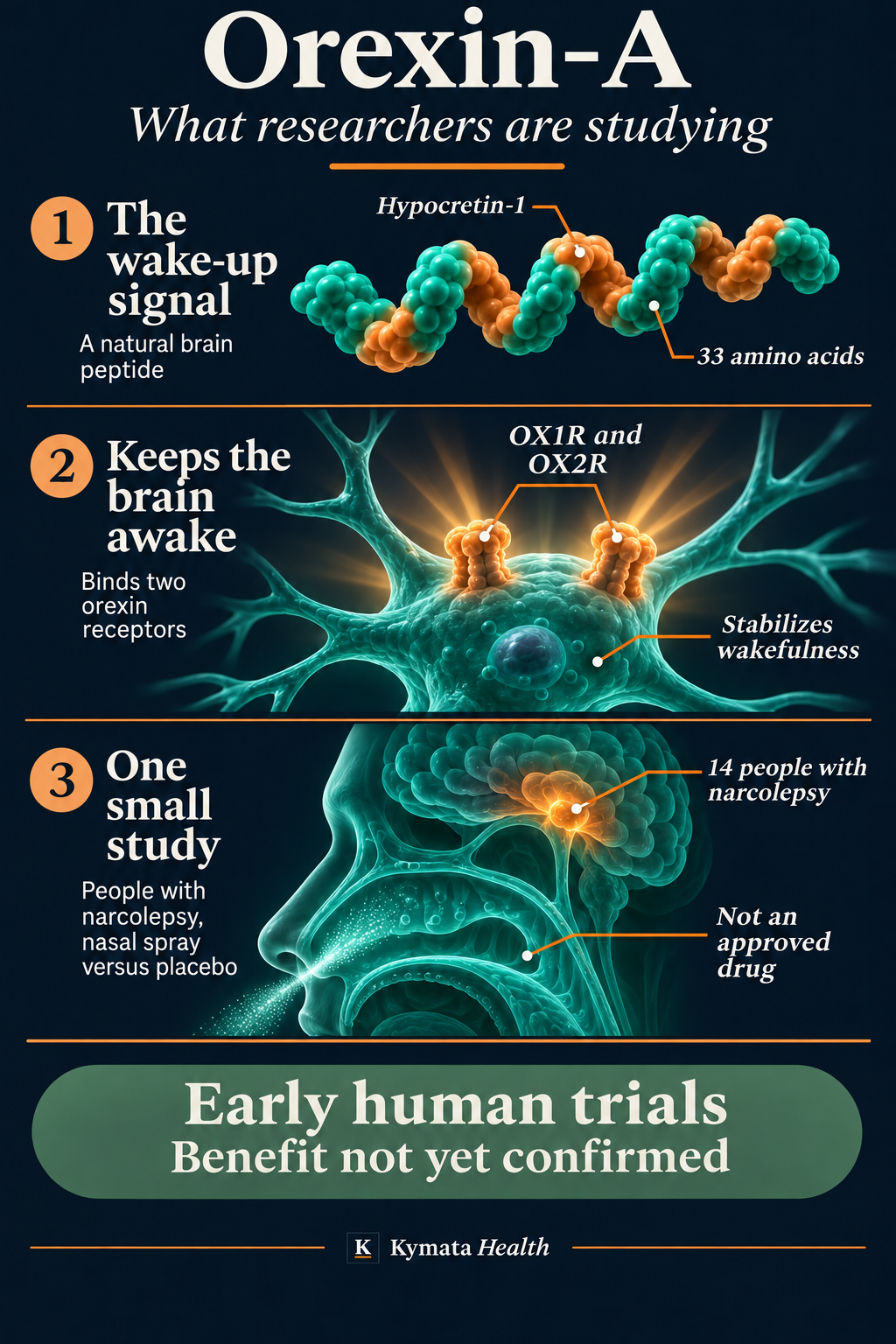
Orexin-A (hypocretin-1), a natural 33-amino-acid brain peptide that helps keep the brain awake. It binds the OX1R and OX2R receptors that stabilize wakefulness; one small crossover study gave it as a nasal spray to people with narcolepsy, and the page records no confirmed benefit. One small human study. Not FDA-approved. The drawing is a schematic, not a measured molecular structure, a product photograph or a treatment result. Illustration review: 19 November 2026, against this page’s own mechanism, evidence and regulatory records.
A sequence model is not provided for this record. Read the identity and evidence notes; an illustration does not verify a molecular structure.
Illustration notes and source record
Read the source record on this page. Laboratory, topical and injected studies are separate evidence; this illustration does not establish an indication or a treatment outcome.

How it works
SourcedOrexin-A (hypocretin-1) is the endogenous 33-aa wake peptide at OX1R/OX2R. Narcolepsy type 1 is orexin-neuron loss. The approved/near-approved drug story is small-molecule OX2R agonists, not gray-market native peptide.
Native peptide BBB and PK are why medicinal chemistry did not ship a nasal research vial as standard of care. This page is identity for a Limitless-style SKU plus a refusal to dress it as narcolepsy treatment.
Source: Discovery PMID: 9419374; clinical narcolepsy care is not this SKU
Orexin-A in a research vial is not TAK-861, not pitolisant, not modafinil. Do not delay sleep-medicine care.
05 / Evidence and limits
Evidence and limits
Limits of current evidence
2 limits- Native peptide BBB/PK is why medicinal chemistry went small-molecule.
- This site will not treat narcolepsy from a peptide page.
What it is studied for
- Catalog identity: Low
Verdict
Orexin-A is hypocretin-1. Narcolepsy type 1 is orexin-neuron loss. A research vial is not the small-molecule OX2R agonist pipeline. Do not delay sleep-medicine care.
06 / Product forms and access
Product forms and access
Regulatory & legal status
- FDA status (US)
- Research OnlyNative hypocretin-1. Not an approved narcolepsy agonist. Gray-market nasal is not a prescription
- WADA status (2026)
- Not ListedNot currently on the WADA 2026 Prohibited List. Policies may change. Verify before competition.
- US compounding
- Not eligible / not available
07 / Tools and practical checks
Tools and practical checks
Dose it
5 mg + 5 mL BAC water → 1 mg/mL · 1 unit (U-100) = 10 mcg.
Reconstitution example
100-unit insulin syringe- Vial
- 5 mg
- Diluent
- 5 mL
- Concentration
- 1 mg/mL
- Per Unit (100u syringe)
- 10 mcg
08 / Published study use
Published study use
What published studies gave, in whom, and the source. Not a dose for you.
What studies used
One small crossover study- 14 people with narcolepsy with cataplexy: one intranasal dose of 435 nmol orexin-A in the morning, against placebo. Weinhold 2014, PMID 24406723 (opens in new tab)
A record of what researchers gave, in whom; not a dose for you.
Administration
- Route / form
- Route used in studies: nasal (one narcolepsy study).
Who it is for
1 use| Category | Fit | What exists |
|---|---|---|
| Catalog identity | Low | Listed because people search hypocretin-1 / orexin-A nasal. Not an endorsement. |
09 / Safety and interactions
Safety and interactions
What the record says
Wake peptides can disrupt sleep. Unknown purity on research SKUs. Not a substitute for sleep-disorder diagnosis or treatment.
10 / Comparisons and goal guides
Comparisons and goal guides
Orexin-A vs. DSIP
3 attributesCanonical comparison: Orexin-A vs DSIP · DSIP evidence profile
| Attribute | Orexin-A | DSIP |
|---|---|---|
| Job | Endogenous wake peptide (OX1R/OX2R) | Delta-sleep-inducing peptide (research) |
| Narcolepsy drugs | Native peptide is not the approved agonist class | Not a narcolepsy drug either |
| SKU | Nasal research | Research peptide |
11 / Common questions
Common questions
Common questions
2 answersWill this treat narcolepsy?
No. Native orexin-A is not the approved agonist class. See a sleep clinician.
Is Orexin-A FDA-approved?
No. Native hypocretin-1. Not an approved narcolepsy agonist. Gray-market nasal is not a prescription.
12 / Sources and references
Sources and references
No separate record is provided here. Read the linked evidence and limitations for this compound.
14 / Prescription options
Prescription options
Prescription options: compare licensed telehealth providers
Some peptide therapies are available only by prescription after a consult with a licensed clinician.
Compare telehealth →15 / Peptide library
Peptide library
Keep reading: Peptide research library
Peptide research library: every pagePeptide libraryBrowse all topics
- SYN-AKEPrevious in this topic · Waglerin-1-inspired tripeptide (DSM/Pentapharm SYN-AKE) for expression lines.
- SHLP2Next in this topic · SHLP2 is a 26-amino-acid peptide reported from the mitochondrial 16S ribosomal RNA region.
- GPL ManGPL Man is a boxed Cytomed-style geroprotector kit, not a peptide.
- GPL FemmeGPL Femme is a boxed geroprotector kit: thyroid, vessels, brain, liver, and pineal (Thyreogen, Ventfort, Cerluten, Svetinorm, Endoluten).
- PinalexPinalex is two commercial eye products: Pinalex Tab, an oral supplement with a retinal peptide complex (AA-6) plus carotenoids and vitamins, and Pinalex Eye Balm for eyelid skin.
Regulatory and sport classification
- Not FDA-approved, research chemical