
The peptide field guide
NAD+
NAD+ is a coenzyme involved in cellular energy metabolism, not a peptide.
The reviewed IV records do not establish intracellular delivery, other-route outcomes or anti-aging benefit.
Explore this compoundEditorial redox-role metaphor only, not a molecular structure, enzyme fold, actual apparatus, cellular recharge, repaired tissue or result of an NAD+ product.
Last checked October 2026
02 / At a glance
At a glance
Identity
NAD+ is a coenzyme involved in cellular energy metabolism, not a peptide.
Research context
A 2019 IV plasma pilot and a separate retrospective 2026 commercial-clinic chart review.
Evidence limits
The reviewed IV records do not establish intracellular delivery, other-route outcomes or anti-aging benefit.
Read the technical profile and study-use reference
Quick answer
Evidence: LowNAD+ is a coenzyme every cell uses for energy metabolism, not a peptide. Clinics sell compounded NAD+ injections, IV drips and nasal sprays; none is FDA-approved, and FDA lists NAD as under evaluation for compounding (503A category 1). Human data are thin: in a 2019 pilot, infused NAD+ was cleared from the blood for at least the first 2 hours, and in a 2026 chart review by a commercial IV clinic, IV NAD+ caused more stomach symptoms and chest pressure than IV NR. No published trial has tested NAD+ injections under the skin or nasal NAD+ in people.
- In published studies
- Small IV studies only (PMID 41704678); none of injections under the skin
Research summary, not medical advice.
At a glance
Kymata peptide profile · October 2026- Common vials
- 100 mg / 500 mg
- Molecular weight
- 663.43 g/mol
- CAS
- 53-84-9
- In published studies
- Small IV studies only (PMID 41704678); none of injections under the skin
- Half-life
- Rapidly incorporated intracellularly; serum half-life <1 hour
03 / Identity and origin
Identity and origin
Also called Nicotinamide Adenine Dinucleotide, NAD. Cofactor (NAD+), not a peptide.
Read the sequence and compound record
Compound card
- Class
- Cofactor (NAD+), not a peptide
- Formula
- C21H27N7O14P2
- Molecular weight
- 663.43 g/mol
- CAS
- 53-84-9
- PubChem CID
- 925
- Described by
- Arthur Harden, Hans von Euler-Chelpin (Nobel 1929), 1906
- Bioavailability
- IV (100%) or subcutaneous injection
04 / How it may work
How it may work
Cofactor (NAD+), not a peptide
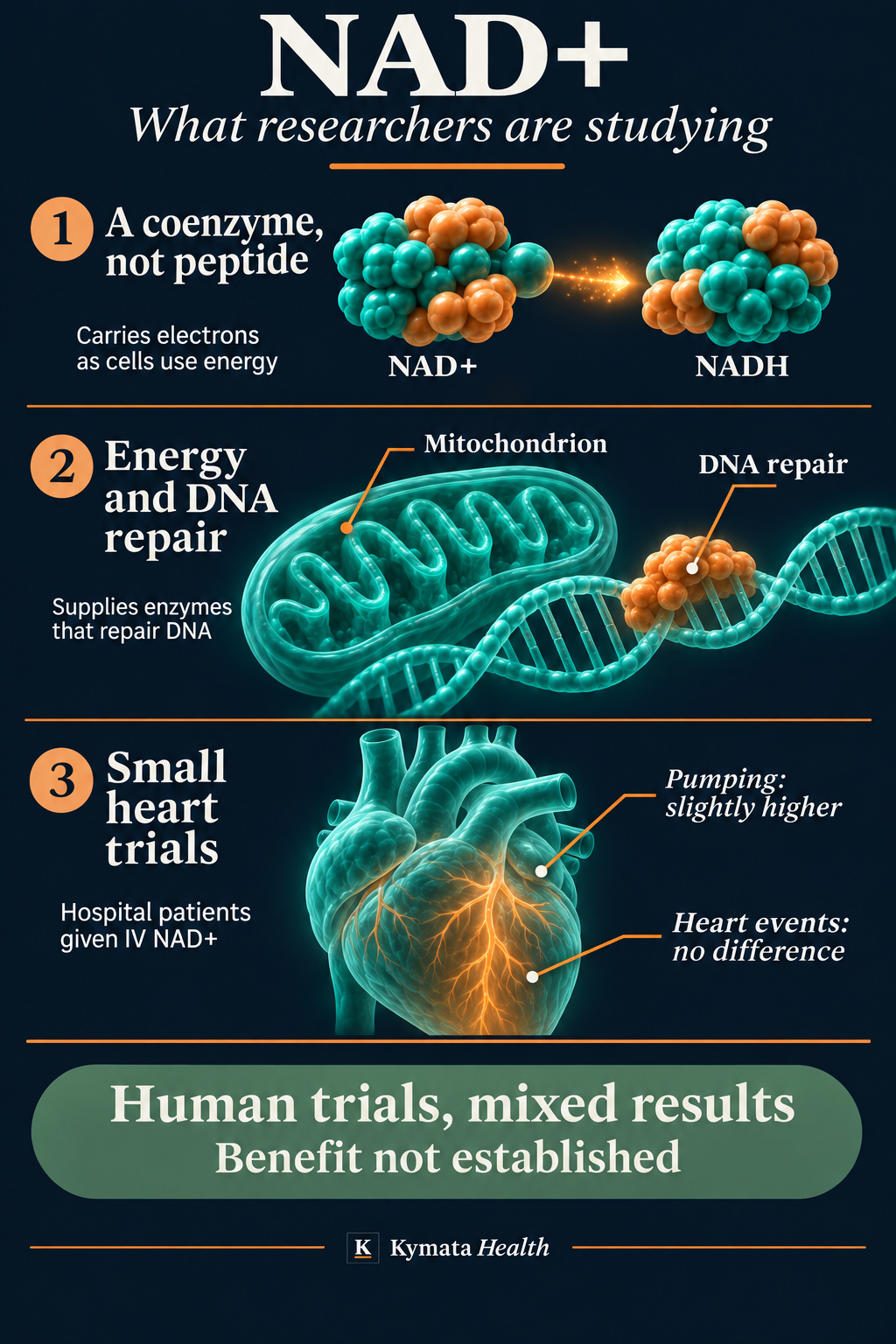
The 2019 IV pilot reported that plasma NAD+ did not rise during the first two hours. This blood measurement does not establish intracellular delivery or an infusion schedule. A separate retrospective 2026 commercial-clinic chart review reported stomach symptoms and chest pressure during IV NAD+. These IV records do not establish subcutaneous or nasal outcomes or anti-aging benefit. NR and NMN are different exposures.
NAD+ is a coenzyme, not an amino-acid peptide. No peptide sequence model is inferred.
Illustration notes and source record
Read the source record on this page. Laboratory, topical and injected studies are separate evidence; this illustration does not establish an indication or a treatment outcome.

How it works
SourcedNAD+ (Nicotinamide Adenine Dinucleotide) is a foundational coenzyme ubiquitous in every living cell, acting as the critical hydrogen and electron carrier in cellular respiration and redox reactions. Within the mitochondria, it cycles between its oxidized (NAD+) and reduced (NADH) states to facilitate the transfer of high-energy electrons through Complexes I and III of the electron transport chain, directly driving the oxidative phosphorylation that generates ATP.
Beyond basic energy metabolism, NAD+ operates as an essential, expendable substrate for critical longevity and regulatory enzymes. It is required for the activation of sirtuins (SIRT1-7), a family of protein deacetylases that govern gene silencing, circadian rhythm, cellular stress resistance, and apoptosis. Furthermore, NAD+ is consumed by PARPs (Poly ADP-Ribose Polymerases) during DNA damage repair, and by CD38 signaling proteins involved in calcium mobilization and immune response.
Because maintaining optimal NAD+ levels is metabolically expensive, concentrations naturally decline by up to 50% between the ages of 40 and 60. This systemic depletion severely impairs mitochondrial efficiency, diminishes DNA repair capacity, and downregulates sirtuin activity, all of which are fundamental drivers of biological aging and degenerative disease. While oral precursors (like NMN and NR) must pass through the salvage pathway to be converted step-wise into the active molecule, direct SubQ or IV administration of NAD+ immediately replenishes the intracellular pool, forcing rapid activation of these vital repair mechanisms.
Source: PMID: 29514064
When purchasing NAD+ for injection, you will often encounter "buffered" and "unbuffered" options. This distinction is entirely about injection comfort, not biological effectiveness. The biological molecule is identical.
Unbuffered NAD+ is the mainstream, standard form used by researchers. Because it is the pure, raw element, it has a naturally low, highly acidic pH in solution (around 3.0-4.0). When injected subcutaneously, this acidity causes a notorious sensory effect, often described as an intense stinging or burning at the injection site that can last a few minutes. However, it is the most affordable and widely available version.
Buffered NAD+ includes a pre-mixed alkalinizing agent (typically a mild sodium bicarbonate solution) in the reconstitution solvent. This raises the pH closer to neutral physiological levels (pH 7.4), significantly reducing or entirely eliminating the infamous "NAD burn". It is usually sold as a premium kit for individuals highly sensitive to injection site pain.
Background & History
NAD+ (nicotinamide adenine dinucleotide) is a coenzyme found in all living cells, central to energy metabolism and to the sirtuin and PARP enzymes involved in DNA repair. It is not a peptide, but it is often listed alongside injectable compounds. Human evidence on NAD+ given as a drug is thin: a 2019 pilot measured how infused NAD+ is cleared from the blood (Grant et al., PMID 31572171), and no published trial has tested NAD+ injections under the skin or NAD+ nasal spray in people. In an animal study from David Sinclair’s lab at Harvard (Gomes et al., Cell 2013, PMID 24360282), NAD+ levels fell with age in mouse muscle, and raising them with the precursor NMN reversed several markers of mitochondrial decline in old mice; that has not been shown in humans.
05 / Evidence and limits
Evidence and limits
Limits of current evidence
2 limits- Plasma NAD+ after IV is not the same as nuclear SIRT1 activation as a clinical endpoint.
- This site will not treat neurodegeneration or aging from an NAD+ page.
Trial FinderRecruiting now: 6 open registrations for NAD+
What it is studied for
- Identity: cofactor vs peptide vs NR/NMN
- IV clinic product is not a sirtuin NDA
- Not a neurodegeneration or addiction protocol on this site
Verdict
NAD+ is a coenzyme, not a peptide. IV bars and SubQ vials are not a longevity NDA. Precursors (NR, NMN) are a different exposure. This page is identity and math, not a sirtuin protocol.
06 / Product forms and access
Product forms and access
Regulatory & legal status
- FDA status (US)
- Research Only
- WADA status (2026)
- Not ListedNot currently on the WADA 2026 Prohibited List. Policies may change. Verify before competition.
- Classification
- Compounded Drug (Rx)
- US compounding
- Available via licensed pharmacy Rx
07 / Tools and practical checks
Tools and practical checks
Dose it
100 mg + 2 mL BAC water → 50 mg/mL · 1 unit (U-100) = 500 mcg.
Reconstitution math
U-100 syringe| Vial | Water | Concentration |
|---|---|---|
| 100 mg lyophilized | 2 mL BAC | 50 mg/mL |
08 / Published study use
Published study use
What published studies gave, in whom, and the source. Not a dose for you.
What studies used
Small infusion studies- A pilot study of a 6-hour IV infusion at 3 µmol per minute: plasma NAD+ did not rise for the first 2 hours. The indexed abstract does not give the number of people. Grant 2019, PMID 31572171 (opens in new tab)
- A retrospective review of clinic records: 500 mg IV on four days in a row. People on NAD+ reported moderate to severe stomach symptoms, a faster heart rate and chest pressure during the infusions. Reyna 2026, PMID 41704678 (opens in new tab)
- We found no published human dosing study of NAD+ injected under the skin.
A record of what researchers gave, in whom; not a dose for you.
Administration
- Route / form
- Route used in studies: IV infusion. No human study of NAD+ injected under the skin.
Who it is for
2 uses| Category | Fit | What exists |
|---|---|---|
| Cellular Energy / Mitochondrial Health | Insufficient human evidence | NAD+ is a coenzyme in cellular energy production. No human trial has shown that injected NAD+ changes energy or mitochondrial function. |
| Longevity / DNA Repair | Insufficient human evidence | Sirtuin and PARP links come from cell and animal studies. No human trial has measured an effect on DNA repair or aging. |
09 / Safety and interactions
Safety and interactions
What the record says
Essential human coenzyme. IV administration may cause nausea and chest tightness if infused too rapidly. SubQ may cause injection site discomfort. No long-term safety data exist for injected NAD+.
Interactions & Contraindications
IV NAD+ infusions can cause facial flushing, nausea, chest tightness at rapid infusion rates. Always infuse slowly. PARP inhibitors (cancer drugs: olaparib, rucaparib) compete for NAD+, so do not combine with oncology treatment without oncologist input. Separate timing from alcohol (competes for NAD+ in metabolism).
10 / Comparisons and goal guides
Comparisons and goal guides
Combinations: what has been tested
2 pairings- + MOTS-c →Cofactor plus AMPK peptide. Mechanism overlap on paper. Not a mitochondrial-health NDA and not an IV-clinic protocol.
- + Epitalon →Epitalon telomerase claims are one-lab. NAD+ is PARP substrate chemistry. That is not a synergistic longevity NDA.
NAD+ vs. Glutathione
5 attributesCanonical comparison: NAD+ vs Glutathione · Glutathione evidence profile
| Attribute | NAD+ | Glutathione |
|---|---|---|
| Primary Mechanism | NAD+ restoration → mitochondrial fuel | Antioxidant master regulator (GSH) |
| Cellular Target | Sirtuins, PARP, mitochondrial ETC | Oxidative stress, glutathione peroxidase |
| Best For | Energy, longevity, DNA repair, alcohol detox | Skin brightening, liver support, oxidative load |
| Administration | IV, SC injection, oral (NMN/NR precursors) | IV, SC injection, oral (liposomal) |
| Combined Use | Often co-administered in IV drip protocols | Often co-administered in IV drip protocols |
Appears in goal guides
1 guideGoal guides give the evidence and status for each compound, with no doses. A mention here is not a treatment plan.
11 / Common questions
Common questions
Common questions
2 answersWhat is more effective: NAD+ IV or SubQ injection?
Neither route has outcome trials: IV NAD+ has only small studies with notable side effects (PMID 41704678), and no study of injections under the skin has been published. There is no FDA-approved NAD+ drug, and we give no dose or schedule.
Why do NAD+ levels decline with age?
NAD+ declines ~50% between ages 40-60 due to increased consumption by CD38, increased PARP activity from DNA damage accumulation, and decreased synthesis from the salvage pathway. This decline contributes to mitochondrial dysfunction and aging.
12 / Sources and references
Sources and references
No separate record is provided here. Read the linked evidence and limitations for this compound.
14 / Prescription options
Prescription options
Prescription options: compare licensed telehealth providers
Some peptide therapies are available only by prescription after a consult with a licensed clinician.
Compare telehealth →Telehealth guides
4 pages15 / Peptide library
Peptide library
Keep reading: Peptide research library
Peptide research library: every pagePeptide libraryBrowse all topics
- KPVPrevious in this topic · KPV is the three-amino-acid sequence Lys-Pro-Val, taken from the end of alpha-melanocyte-stimulating hormone.
- GlutathioneNext in this topic · Glutathione is an antioxidant your body makes from glutamate, cysteine and glycine.
- OxytocinOxytocin is a neurohypophysial hormone, FDA-approved as Pitocin to induce or strengthen labor contractions, and widely studied in behavioral research for its effects on social…
- VIPVIP is a 28-amino-acid neuropeptide isolated by Said and Mutt in 1970.
- ThymalinThymalin is a polypeptide extract of calf thymus registered as a medicine in Russia; Russian studies, mostly from the Khavinson group, examined it in immune function, including…
Regulatory and sport classification
- Not FDA-approved, research chemical