
The peptide field guide
Vesugen
Vesugen is recorded as the synthetic KED peptide; Ventfort is a separate vascular-tissue mixture and Crystagen has a different catalogue identity.
The retained cell experiment and separate small human report do not establish prevention of heart attacks or strokes.
Explore this compoundIllustrative vessel-study context only; not actual patient tissue, blood, measured anatomy or a vascular outcome.
We earn a commission if you buy through some links on this page. You pay the same price. See how we make money.
02 / At a glance
At a glance
Key facts
- Also known as
- Lys-Glu-Asp, KED, Vascular Bioregulator, Везуген
- Sequence
- KED
- Evidence level
- Cell and animal research: human benefit remains unproven.
- US regulatory status
- Not FDA-approved; sold as oral capsules and as research-labelled vials
- Updated
Identity
Vesugen is recorded as the synthetic KED peptide; Ventfort is a separate vascular-tissue mixture and Crystagen has a different catalogue identity.
Research context
Vascular endothelial-cell research measured endothelin-1 and other markers. A separate 2015 report (PMID 26390612) names Pinealon and Vesugen in 32 people aged 41–83 with chronic conditions and organic brain syndrome; its indexed abstract does not state a dose.
Evidence limits
The retained cell experiment and separate small human report do not establish prevention of heart attacks or strokes.
Read the technical profile and study-use reference
Quick answer
Evidence: LowVesugen, also written Vezugen, is KED. Ventfort is a vascular-tissue peptide mixture. The product name, composition and route each matter when interpreting a study.
- Class and target
- Cytogen (synthetic short peptide) · Blood vessels / endothelium · sequence KED
- In published studies
- One small human study; dose not stated
Research summary, not medical advice.
At a glance
Kymata peptide profile · Nov 19, 2026- Half-life
- Short (tripeptide)
- Molecular weight
- 390.39 g/mol
- CAS
- N/A
- In published studies
- One small human study; dose not stated
- Documented forms
- Oral capsule · Lingual drops · Research vial
03 / Identity and origin
Identity and origin
Also called Lys-Glu-Asp, KED, Vascular Bioregulator, Везуген. Khavinson cytogen (KED).
Read the sequence and compound record
Compound card
1 cell = 1 amino acid- Sequence
- KED
- Class
- Khavinson cytogen (KED)
- Formula
- C15H26N4O8
- Molecular weight
- 390.39 g/mol
- CAS
- N/A
- PubChem CID
- N/A
- Described by
- Vladimir Khavinson, St. Petersburg Institute of Bioregulation, 1990s
- Bioavailability
- Oral capsule or subcutaneous injection (research vial)
04 / How it may work
How it may work
Khavinson cytogen (KED)
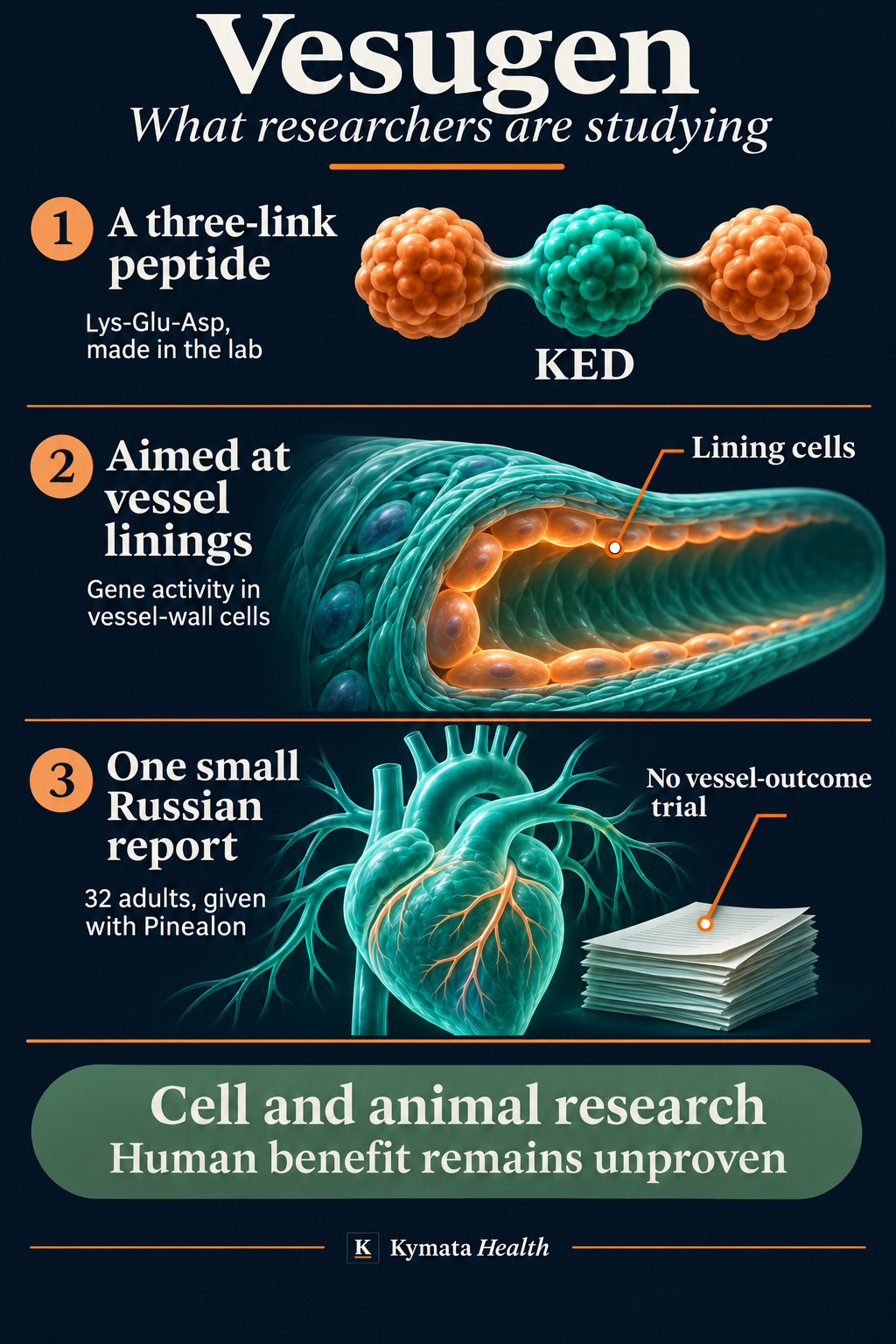
The guide shows Vesugen as the synthetic three-amino-acid peptide Lys-Glu-Asp (KED). In cell cultures and aging animals, researchers measured changes in gene activity in the cells that line blood vessels. The only human record is a small 2015 Russian report in 32 adults aged 41–83 who received it together with Pinealon (PMID 26390612); no trial has measured heart or vessel outcomes. The drawing is a schematic, not a measured molecular structure, a product photograph or a treatment result. Illustration review: 22 November 2026, against this page’s own mechanism, evidence and regulatory records.
KED is the recorded catalogue letter order. It does not verify terminal chemistry, a commercial product lot or a measured molecular structure; no exact chemical model is inferred.
Illustration notes and source record
Why study Vesugen in the lining of blood vessels?
The cells that signal a vessel to narrow. Cells lining blood vessels make endothelin-1, a signal that narrows the vessel. Researchers studied how these cells respond to Vesugen, a synthetic chain of three amino acids called KED.
What changed in the lab. In cultures of cells from diseased vessels, adding KED lowered elevated endothelin-1. The consumer catalog lists capsules and lingual drops. Laboratory suppliers list a research vial.
A thin layer of cells lines the surface that blood flows over.
Earlier contextual illustration
Read the source record on this page. Laboratory, topical and injected studies are separate evidence; this illustration does not establish an indication or a treatment outcome.

Vesugen amino acid sequence
Each bead is one amino acid. Once it is part of the chain, it is called a residue. Drag to rotate or tap a bead. The shape is a schematic illustration.
- Basic
- Acidic
Its side branch usually carries a positive charge near neutral pH, the middle of the acidity scale. Vesugen, also written Vezugen, is KED. Ventfort is a vascular-tissue peptide mixture. The product name, composition and route each matter when interpreting a study.
Read the full sequence
A peptide bond is a covalent link joining two amino acids in a chain. A hydrogen bond is a weaker attraction, for example between a hydrogen on an oxygen and a nearby oxygen atom. A side chain may form hydrogen bonds without joining another amino acid to the chain. This diagram shows the sequence; it does not measure these interactions.
KED
- Lysine. Its side branch usually carries a positive charge near neutral pH, the middle of the acidity scale.
- Glutamate. Its side branch usually carries a negative charge near neutral pH, the middle of the acidity scale.
- Aspartate. Its side branch usually carries a negative charge near neutral pH, the middle of the acidity scale.
Vesugen product forms
Form labels checked Nov 7, 2026Vesugen, also written Vezugen, is KED. Ventfort is a vascular-tissue peptide mixture. The product name, composition and route each matter when interpreting a study.
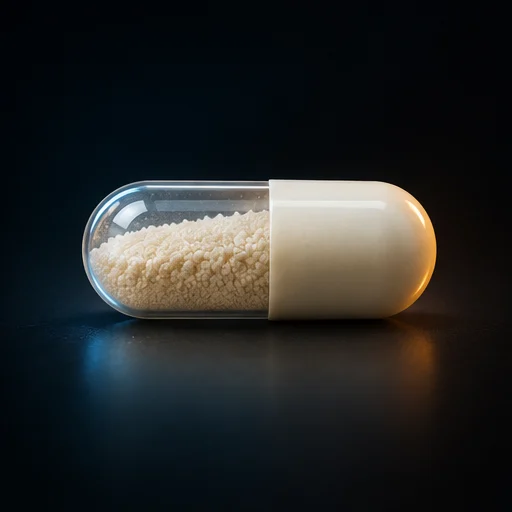
Oral capsule
The pack label states the ingredient and strength per capsule. Capsule contents are not for injection.
How to read capsule and liquid labels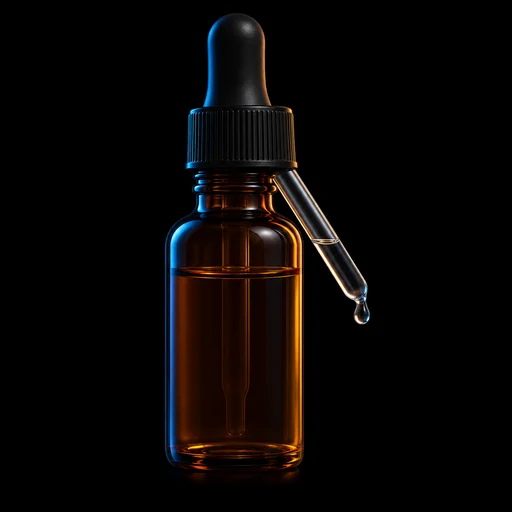
Lingual drops
A separately labeled liquid for use under the tongue. That bottle carries its own label directions. A drop count cannot be calculated from the capsule strength.
How to read capsule and liquid labels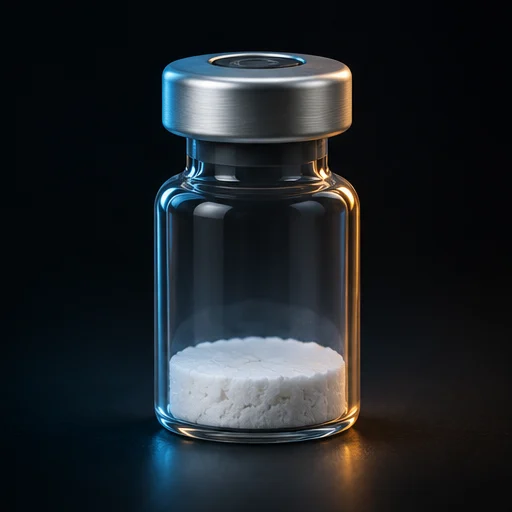
Research vial
The supplier identifies this material for laboratory research. A freeze-dried powder and a purity figure do not establish sterility or a route for human injection. Capsule instructions do not apply.
Laboratory product specificationIllustrations show the type of packaging. Check the name, contents and route on the actual pack. See product names and availability ↓
Inside the study
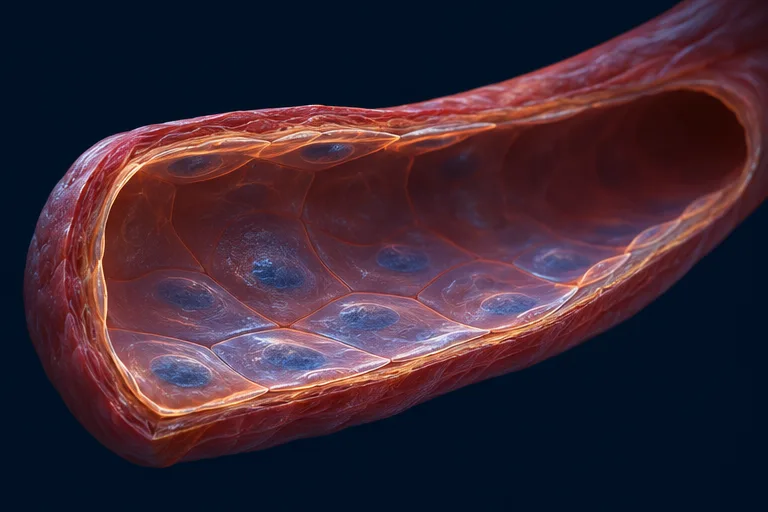
An experiment with vascular endothelial cells measured changes in endothelin-1 and other markers after exposure to KED. It did not test whether a capsule, drops or an injection prevents a cardiovascular event.
Kozlov and colleagues, vascular endothelium experiment ↗05 / Evidence and limits
Evidence and limits
Limits of current evidence
4 limits- A defined sequence is not an FDA indication.
- Gray-market identity is a live problem. HPLC beats a blog table.
- Studies on sibling cytogens do not apply to this product.
- This site will not treat the named organ disease from a peptide page.
What it is studied for
- KED identity vs Ventfort vs Cardiogen
- Not an atherosclerosis or endothelial-restoration protocol
Verdict
Vesugen is the synthetic KED cytogen for Blood vessels / endothelium. Khavinson’s group published in this family. That is a concentrated literature, not a Western Phase 3. Capsules and vials are different SKUs.
06 / Product forms and access
Product forms and access
Regulatory & legal status
- FDA status (US)
- Not approvedNot FDA-approved; sold as oral capsules and as research-labelled vials
- WADA status (2026)
- Not ListedNot currently on the WADA 2026 Prohibited List. Policies may change. Verify before competition.
- Classification
- Research Chemical
- US compounding
- Not eligible / not available
Cytogen (synthetic short peptide) · Blood vessels / endothelium
Identity
Canonical 41- Class
- Cytogen (synthetic short peptide)
- Organ
- Blood vessels / endothelium
- Target
- Blood vessels
- System
- Cardiovascular
- Sequence
- KED · Lys-Glu-Asp
In these Khavinson catalog sets
1 setManufacturer-style organ combinations, not FDA protocols. Every name links to its own page.
The Khavinson school
Vesugen is filed here as cytogen (synthetic short peptide), targeting the blood vessels / endothelium. Khavinson's St. Petersburg group moved from organ extracts (Cytamins) to capsule complexes (Cytomaxes) to synthetic short peptides (Cytogens); most of the evidence comes from that one group, with little independent Western replication.
Read the full background, the proposed epigenetic mechanism, the literature limits, and how we count the canonical 41 on the Khavinson bioregulators index.
History of this molecule
KED is one of the cleaner sequence stories in this catalog: three residues, vessel cells, Cytomed cytogen line. The claim family is endothelial gene expression, capillary trophism, and the unglamorous work of keeping the lining of the pipe from senescing. Sales copy that says it “reverses atherosclerosis” is stealing statin/PCSK9 language.
Do not file Vesugen next to BPC-157 just because both get sold as “vascular.” BPC is a gastric pentadecapeptide with angiogenesis-adjacent animal data. Vesugen is a Khavinson tripeptide in the organ-identity model.
Chelohart/Cardiogen are myocardium. Vesugen is not a heart-failure drug.
A defined sequence is not an FDA indication. Vascular cytogens sit in a Russian experimental-gerontology literature with limited Western replication. “Oral bioavailability because PEPT1” is real peptide-transport biology; it is not proof this SKU treats the organ disease. A purity chromatogram alone cannot identify a peptide sequence or establish that a preparation is sterile.
Full 41-map: Khavinson bioregulators index · Khavinson catalog sets
07 / Tools and practical checks
Tools and practical checks
No separate record is provided here. Read the linked evidence and limitations for this compound.
08 / Published study use
Published study use
What published studies gave, in whom, and the source. Not a dose for you.
What studies used
One small Russian study- Tested alongside pinealon in 32 people aged 41 to 83 with several chronic conditions and organic brain syndrome. The indexed abstract does not give the dose. Meshchaninov 2015, PMID 26390612 (opens in new tab)
A record of what researchers gave, in whom; not a dose for you.
Administration
- Route / form
- Oral capsule. The pack label states the ingredient and strength per capsule. Capsule contents are not for injection. Lingual drops. A separately labeled liquid for use under the tongue. That bottle carries its own label directions. A drop count cannot be calculated from the capsule strength. Research vial. The supplier identifies this material for laboratory research. A freeze-dried powder and a purity figure do not establish sterility or a route for human injection. Capsule instructions do not apply.
- Timing
- Any timing is on the manufacturer’s label; it is not a studied schedule, and this page does not restate it.
- Empty stomach?
- Label only: Food timing, if any, is on the manufacturer’s label. No published study sets it, and this page does not restate it.
Timeline
2 stages- In people
Effects on vascular endothelial gene expression come from cell and animal studies, not human measurements; one 2015 report in 32 adults also gave Pinealon (PMID 26390612).
- Month 3-6
No human trial has measured this.
Who it is for
1 use| Category | Fit | What exists |
|---|---|---|
| Vascular Aging / Endothelial Health | Low | Proposed vascular endothelial bioregulator. Effects on endothelial gene expression come from cell and animal studies. |
09 / Safety and interactions
Safety and interactions
What the record says
Research peptide. Russian use outside controlled trials is not a US safety file; the one small human report (PMID 26390612) was not a safety trial.
Interactions & Contraindications
This site will not treat vascular disease from a peptide page.
10 / Comparisons and goal guides
Comparisons and goal guides
Combinations: what has been tested
1 pairing- + Ventfort →Cytogen vs Cytomax. Not a combo RCT.
11 / Common questions
Common questions
Common questions
6 answersWhich forms of Vesugen are documented, and which instructions apply to each?
Oral capsule. The pack label states the ingredient and strength per capsule. Capsule contents are not for injection. Lingual drops. A separately labeled liquid for use under the tongue. That bottle carries its own label directions. A drop count cannot be calculated from the capsule strength. Research vial. The supplier identifies this material for laboratory research. A freeze-dried powder and a purity figure do not establish sterility or a route for human injection. Capsule instructions do not apply.
Vesugen vs Ventfort vs Cardiogen?
Vesugen = KED cytogen (vessels). Ventfort = vessel Cytomax. Cardiogen = heart cytogen. Endothelium ≠ myocardium.
Blood pressure drug?
No. Vesugen has no blood-pressure indication and is not a substitute for prescribed blood-pressure medicine.
Same as Crystagen?
No. Crystagen is EDP immune. Vesugen is KED vessels. One letter off is a different peptide.
How does Vesugen differ from other cardiovascular peptides?
Vesugen (Lys-Glu-Asp) is proposed to act on gene expression in vascular endothelial cells, based on cell and animal studies. Unlike acute vasodilators (VIP), it has no measured effect on blood flow in people, and no controlled human trial has tested vascular outcomes.
Is Vesugen FDA-approved?
No. Not FDA-approved; sold as oral capsules and as research-labelled vials.
12 / Sources and references
Sources and references
4 papers cited on this page.
Sources
4 papers- 1“Tissue-specific effects of peptides.”Khavinson VKh et al. Bulletin of Experimental Biology and Medicine (2001). PMID: 11713572
- 2“Short peptides regulate gene expression.”Khavinson VKh, Lin’kova NS, Tarnovskaya SI Bulletin of Experimental Biology and Medicine (2016). PMID: 27909961
- 3“Peptides of pineal gland and thymus prolong human life.”Khavinson VKh, Morozov VG Neuroendocrinology Letters (2003). PMID: 14523363
- 4“Effect of synthetic peptides on aging of patients with chronic polymorbidity and organic brain syndrome of the central nervous system in remission.”Meshchaninov VN, Tkachenko EL, Zharkov SV, Gavrilov IV, Katyreva IuE Advances in Gerontology (Uspekhi Gerontologii) (2015). PMID: 26390612
14 / Prescription options
Prescription options
Oral tissue-peptide capsules sold by Vita-Stream, house line first: a different product from the Vesugen studied above.
Capsule form
Paid links · we earn a commissionOral capsuleAffiliate links: we earn a commission if you buy, at no extra cost to you.
- Browse Vesugen (paid link, opens in new tab)
Vesugen is a Cytogen (synthesized) blood vessels peptide capsule sold by Vita-Stream. Vita Peptides' house line has no product for this tissue. No trial has tested it.
- Per capsule
- 100 mcg active synthesized peptides
Label wording as Vita-Stream's product page states it, read 19 October 2026. Follow the label on the bottle you buy.
- In Khavinson’s lab work, synthetic short peptides modeled on a tissue’s peptide extract stimulated the growth of cultured rat explants of that same tissue. Khavinson 2001, PMID 11713572 (opens in new tab)
- His group proposes that such peptides act on gene expression in the cells they reach; most of that work is in cells and animals. Khavinson 2021 review, PMID 34834147 (opens in new tab)
These statements have not been evaluated by the FDA. These products are not intended to diagnose, treat, cure, or prevent any disease.
Use code KymataLabs at checkout
15 / Peptide library
Peptide library
← Back to Peptide LibraryKhavinson catalog sets
Keep reading: Peptide research library
Peptide research library: every pagePeptide libraryBrowse all topics
- CartalaxPrevious in this topic · Cartalax (Ala-Glu-Asp) is a short synthetic peptide (cytogen) from the Khavinson group; its published studies, mostly Russian cell and animal work, examined cartilage cells.
- BronchogenNext in this topic · Bronchogen (Ala-Glu-Asp-Leu) is a short synthetic peptide (cytogen) from the Khavinson group; its published studies, mostly Russian cell and animal work, examined bronchial and…
- CardiogenCardiogen (Ala-Glu-Asp-Arg) is a short synthetic peptide (cytogen) from the Khavinson group; its published studies, mostly Russian cell and animal work, examined heart tissue.
- ChelohartChelohart is a Cytomax capsule bioregulator, a peptide fraction from animal heart tissue; published work on it comes mostly from the developers' own Russian studies of heart…
- ChitomurChitomur is a Cytomax capsule bioregulator, a peptide fraction from animal bladder tissue; published work on it comes mostly from the developers' own Russian studies of bladder…
Regulatory and sport classification
- Not FDA-approved; sold as oral capsules and as research-labelled vials