
The peptide field guide
Bronchogen
A synthetic four-amino-acid peptide (Ala-Glu-Asp-Leu) from the Khavinson group, designed for the lining of the bronchi.
Cell and animal studies only. No human trial has measured lung function. Not FDA-approved.
Explore this compoundConceptual editorial illustration; not a measured molecular structure, product photograph or treatment result.
We earn a commission if you buy through some links on this page. You pay the same price. See how we make money.
02 / At a glance
At a glance
Key facts
- Also known as
- Ala-Glu-Asp-Leu, AEDL, Bronchial Bioregulator, Бронхоген
- Sequence
- AEDL
- Evidence level
- Cell and animal research: human benefit remains unproven.
- US regulatory status
- Not FDA-approved; sold as oral capsules and as research-labelled vials
- Updated
Identity
A synthetic four-amino-acid peptide (Ala-Glu-Asp-Leu) from the Khavinson group, designed for the lining of the bronchi.
Research context
In cultured human bronchial cells the Khavinson group reported changes in markers of cell differentiation, and rat studies of obstructive lung disease reported changes in bronchial gene expression and inflammatory markers.
Evidence limits
Cell and animal studies only. No human trial has measured lung function. Not FDA-approved.
Read the technical profile and study-use reference
Quick answer
Evidence: LowBronchogen has the reported residue sequence AEDL. The sequence identifies the order of amino acids. The package label identifies the formulation and its intended use.
- Class and target
- Cytogen (synthetic short peptide) · Bronchi · sequence AEDL
- In published studies
- No human dosing study published
Research summary, not medical advice.
At a glance
Kymata peptide profile · Nov 21, 2026- Documented forms
- Oral capsule
- Molecular weight
- 446.46 g/mol
- In published studies
- No human dosing study published
- Half-life
- Not established in humans
- CAS
- 857267-12-0 (PubChem depositor synonym)
03 / Identity and origin
Identity and origin
Also called Ala-Glu-Asp-Leu, AEDL, Bronchial Bioregulator, Бронхоген. Khavinson cytogen (AEDL).
Read the sequence and compound record
Compound card
1 cell = 1 amino acid- Sequence
- AEDL
- Class
- Khavinson cytogen (AEDL)
- Formula
- C18H30N4O9
- Molecular weight
- 446.46 g/mol
- CAS
- 857267-12-0 (PubChem depositor synonym)
- PubChem CID
- 11690869
- Described by
- Vladimir Khavinson, St. Petersburg Institute of Bioregulation, 1990s
- Bioavailability
- Not measured in people; the 2007 report used swallowed capsules
04 / How it may work
How it may work
Khavinson cytogen (AEDL)
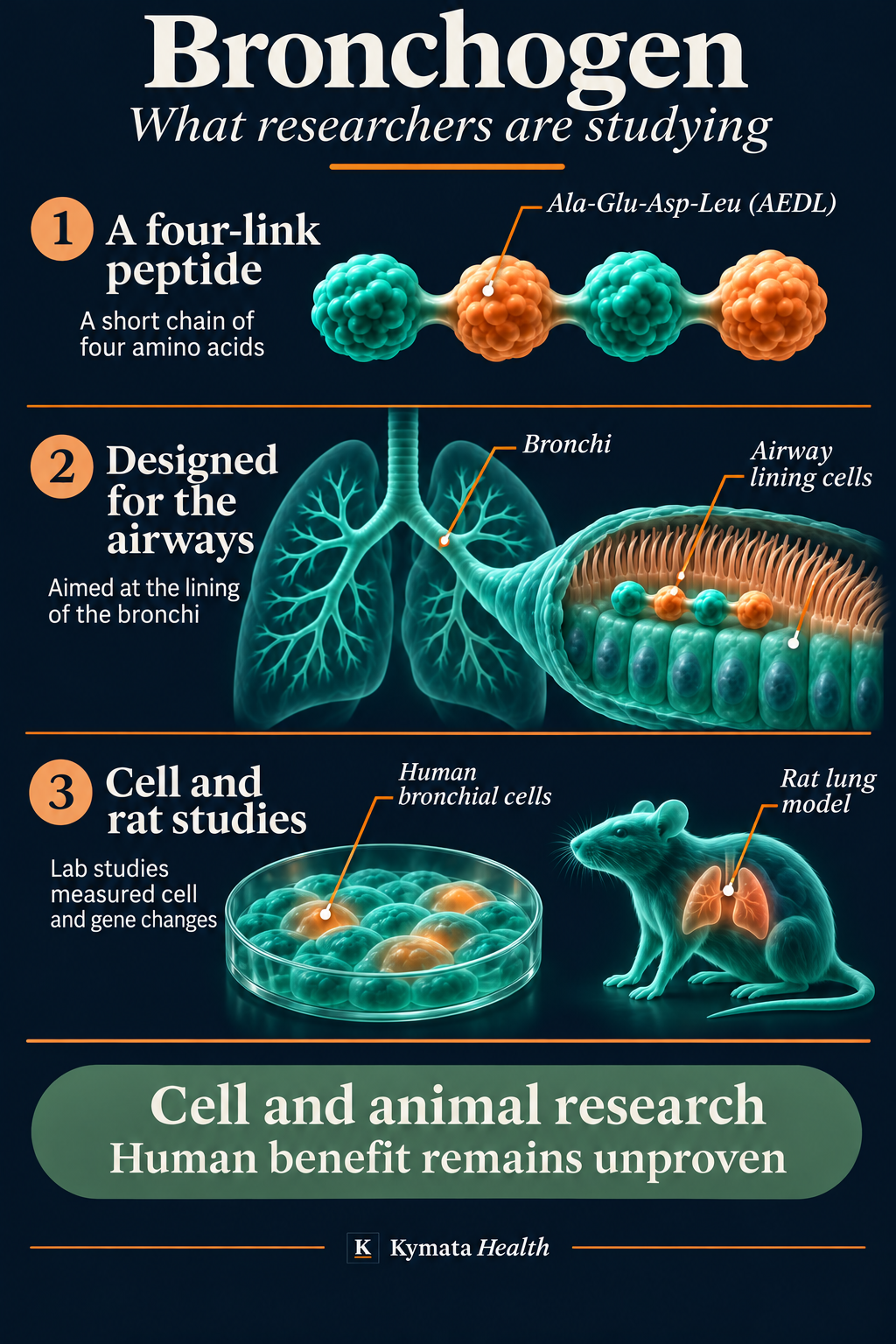
A synthetic four-amino-acid peptide (Ala-Glu-Asp-Leu) from the Khavinson group, designed for the lining of the bronchi. In cultured human bronchial cells the Khavinson group reported changes in markers of cell differentiation, and rat studies of obstructive lung disease reported changes in bronchial gene expression and inflammatory markers. Cell and animal studies only. No human trial has measured lung function. Not FDA-approved. The drawing is a schematic, not a measured molecular structure, a product photograph or a treatment result. Illustration review: 19 November 2026, against this page’s own mechanism, evidence and regulatory records.
A sequence model is not provided for this record. Read the identity and evidence notes; an illustration does not verify a molecular structure.
Illustration notes and source record
What happened when researchers added Bronchogen to airway cells?
Four amino acids in a dish. Bronchogen is a peptide with the sequence AEDL. Researchers added it to human bronchial cells in a dish. They compared cells early in culture with cells grown through more rounds of division.
Signs of how cells mature. Bronchogen increased the expression of markers associated with specialized airway cells. The effect was stronger in older cultures. The experiment leaves open whether people breathe more easily or have fewer symptoms.
Tiny hairs called cilia move mucus along the airway lining.
Earlier contextual illustration
Read the source record on this page. Laboratory, topical and injected studies are separate evidence; this illustration does not establish an indication or a treatment outcome.

How it works
Bronchogen (Ala-Glu-Asp-Leu) is a synthetic tetrapeptide aimed at the bronchial epithelium. Khavinson and colleagues (2012, PMID 22808515) reported that bronchogen (Ala-Glu-Asp-Leu) raised the differentiation markers CXCL12 and Hoxa3 in cultured human embryonic bronchial epithelial cells, with a larger effect in late-passage (aged) cultures; no people or animals were given the peptide. Kuzubova and colleagues (2015, PMID 26468022) modeled COPD in rats with 60 days of intermittent NO2 exposure and reported that one month of the tetrapeptide Bronchogen was followed by less goblet-cell hyperplasia, squamous metaplasia and emphysema, more ciliated cells and higher secretory IgA in lavage fluid. Titova and colleagues (2017, PMID 30199201; Russian article, English abstract) reported in the same 60-day NO2 rat model that Bronchogen lowered neutrophilic inflammation in bronchoalveolar lavage and raised secretory IgA and surfactant protein B. A 2014 paper by Khavinson and colleagues (PMID 25015171) reported gene and protein changes in human embryonic bronchial cultures with a tetrapeptide it names Ala-Asp-Glu-Leu (ADEL); that sequence differs from AEDL, so the paper is not plain Bronchogen evidence.
Bronchogen product forms
Form labels checked Nov 7, 2026Bronchogen has the reported residue sequence AEDL. The sequence identifies the order of amino acids. The package label identifies the formulation and its intended use.
Oral capsule
The pack label states the ingredient and strength per capsule. Capsule contents are not for injection.
Bronchogen capsule pack listingIllustrations show the type of packaging. Check the name, contents and route on the actual pack. See product names and availability ↓
Inside the study
A laboratory study exposed cultured human bronchial cells to AEDL. The authors measured changes in markers of cell differentiation. They did not test a capsule or measure breathing symptoms in people.
Khavinson and colleagues, airway-cell study ↗05 / Evidence and limits
Evidence and limits
One unrandomized report · its table duplicates a Chonluten report
Human evidence
One unrandomized report · its table duplicates a Chonluten report- The institute’s 2007 report (Sept-Oct 2007, unrandomized as written) gave oral Bronchogen capsules with usual care to 23 adults aged 38-65 with chronic bronchitis with an asthmatic component in remission and usual care alone to 19, and reported no adverse effects.
- The 2007 report states that in 73% of the 23 add-on patients (about three in four) Bronchogen “contributed to” better well-being, fewer cough and choking attacks and less sputum, versus a positive change in subjective measures in 62% of the 19 controls (about six in ten), without a between-group test.
- In the 2007 report’s Table 1, FVC (the volume of air blown out after a full breath) rose from a single pooled baseline of 2,851 mL to 3,201 mL with usual care and 3,801 mL with added Bronchogen, the only value marked p<0.05 and only against baseline; vital capacity and total lung capacity were also listed and FEV1 was not reported.
- The institute’s Chonluten report (Nov 2005-Feb 2006; Glu, Asp, Gly complex) describes the same 23 treated adults aged 38-65 and 19 controls with chronic bronchitis with an asthmatic component, the same 73% figure and a Table 1 identical to Bronchogen’s in all nine values with their error terms.
Limits of current evidence
4 limits- The institute’s Chonluten report carries the same patients, the same 73% figure and an identical lung-function table, so neither result can be attributed to Bronchogen.
- The 2007 report is unrandomized as written, uses no placebo or blinding, and marks significance only against baseline.
- PMID 25015171 tested a tetrapeptide named Ala-Asp-Glu-Leu (ADEL), whose sequence differs from AEDL.
- A retail listing gives the capsule complex as Ala, Asp, Glu, Arg, while the signed report gives Ala, Glu, Asp, Leu. Research vials are labeled for laboratory use only.
What it is studied for
- AEDL identity vs Taxorest vs Chonluten
- Not a COPD or chronic-bronchitis treatment page
Verdict
Bronchogen is the synthetic tetrapeptide AEDL (Ala-Glu-Asp-Leu) aimed at the airway lining. Cell and rat studies report changes in bronchial epithelium. The only human report, an unrandomized 2007 institute comparison of capsules plus usual care, carries a lung-function table identical to an earlier Chonluten report, so no reliable human lung-function result exists.
06 / Product forms and access
Product forms and access
Regulatory & legal status
- FDA status (US)
- Not approvedNot FDA-approved; sold as oral capsules and as research-labelled vials
- WADA status (2026)
- Not ListedNot currently on the WADA 2026 Prohibited List. Policies may change. Verify before competition.
- Classification
- Research Chemical
- US compounding
- Not eligible / not available
Cytogen (synthetic short peptide) · Bronchi
Identity
Canonical 41- Class
- Cytogen (synthetic short peptide)
- Organ
- Bronchi
- Target
- Bronchi
- System
- Respiratory
- Sequence
- AEDL · Ala-Glu-Asp-Leu
In these Khavinson catalog sets
1 setManufacturer-style organ combinations, not FDA protocols. Every name links to its own page.
The Khavinson school
Bronchogen is filed here as cytogen (synthetic short peptide), targeting the bronchi. Khavinson's St. Petersburg group moved from organ extracts (Cytamins) to capsule complexes (Cytomaxes) to synthetic short peptides (Cytogens); most of the evidence comes from that one group, with little independent Western replication.
Read the full background, the proposed epigenetic mechanism, the literature limits, and how we count the canonical 41 on the Khavinson bioregulators index.
History of this molecule
AEDL vs EDG is the airway split: Bronchogen more bronchial in the naming, Chonluten lungs-and-bronchi on the poster. Taxorest is the complex for mucosa. Honluten is the extra lung-extract SKU.
This is not albuterol. Mucin, cilia, and epithelial identity are the Khavinson verbs. Keep the inhaler.
A defined sequence is not an FDA indication. Bronchi cytogens sit in a Russian experimental-gerontology literature with limited Western replication. “Oral bioavailability because PEPT1” is real peptide-transport biology; it is not proof this SKU treats the organ disease. A purity chromatogram alone cannot identify a peptide sequence or establish that a preparation is sterile.
Full 41-map: Khavinson bioregulators index · Khavinson catalog sets
07 / Tools and practical checks
Tools and practical checks
No separate record is provided here. Read the linked evidence and limitations for this compound.
08 / Published study use
Published study use
What published studies gave, in whom, and the source. Not a dose for you.
What studies used
One unrandomized human report; no dosing study- We found no human dosing study of Bronchogen in PubMed.
- An unrandomized 2007 institute report gave oral Bronchogen capsules with usual care to 23 adults with chronic bronchitis with an asthmatic component and usual care alone to 19. Its lung-function table is identical to an earlier Chonluten report.
- Rats with a lung-damage model (60 days of intermittent NO2 exposure) were given Bronchogen for 1 month. The indexed abstract does not state the dose or route. Kuzubova 2015, PMID 26468022 (opens in new tab)
- The doses quoted online come from animal work and vendor or forum sources.
A record of what researchers gave, in whom; not a dose for you.
Administration
- Route / form
- Oral capsule. The pack label states the ingredient and strength per capsule. Capsule contents are not for injection.
- Timing
- Any timing is on the manufacturer’s label; it is not a studied schedule, and this page does not restate it.
- Empty stomach?
- Label only: Food timing, if any, is on the manufacturer’s label. No published study sets it, and this page does not restate it.
Timeline
2 stages- Cell and animal studies
Effects on bronchial epithelial differentiation markers come from cell and rat studies (PMID 22808515, 26468022, 30199201), not human measurements.
- In people
One unrandomized report (Sept-Oct 2007) whose lung-function table is identical to an earlier Chonluten report; no reliable human measurement exists.
Who it is for
1 use| Category | Fit | What exists |
|---|---|---|
| Respiratory / Lung Health | Low | Bronchial cytogen. Cell and rat studies, plus one human report whose figures duplicate a Chonluten report. |
09 / Safety and interactions
Safety and interactions
What the record says
Research peptide. Sold in Russia as dietary-supplement capsules; that sales history is not a controlled safety record or a US safety NDA.
Interactions & Contraindications
This site will not treat COPD from a peptide page.
10 / Comparisons and goal guides
Comparisons and goal guides
Combinations: what has been tested
1 pairing- + Taxorest →Cytogen vs bronchial Cytomax. Not layered respiratory restoration.
11 / Common questions
Common questions
Common questions
10 answersWhich forms of Bronchogen are documented, and which instructions apply to each?
Oral capsule. The pack label states the ingredient and strength per capsule. Capsule contents are not for injection.
Bronchogen vs Chonluten vs Taxorest?
Bronchogen = AEDL cytogen. Chonluten = EDG cytogen. Taxorest = bronchial Cytomax.
Do the Bronchogen and Chonluten reports agree?
They are not independent. The institute’s Chonluten report describes the same 23 treated adults and 19 controls, the same 73% figure and an identical lung-function table, so neither result can be attributed to Bronchogen.
Asthma replacement?
No.
Sequence?
Ala-Glu-Asp-Leu (AEDL), PubChem CID 11690869. A 2014 paper tested ADEL, a different order.
Vs Honluten?
Honluten is a lung-extract catalog SKU, not this tetrapeptide.
What does Bronchogen target?
Bronchogen is aimed at the bronchial epithelium, the lining of the airways. In cultured human bronchial cells it raised markers of cell differentiation, and rat studies of an obstructive lung model reported changes in that lining. The only human report, an unrandomized 2007 comparison, shares its lung-function table with an earlier Chonluten report.
Did Bronchogen improve lung function in people?
In the 2007 report’s Table 1, FVC (the volume of air blown out after a full breath) rose from a single pooled baseline of 2,851 mL to 3,201 mL with usual care and 3,801 mL with added Bronchogen, the only value marked p<0.05 and only against baseline; vital capacity and total lung capacity were also listed and FEV1 was not reported. The same table appears in the institute’s Chonluten report, so the result cannot be attributed to Bronchogen.
Is ADEL the same as Bronchogen?
No. Bronchogen is Ala-Glu-Asp-Leu (AEDL; PubChem CID 11690869). A 2014 bronchial-cell paper (PMID 25015171) names its tetrapeptide Ala-Asp-Glu-Leu (ADEL), a different order.
Is Bronchogen FDA-approved?
No. Not FDA-approved; sold as oral capsules and as research-labelled vials.
12 / Sources and references
Sources and references
7 papers cited on this page.
Sources
7 papers- 1“Peptides tissue-specifically stimulate cell differentiation during their aging.”Khavinson VKh et al. Bulletin of Experimental Biology and Medicine (2012). PMID: 22808515
- 2“Modulating effect of peptide therapy on the morphofunctional state of bronchial epithelium in rats with obstructive lung pathology.”Kuzubova NA et al. Bulletin of Experimental Biology and Medicine (2015). PMID: 26468022
- 3“Anti-inflammatory and regenerative effect of peptide therapy in the model of obstructive lung pathology.”Titova ON et al. Rossiiskii Fiziologicheskii Zhurnal im. I.M. Sechenova (2017). PMID: 30199201
- 4“Short peptides regulate gene expression.”Khavinson VKh, Lin’kova NS, Tarnovskaya SI Bulletin of Experimental Biology and Medicine (2016). PMID: 27909961
- 5“Peptide regulation of gene expression and protein synthesis in bronchial epithelium (tests ADEL; sequence differs from AEDL).”Khavinson VKh et al. Lung (2014). PMID: 25015171 DOI: 10.1007/s00408-014-9620-7
- 6“Bronchogen in chronic bronchitis with an asthmatic component, Sept-Oct 2007, signed report (Russian).”St. Petersburg Institute of Bioregulation and Gerontology Institute report (2007).
- 7“Chonluten report, Nov 2005-Feb 2006 (lung-function table identical to the Bronchogen report).”St. Petersburg Institute of Bioregulation and Gerontology Institute report (2006).
14 / Prescription options
Prescription options
Oral tissue-peptide capsules sold by Vita-Stream, house line first: a different product from the Bronchogen studied above.
Capsule form
Paid links · we earn a commissionOral capsuleAffiliate links: we earn a commission if you buy, at no extra cost to you.
- Browse Lungard (paid link, opens in new tab)
Lungard is Vita-Stream's US-made lung peptide capsule (Vita Peptides' own house line), a different product from Bronchogen. No trial has tested it.
- Per capsule
- 15 mg active natural peptides
Label wording as Vita-Stream's product page states it, read 19 October 2026. Follow the label on the bottle you buy.
- In Khavinson’s lab work, synthetic short peptides modeled on a tissue’s peptide extract stimulated the growth of cultured rat explants of that same tissue. Khavinson 2001, PMID 11713572 (opens in new tab)
- His group proposes that such peptides act on gene expression in the cells they reach; most of that work is in cells and animals. Khavinson 2021 review, PMID 34834147 (opens in new tab)
These statements have not been evaluated by the FDA. These products are not intended to diagnose, treat, cure, or prevent any disease.
Use code KymataLabs at checkout
15 / Peptide library
Peptide library
← Back to Peptide LibraryKhavinson catalog sets
Keep reading: Peptide research library
Peptide research library: every pagePeptide libraryBrowse all topics
- VesugenPrevious in this topic · Vesugen (Lys-Glu-Asp) is a short synthetic peptide (cytogen) from the Khavinson group; its published studies, mostly Russian cell and animal work, examined blood-vessel wall cells.
- CardiogenNext in this topic · Cardiogen (Ala-Glu-Asp-Arg) is a short synthetic peptide (cytogen) from the Khavinson group; its published studies, mostly Russian cell and animal work, examined heart tissue.
- ChelohartChelohart is a Cytomax capsule bioregulator, a peptide fraction from animal heart tissue; published work on it comes mostly from the developers' own Russian studies of heart…
- ChitomurChitomur is a Cytomax capsule bioregulator, a peptide fraction from animal bladder tissue; published work on it comes mostly from the developers' own Russian studies of bladder…
- VesilutVesilut (Vesilute) is the bladder cytogen on the official NPCRIZ/Cytomed list, the SKU Western catalogs most often skip.
Regulatory and sport classification
- Not FDA-approved; sold as oral capsules and as research-labelled vials