
The peptide field guide
Cartalax
Cartalax is the synthetic AED peptide in the catalogue, distinct from the tissue-derived Sigumir mixture.
Cartilage-marker changes in cultured cells do not establish knee-pain relief, cartilage repair or another joint outcome in people.
Explore this compoundIllustrative tissue context only; not patient tissue, a clinical result or evidence of cartilage repair.
We earn a commission if you buy through some links on this page. You pay the same price. See how we make money.
02 / At a glance
At a glance
Key facts
- Also known as
- Ala-Glu-Asp, AED, Cartilage Bioregulator, Kartalax, Карталакс
- Sequence
- AED
- Evidence level
- Cell and animal research: human benefit remains unproven.
- US regulatory status
- Not FDA-approved; sold as oral capsules and as research-labelled vials
- Updated
Identity
Cartalax is the synthetic AED peptide in the catalogue, distinct from the tissue-derived Sigumir mixture.
Research context
The retained Myakisheva study record (PMID 37782646) concerns aging human stem cells in a laboratory and markers including type II collagen and aggrecan. Knee pain and cartilage thickness were not measured in patients.
Evidence limits
Cartilage-marker changes in cultured cells do not establish knee-pain relief, cartilage repair or another joint outcome in people.
Read the technical profile and study-use reference
Quick answer
Evidence: LowCartalax is the three-residue peptide AED. Sigumir is a cartilage-derived mixture. A vial of AED and a capsule of that mixture contain different materials.
- Class and target
- Cytogen (synthetic short peptide) · Cartilage · sequence AED
- In published studies
- No human dosing study published
Research summary, not medical advice.
At a glance
Kymata peptide profile · Nov 21, 2026- Molecular weight
- 333.29 g/mol
- In published studies
- No human dosing study published
- Half-life
- Not established in humans
- Documented forms
- Oral capsule · Sublingual drops · Research vial
- CAS
- 85806-95-7 (PubChem depositor synonym)
03 / Identity and origin
Identity and origin
Also called Ala-Glu-Asp, AED, Cartilage Bioregulator, Kartalax, Карталакс. Khavinson cytogen (AED).
Read the sequence and compound record
Compound card
1 cell = 1 amino acid- Sequence
- AED
- Class
- Khavinson cytogen (AED)
- Formula
- C12H19N3O8
- Molecular weight
- 333.29 g/mol
- CAS
- 85806-95-7 (PubChem depositor synonym)
- PubChem CID
- 87815447
- Described by
- Vladimir Khavinson, St. Petersburg Institute of Bioregulation, 1990s
- Bioavailability
- Not measured in people; the institute report used swallowed capsules and the patent example used intramuscular injection
04 / How it may work
How it may work
Khavinson cytogen (AED)
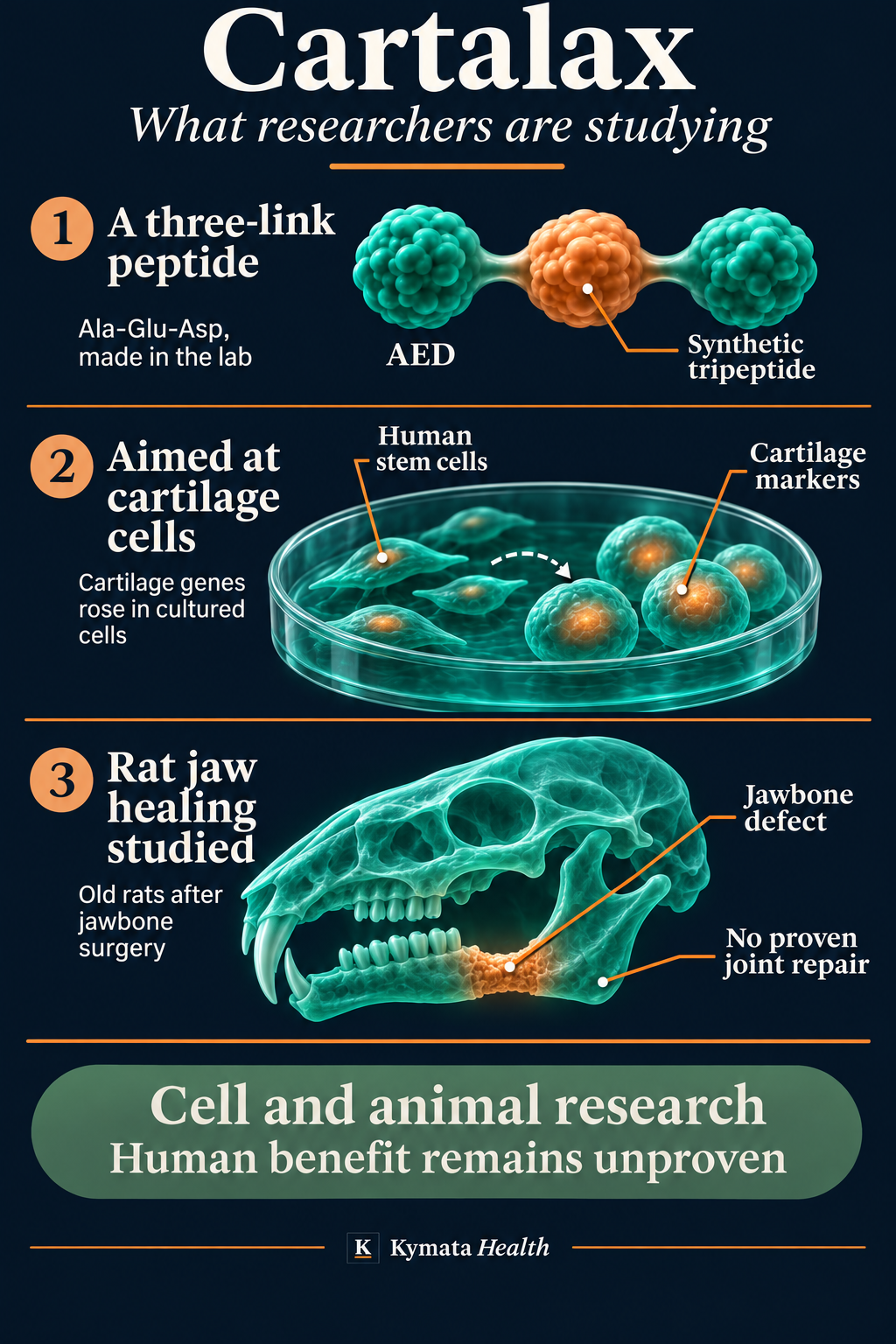
The guide shows Cartalax as the synthetic three-amino-acid peptide Ala-Glu-Asp (AED). Cartilage-related genes rose in cultured human stem cells (Myakisheva 2023), and jawbone healing after surgery was studied in old rats (Slugina 2016). Small human reports do not show cartilage repair. The drawing is a schematic, not a measured molecular structure, a product photograph or a treatment result. Illustration review: 22 November 2026, against this page’s own mechanism, evidence and regulatory records.
AED is the recorded catalogue letter order. It does not verify the contents or terminal chemistry of a commercial product or a measured molecular structure; no exact chemical model is inferred.
Illustration notes and source record
Why do researchers study Cartalax in cartilage?
Three amino acids. Cartalax is a synthetic peptide called AED. Its catalog lists capsules and a liquid for use under the tongue. Suppliers also list AED powder in vials for laboratory research.
What the cells made. In aging human stem cells grown in the lab, AED increased production of type II collagen and aggrecan. These proteins give cartilage structure and help it hold water.
Cartilage cells sit in a mesh of collagen and other proteins.
Earlier contextual illustration
Read the source record on this page. Laboratory, topical and injected studies are separate evidence; this illustration does not establish an indication or a treatment outcome.

Cartalax amino acid sequence
Each bead is one amino acid. Once it is part of the chain, it is called a residue. Drag to rotate or tap a bead. The shape is a schematic illustration.
- Nonpolar
- Acidic
Its short side branch mixes poorly with water. Chemists call this a nonpolar methyl group. Cartalax is the three-residue peptide AED. Sigumir is a cartilage-derived mixture. A vial of AED and a capsule of that mixture contain different materials.
Read the full sequence
A peptide bond is a covalent link joining two amino acids in a chain. A hydrogen bond is a weaker attraction, for example between a hydrogen on an oxygen and a nearby oxygen atom. A side chain may form hydrogen bonds without joining another amino acid to the chain. This diagram shows the sequence; it does not measure these interactions.
AED
- Alanine. Its short side branch mixes poorly with water. Chemists call this a nonpolar methyl group.
- Glutamate. Its side branch usually carries a negative charge near neutral pH, the middle of the acidity scale.
- Aspartate. Its side branch usually carries a negative charge near neutral pH, the middle of the acidity scale.
Cartalax product forms
Form labels checked Nov 7, 2026Cartalax is the three-residue peptide AED. Sigumir is a cartilage-derived mixture. A vial of AED and a capsule of that mixture contain different materials.
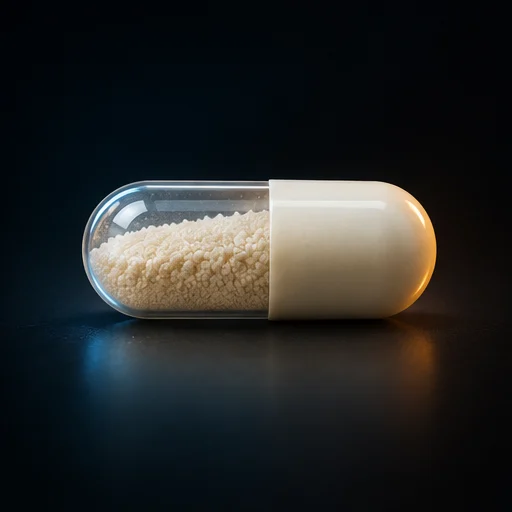
Oral capsule
The pack label states the ingredient and strength per capsule. Capsule contents are not for injection.
How to read capsule and liquid labels
Sublingual drops
The Cartalax Lingual pack contains a 10 mL bottle of liquid for use under the tongue. Look for “lingual” on the white bottle and pink carton. This is a different pack from the capsules and the laboratory vial.
See the Cartalax bottle and label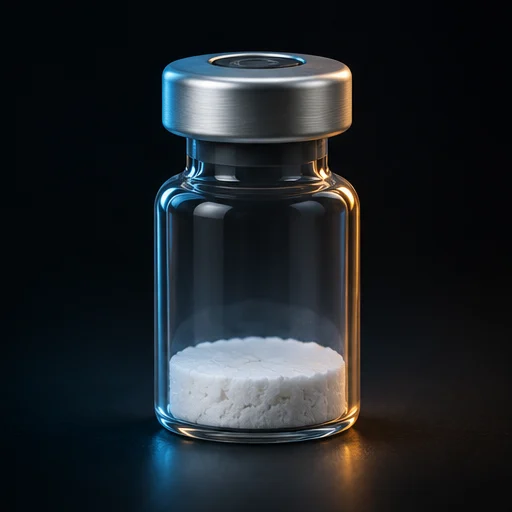
Research vial
The supplier identifies this material for laboratory research. A freeze-dried powder and a purity figure do not establish sterility or a route for human injection. Capsule instructions do not apply.
Laboratory product specificationIllustrations show the type of packaging. Check the name, contents and route on the actual pack. See product names and availability ↓
Inside the study
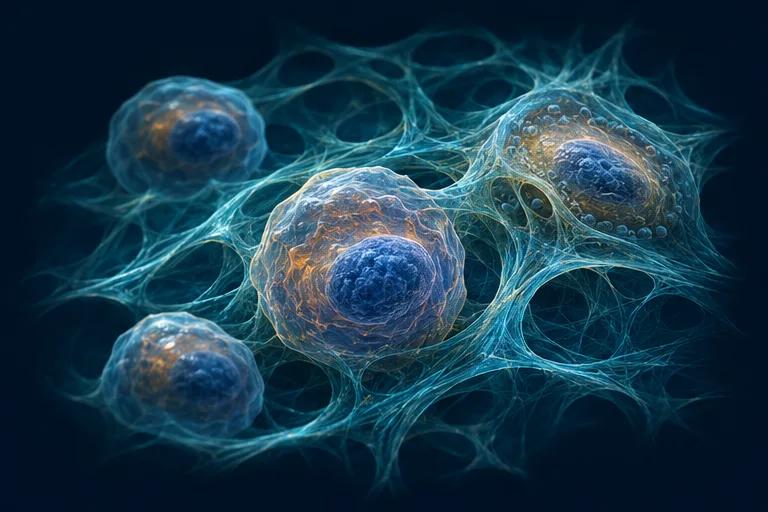
Researchers exposed aging human stem cells to AED and measured markers of cartilage formation. The experiment did not measure a change in knee pain or cartilage thickness in patients.
Myakisheva and colleagues, human stem-cell experiment ↗05 / Evidence and limits
Evidence and limits
Small human reports · no adequate controlled trial
Human evidence
Small human reports · no adequate controlled trial- In an unpublished 2005-2006 St. Petersburg institute report, 10 people with knee osteoarthritis who added oral Cartalax to usual care and 9 on usual care alone were compared, with less pain and better joint mobility described in 68.5% of cases and no meaningful X-ray change; the institute’s Sigumir report prints the same patient table (33 treated, 31 controls, 10 vs 9 knee patients) and the same 68.5% and 53.7% response figures, so these numbers cannot be counted as Cartalax-specific evidence. No randomization or blinding is described.
- In example 5 of patent WO2007139433A1, the inventors described 29 people aged 52-72 with knee osteoarthritis who were randomly divided into intramuscular H-Ala-Glu-Asp-OH and saline groups (12 on saline), reporting less pain and better movement in 54.5-62.7% of treated cases depending on severity, no significant X-ray change, and no pain results for the saline group.
- Serikov and colleagues (2022, PMID 36617325) followed men aged 35-74 with temporomandibular joint dysfunction who received unnamed “bioregulatory therapy” as part of combined treatment and reported that joint bone density and a functional-pathology index shifted from severe toward moderate in the older patients, with comparisons made against a healthy control group rather than an untreated patient group. The abstract does not name Cartalax or give group sizes.
Limits of current evidence
4 limits- The institute’s Cartalax and Sigumir reports (2005-2006) print the same patient table (33 treated, 31 controls; 10 and 9 knee patients) and the same 68.5% and 53.7% response figures, so neither counts as independent evidence for either product.
- The patent example compared intramuscular AED with saline but reported no pain results for the saline group.
- Cartilage-marker changes in cultured stem cells and jawbone healing in rats are not joint outcomes in people.
- A defined sequence is not an FDA indication, and a research vial’s identity needs an HPLC and mass-spectrometry report.
What it is studied for
- AED identity vs Sigumir
- Not an osteoarthritis treatment page
Verdict
Cartalax is the synthetic tripeptide AED (Ala-Glu-Asp). Its studies are mostly cell and animal work from the Khavinson group. Small, uncontrolled or poorly controlled human reports exist, but they do not show cartilage repair, and the institute’s knee-arthritis figures for Cartalax repeat those printed for Sigumir.
06 / Product forms and access
Product forms and access
Regulatory & legal status
- FDA status (US)
- Not approvedNot FDA-approved; sold as oral capsules and as research-labelled vials
- WADA status (2026)
- Not ListedNot currently on the WADA 2026 Prohibited List. Policies may change. Verify before competition.
- Classification
- Research Chemical
- US compounding
- Not eligible / not available
Cytogen (synthetic short peptide) · Cartilage
Identity
Canonical 41- Class
- Cytogen (synthetic short peptide)
- Organ
- Cartilage
- Target
- Cartilage
- System
- Musculoskeletal
- Sequence
- AED · Ala-Glu-Asp
In these Khavinson catalog sets
1 setManufacturer-style organ combinations, not FDA protocols. Every name links to its own page.
The Khavinson school
Cartalax is filed here as cytogen (synthetic short peptide), targeting the cartilage. Khavinson's St. Petersburg group moved from organ extracts (Cytamins) to capsule complexes (Cytomaxes) to synthetic short peptides (Cytogens); most of the evidence comes from that one group, with little independent Western replication.
Read the full background, the proposed epigenetic mechanism, the literature limits, and how we count the canonical 41 on the Khavinson bioregulators index.
History of this molecule
Khavinson’s group proposes that AED acts on gene expression in cartilage cells. The best-documented result is a 2023 cell-culture study: AED raised SOX9, aggrecan, type II collagen and COMP in aging human stem cells (PMID 37782646). A 2016 rat study reported better jawbone healing after surgery (PMID 28423258).
The human record is thin. A 2005-2006 institute report on oral Cartalax in knee osteoarthritis prints the same patient table and response percentages as the institute’s Sigumir report, and a patent example (WO2007139433A1) compared intramuscular AED with saline in 29 people without reporting pain results for the saline group. Neither shows cartilage repair. Gotratix is muscle, a different tissue, and intra-articular injection of a research cytogen is not supported by any of these papers.
A defined sequence is not an FDA indication. Cartilage cytogens sit in a Russian experimental-gerontology literature with limited Western replication. “Oral bioavailability because PEPT1” is real peptide-transport biology; it is not proof this SKU treats the organ disease. A purity chromatogram alone cannot identify a peptide sequence or establish that a preparation is sterile.
Full 41-map: Khavinson bioregulators index · Khavinson catalog sets
07 / Tools and practical checks
Tools and practical checks
No separate record is provided here. Read the linked evidence and limitations for this compound.
08 / Published study use
Published study use
What published studies gave, in whom, and the source. Not a dose for you.
What studies used
Small human reports; no dosing study- An institute report (2005-2006) compared oral Cartalax plus usual care with usual care alone in knee osteoarthritis (10 vs 9 people). Its patient table and response figures are identical to the institute’s Sigumir report.
- Patent WO2007139433A1 (example 5) describes 29 people with knee osteoarthritis randomly divided into intramuscular AED and saline groups, with less pain and better movement in 54.5 to 62.7% of treated cases and no pain results reported for the saline group.
- Aging human stem cells in culture: AED raised cartilage-marker genes (SOX9, aggrecan, type II collagen, COMP). No one was given the peptide. Myakisheva 2023, PMID 37782646 (opens in new tab)
- The doses quoted online come from animal work and vendor or forum sources.
A record of what researchers gave, in whom; not a dose for you.
Administration
- Route / form
- Oral capsule. The pack label states the ingredient and strength per capsule. Capsule contents are not for injection. Sublingual drops. The Cartalax Lingual pack contains a 10 mL bottle of liquid for use under the tongue. Look for “lingual” on the white bottle and pink carton. This is a different pack from the capsules and the laboratory vial. Research vial. The supplier identifies this material for laboratory research. A freeze-dried powder and a purity figure do not establish sterility or a route for human injection. Capsule instructions do not apply.
- Timing
- Any timing is on the manufacturer’s label; it is not a studied schedule, and this page does not restate it.
- Empty stomach?
- Label only: Food timing, if any, is on the manufacturer’s label. No published study sets it, and this page does not restate it.
Timeline
2 stages- Laboratory and animal studies
Cartilage-marker genes in cultured human stem cells (PMID 37782646) and jawbone healing in old rats at 60 to 120 days (PMID 28423258). These are not human joint measurements.
- Human reports
An institute knee report (Oct 2005-Feb 2006) whose figures duplicate the Sigumir report, and a 29-person patent example (WO2007139433A1). Neither establishes a benefit for knee cartilage.
Who it is for
1 use| Category | Fit | What exists |
|---|---|---|
| Cartilage / Joint Aging | Low | Cartilage-specific cytogen. Evidence is cell and animal work plus two small human reports with the limits described on this page. |
09 / Safety and interactions
Safety and interactions
What the record says
Not FDA-approved. The small human reports were too short and too small to establish safety, and no systematic safety study of Cartalax was found. Research vials are labeled for laboratory use; their identity and sterility are not verified for use in people.
Interactions & Contraindications
No interaction study of Cartalax was found. Arthritis care and its medicines stay with the treating clinician.
10 / Comparisons and goal guides
Comparisons and goal guides
Combinations: what has been tested
1 pairing- + Sigumir →Cytogen vs Cytomax. No study tested them together, and the institute’s reports on the two print identical knee figures.
11 / Common questions
Common questions
Common questions
10 answersWhich forms of Cartalax are documented, and which instructions apply to each?
Oral capsule. The pack label states the ingredient and strength per capsule. Capsule contents are not for injection. Sublingual drops. The Cartalax Lingual pack contains a 10 mL bottle of liquid for use under the tongue. Look for “lingual” on the white bottle and pink carton. This is a different pack from the capsules and the laboratory vial. Research vial. The supplier identifies this material for laboratory research. A freeze-dried powder and a purity figure do not establish sterility or a route for human injection. Capsule instructions do not apply.
Cartalax vs Sigumir vs BPC-157?
Cartalax = AED cytogen. Sigumir = cartilage and bone Cytomax extract. BPC-157 = Zagreb pentadecapeptide, different program.
Are the Cartalax and Sigumir knee figures independent?
No. The institute’s two 2005-2006 reports print the same patient table (33 treated, 31 controls) and the same 68.5% and 53.7% response figures under both product names, so neither can be counted as independent evidence.
Can it be injected into the joint?
Not a labeled viscosupplement. The patent example used intramuscular injection, not the joint, and no intra-articular study was found.
Sequence?
Ala-Glu-Asp (AED). PubChem CID 87815447 lists C12H19N3O8 and 333.29 g/mol.
Was Cartalax tested with Gotratix?
No study tested them together. Gotratix is a skeletal-muscle extract; Cartalax is the cartilage tripeptide AED.
What has Cartalax been studied for?
Most work is in cells and animals. Two small human reports exist: an institute report of oral Cartalax in knee osteoarthritis whose patient table duplicates the institute’s Sigumir report, and a patent example comparing intramuscular AED with saline in 29 people. Neither establishes a benefit for knee cartilage.
Are the Cartalax and Sigumir knee results the same data?
The two institute reports name different products, Cartalax (synthetic AED) and Sigumir (a cartilage and bone extract), but print an identical patient table (33 treated, 31 controls) and the same 68.5% and 53.7% response figures. Identical numbers under two product names cannot be counted as evidence for either one.
Was Cartalax tested for jaw-joint problems?
Iordanishvili and colleagues (2012, PMID 22708467) described 62 older patients with temporomandibular joint disease who received Sigumir, not Cartalax, within combined prosthetic, functional and drug treatment and reported faster pain relief and wider mouth opening, without a separate comparison group in the abstract. A 2022 jaw-joint study by Serikov and colleagues (PMID 36617325) describes unnamed “bioregulatory therapy”; its abstract does not name Cartalax.
Is Cartalax FDA-approved?
No. Not FDA-approved; sold as oral capsules and as research-labelled vials.
12 / Sources and references
Sources and references
6 papers cited on this page.
Sources
6 papers- 1“The influence of peptides on the chondrogenic differentiation of human mesenchymal stem cells during replicative aging.”Myakisheva SN, Linkova NS, Diatlova AS, Polyakova VO, Ryzhak GA Advances in Gerontology (Uspekhi Gerontologii) (2023). PMID: 37782646
- 2“Optimization of reparative osteogenesis of the jaws in aging (preclinical studies).”Slugina AS et al. Advances in Gerontology (2016). PMID: 28423258
- 3“Bioregulation therapy in the treatment of age-related osteoarthropathy of the temporomandibular joint (abstract names no product).”Serikov AA et al. Advances in Gerontology (2022). PMID: 36617325 DOI: 10.34922/AE.2022.35.5.006
- 4“Application of bioregulating therapy in complex treatment of temporomandibular joint diseases in people of elderly and senile age (Sigumir).”Iordanishvili AK et al. Advances in Gerontology (2012). PMID: 22708467
- 5“Cartalax in knee osteoarthritis, Oct 2005-Feb 2006 (patient table identical to the Sigumir report).”St. Petersburg Institute of Bioregulation and Gerontology Institute report (2006).
- 6“Patent WO2007139433A1, example 5: intramuscular AED vs saline in 29 people with knee osteoarthritis.”Khavinson VKh and colleagues (inventors) International patent application (2007).
14 / Prescription options
Prescription options
Oral tissue-peptide capsules sold by Vita-Stream, house line first: a different product from the Cartalax studied above.
Capsule form
Paid links · we earn a commissionOral capsuleAffiliate links: we earn a commission if you buy, at no extra cost to you.
- Browse Cartesyl (paid link, opens in new tab)
Cartesyl is Vita-Stream's US-made cartilage peptide capsule (Vita Peptides' own house line), a different product from Cartalax. No trial has tested it.
- Per capsule
- 15 mg active natural peptides
Label wording as Vita-Stream's product page states it, read 19 October 2026. Follow the label on the bottle you buy.
- In Khavinson’s lab work, synthetic short peptides modeled on a tissue’s peptide extract stimulated the growth of cultured rat explants of that same tissue. Khavinson 2001, PMID 11713572 (opens in new tab)
- His group proposes that such peptides act on gene expression in the cells they reach; most of that work is in cells and animals. Khavinson 2021 review, PMID 34834147 (opens in new tab)
These statements have not been evaluated by the FDA. These products are not intended to diagnose, treat, cure, or prevent any disease.
Use code KymataLabs at checkout
15 / Peptide library
Peptide library
← Back to Peptide LibraryKhavinson catalog sets
Keep reading: Peptide research library
Peptide research library: every pagePeptide libraryBrowse all topics
- LivagenPrevious in this topic · Livagen (Lys-Glu-Asp-Ala) is a short synthetic peptide (cytogen) from the Khavinson group; its published studies, mostly Russian cell and animal work, examined liver tissue and…
- VesugenNext in this topic · Vesugen (Lys-Glu-Asp) is a short synthetic peptide (cytogen) from the Khavinson group; its published studies, mostly Russian cell and animal work, examined blood-vessel wall cells.
- BronchogenBronchogen (Ala-Glu-Asp-Leu) is a short synthetic peptide (cytogen) from the Khavinson group; its published studies, mostly Russian cell and animal work, examined bronchial and…
- CardiogenCardiogen (Ala-Glu-Asp-Arg) is a short synthetic peptide (cytogen) from the Khavinson group; its published studies, mostly Russian cell and animal work, examined heart tissue.
- ChelohartChelohart is a Cytomax capsule bioregulator, a peptide fraction from animal heart tissue; published work on it comes mostly from the developers' own Russian studies of heart…
Regulatory and sport classification
- Not FDA-approved; sold as oral capsules and as research-labelled vials