
The peptide field guide
Thymosin Beta-4
Thymosin beta-4 is the body’s own 43-amino-acid actin-binding peptide, not the TB-500 fragment.
Small eye-drop trials for dry eye gave mixed results; they do not establish other uses.
Explore this compoundConceptual editorial illustration; not a measured molecular structure, product photograph or treatment result.
02 / At a glance
At a glance
Key facts
- Also known as
- TB4, Tβ4, Full-length thymosin beta-4
- Type
- Healing & Recovery
- Evidence level
- Human trials, mixed results: benefit not established.
- US regulatory status
- Not FDA-approved, research chemical
- Updated
Identity
Thymosin beta-4 is the body’s own 43-amino-acid actin-binding peptide, not the TB-500 fragment.
Research context
Catalogue identity comparison only; no patient-study results are depicted.
Evidence limits
Small eye-drop trials for dry eye gave mixed results; they do not establish other uses.
Read the technical profile and study-use reference
Quick answer
Evidence: ModerateThymosin β4 is the endogenous 43-amino-acid G-actin-sequestering peptide (CAS 77591-33-4, ~4963 Da). That is not TB-500. Commercial TB-500 is usually the 7-mer Ac-LKKTETQ. Human trial programs (ophthalmic, dermal, cardiac) used formulated 43-mer; a 72-participant phase 2 eye study did not meet its primary endpoints (PMID 26056426). Research-chem vials labeled TB4 are often the fragment. Confirm the COA before you math a dose.
- In published studies
- Trial amounts are recorded under What studies used (PMID 20536472)
Research summary, not medical advice.
At a glance
Kymata peptide profile · Nov 6, 2026- Common vials
- 5 mg
- Molecular weight
- 4963.4 g/mol
- CAS
- 77591-33-4
- In published studies
- Trial amounts are recorded under What studies used (PMID 20536472)
- Half-life
- Hours-class in some models; SKU PK unpublished. No 12–24 h fragment figure is established.
03 / Identity and origin
Identity and origin
Also called TB4, Tβ4, Full-length thymosin beta-4. Endogenous G-actin-sequestering peptide (full-length Tβ4).
Read the sequence and compound record
Compound card
- Sequence
- 43-aa parent (Ac-SDKP…AGES). Not Ac-LKKTETQ.
- Class
- Endogenous G-actin-sequestering peptide (full-length Tβ4)
- Formula
- C212H350N56O78S
- Molecular weight
- 4963.4 g/mol
- CAS
- 77591-33-4
- Described by
- Allan Goldstein (identified from thymus extracts), 1981
- Bioavailability
- Subcutaneous injection, ocular drops (research programs used formulated 43-mer, not gray-market vials)
04 / How it may work
How it may work
Endogenous G-actin-sequestering peptide (full-length Tβ4)
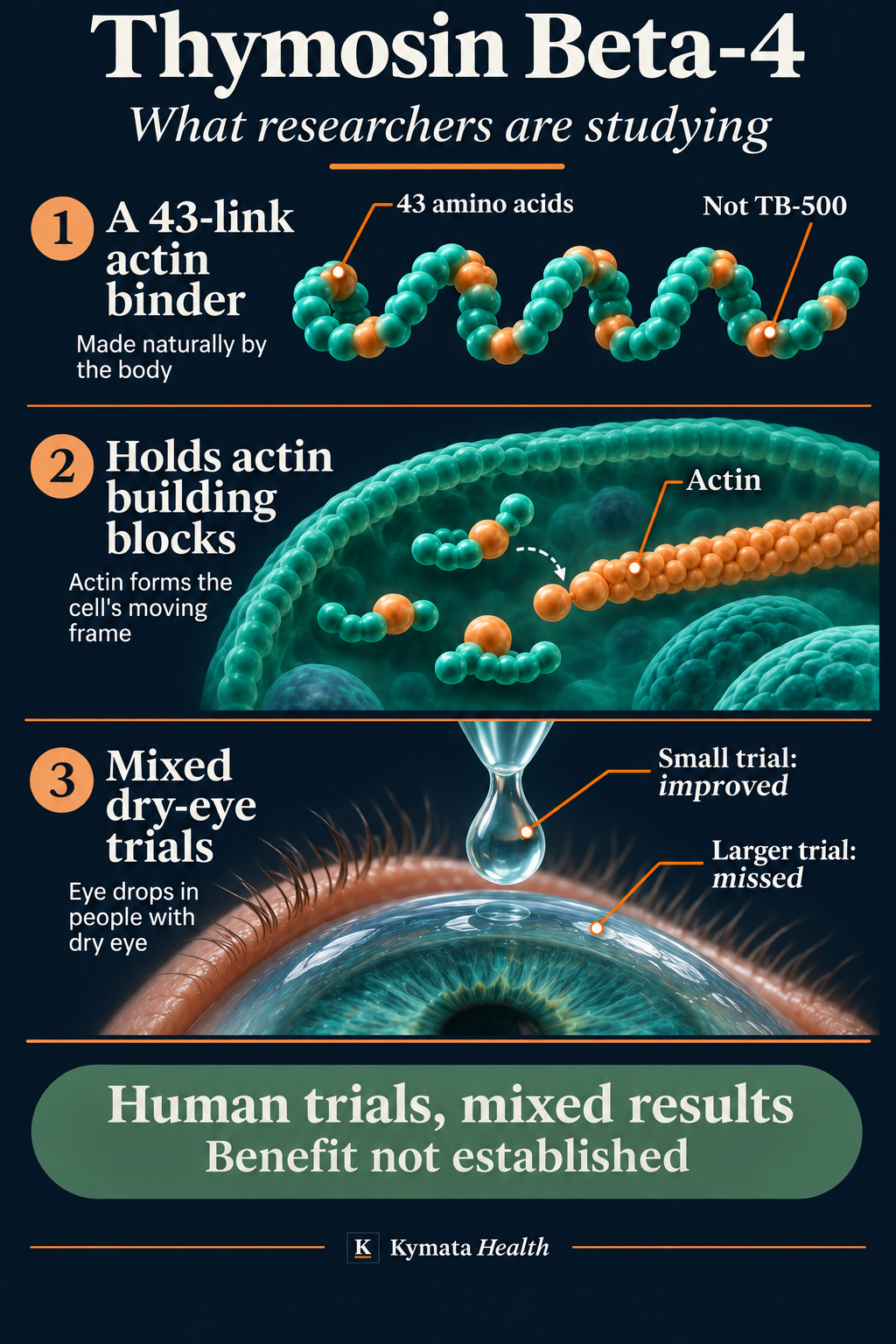
The guide shows thymosin beta-4 as the body's own 43-amino-acid peptide that holds actin building blocks; it is not the TB-500 fragment. In formulated eye-drop studies for dry eye, a nine-patient trial reported improvements at selected assessments, while a 72-participant trial did not meet either primary endpoint. These eye studies do not establish other uses. The drawing is a schematic, not a measured molecular structure, a product photograph or a treatment result. Illustration review: 22 November 2026, against this page’s own mechanism, evidence and regulatory records.
Residue letters are not a measured molecular structure or a test of a commercial product; terminal chemistry is not modeled.
Illustration notes and source record
Read the source record on this page. Laboratory, topical and injected studies are separate evidence; this illustration does not establish an indication or a treatment outcome.

How it works
SourcedThymosin β4 is the full-length 43-amino-acid actin-binding peptide; TB-500 often refers to the shorter Ac-LKKTETQ fragment. A product name alone does not establish its sequence. The human eye studies below tested formulated Tβ4, not an oral capsule or a research-vial preparation. Two phase 2 reports differ: a nine-patient severe-dry-eye trial reported improvements at selected assessments (PMID 25826322), while a separate 72-participant controlled-environment study found no significant difference on either prespecified primary endpoint (PMID 26056426). Secondary findings do not turn that primary result into a positive trial, and neither study establishes tendon-healing efficacy.
Source: PMID: 20536467
Full Tβ4 is ~4963 Da, CAS 77591-33-4. TB-500 is Ac-LKKTETQ, ~889 Da, CAS 885340-08-9. Many bottles labeled “TB4” are the fragment. Use the TB-500 page if that is what you have.
Background & History
Thymosin β4 is the 43-aa G-actin-sequestering peptide (CAS 77591-33-4, ~4963 Da). TB-500 as sold is usually the 7-mer Ac-LKKTETQ, not a 17-aa fragment. The 72-participant phase 2 dry-eye study of formulated Tβ4 eye drops found that neither prespecified primary endpoint differed significantly from placebo (PMID 26056426). Those findings do not establish efficacy for the TB-500 fragment. Research-chem “TB4” is often the fragment. Confirm the COA.
05 / Evidence and limits
Evidence and limits
Limits of current evidence
3 limits- The nine-patient severe-dry-eye study (PMID 25826322) is not the 72-participant controlled-environment study (PMID 26056426). Small samples, selected time points and different endpoints limit generalization.
- In the 72-participant study, neither ocular discomfort nor inferior corneal staining differed significantly at the prespecified primary assessment; some secondary and ad hoc analyses favored Tβ4 (PMID 26056426).
- These ophthalmic studies do not establish an oral-capsule formulation, research-vial equivalence, long-term systemic safety or efficacy for tendon injury.
Published Trial Data
2 trials| Study | Phase | Summary | Source |
|---|---|---|---|
| RGN-259 eye drops; nine patients with severe dry eye (2015) | Phase 2 | Randomized, double-masked vehicle-controlled study. Selected symptom/sign assessments favored RGN-259; the small sample and multiple time points limit certainty. Not an oral or tendon study (PMID 25826322). | Source |
| RGN-259 eye drops; 72 participants, controlled adverse environment (2015) | Phase 2 | Neither prespecified primary endpoint (ocular discomfort or inferior corneal staining) differed significantly from placebo. Some secondary outcomes favored Tβ4; these do not establish primary-endpoint success (PMID 26056426). | Source |
What it is studied for
- Full-length 43-mer identity (vs TB-500)
- Not the TB-500 fragment
Verdict
Full-length thymosin β4 and the TB-500 fragment are different formulations. Small human eye studies of formulated Tβ4 do not establish efficacy for oral capsules, research vials or tendon injury. The trial table separates exploratory improvements from a study that did not meet its primary endpoints.
06 / Product forms and access
Product forms and access
Regulatory & legal status
- FDA status (US)
- Research Only
- WADA status (2026)
- Prohibited (S0)Competitive athletes subject to anti-doping controls should not use Thymosin Beta-4.
- US compounding
- Not eligible / not available
07 / Tools and practical checks
Tools and practical checks
Dose it
5 mg + 2 mL BAC water → 2.5 mg/mL · 1 unit (U-100) = 25 mcg.
Reconstitution math
U-100 syringe| Vial | Water | Concentration |
|---|---|---|
| 5 mg (43-mer) | 2.0 mL BAC | 2.5 mg/mL |
08 / Published study use
Published study use
What published studies gave, in whom, and the source. Not a dose for you.
What studies used
Phase 1 and small eye trials- Healthy volunteers, four groups of 10 with placebo: 42, 140, 420 or 1,260 mg by IV, once and then daily for 14 days. No dose-limiting toxicity. Ruff 2010, PMID 20536472 (opens in new tab)
- 9 people with severe dry eye: 0.1% eye drops (RGN-259) six times a day for 28 days, against vehicle. Sosne 2015, PMID 25826322 (opens in new tab)
- Neither study used TB-500, the short fragment sold in vials.
A record of what researchers gave, in whom; not a dose for you.
Administration
- Route / form
- Route used in studies: IV infusion (phase 1 safety study) and eye drops (dry eye). Neither used TB-500.
Who it is for
2 uses| Category | Fit | What exists |
|---|---|---|
| Need the parent molecule | Moderate | This is the 43-mer with the human trial record. Confirm CAS 77591-33-4. |
| Need the fragment SKU | Low | That is TB-500 (Ac-LKKTETQ). Do not dual-count. |
09 / Safety and interactions
Safety and interactions
What the record says
Safety observations from formulated eye-drop studies cannot establish systemic or research-vial safety. The 72-participant phase 2 study reported no significant treatment-related safety issue within its limited study window (PMID 26056426); this does not establish long-term safety, cancer safety or suitability for an individual.
Interactions & Contraindications
Cell-migration and angiogenesis signaling is the theoretical caution in active malignancy. Research compound. No established drug-interaction file for gray-market 43-mer lots.
10 / Comparisons and goal guides
Comparisons and goal guides
Combinations: what has been tested
2 pairings- + TB-500 →Parent vs fragment. Do not dual-count. If the COA is Ac-LKKTETQ, use the TB-500 page.
- + BPC-157 →Common pair. Complementary marketing (actin vs gastric 15-mer) is not a synergy RCT.
11 / Common questions
Common questions
Common questions
9 answersIs thymosin β4 the same as TB-500?
No. This page is the 43-mer (CAS 77591-33-4, ~4963 Da). TB-500 as sold is usually Ac-LKKTETQ (CAS 885340-08-9, ~889 Da). Read the COA.
Does TB-500 have a longer half-life than Tβ4?
That is not established. Fragment vs parent PK is not a sourced head-to-head we will treat as fact. See the TB-500 page for what is actually published (equine detection work, not a human t½ table).
What dose did studies use for thymosin beta-4?
A phase 1 safety study in healthy volunteers gave it by IV for 14 days (PMID 20536472), and a small dry-eye trial tested 0.1% eye drops for 28 days (PMID 25826322). Neither used TB-500.
How do I reconstitute a 5 mg 43-mer vial?
A 5 mg vial in 2.0 mL of water is 2.5 mg/mL (each U-100 unit is 25 mcg). That is arithmetic, not a dose: no study has established a human dose of thymosin beta-4, and we give none.
Did human trials use this peptide?
The two eye studies in the trial table tested formulated Tβ4, not TB-500 capsules or research vials. A nine-patient study reported exploratory improvements (PMID 25826322); a separate 72-participant study did not meet its primary endpoints (PMID 26056426).
Does a thymosin beta-4 capsule have the same evidence as eye drops?
No. The eye-drop studies do not establish oral absorption, an effective capsule formulation or equivalent outcomes. Formulation and population must match before findings can be applied.
Has it been tested with BPC-157?
One rat study has tested the pair: in 32 rats after Achilles tendon repair (Biçer 2026, PMID 42542926), load to failure at four weeks rose significantly only with TB-500 (a product sold as a thymosin beta-4 fragment), and the combination gave no added benefit over either peptide alone. No human study has tested it. We give no stacking advice.
Is it FDA-approved?
No approved US drug for “heal my tendon.” Ophthalmic and cardiac programs were development paths, not a research-chem label.
What about cancer risk?
Cell-migration and angiogenesis signaling is a theoretical concern with active cancer; no human data. There is no human oncology indication either direction.
12 / Sources and references
Sources and references
3 papers cited on this page.
Sources
3 papers- 1“Thymosin β4 significantly improves signs and symptoms of severe dry eye in a phase 2 randomized trial.”Sosne G, Dunn SP, Kim C Cornea (2015). PMID: 25826322
- 2“Thymosin beta 4 ophthalmic solution for dry eye: randomized placebo-controlled phase II trial using the controlled adverse environment model.”Sosne G, Ousler GW Clinical Ophthalmology (2015). PMID: 26056426
- 3“"Thymosin beta4: actin-sequestering protein moonlights to repair injured tissues".”Goldstein AL et al. Trends in Molecular Medicine (2005). PMID: 16099219
14 / Prescription options
Prescription options
Prescription options: compare licensed telehealth providers
Some peptide therapies are available only by prescription after a consult with a licensed clinician.
Compare telehealth →15 / Peptide library
Peptide library
Keep reading: Peptide research library
Peptide research library: every pagePeptide libraryBrowse all topics
- VasopressinPrevious in this topic · Vasopressin is a hormone that narrows blood vessels and helps the kidneys retain water.
- GhrelinNext in this topic · Ghrelin is a 28-amino-acid stomach hormone that activates the growth hormone secretagogue receptor (GHS-R1a); infusions have been studied in small human trials of appetite, GH…
- Melanotan 1Afamelanotide (Scenesse), the approved form of melanotan I, is a synthetic alpha-MSH analog that acts at MC1R; it is FDA- and EMA-approved as an implant to increase pain-free…
- ArgirelineArgireline (acetyl hexapeptide-8) is a cosmetic peptide modeled on part of the SNAP-25 protein; one 60-person randomized trial reported fewer eye-area wrinkles than placebo, and…
- Snap-8Snap-8 (acetyl octapeptide-3) is a cosmetic peptide that extends the Argireline sequence by two amino acids; published studies tested it only inside multi-ingredient serums and…
Regulatory and sport classification
- Not FDA-approved, research chemical
- WADA (S0): prohibited in sport at all times