
The peptide field guide
Argireline
Argireline is acetyl hexapeptide-8, used as a topical cosmetic ingredient.
Cosmetic ingredient, not a drug. One positive and one null small skin trial.
Explore this compoundConceptual editorial illustration; not a measured molecular structure, product photograph or treatment result.
02 / At a glance
At a glance
Key facts
- Also known as
- Acetyl hexapeptide-8, Acetyl hexapeptide-3
- Type
- Cosmetic Peptide
- Evidence level
- Cosmetic ingredient: not a drug.
- US regulatory status
- Cosmetic ingredient, not a drug
- Updated
Identity
Argireline is acetyl hexapeptide-8, used as a topical cosmetic ingredient.
Research context
A laboratory SNARE proposition, separate from the skin trials: a 4-week randomized trial in 60 adults found fewer eye-area wrinkles than placebo (Wang 2013), and a 4-week split-face study in 19 women found no difference (Henseler 2023).
Evidence limits
Cosmetic ingredient, not a drug. One positive and one null small skin trial.
Read the technical profile and study-use reference
Quick answer
Evidence: LowArgireline (acetyl hexapeptide-8) is a cosmetic peptide modeled on part of the SNAP-25 protein; one 60-person randomized trial reported fewer eye-area wrinkles than placebo, and a 19-person split-face study found no difference.
- In published studies
- Trial amounts are recorded under What studies used (PMID 23417317)
Research summary, not medical advice.
At a glance
Kymata peptide profile · Oct 30, 2026- Molecular weight
- 888.99 g/mol
- CAS
- 616204-22-9
- In published studies
- Trial amounts are recorded under What studies used (PMID 23417317)
- Half-life
- No human topical half-life has been published
- Common vials
- Topical cosmetic ingredient; not a calculator product
03 / Identity and origin
Identity and origin
Also called Acetyl hexapeptide-8, Acetyl hexapeptide-3. Acetyl hexapeptide-8 (topical SNARE-targeting cosmetic).
Read the sequence and compound record
Compound card
- Class
- Acetyl hexapeptide-8 (topical SNARE-targeting cosmetic)
- Formula
- C34H60N14O12S
- Molecular weight
- 888.99 g/mol
- CAS
- 616204-22-9
- PubChem CID
- N/A
- Described by
- Lipotec (Lubrizol), 2002 (first publication)
- Bioavailability
- Mostly stays in the outer skin layer in laboratory skin tests (PMID 24754410)
04 / How it may work
How it may work
Acetyl hexapeptide-8 (topical SNARE-targeting cosmetic)
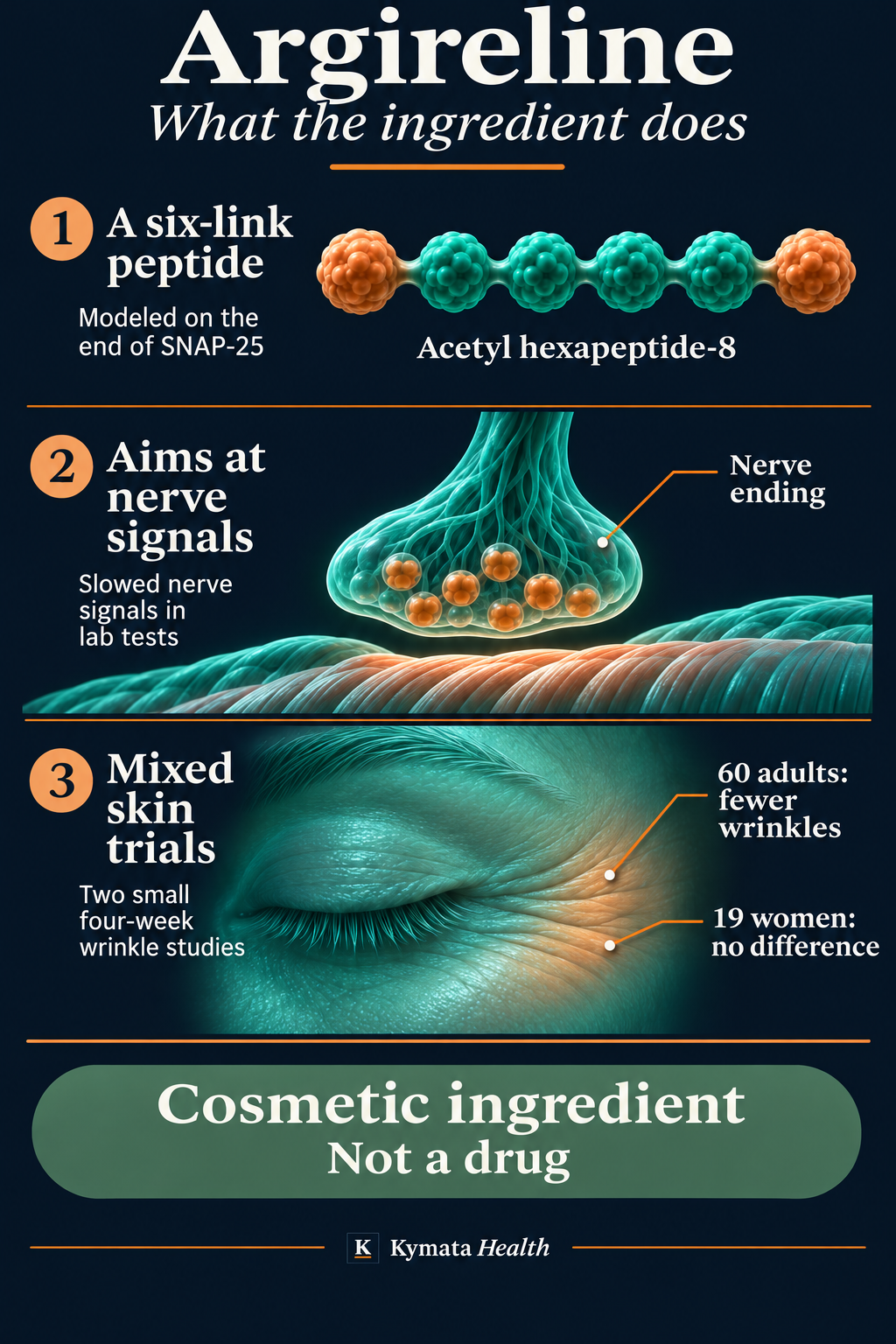
The guide shows Argireline as acetyl hexapeptide-8, a six-amino-acid peptide modeled on the end of SNAP-25, a protein that helps nerve endings release their signal. In the developer’s laboratory work it slowed that release machinery. In skin, a 4-week randomized trial in 60 adults found fewer eye-area wrinkles than placebo (Wang 2013), while a 4-week split-face study in 19 women found no difference (Henseler 2023). It is a cosmetic ingredient, not a drug. The drawing is a schematic, not a measured molecular structure, a product photograph or a treatment result. Illustration review: 22 November 2026, against this page’s own mechanism, evidence and regulatory records.
The retained record identifies acetyl hexapeptide-8 without a verified residue list. A sequence is not inferred from the product name or the different SNAP-8 peptide.
Illustration notes and source record
Read the source record on this page. Laboratory, topical and injected studies are separate evidence; this illustration does not establish an indication or a treatment outcome.

How it works
Argireline is acetyl hexapeptide-8 (older ingredient name: acetyl hexapeptide-3), a six-amino-acid peptide modeled on the end of SNAP-25, one of the proteins that lets nerve endings release acetylcholine. In the developer's laboratory work it interfered with assembly of that release machinery (the SNARE complex) and reduced neurotransmitter release, far less effectively than botulinum toxin (Blanes-Mira 2002, PMID 18498523).
Whether enough reaches the nerve endings under facial skin is the open question. In an FDA laboratory study on human cadaver and guinea-pig skin, most of an applied 10% emulsion washed off the surface, about 0.22% of the dose stayed in the outer layer of human skin, about 0.01% reached the epidermis, and none was detected in the dermis (Kraeling 2015, PMID 24754410).
Background & History
Argireline was developed by Lipotec (now part of Lubrizol) in Barcelona and first described in 2002 as a cosmetic peptide aimed at the nerve-to-muscle signal behind expression lines. It is often marketed as a topical alternative to botulinum toxin, but no trial has compared the two, and its human evidence is one positive 60-person randomized trial (PMID 23417317) and one null 19-person split-face study (PMID 38024099).
05 / Evidence and limits
Evidence and limits
One positive randomized trial, one null split-face study
Human evidence
One positive randomized trial, one null split-face study- People counted
- 79
- Studies listed here
- 2
- Null / negative
- 1
- In a 4-week randomized, placebo-controlled trial in 60 Chinese adults (assigned 3 to 1, argireline to placebo), 48.9% of the argireline group met the investigators' criterion for improved eye-area wrinkles versus 0% on placebo, and skin-replica roughness fell only with argireline (Wang 2013, PMID 23417317).
- In a 4-week double-blind split-face study in 19 women, a serum with argireline on one side and the same serum without it on the other showed no significant difference between sides in camera-measured wrinkle score (Henseler 2023, PMID 38024099).
- The developer's 2002 report of up to 30% lower wrinkle depth after 30 days came from a small manufacturer test whose abstract gives no sample size (PMID 18498523).
Limits of current evidence
2 limits- One positive 60-person randomized trial (PMID 23417317) and one null 19-person split-face study (PMID 38024099), both 4 weeks.
- SNAP-8 is a related but different sequence.
Published Trial Data
2 trials| Study | Phase | Summary | Source |
|---|---|---|---|
| Wang 2013, randomized placebo-controlled trial | Cosmetic trial | In 60 Chinese adults randomized 3 to 1 for 4 weeks, 48.9% of the argireline group met the investigators' global criterion for improved eye-area wrinkles versus 0% on placebo, and replica roughness fell only with argireline (PMID 23417317). | Source |
| Henseler 2023, split-face serum study | Cosmetic study | In 19 women using an argireline serum on one side and the same serum without it on the other for 4 weeks, camera-measured wrinkle scores did not differ significantly between sides (PMID 38024099). | Source |
What it is studied for
- Expression-line cosmetics (appearance)
Verdict
Argireline is acetyl hexapeptide-8, a topical expression-line peptide. It is not botulinum toxin. Empty vial list: do not BAC-water this.
06 / Product forms and access
Product forms and access
Regulatory & legal status
- FDA status (US)
- Not approvedAcetyl hexapeptide-8, a topical cosmetic ingredient, not an FDA-approved drug. Cosmetic ingredients do not need FDA approval before sale; a product intended for a therapeutic use or to affect the body's structure or function is regulated as a drug (FDA, checked Nov 22, 2026)
- WADA status (2026)
- Not ListedNot currently on the WADA 2026 Prohibited List. Policies may change. Verify before competition.
- US compounding
- Not eligible / not available
07 / Tools and practical checks
Tools and practical checks
No separate record is provided here. Read the linked evidence and limitations for this compound.
08 / Published study use
Published study use
What published studies gave, in whom, and the source. Not a dose for you.
What studies used
Two small skin trials, one null- 60 Chinese adults randomized 3 to 1 to argireline or placebo around the eyes for 4 weeks; 48.9% of the argireline group met the investigators' improvement criterion versus 0% on placebo. The abstract does not give the concentration. Wang 2013, PMID 23417317 (opens in new tab)
- 19 women: a serum with argireline on one side of the face and the same serum without it on the other for 4 weeks; no significant difference between sides. Henseler 2023, PMID 38024099 (opens in new tab)
- Healthy women in a manufacturer test: an emulsion with 10% of the hexapeptide for 30 days; wrinkle depth fell by up to 30%, with no sample size in the abstract. Blanes-Mira 2002, PMID 18498523 (opens in new tab)
A record of what researchers gave, in whom; not a dose for you.
Administration
- Route / form
- Route used in studies: a cream or serum applied to the skin around the eyes.
Who it is for
1 use| Category | Fit | What exists |
|---|---|---|
| Expression lines (appearance) | Low | One positive 60-person randomized trial (PMID 23417317) and one null 19-person split-face study (PMID 38024099). |
09 / Safety and interactions
Safety and interactions
What the record says
Both trials reported no significant adverse reactions over 4 weeks (PMID 23417317, 38024099). Neither was large or long enough to find uncommon reactions. In laboratory skin tests almost none reached the dermis (PMID 24754410), which also means effects on the muscles under the skin are unproven.
Interactions & Contraindications
Applied to the skin. No interaction studies with other cosmetic or drug products have been published.
10 / Comparisons and goal guides
Comparisons and goal guides
There is no separate comparison record on this page. Similar names do not establish that products or their evidence are interchangeable.
11 / Common questions
Common questions
Common questions
4 answersIs Argireline like Botox?
Both target the release of acetylcholine from nerve endings, but botulinum toxin is injected and cuts SNAP-25, while argireline is applied to the skin and only interfered with the release machinery in laboratory tests, much more weakly (PMID 18498523). In laboratory skin tests almost none of it reached the dermis (PMID 24754410). No trial has compared the two.
What did the trials find?
A 4-week randomized trial in 60 adults found 48.9% of the argireline group improved on the investigators' wrinkle rating versus 0% on placebo (PMID 23417317). A 4-week split-face study in 19 women found no significant difference between the argireline side and the plain side (PMID 38024099).
Is SNAP-8 the same thing?
No. SNAP-8 is acetyl octapeptide-3, a longer, eight-amino-acid peptide. Its published studies tested multi-ingredient serums and patches, so its own effect has not been separated out.
Is Argireline FDA-approved?
No. Acetyl hexapeptide-8, a topical cosmetic ingredient, not an FDA-approved drug. Cosmetic ingredients do not need FDA approval before sale; a product intended for a therapeutic use or to affect the body's structure or function is regulated as a drug (FDA, checked Nov 22, 2026).
12 / Sources and references
Sources and references
5 papers cited on this page.
Sources
5 papers- 1“The anti-wrinkle efficacy of argireline, a synthetic hexapeptide, in Chinese subjects: a randomized, placebo-controlled study.”Wang Y, Wang M, Xiao S, et al. American Journal of Clinical Dermatology (2013). PMID: 23417317 DOI: 10.1007/s40257-013-0009-9
- 2“Investigating the effects of Argireline in a skin serum containing hyaluronic acids on skin surface wrinkles using the Visia Complexion Analysis camera system.”Henseler H GMS Interdisciplinary Plastic and Reconstructive Surgery DGPW (2023). PMID: 38024099 DOI: 10.3205/iprs000179
- 3“A synthetic hexapeptide (Argireline) with antiwrinkle activity.”Blanes-Mira C, Clemente J, Jodas G, et al. International Journal of Cosmetic Science (2002). PMID: 18498523 DOI: 10.1046/j.1467-2494.2002.00153.x
- 4“In vitro skin penetration of acetyl hexapeptide-8 from a cosmetic formulation.”Kraeling ME, Zhou W, Wang P, Ogunsola OA Cutaneous and Ocular Toxicology (2015). PMID: 24754410 DOI: 10.3109/15569527.2014.894521
- 5“FDA Authority Over Cosmetics: How Cosmetics Are Not FDA-Approved, but Are FDA-Regulated.”US Food and Drug Administration FDA (2026).
14 / Prescription options
Prescription options
Prescription options: compare licensed telehealth providers
Some peptide therapies are available only by prescription after a consult with a licensed clinician.
Compare telehealth →15 / Peptide library
Peptide library
Keep reading: Peptide research library
Peptide research library: every pagePeptide libraryBrowse all topics
- Melanotan 1Previous in this topic · Afamelanotide (Scenesse), the approved form of melanotan I, is a synthetic alpha-MSH analog that acts at MC1R; it is FDA- and EMA-approved as an implant to increase pain-free…
- Snap-8Next in this topic · Snap-8 (acetyl octapeptide-3) is a cosmetic peptide that extends the Argireline sequence by two amino acids; published studies tested it only inside multi-ingredient serums and…
- MatrixylMatrixyl (palmitoyl pentapeptide-4) is a cosmetic lipopeptide whose KTTKS sequence raised collagen production in fibroblast cultures; one 12-week split-face trial in 93 women…
- KyotorphinResearchers have measured native kyotorphin (Tyr-Arg) in human spinal fluid and blood.
- TabimorelinTabimorelin (NN703) is an orally active growth hormone secretagogue that reached Phase 2 trials in adults with growth hormone deficiency before its development stopped.
Regulatory and sport classification
- Cosmetic ingredient, not a drug