
The peptide field guide
Vasopressin
The body’s nine-amino-acid water hormone, also given as a drug in critical care.
FDA-approved for hospital use. Critical care only.
Explore this compoundConceptual editorial illustration; not a measured molecular structure, product photograph or treatment result.
02 / At a glance
At a glance
Key facts
- Also known as
- ADH, Arginine vasopressin, AVP, Pitressin, Antidiuretic hormone
- Type
- Clinical / Pharmaceutical
- Evidence level
- FDA-approved for hospital use: critical care only.
- US regulatory status
- FDA-approved for intravenous use (Vasostrict® and generics) to raise blood pressure in vasodilatory shock
- Updated
Identity
The body’s nine-amino-acid water hormone, also given as a drug in critical care.
Research context
It acts on V2 receptors in the kidneys to hold water and on V1 receptors in blood vessels to raise blood pressure; in hospitals it is given by IV infusion for shock.
Evidence limits
FDA-approved for hospital use. Critical care only.
Read the technical profile and study-use reference
Quick answer
Evidence: HighVasopressin is a hormone that narrows blood vessels and helps the kidneys retain water. Vasostrict is FDA-approved to raise blood pressure in adults with vasodilatory shock whose pressure stays low despite fluids and catecholamines. In the VASST septic-shock trial, it did not significantly improve 28-day survival compared with norepinephrine.
- FDA label dose
- FDA label (Vasostrict): IV infusion in shock
Research summary, not medical advice.
At a glance
Kymata peptide profile · Nov 22, 2026- Molecular weight
- 1084.2 g/mol
- CAS
- 113-79-1
- FDA label dose
- FDA label (Vasostrict): IV infusion in shock
- Half-life
- ≤10 minutes (IV infusion in shock)
- Common vials
- Ready-to-use solution; no reconstitution in this calculator
03 / Identity and origin
Identity and origin
Also called ADH, Arginine vasopressin, AVP, Pitressin, Antidiuretic hormone. Arginine vasopressin (ADH; ICU/endocrine drug class).
Read the sequence and compound record
Compound card
- Class
- Arginine vasopressin (ADH; ICU/endocrine drug class)
- Formula
- C46H65N15O12S2
- Molecular weight
- 1084.2 g/mol
- CAS
- 113-79-1
- PubChem CID
- 644077
- Described by
- Vincent du Vigneaud (identified structure 1953, Nobel Prize), 1953
- Bioavailability
- Intravenous injection/infusion
04 / How it may work
How it may work
Arginine vasopressin (ADH; ICU/endocrine drug class)
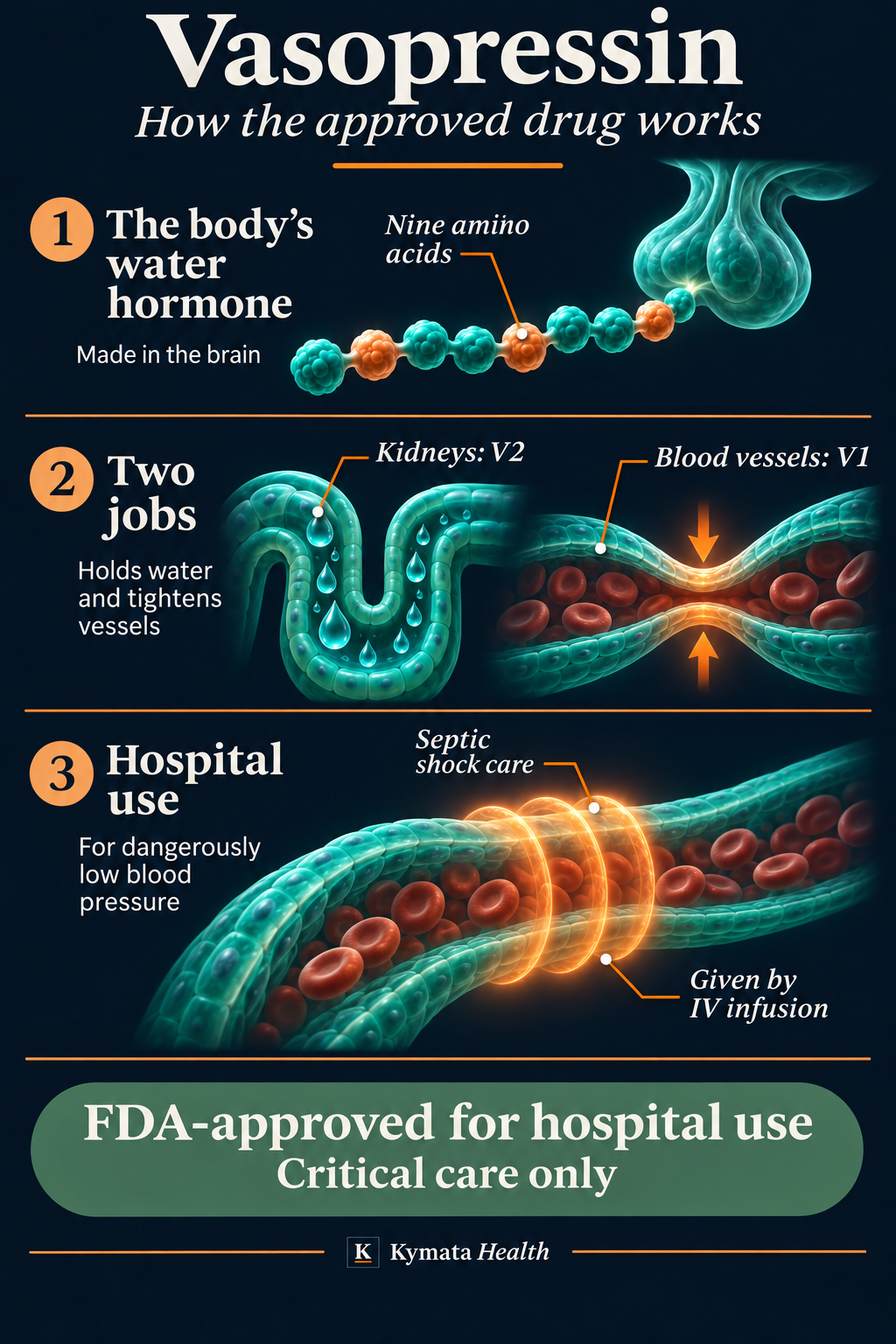
The body’s nine-amino-acid water hormone, also given as a drug in critical care. It acts on V2 receptors in the kidneys to hold water and on V1 receptors in blood vessels to raise blood pressure; in hospitals it is given by IV infusion for shock. FDA-approved for hospital use. Critical care only. The drawing is a schematic, not a measured molecular structure, a product photograph or a treatment result. Illustration review: 19 November 2026, against this page’s own mechanism, evidence and regulatory records.
A sequence model is not provided for this record. Read the identity and evidence notes; an illustration does not verify a molecular structure.
Illustration notes and source record
Read the source record on this page. Laboratory, topical and injected studies are separate evidence; this illustration does not establish an indication or a treatment outcome.

How it works
SourcedVasopressin (also known as arginine vasopressin or AVP) is an endogenous nine-amino-acid peptide hormone synthesized in the hypothalamus and released by the posterior pituitary. It has two main actions: (1) stimulating V2 receptors in the kidneys to increase water reabsorption, controlling blood osmolarity; and (2) stimulating V1 receptors on vascular smooth muscle to induce profound vasoconstriction.
In critical care, synthetic vasopressin (Vasostrict and generics) is given by continuous IV infusion; its labeled use is to raise blood pressure in adults with vasodilatory shock (such as septic or post-cardiotomy shock) who remain hypotensive despite fluids and catecholamines. In the VASST trial, adding low-dose vasopressin rather than norepinephrine did not lower 28-day mortality in septic shock (PMID 18305265).
Source: Vasostrict prescribing information (revised February 2023); VASST, PMID 18305265
Background & History
Vasopressin is one of the earliest characterized peptide hormones; Vincent du Vigneaud determined its structure and synthesized it in the 1950s. Its dual role in water balance and vascular tone links endocrinology and critical care. In septic shock it is used as an add-on to norepinephrine, as reflected in Surviving Sepsis Campaign guidance. It was removed from the American Heart Association adult cardiac-arrest algorithm in 2015.
05 / Evidence and limits
Evidence and limits
Septic shock · randomized clinical trial
Human evidence
Septic shock · randomized clinical trial- In the 2008 VASST double-blind randomized trial of 778 patients with septic shock already receiving catecholamine vasopressors, 28-day mortality was 35.4% with vasopressin and 39.3% with norepinephrine (P = 0.26), not a statistically significant difference (Russell et al., PMID 18305265).
- In the same trial, 90-day mortality was 43.9% and 49.6% (P = 0.11), and serious adverse events occurred in 10.3% and 10.5% of patients. The trial compared two add-on vasopressors; it did not test vasopressin against no vasopressor.
Limits of current evidence
1 limit- VASST studied vasopressin added to existing catecholamine vasopressors in septic shock. Its overall result does not establish a survival benefit or answer the same question in other types of shock.
Trial FinderRecruiting now: 20 open registrations for vasopressin
What it is studied for
- Vasodilatory shock despite fluids and catecholamines (labeled, Vasostrict)
- Septic shock
- Post-cardiotomy shock
Verdict
In adults with vasodilatory shock, the labeled reason for Vasostrict is to raise blood pressure. The VASST trial asked a separate question, survival in septic shock, and found no significant difference from norepinephrine.
06 / Product forms and access
Product forms and access
Regulatory & legal status
- FDA status (US)
- ApprovedFDA-approved for intravenous use (Vasostrict® and generics) to raise blood pressure in vasodilatory shock
- WADA status (2026)
- Not ListedNot currently on the WADA 2026 Prohibited List. Policies may change. Verify before competition.
- Classification
- Prescription Drug
07 / Tools and practical checks
Tools and practical checks
No separate record is provided here. Read the linked evidence and limitations for this compound.
08 / Published study use
Published study use
What the label states, for the patients it is approved for, and the source. Not a dose for you.
What the FDA label says
FDA label (hospital use)- Vasostrict approved strengths: 20 units/mL in single-dose and 10 mL multiple-dose vials, diluted before IV use, and ready-to-use premixed vials of 20 units/100 mL, 40 units/100 mL, 60 units/100 mL and 50 units/50 mL. Vasostrict label, DailyMed (opens in new tab)
The label’s dosing, for the patients it is approved for; the prescriber sets the dose.
Administration
- Route / form
- Monitored intravenous infusion in hospital
Timeline
1 stage- Immediate (Minutes)
The clinical team measures the blood-pressure response to intravenous treatment.
Who it is for
1 use| Category | Fit | What exists |
|---|---|---|
| Vasodilatory Shock | High | Labeled (Vasostrict) as an add-on when vasodilatory shock persists despite fluids and catecholamines. |
09 / Safety and interactions
Safety and interactions
What the record says
The Vasostrict label lists decreased cardiac output, bradycardia, tachyarrhythmias, hyponatremia and ischemia (coronary, mesenteric, skin and digital) among its most common adverse reactions. It is a hospital drug given with continuous monitoring.
Interactions & Contraindications
Adds to the effects of other vasopressors. Can cause limb, mesenteric or cardiac ischemia, particularly at higher doses. Terlipressin is a separate, longer-acting analogue.
10 / Comparisons and goal guides
Comparisons and goal guides
There is no separate comparison record on this page. Similar names do not establish that products or their evidence are interchangeable.
11 / Common questions
Common questions
Common questions
3 answersWhy is vasopressin used in sepsis?
In septic shock, blood vessels dilate and blood pressure falls. Vasopressin constricts vessels through V1 receptors, independent of adrenergic receptors, so it is added when fluids and catecholamines are not enough. In the VASST trial it did not lower 28-day mortality compared with norepinephrine (PMID 18305265).
Did vasopressin improve survival in the VASST septic-shock trial?
No significant difference was found. Among 778 patients already receiving catecholamine vasopressors, 28-day mortality was 35.4% with vasopressin and 39.3% with norepinephrine (P = 0.26). The labeled goal of treatment is raising blood pressure, which is a different outcome from survival.
Is Vasopressin FDA-approved?
Yes. FDA-approved for intravenous use (Vasostrict® and generics) to raise blood pressure in vasodilatory shock.
12 / Sources and references
Sources and references
2 sources cited on this page.
Sources
2 sources- 1“Vasopressin versus norepinephrine infusion in patients with septic shock.”Russell JA et al. NEJM (2008). PMID: 18305265 DOI: 10.1056/NEJMoa067373
- 2“Vasostrict (vasopressin injection): prescribing information, revised February 2023.”Par Health DailyMed (2023). Prescribing information
14 / Prescription options
Prescription options
Prescription options: compare licensed telehealth providers
Some peptide therapies are available only by prescription after a consult with a licensed clinician.
Compare telehealth →15 / Peptide library
Peptide library
Keep reading: Peptide research library
Peptide research library: every pagePeptide libraryBrowse all topics
- TetracosactidePrevious in this topic · Tetracosactide (cosyntropin) helps clinicians investigate whether the adrenal glands can make enough cortisol.
- Thymosin Beta-4Next in this topic · Thymosin β4 is the endogenous 43-amino-acid G-actin-sequestering peptide (CAS 77591-33-4, ~4963 Da).
- GhrelinGhrelin is a 28-amino-acid stomach hormone that activates the growth hormone secretagogue receptor (GHS-R1a); infusions have been studied in small human trials of appetite, GH…
- Melanotan 1Afamelanotide (Scenesse), the approved form of melanotan I, is a synthetic alpha-MSH analog that acts at MC1R; it is FDA- and EMA-approved as an implant to increase pain-free…
- ArgirelineArgireline (acetyl hexapeptide-8) is a cosmetic peptide modeled on part of the SNAP-25 protein; one 60-person randomized trial reported fewer eye-area wrinkles than placebo, and…
Regulatory and sport classification
- FDA-approved