
The peptide field guide
Melanotan 1
A 13-amino-acid alpha-MSH analog (afamelanotide) that signals pigment cells through MC1R.
FDA-approved only as the Scenesse implant, for a rare light sensitivity (EPP).
Explore this compoundConceptual editorial illustration; not a measured molecular structure, product photograph or treatment result.
02 / At a glance
At a glance
Key facts
- Also known as
- Afamelanotide, Scenesse, NDP-MSH, [Nle4, D-Phe7]-α-MSH, MT-1
- Type
- Clinical / Pharmaceutical
- Evidence level
- FDA-approved as Scenesse implant: for a rare light sensitivity.
- US regulatory status
- Not FDA-approved as sold; the same molecule, afamelanotide, is approved only as the Scenesse® implant (2019) for erythropoietic protoporphyria
- Updated
Identity
A 13-amino-acid alpha-MSH analog (afamelanotide) that signals pigment cells through MC1R.
Research context
In people with erythropoietic protoporphyria it increased the time spent in sunlight without pain; injectable research products are not the approved implant.
Evidence limits
FDA-approved only as the Scenesse implant, for a rare light sensitivity (EPP).
Read the technical profile and study-use reference
Quick answer
Evidence: ModerateAfamelanotide (Scenesse), the approved form of melanotan I, is a synthetic alpha-MSH analog that acts at MC1R; it is FDA- and EMA-approved as an implant to increase pain-free light exposure in adults with erythropoietic protoporphyria.
- FDA label dose
- FDA label (Scenesse): one 16 mg implant
Research summary, not medical advice.
At a glance
Kymata peptide profile · Aug 31, 2026- Molecular weight
- 1646.9 g/mol
- CAS
- 75921-69-6
- FDA label dose
- FDA label (Scenesse): one 16 mg implant
- Half-life
- ~30-45 minutes (longer in depot form)
- Common vials
- Implant under the skin (Scenesse); no reconstitution in this calculator
03 / Identity and origin
Identity and origin
Also called Afamelanotide, Scenesse, NDP-MSH, [Nle4, D-Phe7]-α-MSH, MT-1. Afamelanotide analog class (Scenesse is the labeled implant, not this powder).
Read the sequence and compound record
Compound card
- Class
- Afamelanotide analog class (Scenesse is the labeled implant, not this powder)
- Formula
- C78H111N21O19
- Molecular weight
- 1646.9 g/mol
- CAS
- 75921-69-6
- Described by
- Mac E. Hadley, Victor Hruby (University of Arizona) / Clinuvel, 1987 (US approval 2019, EPP)
- Bioavailability
- Subcutaneous injection or implant
04 / How it may work
How it may work
Afamelanotide analog class (Scenesse is the labeled implant, not this powder)
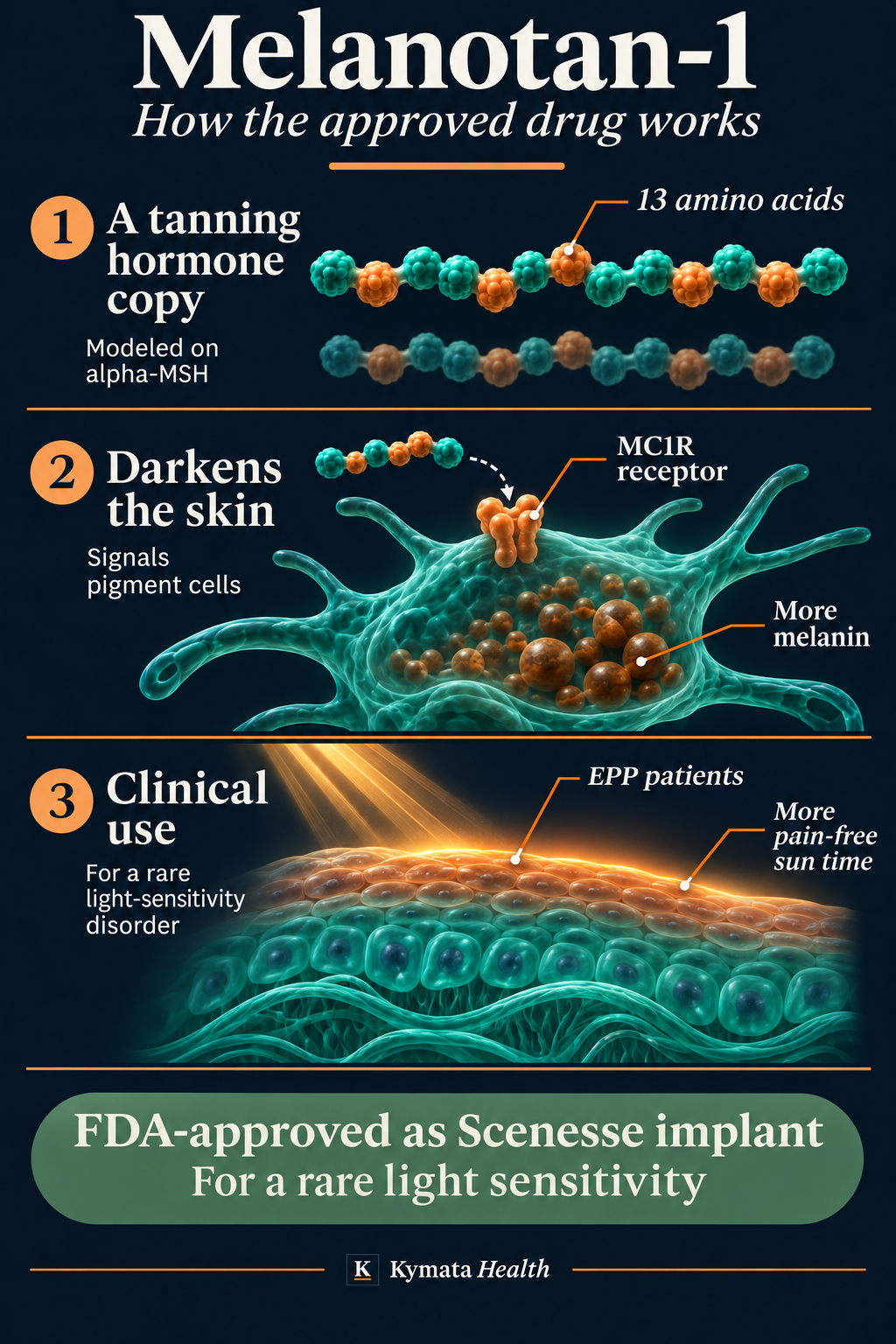
A 13-amino-acid alpha-MSH analog (afamelanotide) that signals pigment cells through MC1R. In people with erythropoietic protoporphyria it increased the time spent in sunlight without pain; injectable research products are not the approved implant. FDA-approved only as the Scenesse implant, for a rare light sensitivity (EPP). The drawing is a schematic, not a measured molecular structure, a product photograph or a treatment result. Illustration review: 19 November 2026, against this page’s own mechanism, evidence and regulatory records.
A sequence model is not provided for this record. Read the identity and evidence notes; an illustration does not verify a molecular structure.
Illustration notes and source record
Read the source record on this page. Laboratory, topical and injected studies are separate evidence; this illustration does not establish an indication or a treatment outcome.

How it works
Melanotan-1 (Afamelanotide, Scenesse) is a synthetic 13-amino-acid analog of naturally occurring α-MSH. It was developed at the University of Arizona to provide a sunless tanning effect to protect against UV radiation and skin cancer. Unlike Melanotan-2, it is a linear (not cyclic) full-length analog.
Mechanistically, MT-1 binds to melanocortin-1 receptors (MC1R) with much higher affinity and an exponentially longer half-life than natural α-MSH. This binding stimulates melanocytes to ramp up production of eumelanin (the dark protective pigment). Importantly, MT-1 is highly selective to MC1R in the skin, generally avoiding the MC3R/MC4R receptors that cause the intense libido enhancement and nausea associated with Melanotan-2.
Background & History
Melanotan 1 (afamelanotide) was developed at the University of Arizona in the 1980s as part of research into α-MSH analogues for photoprotection. Unlike Melanotan II (a cyclic heptapeptide with broad melanocortin receptor activity), MT-1 is a linear tridecapeptide selective for MC1R. It was approved by the EMA in 2014 and FDA in 2019 as Scenesse (a 16 mg sub-dermal implant) for erythropoietic protoporphyria (EPP), an inherited condition causing severe photosensitivity.
05 / Evidence and limits
Evidence and limits
Limits of current evidence
2 limits- Scenesse photoprotection percentages do not apply to a SubQ research vial.
- EPP is a hematology indication, not a beach protocol.
What it is studied for
- Erythropoietic protoporphyria (EPP)
- Photoprotection research
- Skin cancer prevention research
Verdict
Melanotan-1 is the linear α-MSH analog people confuse with Scenesse. Scenesse is a 16 mg implant for erythropoietic protoporphyria. This page is the research powder. Not a tanning salon drug.
06 / Product forms and access
Product forms and access
Regulatory & legal status
- FDA status (US)
- Not approvedNot FDA-approved as sold; the same molecule, afamelanotide, is approved only as the Scenesse® implant (2019) for erythropoietic protoporphyria
- WADA status (2026)
- Not ListedNot currently on the WADA 2026 Prohibited List. Policies may change. Verify before competition.
- Classification
- Research Chemical
- US compounding
- Not eligible / not available
07 / Tools and practical checks
Tools and practical checks
No separate record is provided here. Read the linked evidence and limitations for this compound.
08 / Published study use
Published study use
What the label states, for the patients it is approved for, and the source. Not a dose for you.
What the FDA label says
FDA label- Scenesse (afamelanotide), for erythropoietic protoporphyria: one 16 mg implant inserted under the skin above the hip crest every 2 months by a trained health care professional. Scenesse label, DailyMed (opens in new tab)
The label’s dosing, for the patients it is approved for; the prescriber sets the dose.
Administration
- Route / form
- Route on the Scenesse (afamelanotide) label: an implant placed under the skin by a health care professional.
Timeline
1 stage- In the EPP trials
In people with erythropoietic protoporphyria, afamelanotide implants increased pain-free time in direct sunlight compared with placebo (Langendonk 2015, PMID 26132941).
Who it is for
2 uses| Category | Fit | What exists |
|---|---|---|
| Photoprotection / EPP | High | Scenesse label: erythropoietic protoporphyria, to raise light tolerance. |
| Cosmetic Tanning | High | Highly effective safe sunless/low-sun tan. Much lower side-effect profile than MT-2. |
09 / Safety and interactions
Safety and interactions
What the record says
FDA-approved as Scenesse implant. Injectable MT-1 is well-tolerated. Will darken existing moles, freckles, and nevi heavily. Nausea is possible but much rarer than MT-2. No spontaneous erections/libido effects like MT-2.
Interactions & Contraindications
Monitor pre-existing nevi for changes. May darken existing moles. Not for use with phototherapy. No significant drug interactions reported at approved doses.
10 / Comparisons and goal guides
Comparisons and goal guides
Combinations: what has been tested
1 pairing- + Melanotan 2 →MT-1 and MT-2 both stimulate melanogenesis but through different receptor selectivity profiles. MT-1 is the clinically approved, selective compound; MT-2 is the broader-acting research peptide.
11 / Common questions
Common questions
Common questions
3 answersIs Melanotan-1 safer than Melanotan-2?
Generally yes. Afamelanotide (MT-1) is the molecule in Scenesse. It is highly selective for the skin MC1R receptor and avoids the brain MC4R receptors that cause the intense nausea, flushing, and spontaneous erections seen with MT-2.
Do you still need sun to tan on MT-1?
Yes. MT-1 upregulates the melanocytes and primes the melanin synthesis pathways, but a small amount of UV radiation is still the catalyst required to significantly darken the skin.
Is Melanotan 1 FDA-approved?
No. Not FDA-approved as sold; the same molecule, afamelanotide, is approved only as the Scenesse® implant (2019) for erythropoietic protoporphyria.
12 / Sources and references
Sources and references
1 paper cited on this page.
Sources
1 paper- 1“"Afamelanotide for erythropoietic protoporphyria".”Langendonk JG et al. NEJM (2015). PMID: 26132941
14 / Prescription options
Prescription options
Prescription options: compare licensed telehealth providers
Some peptide therapies are available only by prescription after a consult with a licensed clinician.
Compare telehealth →15 / Peptide library
Peptide library
Keep reading: Peptide research library
Peptide research library: every pagePeptide libraryBrowse all topics
- GhrelinPrevious in this topic · Ghrelin is a 28-amino-acid stomach hormone that activates the growth hormone secretagogue receptor (GHS-R1a); infusions have been studied in small human trials of appetite, GH…
- ArgirelineNext in this topic · Argireline (acetyl hexapeptide-8) is a cosmetic peptide modeled on part of the SNAP-25 protein; one 60-person randomized trial reported fewer eye-area wrinkles than placebo, and…
- Snap-8Snap-8 (acetyl octapeptide-3) is a cosmetic peptide that extends the Argireline sequence by two amino acids; published studies tested it only inside multi-ingredient serums and…
- MatrixylMatrixyl (palmitoyl pentapeptide-4) is a cosmetic lipopeptide whose KTTKS sequence raised collagen production in fibroblast cultures; one 12-week split-face trial in 93 women…
- KyotorphinResearchers have measured native kyotorphin (Tyr-Arg) in human spinal fluid and blood.
Regulatory and sport classification
- Not FDA-approved as sold; the same molecule, afamelanotide, is approved only as the Scenesse® implant (2019) for erythropoietic protoporphyria