
The peptide field guide
Ghrelin
The 28-amino-acid hunger hormone made in the stomach.
Small human infusion studies. Not an approved drug.
Explore this compoundConceptual editorial illustration; not a measured molecular structure, product photograph or treatment result.
02 / At a glance
At a glance
Key facts
- Also known as
- GHRL, Lenomorelin, Growth hormone-releasing peptide
- Type
- Growth Hormone
- Evidence level
- Early human trials: benefit not yet confirmed.
- US regulatory status
- Not FDA-approved, research chemical
- Updated
Identity
The 28-amino-acid hunger hormone made in the stomach.
Research context
It acts on the GHS-R1a receptor in the brain and pituitary, raising appetite and growth hormone release.
Evidence limits
Small human infusion studies. Not an approved drug.
Read the technical profile and study-use reference
Quick answer
Evidence: ModerateGhrelin is a 28-amino-acid stomach hormone that activates the growth hormone secretagogue receptor (GHS-R1a); infusions have been studied in small human trials of appetite, GH release, cancer cachexia and gastroparesis, and it is not an approved drug.
- In published studies
- Trial amounts are recorded under What studies used (PMID 26260705)
Research summary, not medical advice.
At a glance
Kymata peptide profile · Oct 30, 2026- Half-life
- Short (~10-15 minutes)
- Common vials
- 5 mg
- Molecular weight
- 3370.9 g/mol
- CAS
- 258279-04-8
- In published studies
- Trial amounts are recorded under What studies used (PMID 26260705)
03 / Identity and origin
Identity and origin
Also called GHRL, Lenomorelin, Growth hormone-releasing peptide. 28-aa ghrelin (GHS-R1a endogenous ligand).
Read the sequence and compound record
Compound card
- Class
- 28-aa ghrelin (GHS-R1a endogenous ligand)
- Formula
- C149H249N47O42 (Acyl-Ghrelin)
- Molecular weight
- 3370.9 g/mol
- CAS
- 258279-04-8
- Described by
- Masayasu Kojima, Kenji Kangawa (discovered), 1999
- Bioavailability
- Injection (endogenous peptide)
04 / How it may work
How it may work
28-aa ghrelin (GHS-R1a endogenous ligand)
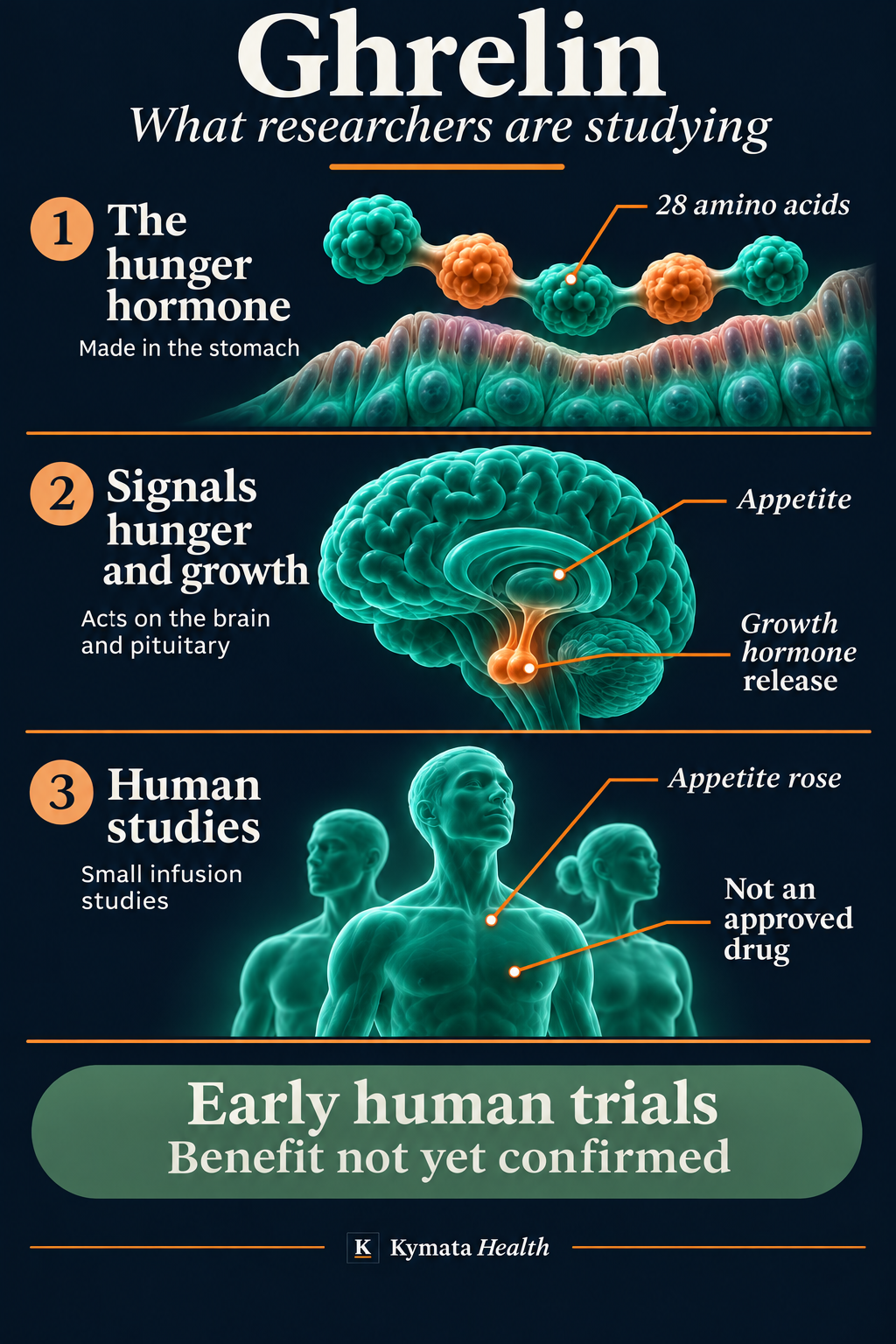
The 28-amino-acid hunger hormone made in the stomach. It acts on the GHS-R1a receptor in the brain and pituitary, raising appetite and growth hormone release. Small human infusion studies. Not an approved drug. The drawing is a schematic, not a measured molecular structure, a product photograph or a treatment result. Illustration review: 19 November 2026, against this page’s own mechanism, evidence and regulatory records.
A sequence model is not provided for this record. Read the identity and evidence notes; an illustration does not verify a molecular structure.
Illustration notes and source record
Read the source record on this page. Laboratory, topical and injected studies are separate evidence; this illustration does not establish an indication or a treatment outcome.

How it works
SourcedGhrelin (the "hunger hormone") is a 28-amino-acid endogenous peptide produced primarily by endocrine cells in the stomach fundus. It requires octanoylation at its 3rd serine residue to become biologically active (acyl-ghrelin).
It works by binding the growth hormone secretagogue receptor 1a (GHS-R1a) in the hypothalamus, triggering two dramatic effects: profound appetite stimulation (orexigenic effect) and potent growth hormone release from the pituitary. Because the actual ghrelin peptide is highly unstable and difficult to synthesize with its required lipid modification, synthetic GHRPs (like GHRP-6, GHRP-2, Ipamorelin) or non-peptides (Macimorelin) are used instead to stimulate the ghrelin receptor therapeutically.
Source: PMID: 10604470
Background & History
Ghrelin was discovered in 1999 by Masayasu Kojima and colleagues in rat stomach. It was the first known endogenous ligand for the growth hormone secretagogue receptor (GHS-R1a), explaining how synthetic secretagogues like GHRP-6 worked. Ghrelin is now recognized as a key regulator of energy homeostasis, connecting gut-brain signaling for appetite, metabolism, and growth hormone release. Its role in cachexia (cancer-related wasting) has driven clinical trials.
05 / Evidence and limits
Evidence and limits
Limits of current evidence
1 limit- Appetite is the feature. Do not market this as cutting.
What it is studied for
- Cancer cachexia research
- Gastroparesis
- GH deficiency research
- Anorexia nervosa research
- Post-surgical ileus
Verdict
Ghrelin is the stomach hormone that makes you hungry and raises GH. Ibupamorelin/MK-677/GHRP are ligands or mimetics, not this 28-mer. Not a fat-loss peptide.
06 / Product forms and access
Product forms and access
Regulatory & legal status
- FDA status (US)
- Research Only
- WADA status (2026)
- Prohibited (S2)Competitive athletes subject to anti-doping controls should not use Ghrelin.
- US compounding
- Not eligible / not available
07 / Tools and practical checks
Tools and practical checks
Dose it
5 mg + 2 mL BAC water → 2.5 mg/mL · 1 unit (U-100) = 25 mcg.
Reconstitution math
U-100 syringe| Vial | Water | Concentration |
|---|---|---|
| 5 mg lyophilized | 2 mL BAC | 2.5 mg/mL |
08 / Published study use
Published study use
What published studies gave, in whom, and the source. Not a dose for you.
What studies used
Small human studies- 9 healthy volunteers: IV ghrelin at 5.0 pmol/kg per minute against saline; they ate 28% more at a buffet. Wren 2001, PMID 11739476 (opens in new tab)
- 18 people with chronic respiratory failure in rehabilitation: 1 or 2 µg/kg IV twice a day for 3 weeks. Miki 2017, PMID 26260705 (opens in new tab)
- People in a coma after cardiac arrest (GRECO): acyl-ghrelin 600 µg IV twice a day for 7 days, or placebo. Nutma 2024, PMID 38709502 (opens in new tab)
A record of what researchers gave, in whom; not a dose for you.
Administration
- Route / form
- Route used in studies: IV infusion.
Who it is for
1 use| Category | Fit | What exists |
|---|---|---|
| Endogenous Marker | Moderate | Important mechanism for hunger and GH release, targeted by many other pharmacological peptides. |
09 / Safety and interactions
Safety and interactions
What the record says
Endogenous hormone. Ghrelin is not FDA-approved. High ghrelin states (Prader-Willi syndrome) cause insatiable hunger. Modulated extensively by fasting, sleep, and medical peptides.
Interactions & Contraindications
May increase appetite and food intake. Can cause transient hyperglycemia. Interacts with insulin and leptin signaling pathways. Ghrelin O-acyltransferase (GOAT) inhibitors are being developed as anti-obesity agents.
10 / Comparisons and goal guides
Comparisons and goal guides
Combinations: what has been tested
2 pairings- + GHRP-2 →GHRP-2 is a synthetic ghrelin receptor agonist, and ghrelin is the endogenous ligand. They activate the same receptor but ghrelin has additional metabolic effects.
- + MK-677 →MK-677 is a non-peptide oral ghrelin mimetic. It provides sustained oral GHS-R1a activation that compensates for ghrelin's extremely short half-life.
11 / Common questions
Common questions
Common questions
2 answersWhy is native ghrelin not used as a medicine?
It requires a specific fatty acid attachment to work, making it expensive and unstable to manufacture. Instead, scientists designed synthetic peptides (like GHRP-2, Ipamorelin) that bind the same receptor but are much more stable.
Is Ghrelin FDA-approved?
No. Not FDA-approved, research chemical.
12 / Sources and references
Sources and references
1 paper cited on this page.
Sources
1 paper- 1“"Ghrelin is a growth-hormone-releasing acylated peptide from stomach".”Kojima M et al. Nature (1999). PMID: 10604470
14 / Prescription options
Prescription options
Prescription options: compare licensed telehealth providers
Some peptide therapies are available only by prescription after a consult with a licensed clinician.
Compare telehealth →15 / Peptide library
Peptide library
Keep reading: Peptide research library
Peptide research library: every pagePeptide libraryBrowse all topics
- Thymosin Beta-4Previous in this topic · Thymosin β4 is the endogenous 43-amino-acid G-actin-sequestering peptide (CAS 77591-33-4, ~4963 Da).
- Melanotan 1Next in this topic · Afamelanotide (Scenesse), the approved form of melanotan I, is a synthetic alpha-MSH analog that acts at MC1R; it is FDA- and EMA-approved as an implant to increase pain-free…
- ArgirelineArgireline (acetyl hexapeptide-8) is a cosmetic peptide modeled on part of the SNAP-25 protein; one 60-person randomized trial reported fewer eye-area wrinkles than placebo, and…
- Snap-8Snap-8 (acetyl octapeptide-3) is a cosmetic peptide that extends the Argireline sequence by two amino acids; published studies tested it only inside multi-ingredient serums and…
- MatrixylMatrixyl (palmitoyl pentapeptide-4) is a cosmetic lipopeptide whose KTTKS sequence raised collagen production in fibroblast cultures; one 12-week split-face trial in 93 women…
Regulatory and sport classification
- Not FDA-approved, research chemical
- WADA (S2): prohibited in sport at all times