
The peptide field guide
Retinalamin
A polypeptide extract of animal retina, registered as a medicine in Russia and used in Russian eye care; not the oral Visoluten.
Registered as a medicine in Russia. Not FDA-approved. Not yet confirmed in Western trials.
Explore this compoundConceptual editorial illustration; not a measured molecular structure, product photograph or treatment result.
We earn a commission if you buy through some links on this page. You pay the same price. See how we make money.
02 / At a glance
At a glance
Key facts
- Also known as
- Retinal bioregulator, Ретиналамин
- Type
- Khavinson Bioregulator
- Evidence level
- Registered drug in Russia: not FDA-approved.
- US regulatory status
- Not FDA-approved, research chemical
- Updated
Identity
A polypeptide extract of animal retina, registered as a medicine in Russia and used in Russian eye care; not the oral Visoluten.
Research context
Russian clinical studies examined it in retinal diseases, including diabetic retinopathy and glaucoma, and animal studies examined retinal cell survival; a 24-month randomized trial in 147 adults with early glaucoma found no difference between groups.
Evidence limits
Registered as a medicine in Russia. Not FDA-approved. Not yet confirmed in Western trials.
Read the technical profile and study-use reference
Quick answer
Evidence: LowRetinalamin is the pharmaceutical retinal extract, including parabulbar use in CIS ophthalmology. Adjacent to the 41. Visoluten is the Cytomax; Normoftal is the cytogen.
- Class and target
- Pharmaceutical extract (Cytamin-era) · Retina
- In published studies
- Studied in a trial (PMID 41432508); no dose is given here
Research summary, not medical advice.
At a glance
Kymata peptide profile · Nov 19, 2026- Half-life
- Mixture (variable)
- Common vials
- 5 mg
- Molecular weight
- Mixture (<10 kDa)
- In published studies
- Studied in a trial (PMID 41432508); no dose is given here
- CAS
- N/A (biological extract)
03 / Identity and origin
Identity and origin
Also called Retinal bioregulator, Ретиналамин. Bovine retinal polypeptide extract (parabulbar clinic product class).
Read the sequence and compound record
Compound card
- Class
- Bovine retinal polypeptide extract (parabulbar clinic product class)
- Formula
- Polypeptide extract (Retinal tissue)
- Molecular weight
- Mixture (<10 kDa)
- CAS
- N/A (biological extract)
- PubChem CID
- N/A
- Described by
- S.M. Kirov Military Medical Academy, St. Petersburg (Khavinson group); manufactured by Geropharm (Russia), 1999
- Bioavailability
- Intramuscular or parabulbar injection
04 / How it may work
How it may work
Bovine retinal polypeptide extract (parabulbar clinic product class)
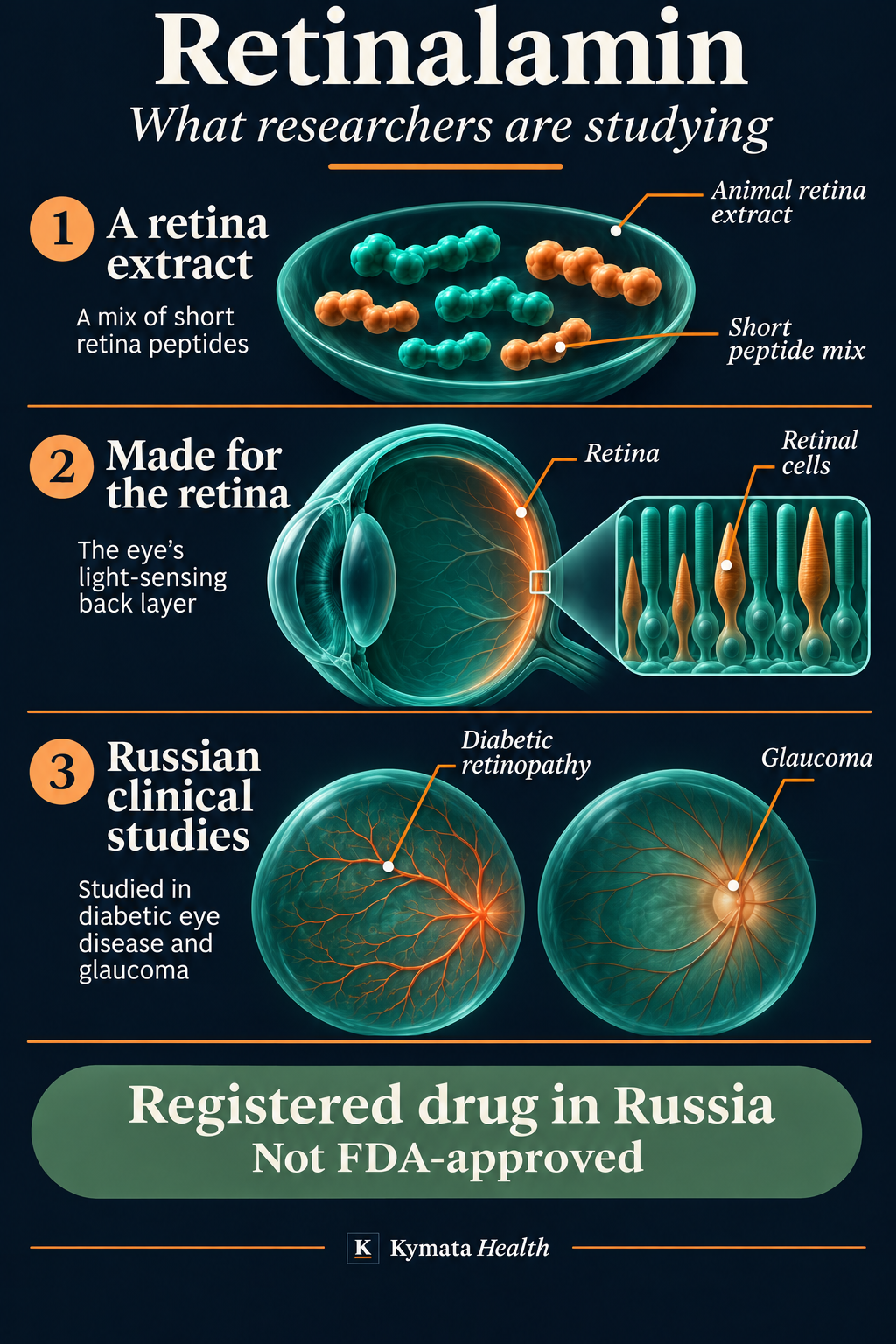
A polypeptide extract of animal retina, registered as a medicine in Russia and used in Russian eye care; not the oral Visoluten. Russian clinical studies examined it in retinal diseases, including diabetic retinopathy and glaucoma, and animal studies examined retinal cell survival; a 24-month randomized trial in 147 adults with early glaucoma found no difference between groups. Registered as a medicine in Russia. Not FDA-approved. Not yet confirmed in Western trials. The drawing is a schematic, not a measured molecular structure, a product photograph or a treatment result. Illustration review: 19 November 2026, against this page’s own mechanism, evidence and regulatory records.
A sequence model is not provided for this record. Read the identity and evidence notes; an illustration does not verify a molecular structure.
Illustration notes and source record
Read the source record on this page. Laboratory, topical and injected studies are separate evidence; this illustration does not establish an indication or a treatment outcome.

How it works
SourcedRetinalamin is a polypeptide extract of cattle retina (the Russian label names it "polypeptides of livestock retina"). It is a registered prescription medicine in Russia, made by Geropharm and used in ophthalmology.
Russian studies report effects on retinal cell metabolism and the retinal pigment epithelium (RPE) in animal models and clinical series. In Russia it is prescribed by ophthalmologists for conditions such as diabetic retinopathy and glaucoma; there are no Western controlled trials.
Source: PMID: 33056965
05 / Evidence and limits
Evidence and limits
Limits of current evidence
2 limits- Parabulbar administration is clinic territory.
- This site will not treat macular degeneration from this page.
What it is studied for
- Age-related macular degeneration
- Diabetic retinopathy
- Retinitis pigmentosa
- Glaucoma support
Verdict
Retinalamin is an injectable retinal extract used in Russian ophthalmology practice. Not Visoluten capsules, not Normoftal, not Pinalex. Not a US AMD drug.
06 / Product forms and access
Product forms and access
Regulatory & legal status
- FDA status (US)
- Research OnlyRegistered as a drug in Russia; not FDA-approved
- WADA status (2026)
- Not ListedNot currently on the WADA 2026 Prohibited List. Policies may change. Verify before competition.
- US compounding
- Not eligible / not available
Pharmaceutical extract (Cytamin-era) · Retina
Identity
Adjacent (not padded into the 41)- Class
- Pharmaceutical extract (Cytamin-era)
- Organ
- Retina
- Target
- Retina
- System
- Visual
- Sequence
- Mixture / not a single CAS
In these Khavinson catalog sets
1 setManufacturer-style organ combinations, not FDA protocols. Every name links to its own page.
The Khavinson school
Retinalamin is filed here as pharmaceutical extract (cytamin-era), targeting the retina. Khavinson's St. Petersburg group moved from organ extracts (Cytamins) to capsule complexes (Cytomaxes) to synthetic short peptides (Cytogens); most of the evidence comes from that one group, with little independent Western replication.
Read the full background, the proposed epigenetic mechanism, the literature limits, and how we count the canonical 41 on the Khavinson bioregulators index.
History of this molecule
This is the eye extract that actually has a hospital technique (parabulbar) in its home market. That does not make gray-market powder safe to put next to a globe. We document the triad so AMD shoppers do not buy Visoluten thinking it is Retinalamin.
Do not self-inject near the eye. Not FDA.
Full 41-map: Khavinson bioregulators index · Khavinson catalog sets
07 / Tools and practical checks
Tools and practical checks
Vial strengths
Research vials of Retinalamin are listed at 5 mg per vial.
08 / Published study use
Published study use
What published studies gave, in whom, and the source. Not a dose for you.
What studies used
Russian cohort studies- 56 people with advanced open-angle glaucoma, some untreated for comparison: 10 intramuscular injections of 5 mg in saline per course, one course every 3 months for 2 years. Dorofeev 2025, PMID 41432508 (opens in new tab)
- 180 people with open-angle glaucoma were randomized to intramuscular Retinalamin, with a second course 6 months later, or no Retinalamin. The indexed abstract does not give the dose. Egorov 2019, PMID 31393444 (opens in new tab)
A record of what researchers gave, in whom; not a dose for you.
Administration
- Route / form
- Pharmaceutical extract, historically parabulbar / intramuscular in CIS practice. Not a swallowed capsule and not a sublingual tablet.
- Timing
- Timing is the pharmaceutical presentation’s label, which this page does not restate; food does not change an IM or parabulbar shot.
- Empty stomach?
- No: These are clinic-era injectables or suppositories, not capsules. Food timing does not apply.
Retinalamin: Parabulbar / IM extract vs Not Visoluten / not Pinalex
2 routesParabulbar / IM extract
- Bioavailability
- CIS pharmaceutical retinal extract. Documented clinic routes are parabulbar (next to the globe, specialist) and intramuscular.
- Advantages
- The eye extract that actually has a hospital technique in its home market.
- Triad stays honest: Retinalamin (extract) / Visoluten (Cytomax) / Normoftal (cytogen).
- Food does not apply.
- Considerations
- DIY parabulbar is how globes get hurt. No.
- Not anti-VEGF, not AREDS2, not FDA.
Not Visoluten / not Pinalex
- Bioavailability
- Retinalamin is not a swallowed capsule. The oral eye cousin is Visoluten (Cytomax). Normoftal is the retina cytogen. Pinalex is not this extract either.
- Advantages
- Visoluten exists for oral ocular Cytomax shoppers.
- Stops AMD shoppers from buying Visoluten thinking it is Retinalamin.
- Not a sublingual tablet. Nobody manufactures this SKU that way.
- Considerations
- Pinalex is not a loophole to “oral Retinalamin.”
- Degenerative retina disease still belongs to an ophthalmologist.
- Not an eye drop.
Timeline
2 stages- Month 24
In a randomized trial in 147 adults with early open-angle glaucoma, repeated retinalamin treatment left the groups no different at 24 months on visual field, nerve-fiber layer or ganglion-cell thickness (PMID 33056965).
- Diabetic retinopathy
No randomized trial has measured visual acuity. One non-randomized study of 56 patients reported retinal imaging and electroretinogram changes (PMID 39569781).
Who it is for
1 use| Category | Fit | What exists |
|---|---|---|
| Diabetic Retinopathy / Glaucoma | Insufficient human evidence | Registered in Russia for eye disease. The one 24-month randomized glaucoma trial found no difference between groups at the end (PMID 33056965). |
09 / Safety and interactions
Safety and interactions
What the record says
Registered pharmaceutical in Russia. Clinical supervision required. Parabulbar injection must be performed by a specialist.
Interactions & Contraindications
Parabulbar injection requires a trained ophthalmologist. Interaction data outside Russia are lacking.
10 / Comparisons and goal guides
Comparisons and goal guides
Combinations: what has been tested
1 pairing- + Visoluten →Parabulbar extract plus oral eye cytogen. Russian clinic pairing, not a macular-degeneration protocol on this site.
11 / Common questions
Common questions
Common questions
7 answersIn the 41?
No. Documented as the pharma extract layer for retina.
Vs Visoluten / Normoftal?
Extract vs Cytomax vs cytogen.
AMD drug?
Not anti-VEGF. See ophthalmology.
DIY parabulbar?
No.
Oral version?
This extract is parabulbar or IM. Visoluten is the swallowed eye Cytomax. Normoftal is the retina cytogen. None of those is a sublingual Retinalamin.
Is Retinalamin the same as Visoluten?
No. Visoluten is an oral capsule sold as a dietary supplement (a Cytomax). Retinalamin is a sterile injectable medicine registered in Russia and given by clinicians for retinal disease. They are different products, and studies of one do not apply to the other.
Is Retinalamin FDA-approved?
No. Registered as a drug in Russia; not FDA-approved.
12 / Sources and references
Sources and references
2 papers cited on this page.
Sources
2 papers- 1“"The influence of long-term retinal protective therapy on glaucoma progression according to structural and functional tests".”Strakhov VV et al. Vestnik Oftalmologii (2020). PMID: 33056965
- 2“"Objective structural and functional monitoring of polypeptide retinal neuroprotective therapy in diabetic retinopathy".”Malakhova AI et al. Vestnik Oftalmologii (2024). PMID: 39569781
14 / Prescription options
Prescription options
Oral tissue-peptide capsules sold by Vita-Stream, house line first: a different product from the Retinalamin studied above.
Capsule form
Paid links · we earn a commissionOral capsuleAffiliate links: we earn a commission if you buy, at no extra cost to you.
- Browse Visoluten (paid link, opens in new tab)
Visoluten is a GARMONIA Cytomax retina peptide capsule sold by Vita-Stream. Vita Peptides' house line has no product for this tissue. No trial has tested it.
Retinalamin isn't sold under that name at Vita-Stream. Closest match: Visoluten (A-11), the natural retina Cytomax (not the same compound).
- Per capsule
- 10 mg active natural peptides
Label wording as Vita-Stream's product page states it, read 19 October 2026. Follow the label on the bottle you buy.
- In Khavinson’s lab work, synthetic short peptides modeled on a tissue’s peptide extract stimulated the growth of cultured rat explants of that same tissue. Khavinson 2001, PMID 11713572 (opens in new tab)
- His group proposes that such peptides act on gene expression in the cells they reach; most of that work is in cells and animals. Khavinson 2021 review, PMID 34834147 (opens in new tab)
These statements have not been evaluated by the FDA. These products are not intended to diagnose, treat, cure, or prevent any disease.
Use code KymataLabs at checkout
15 / Peptide library
Peptide library
← Back to Peptide LibraryKhavinson catalog sets
Keep reading: Peptide research library
Peptide research library: every pagePeptide libraryBrowse all topics
- ProstatilenPrevious in this topic · Prostatilen (Samprost, Vitaprost) is a polypeptide extract of bovine prostate registered as a medicine in Russia; Russian clinical studies examined it in prostatitis and prostate…
- EpithalaminNext in this topic · Epithalamin is a polypeptide extract of animal pineal glands from the Khavinson group, the natural predecessor of synthetic Epitalon; Russian studies, including long-term…
- AdipotideAdipotide reduced body weight in obese rhesus monkeys and caused kidney injury in primate studies.
- DulaglutideOnce-weekly GLP-1 receptor agonist fused to an IgG4 Fc fragment (Trulicity), approved for glycemic control in type 2 diabetes in adults and children 10 and older and to reduce…
- ExenatideFirst-in-class GLP-1 RA (Byetta BID / Bydureon weekly).
Regulatory and sport classification
- Not FDA-approved, research chemical