
The peptide field guide
Dulaglutide
A once-weekly GLP-1 receptor agonist, approved as Trulicity for type 2 diabetes.
FDA-approved for type 2 diabetes. Prescription only.
Explore this compoundConceptual editorial illustration; not a measured molecular structure, product photograph or treatment result.
02 / At a glance
At a glance
Key facts
- Also known as
- Trulicity, LY2189265
- Type
- Weight Management
- Evidence level
- FDA-approved for type 2 diabetes: prescription only.
- US regulatory status
- FDA-approved as Trulicity® (2014) for glycemic control in type 2 diabetes (adults and children 10 and older) and to reduce the risk of major adverse cardiovascular events in adults with type 2 diabetes and established cardiovascular disease or multiple risk factors
- Updated
Identity
A once-weekly GLP-1 receptor agonist, approved as Trulicity for type 2 diabetes.
Research context
Large AWARD and REWIND trials in adults with type 2 diabetes showed lower blood sugar and fewer major heart events.
Evidence limits
FDA-approved for type 2 diabetes. Prescription only.
Read the technical profile and study-use reference
Quick answer
Evidence: StrongOnce-weekly GLP-1 receptor agonist fused to an IgG4 Fc fragment (Trulicity), approved for glycemic control in type 2 diabetes in adults and children 10 and older and to reduce major adverse cardiovascular events in adults with type 2 diabetes and established cardiovascular disease or multiple risk factors. Weight loss is modest versus Wegovy and Zepbound. Supplied as single-dose pens, not vials.
- FDA label dose
- FDA label (Trulicity): dose and schedule set by the prescriber and the label
Research summary, not medical advice.
At a glance
Kymata peptide profile · Nov 21, 2026- CAS
- 923950-08-7
- FDA label dose
- FDA label (Trulicity): dose and schedule set by the prescriber and the label
- Half-life
- About 5 days (Trulicity label)
- Common vials
- Ready-to-use solution; no water is added
- Molecular weight
- ~63 kDa (Trulicity label)
03 / Identity and origin
Identity and origin
Also called Trulicity, LY2189265. Once-weekly GLP-1 RA (Trulicity).
Read the sequence and compound record
Compound card
- Sequence
- GLP-1 analog fused to IgG4 Fc (LY2189265)
- Class
- Once-weekly GLP-1 RA (Trulicity)
- Formula
- GLP-1 analogue–IgG4 Fc fusion
- Molecular weight
- ~63 kDa (Trulicity label)
- CAS
- 923950-08-7
- Described by
- Eli Lilly and Company, 2014
- Bioavailability
- 65% and 47% after single 0.75 and 1.5 mg SC doses (Trulicity label)
04 / How it may work
How it may work
Once-weekly GLP-1 RA (Trulicity)
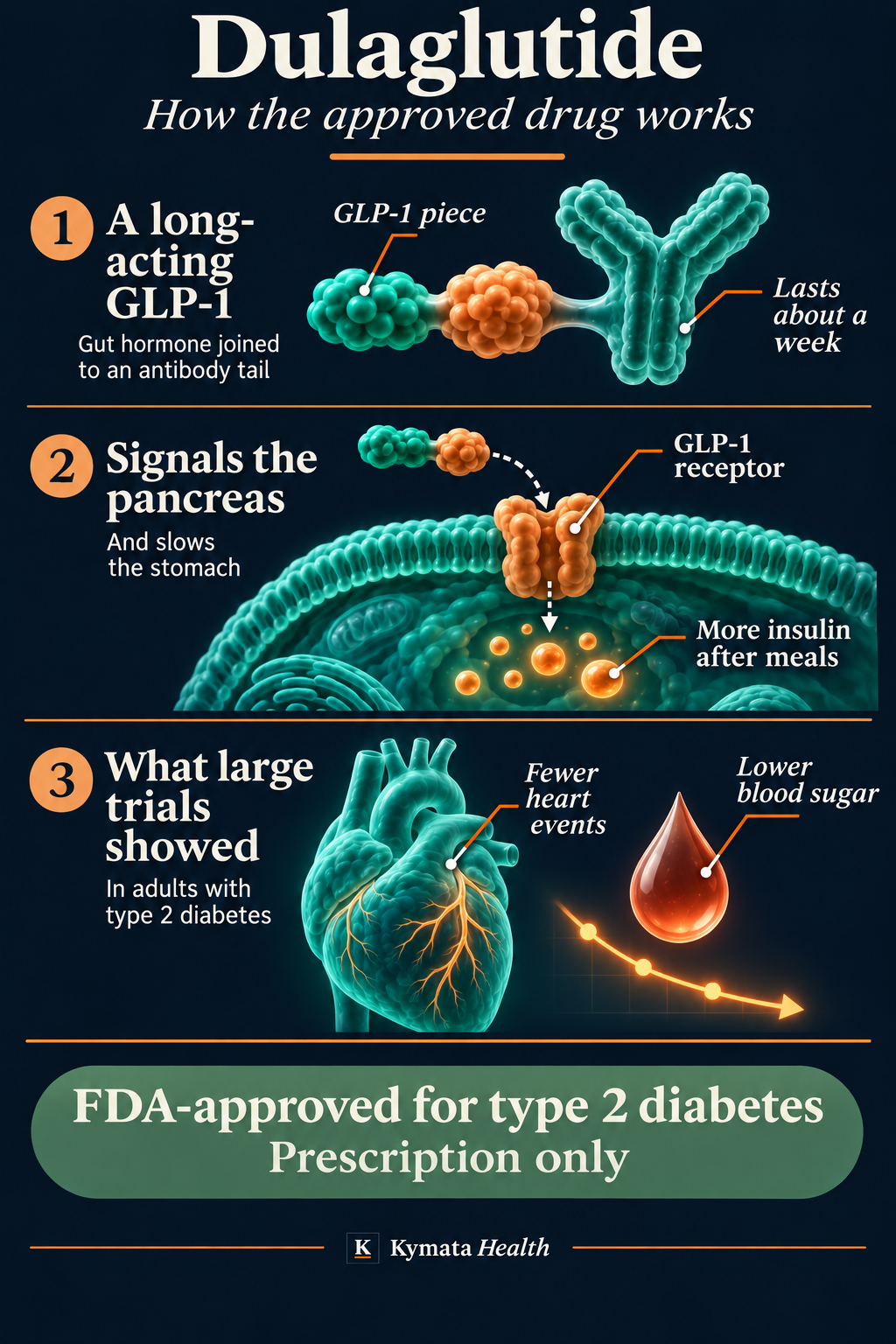
A once-weekly GLP-1 receptor agonist, approved as Trulicity for type 2 diabetes. Large AWARD and REWIND trials in adults with type 2 diabetes showed lower blood sugar and fewer major heart events. FDA-approved for type 2 diabetes. Prescription only. The drawing is a schematic, not a measured molecular structure, a product photograph or a treatment result. Illustration review: 19 November 2026, against this page’s own mechanism, evidence and regulatory records.
A sequence model is not provided for this record. Read the identity and evidence notes; an illustration does not verify a molecular structure.
Illustration notes and source record
Does dulaglutide change the risk of a heart attack or stroke?
Who was in the trial. REWIND followed 9,901 adults aged 50 or older with type 2 diabetes and heart disease or cardiovascular risk factors. They received weekly dulaglutide or placebo alongside their usual care.
The absolute difference. A first nonfatal heart attack, nonfatal stroke, or death from a cardiovascular or unknown cause occurred in 12.0% of the dulaglutide group and 13.4% of the placebo group, a difference of 1.4 percentage points.
Researchers tracked major cardiovascular events over a median of 5.4 years.
Earlier contextual illustration
Read the source record on this page. Laboratory, topical and injected studies are separate evidence; this illustration does not establish an indication or a treatment outcome.

How it works
SourcedDulaglutide (Trulicity) is a GLP-1 receptor agonist made of two identical disulfide-linked chains, each a GLP-1 analog linked to a modified human IgG4 Fc fragment. It increases glucose-dependent insulin secretion, lowers glucagon and slows gastric emptying. Trulicity’s approved strengths are 0.75 mg, 1.5 mg, 3 mg and 4.5 mg, each as 0.5 mL of solution in a single-dose pen; the label gives an elimination half-life of about 5 days and a molecular weight of about 63 kDa.
In the double-blind REWIND trial of 9,901 adults aged 50 or older with type 2 diabetes (Gerstein et al., PMID 31189511), the composite of nonfatal heart attack, nonfatal stroke or death from cardiovascular or unknown causes occurred in 12.0% on weekly dulaglutide 1.5 mg versus 13.4% on placebo over a median 5.4 years (hazard ratio 0.88, 95% CI 0.79 to 0.99). In the head-to-head SUSTAIN 7 trial, injectable semaglutide lowered HbA1c and body weight more than dulaglutide at the doses tested (PMID 29397376).
Source: Trulicity label; REWIND (PMID 31189511); AWARD-PEDS (PMID 35658022); AWARD-11 (PMID 33397768)
05 / Evidence and limits
Evidence and limits
Cardiovascular-outcome, kidney, pediatric and dose-comparison trials
Human evidence
Cardiovascular-outcome, kidney, pediatric and dose-comparison trials- In the double-blind REWIND trial of 9,901 adults aged 50 or older with type 2 diabetes (Gerstein et al., PMID 31189511), the composite of nonfatal heart attack, nonfatal stroke or death from cardiovascular or unknown causes occurred in 12.0% on weekly dulaglutide 1.5 mg versus 13.4% on placebo over a median 5.4 years (hazard ratio 0.88, 95% CI 0.79 to 0.99).
- In the 26-week double-blind AWARD-PEDS trial of 154 youths aged 10 to 17 with type 2 diabetes (Arslanian et al., PMID 35658022), HbA1c fell 0.6 points with dulaglutide 0.75 mg and 0.9 points with 1.5 mg weekly while it rose 0.6 points with placebo, with no between-group difference in BMI change.
- In an exploratory analysis of the 9,901 REWIND participants (Gerstein et al., PMID 31189509), the composite kidney outcome occurred in 17.1% on dulaglutide versus 19.6% on placebo (hazard ratio 0.85), driven mainly by fewer cases of new macroalbuminuria, while the estimates for a sustained 30% eGFR decline (HR 0.89) and chronic renal replacement therapy (HR 0.75, 95% CI 0.39 to 1.44) were not statistically significant.
- In the 52-week open-label AWARD-7 trial of 577 adults with type 2 diabetes and stage 3 to 4 chronic kidney disease, all on insulin lispro (Tuttle et al., PMID 29910024), dulaglutide 0.75 mg or 1.5 mg weekly lowered HbA1c about as much as insulin glargine at 26 weeks (about 1.1 to 1.2 points), and cystatin-C eGFR at 52 weeks was higher with dulaglutide (about 34 vs 31 mL/min/1.73 m2).
- In the 52-week randomized AWARD-11 trial of 1,842 metformin-treated adults with type 2 diabetes (Frias et al., PMID 33397768), dulaglutide 4.5 mg lowered HbA1c by 1.77 points and weight by 4.6 kg at 36 weeks, compared with 1.54 points and 3.0 kg with 1.5 mg (treatment-regimen estimand).
Use-case scores
0–100–10 against the evidence we have, not a gym ranking. Hidden domains do not apply here.
- Metabolic / weight8/10Approved for type 2 diabetes with a REWIND cardiovascular-outcome label claim. Haircut because weight loss is modest versus Wegovy and Zepbound, REWIND tested only the 1.5 mg strength, and a research powder is not Trulicity.
Limits of current evidence
4 limits- In the double-blind REWIND trial of 9,901 adults aged 50 or older with type 2 diabetes (Gerstein et al., PMID 31189511), the composite of nonfatal heart attack, nonfatal stroke or death from cardiovascular or unknown causes occurred in 12.0% on weekly dulaglutide 1.5 mg versus 13.4% on placebo over a median 5.4 years (hazard ratio 0.88, 95% CI 0.79 to 0.99); all-cause mortality did not differ significantly, and the 3 mg and 4.5 mg strengths have no cardiovascular-outcome data.
- The REWIND kidney results come from an exploratory analysis, driven mainly by fewer new cases of macroalbuminuria; the eGFR-decline and renal-replacement estimates were not statistically significant (PMID 31189509).
- The pediatric indication covers glycemic control only; the cardiovascular indication is for adults.
- Same medullary thyroid carcinoma and MEN 2 boxed warning as the GLP-1 class.
Trial FinderRecruiting now: 11 open registrations for dulaglutide
What it is studied for
- Type 2 Diabetes: High
- Weight Management: Moderate
Verdict
Dulaglutide is Trulicity, a once-weekly prefilled pen approved for glycemic control in adults and children 10 and older with type 2 diabetes, and to reduce the risk of major adverse cardiovascular events in adults with type 2 diabetes who have established cardiovascular disease or multiple cardiovascular risk factors. It is not an obesity drug, and a research powder is not Trulicity.
06 / Product forms and access
Product forms and access
Regulatory & legal status
- FDA status (US)
- ApprovedFDA-approved as Trulicity® (2014) for glycemic control in type 2 diabetes (adults and children 10 and older) and to reduce the risk of major adverse cardiovascular events in adults with type 2 diabetes and established cardiovascular disease or multiple risk factors
- WADA status (2026)
- Not ListedNot currently on the WADA 2026 Prohibited List. Policies may change. Verify before competition.
- Classification
- Prescription Drug
07 / Tools and practical checks
Tools and practical checks
No separate record is provided here. Read the linked evidence and limitations for this compound.
08 / Published study use
Published study use
What the label states, for the patients it is approved for, and the source. Not a dose for you.
What the FDA label says
FDA label- Trulicity’s approved strengths are 0.75 mg, 1.5 mg, 3 mg and 4.5 mg, each 0.5 mL in a single-dose pen; the label’s highest pediatric strength is 1.5 mg. The regimen is set by the prescriber and the label. Trulicity label, DailyMed (opens in new tab)
The label’s dosing, for the patients it is approved for; the prescriber sets the dose.
Administration
- Route / form
- Subcutaneous injection (single-dose prefilled pen)
Timeline
3 stages- Week 26
In AWARD-PEDS (PMID 35658022), HbA1c fell 0.6 to 0.9 points with dulaglutide and rose 0.6 points with placebo in youths with type 2 diabetes.
- Week 36
In AWARD-11 (PMID 33397768), HbA1c fell 1.77 points with 4.5 mg versus 1.54 with 1.5 mg.
- Median 5.4 years
In REWIND (PMID 31189511), major cardiovascular events occurred in 12.0% on dulaglutide versus 13.4% on placebo (hazard ratio 0.88).
Who it is for
2 uses| Category | Fit | What exists |
|---|---|---|
| Type 2 Diabetes | High | Trulicity label for adults and children 10 and older. In REWIND, the major cardiovascular event composite was lower than placebo (hazard ratio 0.88; PMID 31189511). |
| Weight Management | Moderate | Not labeled for weight loss. In SUSTAIN 7, weight fell less than with semaglutide (PMID 29397376). |
09 / Safety and interactions
Safety and interactions
What the record says
FDA-approved (Trulicity). The label carries a boxed warning for thyroid C-cell tumors and contraindicates use with a personal or family history of medullary thyroid carcinoma or MEN 2, or serious hypersensitivity to dulaglutide. Gastrointestinal effects (nausea, diarrhea, vomiting) are the most common; in REWIND, 47.4% on dulaglutide versus 34.1% on placebo reported a gastrointestinal adverse event. It is not labeled for obesity.
10 / Comparisons and goal guides
Comparisons and goal guides
There is no separate comparison record on this page. Similar names do not establish that products or their evidence are interchangeable.
11 / Common questions
Common questions
Common questions
5 answersWhat is Trulicity FDA-approved for?
Trulicity is FDA-approved as an adjunct to diet and exercise to improve glycemic control in adults and children 10 and older with type 2 diabetes, and to reduce the risk of major adverse cardiovascular events in adults with type 2 diabetes who have established cardiovascular disease or multiple cardiovascular risk factors.
What strengths does Trulicity come in?
Trulicity’s approved strengths are 0.75 mg, 1.5 mg, 3 mg and 4.5 mg, each as 0.5 mL of solution in a single-dose pen (Trulicity prescribing information, Eli Lilly 2026). The dose is set by the prescriber and the label.
What did REWIND show about heart outcomes?
In the double-blind REWIND trial of 9,901 adults aged 50 or older with type 2 diabetes (Gerstein et al., PMID 31189511), the composite of nonfatal heart attack, nonfatal stroke or death from cardiovascular or unknown causes occurred in 12.0% on weekly dulaglutide 1.5 mg versus 13.4% on placebo over a median 5.4 years (hazard ratio 0.88, 95% CI 0.79 to 0.99).
What did REWIND show about kidney outcomes?
In an exploratory analysis of the 9,901 REWIND participants (Gerstein et al., PMID 31189509), the composite kidney outcome occurred in 17.1% on dulaglutide versus 19.6% on placebo (hazard ratio 0.85), driven mainly by fewer cases of new macroalbuminuria, while the estimates for a sustained 30% eGFR decline and chronic renal replacement therapy were not statistically significant.
How does dulaglutide compare to semaglutide?
In the 40-week open-label SUSTAIN 7 trial of 1,201 metformin-treated adults with type 2 diabetes (Pratley et al., PMID 29397376), weight fell 3.0 kg with dulaglutide 1.5 mg versus 6.5 kg with semaglutide 1.0 mg, and HbA1c fell 1.4 versus 1.8 points. Dulaglutide is not labeled for weight loss.
12 / Sources and references
Sources and references
7 sources cited on this page.
Sources
7 sources- 1“Dulaglutide and cardiovascular outcomes in type 2 diabetes (REWIND): a double-blind, randomised placebo-controlled trial.”Gerstein HC et al. The Lancet (2019). PMID: 31189511 DOI: 10.1016/S0140-6736(19)31149-3
- 2“Once-Weekly Dulaglutide for the Treatment of Youths with Type 2 Diabetes.”Arslanian SA et al. New England Journal of Medicine (2022). PMID: 35658022 DOI: 10.1056/NEJMoa2204601
- 3“Dulaglutide and renal outcomes in type 2 diabetes: an exploratory analysis of the REWIND randomised, placebo-controlled trial.”Gerstein HC et al. The Lancet (2019). PMID: 31189509 DOI: 10.1016/S0140-6736(19)31150-X
- 4“Dulaglutide versus insulin glargine in patients with type 2 diabetes and moderate-to-severe chronic kidney disease (AWARD-7): a multicentre, open-label, randomised trial.”Tuttle KR et al. The Lancet Diabetes & Endocrinology (2018). PMID: 29910024 DOI: 10.1016/S2213-8587(18)30104-9
- 5“Efficacy and Safety of Dulaglutide 3.0 mg and 4.5 mg Versus Dulaglutide 1.5 mg in Metformin-Treated Patients With Type 2 Diabetes in a Randomized Controlled Trial (AWARD-11).”Frias JP et al. Diabetes Care (2021). PMID: 33397768 DOI: 10.2337/dc20-1473
- 6“Semaglutide versus dulaglutide once weekly in patients with type 2 diabetes (SUSTAIN 7): a randomised, open-label, phase 3b trial.”Pratley RE et al. The Lancet Diabetes & Endocrinology (2018). PMID: 29397376 DOI: 10.1016/S2213-8587(18)30024-X
- 7“Trulicity (dulaglutide): prescribing information.”Eli Lilly and Company DailyMed (2026). Prescribing information
14 / Prescription options
Prescription options
Prescription options: compare licensed telehealth providers
Some peptide therapies are available only by prescription after a consult with a licensed clinician.
Compare telehealth →15 / Peptide library
Peptide library
Keep reading: Peptide research library
Peptide research library: every pagePeptide libraryBrowse all topics
- AdipotidePrevious in this topic · Adipotide reduced body weight in obese rhesus monkeys and caused kidney injury in primate studies.
- ExenatideNext in this topic · First-in-class GLP-1 RA (Byetta BID / Bydureon weekly).
- LixisenatideOnce-daily short-acting GLP-1 RA (Adlyxin / Lyxumia); stand-alone Adlyxin was withdrawn from US sale in 2023, and in the US it is sold with insulin glargine as Soliqua.
- MazdutideMazdutide (IBI362) is Innovent’s GLP-1/glucagon dual agonist, approved in China for obesity and type 2 diabetes but not by the FDA.
- Peptides by goalEvidence and US status for the compounds named for each goal and combination.
Regulatory and sport classification
- FDA-approved