
The peptide field guide
Visoluten
A Khavinson Cytomax capsule complex: a mix of short peptides (under 10 kDa) from animal retina and eye tissue; not Retinalamin and not eye drops.
Cell and animal studies. Not FDA-approved; sold as a food supplement.
Explore this compoundConceptual editorial illustration; not a measured molecular structure, product photograph or treatment result.
We earn a commission if you buy through some links on this page. You pay the same price. See how we make money.
02 / At a glance
At a glance
Key facts
- Also known as
- Eye Extract Bioregulator, Retinal Cytomax, Визолутен
- Type
- Khavinson Bioregulator
- Evidence level
- Cell and animal research: human benefit remains unproven.
- US regulatory status
- Not FDA-approved; sold as oral capsules (a food supplement), not as a drug
- Updated
Identity
A Khavinson Cytomax capsule complex: a mix of short peptides (under 10 kDa) from animal retina and eye tissue; not Retinalamin and not eye drops.
Research context
The group frames it around gene expression in photoreceptors and the retinal pigment epithelium; its own Russian cell and animal studies examined eye and retinal tissue, and no controlled trial outside Russia has tested this product.
Evidence limits
Cell and animal studies. Not FDA-approved; sold as a food supplement.
Read the technical profile and study-use reference
Quick answer
Evidence: LowVisoluten contains a tissue-derived mixture. A sequence diagram would describe only a single component. Compare the extract, product form and route in the study with the label in front of you.
- Class and target
- Cytomax (natural peptide complex) · Retina / eye tissue
- Product label
- See the product label
Research summary, not medical advice.
At a glance
Kymata peptide profile · Nov 21, 2026- Product label
- See the product label
- Frequency
- See the product label
- Half-life
- Not established in humans
- Documented forms
- Oral capsule · Lingual drops
- Molecular weight
- Peptides up to 5,000 Da
- CAS
- N/A (biological extract)
03 / Identity and origin
Identity and origin
Also called Eye Extract Bioregulator, Retinal Cytomax, Визолутен. Khavinson Cytomax capsule complex (Retina / eye tissue).
Read the sequence and compound record
Compound card
- Sequence
- Retina / eye tissue peptide complex (mixture, not a single CAS)
- Class
- Khavinson Cytomax capsule complex (Retina / eye tissue)
- Formula
- Peptide extract of calf or pig eye tissue, peptides up to 5,000 Da (institute report)
- Molecular weight
- Peptides up to 5,000 Da
- CAS
- N/A (biological extract)
- PubChem CID
- N/A
- Described by
- Vladimir Khavinson, St. Petersburg Institute of Bioregulation
- Bioavailability
- Not measured in people
04 / How it may work
How it may work
Khavinson Cytomax capsule complex (Retina / eye tissue)
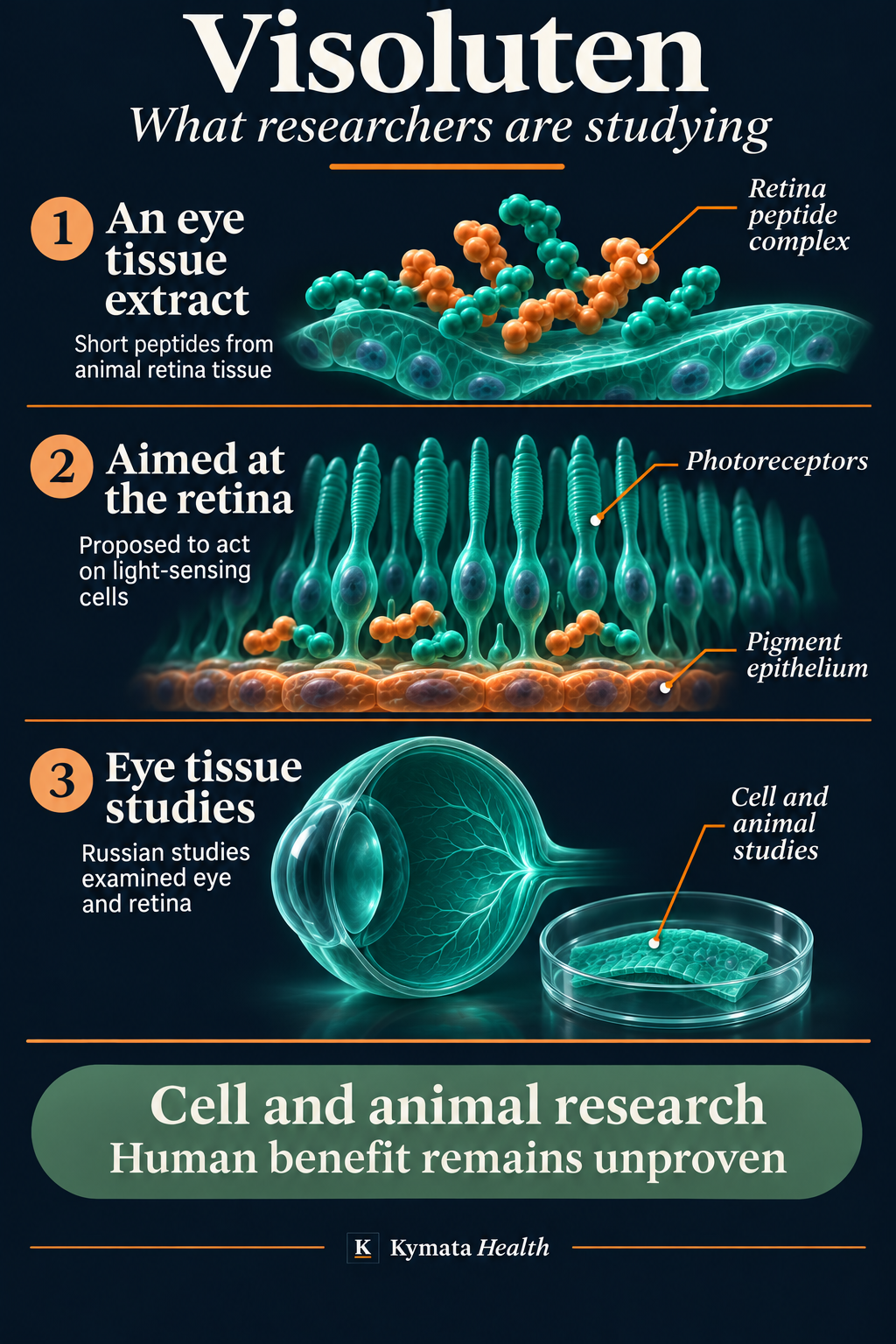
A Khavinson Cytomax capsule complex: a mix of short peptides (under 10 kDa) from animal retina and eye tissue; not Retinalamin and not eye drops. The group frames it around gene expression in photoreceptors and the retinal pigment epithelium; its own Russian cell and animal studies examined eye and retinal tissue, and no controlled trial outside Russia has tested this product. Cell and animal studies. Not FDA-approved; sold as a food supplement. The drawing is a schematic, not a measured molecular structure, a product photograph or a treatment result. Illustration review: 19 November 2026, against this page’s own mechanism, evidence and regulatory records.
A sequence model is not provided for this record. Read the identity and evidence notes; an illustration does not verify a molecular structure.
Illustration notes and source record
Read the source record on this page. Laboratory, topical and injected studies are separate evidence; this illustration does not establish an indication or a treatment outcome.

How it works
The institute report describes Visoluten as low-molecular-weight peptides up to 5,000 Da extracted from the eye tissue of calves up to 12 months old or pigs, and the current capsule label names the mixture peptide complex A-11. The institute measured visual-acuity bands, electroretinogram amplitudes and corneal symptoms in people receiving usual care; no study measured how the mixture acts in the eye. It is sold as a food supplement, not as a drug, and it is not intended to diagnose, treat, cure or prevent any disease.
Visoluten product forms
Form labels checked Nov 7, 2026Visoluten contains a tissue-derived mixture. A sequence diagram would describe only a single component. Compare the extract, product form and route in the study with the label in front of you.
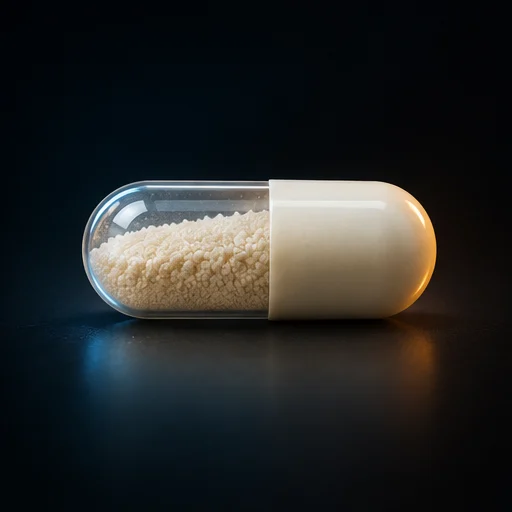
Oral capsule
The pack label states the ingredient and strength per capsule. Capsule contents are not for injection.
Vita-Stream's label for Visoluten lists 10 mg active natural peptides per capsule. That is a manufacturer label, not an FDA label, and its serving is the manufacturer's, not ours to restate.
How to read capsule and liquid labels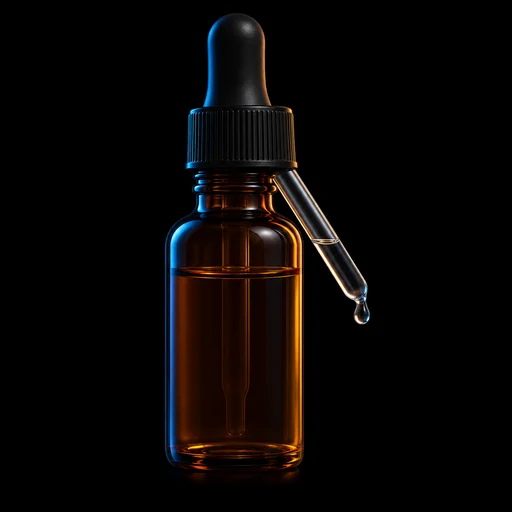
Lingual drops
A separately labeled liquid for use under the tongue. That bottle carries its own label directions. A drop count cannot be calculated from the capsule strength.
How to read capsule and liquid labelsIllustrations show the type of packaging. Check the name, contents and route on the actual pack.
Inside the study
A 2011 institute report compared Visoluten capsules plus usual care with usual care alone in people with retinal or corneal dystrophy and reported visual-acuity bands and electroretinogram amplitudes, without masking or an allocation method. It did not test the lingual liquid.
Visoluten institute report (Russian PDF) ↗What is in the extract?

The extract contains multiple chains. The diagram illustrates that variety. An amino acid sequence would identify one chain, and a label for the whole extract does not establish which chains or amounts are present.
05 / Evidence and limits
Evidence and limits
One small institute comparison · no masking described
Human evidence
One small institute comparison · no masking described- In a St. Petersburg institute report (January to August 2011), 49 people were described as randomized to swallowed Visoluten plus usual care (29) or usual care alone (20) for 30 days, comprising retinal dystrophy patients aged 51 to 70 (17 vs 10) and post-traumatic corneal dystrophy patients aged 20 to 43 (12 vs 10).
- In the 2011 institute report, among people with retinal dystrophy, 15.7% of the Visoluten group and 9.8% of the usual-care group were in the best visual-acuity band (0.9 to 1.0) after treatment, from one pooled baseline of 8.1%, with no patient or eye counts given.
- In the 2011 institute report, the electroretinogram B-wave in retinal dystrophy averaged 216.3 microvolts with Visoluten versus 178.3 with usual care (marked significant against controls), both below the stated 225 to 400 reference.
- For post-traumatic corneal disease, the 2011 institute report states that blepharospasm, light sensitivity and tearing resolved 2.4 times faster with Visoluten than with usual care and calls treatment 1.4 times more effective, without giving days, counts or a statistical test, so the ratios cannot be checked.
Limits of current evidence
4 limits- The 2011 report describes randomization without a method, masking or per-group baselines, and gives no patient or eye counts for its acuity bands.
- The corneal results are given only as ratios (2.4 times faster, 1.4 times more effective) without days, counts or a test, so they cannot be checked.
- The 2011 institute report says no postoperative complications developed in 86.7% of cases after keratoplasty and vitreoretinal surgery with Visoluten, with no patient count or comparison rate.
- Retinalamin glaucoma studies (PMID 32366071) used an injected retinal extract, a different product. The lingual liquid has not been studied.
What it is studied for
- Eye Cytomax vs Normoftal vs Retinalamin
- Not glaucoma, retinal-decline, or anti-VEGF treatment
Verdict
Visoluten (A-11) is a mixture of peptides up to 5,000 Da from calf or pig eye tissue, sold as capsules and a lingual liquid. Its one human report, a 2011 institute comparison in 49 people with retinal or post-traumatic corneal dystrophy, lacks an allocation method, masking and per-group baselines. It is not Pinealon (EDR), not Normoftal and not Retinalamin.
06 / Product forms and access
Product forms and access
Regulatory & legal status
- FDA status (US)
- Not approvedNot FDA-approved; sold as oral capsules (a food supplement), not as a drug
- WADA status (2026)
- Not ListedNot currently on the WADA 2026 Prohibited List. Policies may change. Verify before competition.
- Classification
- OTC Supplement
- US compounding
- Not eligible / not available
Cytomax (natural peptide complex) · Retina / eye tissue
Identity
Canonical 41- Class
- Cytomax (natural peptide complex)
- Organ
- Retina / eye tissue
- Target
- Eye
- System
- Visual
- Sequence
- Mixture / not a single CAS
In these Khavinson catalog sets
2 setsManufacturer-style organ combinations, not FDA protocols. Every name links to its own page.
The Khavinson school
Visoluten is filed here as cytomax (natural peptide complex), targeting the retina / eye tissue. Khavinson's St. Petersburg group moved from organ extracts (Cytamins) to capsule complexes (Cytomaxes) to synthetic short peptides (Cytogens); most of the evidence comes from that one group, with little independent Western replication.
Read the full background, the proposed epigenetic mechanism, the literature limits, and how we count the canonical 41 on the Khavinson bioregulators index.
History of this molecule
Russian peptide ophthalmology is older than the US research-chem boom. Retinalamin (polypeptide extract of cattle retina) was a real hospital product for retinal dystrophy and degenerative disease in CIS practice. Visoluten is the oral Cytomax complex aimed at the same tissue class. Normoftal is the defined synthetic on the NPCRIZ cytogen list.
Western catalogs sometimes map Visoluten to Vilon because both start with V. That is a string-matching injury. Vilon is thymus KE. Visoluten is eye, and it is not EDR either (that is Pinealon). If a blog table pairs Visoluten with Vilon, throw the table out.
The Khavinson frame is photoreceptor and retinal-pigment epithelium gene expression fading with age and light damage. Visoluten’s own record is a small 2011 institute comparison in retinal and corneal dystrophy. Retinalamin papers are a separate injected product and should not be cited as Visoluten evidence.
Retina Cytomax is not a US dietary-supplement monograph and not a drug. The tissue-extract model means lot-to-lot composition is a fingerprint, not a single CAS number. Some English-language bottles carry a “V2” label. Vita Peptides, for example, labels its own house line V2 (15 mg per capsule vs 10 mg in V1). No study compares V1 and V2 outcomes, and neither label is the subject of Khavinson’s 1990s papers. Animal-source capsules are inappropriate if the reader has a religious or allergy constraint on the source species. None of this replaces care for the actual organ disease.
Full 41-map: Khavinson bioregulators index · Khavinson catalog sets
07 / Tools and practical checks
Tools and practical checks
No separate record is provided here. Read the linked evidence and limitations for this compound.
08 / Published study use
Published study use
See the product label
Dosing
1 row| Phase | Dose | Frequency | Notes |
|---|---|---|---|
| Product label | See the product label | See the product label | The manufacturer's label for this food supplement carries the serving. It is not a dose tested in a trial, and this page does not restate it (no dosing instructions here). |
Administration
- Route / form
- Oral capsule. The pack label states the ingredient and strength per capsule. Capsule contents are not for injection. Lingual drops. A separately labeled liquid for use under the tongue. That bottle carries its own label directions. A drop count cannot be calculated from the capsule strength.
- Timing
- Any timing is on the manufacturer’s label; it is not a studied schedule, and this page does not restate it.
- Empty stomach?
- Label only: Food timing, if any, is on the manufacturer’s label. No published study sets it, and this page does not restate it.
09 / Safety and interactions
Safety and interactions
What the record says
The 2011 institute report states that Visoluten caused no side effects, complications or dependence, without describing how harms were collected. Its safety has not been tested in controlled trials outside Russia; tell your clinician before using it if you take any medicine, are pregnant or breastfeeding, or have a medical condition. Not intended to diagnose, treat, cure or prevent any disease.
Interactions & Contraindications
This site will not treat eye disease from a peptide page.
10 / Comparisons and goal guides
Comparisons and goal guides
Combinations: what has been tested
1 pairing- + Normoftal →Complex vs cytogen. Same organ, two classes. Not two extracts.
11 / Common questions
Common questions
Common questions
8 answersWhich forms of Visoluten are documented, and which instructions apply to each?
Oral capsule. The pack label states the ingredient and strength per capsule. Capsule contents are not for injection. Lingual drops. A separately labeled liquid for use under the tongue. That bottle carries its own label directions. A drop count cannot be calculated from the capsule strength.
Is this a treatment for macular degeneration?
Not in the US regulatory sense, and no macular degeneration group was studied with Visoluten. It is not Lucentis, not AREDS2, and not a reason to skip an ophthalmologist.
Does Visoluten pair with Vilon?
No. That pairing is a catalog typo that still circulates. Vilon is thymus.
What did the Visoluten study find?
In the 2011 institute report, among people with retinal dystrophy, 15.7% of the Visoluten group and 9.8% of the usual-care group were in the best visual-acuity band (0.9 to 1.0) after treatment, from one pooled baseline of 8.1%, with no patient or eye counts given. In the 2011 institute report, the electroretinogram B-wave in retinal dystrophy averaged 216.3 microvolts with Visoluten versus 178.3 with usual care (marked significant against controls), both below the stated 225 to 400 reference.
Is Visoluten the same as Pinealon (EDR)?
No. EDR is the synthetic tripeptide Pinealon. Visoluten is an eye-tissue extract (A-11) with no defined sequence.
Is the Retinalamin glaucoma study about Visoluten?
Erichev and colleagues (2020, PMID 32366071) compared intramuscular, retrobulbar and combined injections of Retinalamin in 498 eyes with open-angle glaucoma and reported gains in retinal threshold sensitivity, mainly in early and moderate stages, with no significant change in visual acuity. Retinalamin is a separate injected retinal extract, not Visoluten.
Does Visoluten help after eye surgery?
The 2011 institute report says no postoperative complications developed in 86.7% of cases after keratoplasty and vitreoretinal surgery with Visoluten, with no patient count or comparison rate.
Is Visoluten FDA-approved?
No. Not FDA-approved; sold as oral capsules (a food supplement), not as a drug.
12 / Sources and references
Sources and references
4 papers cited on this page.
Sources
4 papers- 1“Visoluten in retinal and post-traumatic corneal dystrophy, Jan-Aug 2011 (Russian).”St. Petersburg Institute of Bioregulation and Gerontology Institute report (2011).
- 2“Peptide bioregulators: delivery and efficacy (Retinalamin, not Visoluten).”Erichev VP et al. Vestnik Oftalmologii (2020). PMID: 32366071 DOI: 10.17116/oftalma202013602156
- 3“Visoluten capsule product page (peptide complex A-11).”Peptides (manufacturer) Product page (2026).
- 4“Visoluten Lingual product page.”Peptides (manufacturer) Product page (2026).
14 / Prescription options
Prescription options
Where to get it
Paid links · we earn a commissionOral bioregulatorAffiliate links: we earn a commission if you buy, at no extra cost to you.
- Browse Visoluten (paid link, opens in new tab)
Get Visoluten from Vita-Stream, which sells the GARMONIA Cytomax and Cytogen oral capsules. No reconstitution math on a capsule bottle.
Use code KymataLabs at checkout
15 / Peptide library
Peptide library
← Back to Peptide LibraryKhavinson catalog sets
Keep reading: Peptide research library
Peptide research library: every pagePeptide libraryBrowse all topics
- VentfortPrevious in this topic · Ventfort is a Cytomax capsule bioregulator, a peptide fraction from animal blood vessels; published work on it comes mostly from the developers' own Russian studies of…
- VladonixNext in this topic · Vladonix is a Cytomax capsule bioregulator, a peptide fraction from animal thymus; its one clinical record is a 2006 St. Petersburg Institute of Bioregulation and Gerontology…
- ZhenolutenZhenoluten is a Cytomax capsule bioregulator, a peptide fraction from animal ovarian tissue; published work on it comes mostly from the developers' own Russian studies of ovarian…
- BonomarlotBonomarlot (A-20) contains a mixture of peptides from animal bone marrow tissue.
- BonothyrkBonothyrk (A-21) is a Cytomax capsule bioregulator, a peptide fraction from animal parathyroid glands; its one human record is a 2011 St. Petersburg Institute of Bioregulation…
Regulatory and sport classification
- Not FDA-approved; sold as oral capsules (a food supplement), not as a drug